
Annuity Options for Retirees Without Pensions

Jason Stolz CLTC, CRPC
Retiring without a traditional employer pension fundamentally changes how income planning must be approached. For previous generations, a pension combined with Social Security created a stable foundation that covered the majority of essential expenses. Today, many retirees must construct that foundation themselves using personal savings, IRAs, 401(k)s, brokerage accounts, and other accumulated assets. Without careful structuring, withdrawals from investments alone can expose a retiree to market volatility, sequence-of-returns risk, and longevity uncertainty. The central challenge becomes clear: how do you convert accumulated assets into reliable, sustainable lifetime income without running out of money or sacrificing flexibility? One of the most effective solutions is the strategic use of annuities to replicate — and in many cases improve upon — the pension model. When designed correctly, annuities can create guaranteed income streams that work alongside Social Security, while preserving liquidity and growth opportunities in the rest of your portfolio.
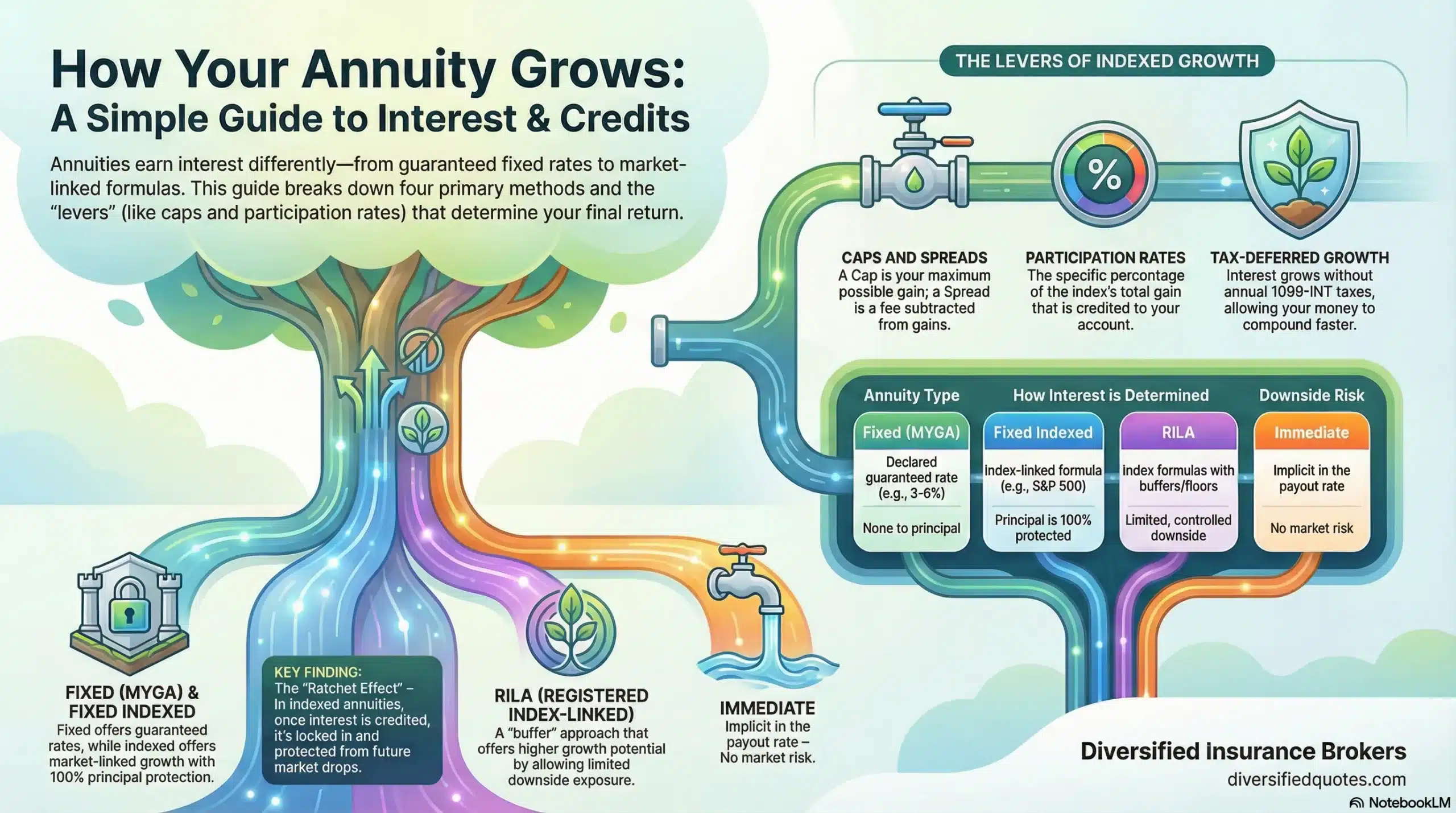
Before selecting a specific structure, it is critical to understand that annuities are not one-size-fits-all products. They are income engineering tools. Some prioritize immediate payout, others focus on future income, some emphasize principal protection with growth potential, and others lock in fixed interest for a defined period. The right approach depends on when you need income, how much risk you are willing to tolerate, whether you need spousal continuation, and how important legacy planning is to you. Because rates and rider terms shift with interest rate cycles, reviewing today’s highest fixed annuity rates and highest bonus annuity rates is essential before locking in any strategy. Competitive positioning can materially change lifetime income projections over a 20–30 year retirement horizon.
Create Your Personal Pension Blueprint
We compare income amounts, joint-life structures, inflation adjustments, and carrier strength across top-rated insurers to design a guaranteed income floor tailored to your retirement.
Start Your Income ComparisonFor many retirees without pensions, the planning process begins by identifying essential expenses — housing, utilities, food, insurance premiums, property taxes, healthcare costs, and other non-negotiable obligations. The goal is to cover these core expenses with guaranteed income streams that are not dependent on market performance. Social Security provides the first layer of guaranteed income, but rarely covers all fixed costs. The shortfall is where annuities become powerful. A properly structured annuity can transform a portion of retirement savings into a dependable monthly paycheck that continues for life, effectively replacing the role a traditional pension once played. By securing the baseline expenses with guarantees, retirees can allow the remainder of their investment portfolio to pursue growth with greater confidence and reduced emotional pressure during market downturns.
One of the most straightforward ways to accomplish this is through a Single Premium Immediate Annuity (SPIA). With a SPIA, a lump sum is exchanged for income that begins within twelve months and continues for life. Payment options can be structured as life-only for maximum payout, life with a guaranteed period certain, or joint-life to ensure income continues for a surviving spouse. The appeal of this design lies in its simplicity and payout efficiency; because the income begins immediately, the insurer can provide higher starting payments relative to deferred structures. However, the trade-off is liquidity, as access to principal is generally surrendered once the income stream begins. For retirees who value predictability and want to eliminate uncertainty around essential expenses, the SPIA often serves as the clearest pension replacement.
For those who do not need income immediately but want protection against outliving their assets, a Deferred Income Annuity (DIA) can serve as longevity insurance. Instead of starting payments right away, the retiree selects a future start date — perhaps age 75 or 80 — and locks in a guaranteed income stream that activates at that time. Because the income is deferred, payouts are typically higher than immediate annuities when they eventually begin. This allows retirees to rely on investment withdrawals or other assets during early retirement, while knowing a powerful income stream will begin later in life when portfolio sustainability risk becomes more pronounced. Structuring a DIA strategically can help smooth income across decades and reduce anxiety about advanced-age financial strain.
Another widely used strategy for no-pension retirees is the Fixed Indexed Annuity paired with a guaranteed lifetime withdrawal benefit rider. This design combines principal protection with index-linked growth potential, subject to caps or participation rates, and includes a rider that guarantees lifetime income withdrawals regardless of market conditions. Unlike a SPIA, the contract value remains accessible, providing a balance between flexibility and guarantees. Because rider terms vary significantly across carriers, and bonus structures can influence long-term income bases, comparing current market offerings is crucial. Evaluating available designs alongside the latest bonus annuity rate opportunities ensures that lifetime income projections reflect real, competitive terms rather than outdated illustrations.
For retirees who are not yet ready to turn on income but want principal stability, fixed annuities and multi-year guaranteed annuities (MYGAs) offer CD-like safety with often higher yields. These products lock in a guaranteed interest rate for a specified term, typically between three and ten years. They can function as a strategic parking place for funds that may later be annuitized or repositioned depending on income needs and rate environments. Monitoring the highest fixed annuity rates allows retirees to take advantage of favorable interest rate cycles and maximize safe growth before committing to lifetime payouts.
Integrating annuities with Social Security claiming strategies is another critical dimension of planning without a pension. Decisions about when to claim Social Security can significantly influence lifetime benefits, and coordinating annuity start dates with optimized claiming ages can increase overall household income. Some retirees choose to delay Social Security to age 70 in order to receive higher lifetime benefits, using annuity income or portfolio withdrawals to bridge the gap. Others structure deferred annuities to begin at the same time Social Security taxation thresholds shift, smoothing after-tax income across retirement years. Thoughtful integration of guaranteed income sources can reduce volatility in tax brackets and potentially mitigate Medicare premium surcharges.
To model these combinations effectively, income projections must be based on real-time carrier data rather than hypothetical assumptions. The lifetime income calculator below allows you to compare payout amounts, deferral strategies, and joint-life options using current market terms. By adjusting funding levels, ages, and income start dates, you can visualize how guaranteed income changes under different scenarios and identify which structure best supports your retirement objectives.
Because there is no corporate pension sponsor backing your income, the financial strength of the issuing insurance company deserves careful attention. Diversifying among highly rated insurers and evaluating balance sheet stability, reserve adequacy, and contractual guarantees can add another layer of protection. As an independent brokerage, we compare offerings from dozens of leading carriers to identify strong combinations of payout rates, rider design, and long-term stability, ensuring that guaranteed income promises are supported by financially sound institutions.
Ultimately, constructing retirement income without a pension is about building layers of security. The first layer is Social Security. The second layer is guaranteed annuity income covering essential expenses. The third layer is flexible investment capital for discretionary spending and legacy planning. When structured cohesively, these layers reduce the emotional impact of market swings and create confidence that income will continue regardless of lifespan. The objective is not to annuitize every dollar, but to secure enough predictable income to remove financial anxiety, allowing remaining assets to pursue measured growth.
Review Today’s Competitive Annuity Opportunities
Rates and rider structures change frequently. Compare the strongest current fixed and bonus annuity offers before making a commitment.
View Fixed Annuity Rates View Bonus Annuity RatesDesign Your Guaranteed Income Plan
Receive side-by-side lifetime income illustrations across top-rated carriers, including joint-life projections and deferral strategies.
Request Your Free Income AnalysisOr call 800-533-5969 to speak directly with an annuity specialist.
Financial Protection Essentials
Smart retirement protection, insurance underwriting insights, and healthcare cost planning resources.
Talk With an Advisor Today
Choose how you’d like to connect—call or message us, then book a time that works for you.
Schedule here:
calendly.com/jason-dibcompanies/diversified-quotes
Licensed in all 50 states • Fiduciary, family-owned since 1980
FAQs: Annuity Options for Retirees Without Pensions
Which annuity is best if I don’t have a pension?
There is no single “best” annuity for everyone. Many no-pension retirees blend options: a SPIA or DIA for core guaranteed income, and a fixed indexed annuity with an income rider for additional lifetime withdrawals and flexibility. The right mix depends on your age, risk tolerance, health, and how much of your essential expenses you want fully covered by guarantees. Some retirees also evaluate conservative fixed strategies such as MYGA annuity strategies for affluent individuals when building a base layer of income.
How much monthly income can an annuity realistically provide?
Monthly income is driven by your premium amount, age, payout option (single or joint life), current carrier rates, and whether you add features like inflation increases or minimum guarantees. In general, the older you are when income starts, the higher the payout per dollar of premium. Personalized illustrations will show exact numbers for your situation. Reviewing retirement platform comparisons — such as Is Empower Retirement a Good Company? — can also provide context about income administration.
Is my money safe in an annuity?
With fixed and fixed indexed annuities, your principal is protected from market losses and backed by the claims-paying ability of the issuing insurer. Safety depends on choosing strong, well-capitalized carriers and matching the product type to your time horizon and risk tolerance. Annuities are not bank deposits and are not FDIC-insured. Liquidity planning is also important, especially in situations involving access to funds such as pre-settlement funding arrangements.
How do annuities work with Social Security?
Annuities can complement Social Security by creating an additional guaranteed paycheck. Many retirees use annuity income to cover essential expenses so they feel more comfortable delaying the higher earner’s Social Security benefit. This strategy can increase lifetime and survivor benefits, while the annuity helps stabilize cash flow in the meantime. Coordinating guaranteed income with estate tools like establishing a will and trust online can also strengthen long-term planning.
Are annuity payments taxable?
Yes, in most cases. For qualified annuities funded with pre-tax dollars (like IRAs and 401(k)s), payments are generally fully taxable as ordinary income. For non-qualified annuities funded with after-tax dollars, each payment is usually part tax-free return of premium and part taxable earnings, based on IRS rules. Understanding income taxation — similar to discussions in how lottery winnings are taxed — can provide helpful perspective.
What happens to my annuity when I die?
What happens at death depends on your contract and payout option. Many annuities offer beneficiary provisions so any remaining value or guaranteed payments go to heirs. With life-only options, payments may stop at death; with period-certain, refund, or joint-life features, income can continue to a spouse or beneficiaries. It’s important to review and update beneficiary designations as part of your overall estate plan, including documents such as creating a will online.
Can I lose access to my money if I buy an income annuity?
Some income structures, like SPIAs and DIAs, trade liquidity for higher guaranteed payments—once you annuitize, you typically cannot take lump-sum withdrawals. Other designs, such as fixed indexed annuities with income riders, keep an account value and usually include free-withdrawal provisions and emergency-access features. A good plan balances guaranteed income with liquid reserves so you never feel “locked in,” particularly if you face unexpected financial events such as receiving lawsuit settlement proceeds.
How do current annuity rates affect my retirement income?
Higher interest rates generally translate into stronger fixed annuity yields and richer payout factors on many income products. When rates are attractive, you may be able to secure more guaranteed income per dollar of premium or lock in competitive multi-year guarantees. Because rates change, it’s wise to review current offers before finalizing your income plan.
How do I choose between single-life and joint-life income?
Single-life income typically pays the highest monthly amount but stops when you pass away. Joint-life income generally pays a bit less each month but continues as long as either spouse is alive. The right choice depends on your spouse’s income, assets, health, and how important it is that guarantees continue for the survivor. Many couples model both options before deciding.
About the Author:
Jason Stolz, CLTC, CRPC and Chief Underwriter at Diversified Insurance Brokers (NPN 20471358), is a senior insurance and retirement professional with more than two decades of real-world experience helping individuals, families, and business owners protect their income, assets, and long-term financial stability. As a long-time partner of the nationally licensed independent agency Diversified Insurance Brokers, Jason provides trusted guidance across multiple specialties—including fixed and indexed annuities, long-term care planning, personal and business disability insurance, life insurance solutions, Group Health, and short-term health coverage. Diversified Insurance Brokers maintains active contracts with over 100 highly rated insurance carriers, ensuring clients have access to a broad and competitive marketplace.
His practical, education-first approach has earned recognition in publications such as VoyageATL, highlighting his commitment to financial clarity and client-focused planning. Drawing on deep product knowledge and years of hands-on field experience, Jason helps clients evaluate carriers, compare strategies, and build retirement and protection plans that are both secure and cost-efficient. Visitors who want to explore current annuity rates and compare options across multiple insurers can also use this annuity quote and comparison tool.
