
Best Annuities for 401k Rollover

Jason Stolz CLTC, CRPC
For many retirees, a 401(k) represents the largest pool of retirement savings they will ever accumulate. Employer plans can be excellent during your working years because they make saving automatic, offer tax advantages, and often include matching contributions. But once you retire—or even as you get close—your needs usually shift. The biggest question stops being “How do I grow this account?” and becomes “How do I turn this into dependable income without taking unnecessary risk?” That’s why so many people start researching the best annuities for 401k rollovers: to convert accumulated savings into predictable, tax-deferred retirement income that can be structured to last.
At Diversified Insurance Brokers, we help retirees evaluate annuity strategies specifically for 401(k) rollovers. We compare options across a wide range of highly rated carriers, focusing on what actually matters in retirement: principal protection, predictable income, smart distribution design, and a clear understanding of tradeoffs like liquidity and timing. In many plans, an annuity is not “the whole plan.” It’s the part of the plan that builds an income floor—so the rest of the portfolio can be managed with more confidence and less pressure.
Ensure you are receiving the absolute top rates
Lifetime Income Calculator
💡 Note: The calculator accepts premiums up to $2,000,000. If you’re investing more, results increase in direct proportion — for example, doubling your premium roughly doubles the guaranteed income at the same age and options.
Why retirees roll a 401(k) into an annuity
A 401(k) is built for accumulation. It’s optimized for contribution habits, long-term compounding, and employer plan structure. Retirement, however, is a distribution problem. You need a way to convert a lump sum into reliable income, often while controlling taxes and reducing the odds that market volatility forces painful decisions. An annuity can solve a very specific retirement need: it can create contractual guarantees that traditional investment accounts cannot, especially when income stability becomes a priority.
Rolling over all or part of a 401(k) into an annuity can allow you to create an “income floor”—a baseline level of predictable cash flow intended to cover essential expenses like housing, groceries, utilities, and healthcare. Once the essentials are covered, many retirees feel more comfortable leaving other assets invested for growth or using them for discretionary spending. In other words, an annuity is often used to reduce pressure on the rest of the portfolio, not to replace everything you own.
Another reason rollovers are common is control. Employer plans can have limited investment menus, plan rules, and distribution features. Once you separate from service, many retirees prefer consolidating old plans, simplifying account management, and gaining more flexibility in how income is structured. If you’re in the planning phase, it can also help to coordinate timing and next steps with broader retirement prep, including this pre-retirement checklist.
How a 401(k) rollover into an annuity works
The cleanest way to move 401(k) funds into an annuity is typically a direct rollover. That means the money moves from your employer plan directly to the receiving account or annuity carrier without ever being paid to you personally. When executed correctly, a direct rollover preserves the tax-deferred status of your retirement savings and avoids avoidable tax withholding mistakes.
Many retirees choose to roll over only a portion of their 401(k) instead of everything. That can be a practical middle ground: one portion is positioned to create predictable retirement income, while the other portion stays liquid and flexible for emergencies, large purchases, or long-term growth. If you want a step-by-step view of the mechanics, this guide explains the typical process for rolling a 401(k) into a guaranteed annuity.
In most cases, a 401(k) rollover is first moved into a traditional IRA (or an IRA-like receiving vehicle) and then into the chosen annuity if that is the strategy. In other cases, it may be moved directly into a qualified annuity structure depending on the annuity and the custodian workflow. What matters is that the move is handled as a qualified transfer and is documented properly.
The “best annuity” depends on the role it plays in your plan
The phrase “best annuities for 401k rollover” can be misleading if you treat it like a product ranking. The best annuity is the one that matches your timeline, your income needs, your risk tolerance, and your preferences around control and liquidity. A retiree who wants immediate checks typically doesn’t want the same solution as a retiree who wants safe growth for five years and then income later. A retiree who wants maximum guaranteed income per dollar may choose a very different structure than a retiree who wants access flexibility or beneficiary protections.
A good way to evaluate annuities for a rollover is to decide what job the rollover money needs to do. Common “jobs” include creating stable growth with principal protection, producing income immediately, producing income later, creating a lifetime income layer on top of protected principal, or reducing market exposure for the essential-expense portion of the plan. Once you define the job, the product category becomes clearer.
Best types of annuities for a 401(k) rollover
1) MYGAs and fixed-rate annuities for conservative growth
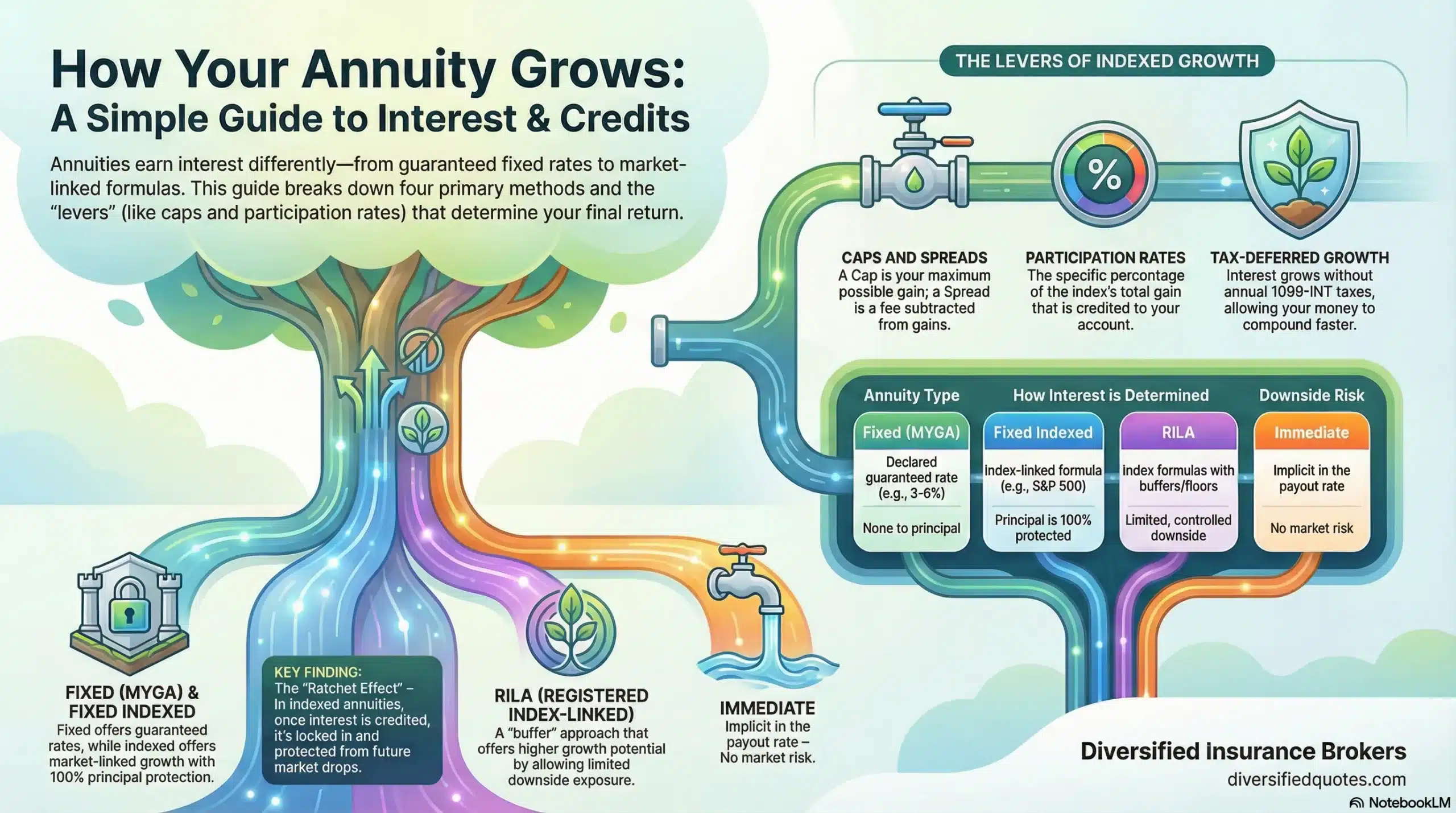
If your top priority is principal protection with predictable growth, a MYGA (multi-year guaranteed annuity) or a traditional fixed-rate annuity is often a strong starting point. These are frequently used as “bond replacements” inside retirement plans because they can offer a guaranteed rate for a set term. In a rollover context, that can be useful for retirees who want to reduce market exposure while they transition into retirement, build a ladder of maturities, or create a safer pool of assets earmarked for later income decisions.
Because rates can change, many retirees compare terms and rates before choosing. This is where having a current snapshot helps: review current annuity rates and then compare that baseline against other strategies to see which one fits your timeline.
2) Fixed indexed annuities for principal protection with upside potential
A fixed indexed annuity (FIA) is designed to protect principal from market losses while offering interest crediting tied to an index formula. It’s not a stock investment, and it doesn’t own the index. Instead, the annuity uses a crediting method that can capture a portion of index-linked performance subject to caps, participation rates, or spreads—depending on the contract terms at the time. FIAs are often considered by retirees who want more upside potential than a fixed-rate product but do not want to accept market downside risk on the portion of money designated for stability.
In a 401(k) rollover plan, an FIA is commonly used for mid-term stability and optional income features. Some FIAs can be paired with income riders (where appropriate) that are designed to create a lifetime withdrawal stream, even if the market-linked credits vary over time. The best approach is to compare multiple carriers and multiple crediting structures so you understand the tradeoffs in plain English instead of guessing based on marketing language.
3) SPIAs for immediate, pension-like income
For retirees who want to convert a lump sum into a paycheck that starts now, a single premium immediate annuity (SPIA) is the simplest income annuity structure. You deposit a premium and the contract begins paying an income stream immediately based on your age and chosen options. This can be useful for retirees who want the highest guaranteed income per dollar for a base layer of essential expenses, especially when they want that income to start right away.
SPIAs are often used alongside Social Security: for example, a retiree might cover certain baseline expenses with a SPIA and then use Social Security for the remaining baseline income. Or a retiree might use a SPIA as a bridge strategy to stabilize income while delaying Social Security. The “best” structure depends on the income gap you are trying to fill and whether you want benefits to continue to a spouse or beneficiaries.
4) DIAs and longevity-focused income planning
A deferred income annuity (DIA) is an income annuity that starts later. Instead of checks beginning immediately, you choose a future start date. The advantage is that deferring income can increase the payout per dollar when the checks begin. DIAs are often used when a retiree is comfortable with their income now but wants to guarantee a later-life paycheck, typically to hedge longevity risk.
In rollover planning, this can show up as a layered approach: one pool covers near-term expenses, another pool covers later-life expenses, and the investment portfolio covers discretionary goals and inflation protection. If you want to explore how annuities can be structured for dependable lifetime income, it can help to review the concept-level framework at lifetime income strategies.
5) Income riders for flexible lifetime withdrawals
Some retirees want lifetime income but also want to keep some degree of account control and access features. In those cases, an income rider strategy can be considered within certain fixed or indexed annuities. A rider is generally designed to provide a lifetime withdrawal benefit based on a contractually defined income base and payout factor rules. The details matter, and rider mechanics differ materially by carrier. When used thoughtfully, an income rider can create a predictable withdrawal stream while maintaining principal protection features in the underlying annuity structure.
The key point is that riders are not all the same. Some are better suited for maximizing income, others prioritize flexibility, and some are more efficient for couples. The most practical way to evaluate riders is to compare actual illustrations side-by-side based on your age, premium size, and income start timing. That is exactly what a rollover comparison should do: turn abstract features into real numbers tied to your timeline.
Rollover planning: partial rollover vs. full rollover
Rolling over the entire 401(k) into a single annuity is rarely the only path. Many retirees prefer a partial rollover strategy because it reduces regret risk. Instead of making one large irreversible decision, a partial rollover can secure income for essentials while leaving the rest flexible. That remaining portion can stay invested, remain liquid, or be deployed later once you see how retirement cash flow actually feels in the first year or two.
A practical framework is to start by identifying your essential monthly expenses and comparing them to predictable income sources like Social Security, pensions, and other guaranteed cash flows. The gap—if any—becomes the “income floor target.” Some retirees use an annuity to cover that floor, then let investments handle discretionary goals and inflation hedging. Others prefer to cover only part of the gap with an annuity and manage the remainder with a systematic withdrawal strategy. There isn’t a universal answer; there is a “best fit” answer for your risk tolerance and priorities.
Taxes: what changes (and what doesn’t) when you roll a 401(k) to an annuity
When you roll over a traditional 401(k) into a qualified annuity structure, the tax treatment stays broadly similar: taxes are deferred until money is distributed. When income begins, distributions are generally taxed as ordinary income. The biggest planning variable is not whether taxes exist; it is the timing and consistency of taxable income. In retirement, timing often matters as much as the rate.
RMDs also remain a factor. If you are rolling qualified dollars, required minimum distributions still apply when you reach RMD age. The annuity or distribution structure needs to be coordinated so that RMD requirements are met without creating unnecessary friction. The best rollover strategies treat RMDs as part of the income timeline rather than an afterthought.
Some retirees also have Roth 401(k) balances. Roth dollars have different tax rules, and handling them correctly can improve long-term outcomes. In many households, a rollover plan involves separating traditional and Roth money, then building a distribution strategy that uses each bucket intentionally. The goal is to avoid “accidental tax stacking” where inherited distributions, Social Security, portfolio withdrawals, and RMDs all land in the same tax year without planning.
Liquidity and surrender schedules: what you should understand upfront
Liquidity is one of the most common concerns people have about annuities—and it’s a fair concern. Many annuities include surrender schedules, which are designed to discourage large early withdrawals. However, most contracts also include annual penalty-free withdrawal provisions, and many allow access for certain purposes (depending on the contract). The real question is not “Is there a surrender schedule?” The real question is “Does this contract’s access design match how you plan to use the money?”
If you are considering an annuity as part of a rollover, the safest approach is to segment money by purpose. Money designated for emergency liquidity should stay liquid. Money designated for a stable income floor can be positioned in a structure that is designed for stability. When you match the product to the purpose, surrender schedules become less threatening because you are not planning to use that pool for short-term emergencies.
It also helps to avoid all-or-nothing thinking. You don’t have to choose between “fully liquid” and “fully locked.” Many retirees use a blended strategy where some assets remain in liquid accounts and some are positioned for stable income. That balance is often what makes the plan feel sustainable over time.
Common misunderstandings about annuity rollovers
Misunderstanding #1: “Annuities are always expensive.” Many fixed and fixed indexed annuities have no explicit annual fees unless optional riders are added. That doesn’t mean all annuities are free, and it doesn’t mean riders are bad. It means you should compare the structure you are considering and understand what you are paying for. If you want lifetime income features, a rider might be a practical tradeoff. If you only want guaranteed rate growth, you may not need rider costs at all.
Misunderstanding #2: “If I use an annuity, I’ll miss market growth.” In practice, annuities are often used to replace the conservative, bond-like portion of a retirement plan. Many retirees keep growth assets invested elsewhere. The annuity’s job is not to beat the market; it is to provide stability and predictable income so the rest of the plan can be managed calmly.
Misunderstanding #3: “A rollover is complicated and risky.” A rollover can be simple when executed correctly as a direct rollover. The key is mechanics: proper paperwork, direct transfer handling, and clear titling. The risk tends to come from mistakes like indirect rollovers or improper withholding—not from the concept of rolling over itself.
Misunderstanding #4: “I should wait until the last minute.” Many rollover and income decisions are easier when you plan early. If you wait until the month you retire, you can feel rushed. Planning early allows you to compare multiple strategies, ladder time horizons, and choose a timeline that fits your retirement goals rather than reacting to whatever is in front of you at the moment.
How to evaluate the best annuity for your specific rollover
When we help someone compare rollover annuities, we generally focus on a few concrete questions. How soon do you need income? Do you need lifetime income or time-limited income? Are you planning around a spouse’s lifetime too? How important is beneficiary value if you pass early? How much of the rollover should be stable and how much should remain growth-oriented? What level of liquidity do you want inside the annuity portion? How does the rollover income interact with Social Security timing and healthcare costs?
Once those questions are answered, we can compare product categories and carrier illustrations more responsibly. A retiree looking for a fixed rate for five years and then income later will compare different structures than a retiree who wants immediate guaranteed income now. A retiree who wants maximum income per dollar may compare income annuities. A retiree who wants principal protection with a path to income later may compare fixed indexed structures with income options. The product should follow the plan, not the other way around.
Why work with Diversified Insurance Brokers
Diversified Insurance Brokers is independent, which means we are not tied to one carrier’s product shelf. That matters in rollover planning because the best-fit annuity often depends on pricing and features that vary across carriers and change over time. Our job is to help you compare real illustrations, understand the tradeoffs in plain English, and choose a structure that makes sense for your retirement timeline and risk preferences.
If you want a broader overview of annuity categories before narrowing down a rollover strategy, you can start with our annuities resource center. If you’re closer to retirement and deciding what the 401(k) should do next, this guide can also help: what to do with your 401(k) after retirement.
Get a Side-by-Side 401(k) Rollover Comparison
We’ll map your income timeline and show conservative growth options, lifetime income options, and blended strategies in one clear view.
High-payout scenario pages (for perspective)
Some retirees like to compare what different premium sizes can produce in the marketplace. If you’re exploring larger retirement balances and want a general point of reference for income planning concepts, these pages can help you think in ranges and scenarios:
Explore High-Payout Annuity Scenarios
How Much Does a $3 Million Annuity Pay?
How Much Does a $5 Million Annuity Pay?
How Much Does a $10 Million Annuity Pay?
Financial Protection Essentials
Core strategies to protect retirement income, prepare for healthcare costs, and build long-term financial stability.
Talk With an Advisor Today
Choose how you’d like to connect—call or message us, then book a time that works for you.
Schedule here:
calendly.com/jason-dibcompanies/diversified-quotes
Licensed in all 50 states • Fiduciary, family-owned since 1980
Is rolling over a 401k into an annuity taxable?
No. When completed as a direct rollover, the transfer remains tax-deferred. Taxes apply only when income or withdrawals begin.
Can I roll over only part of my 401k?
Yes. Many retirees use annuities for guaranteed income while keeping remaining assets invested for flexibility and growth.
What annuity is best for lifetime income?
Fixed indexed annuities with income riders and immediate income annuities are commonly used to generate guaranteed lifetime income.
About the Author:
Jason Stolz, CLTC, CRPC and Chief Underwriter at Diversified Insurance Brokers (NPN 20471358), is a senior insurance and retirement professional with more than two decades of real-world experience helping individuals, families, and business owners protect their income, assets, and long-term financial stability. As a long-time partner of the nationally licensed independent agency Diversified Insurance Brokers, Jason provides trusted guidance across multiple specialties—including fixed and indexed annuities, long-term care planning, personal and business disability insurance, life insurance solutions, Group Health, and short-term health coverage. Diversified Insurance Brokers maintains active contracts with over 100 highly rated insurance carriers, ensuring clients have access to a broad and competitive marketplace.
His practical, education-first approach has earned recognition in publications such as VoyageATL, highlighting his commitment to financial clarity and client-focused planning. Drawing on deep product knowledge and years of hands-on field experience, Jason helps clients evaluate carriers, compare strategies, and build retirement and protection plans that are both secure and cost-efficient. Visitors who want to explore current annuity rates and compare options across multiple insurers can also use this annuity quote and comparison tool.
