
Burial Insurance for People with High Blood Pressure

Jason Stolz CLTC, CRPC
High blood pressure is one of the most common health conditions in the United States, and it’s also one of the most “understood” conditions in life insurance underwriting.
The good news is that burial insurance for people with high blood pressure is often available with day-one coverage, level premiums, and affordable pricing—especially when your readings are stable and your medications are consistent.
At Diversified Insurance Brokers, we help families and seniors nationwide compare final expense options from carriers that regularly approve applicants with hypertension.
In many cases, high blood pressure on its own does not require a waiting period, a medical exam, or “rated” premiums.
The key is understanding how carriers look at control, complications, and overall stability—so you can choose a policy that matches your goal and your budget.
If you’re helping an older parent who has been on blood pressure medications for years, you may also find it helpful to review
burial insurance for parents over 70,
since ages 70+ are where final expense shopping becomes more common—and where the right carrier match can make a big difference.
Instant Burial Insurance Quotes
Use our burial insurance calculator to estimate rates and compare coverage amounts in minutes—even if you’re taking blood pressure medication.
Why High Blood Pressure Usually Isn’t a Barrier
Many people assume that any “heart-related” diagnosis automatically leads to expensive insurance or limited options.
But from a burial insurance underwriting perspective, hypertension is typically viewed as manageable when it’s controlled with medication and regular follow-up.
That’s especially true when there have been no recent hospitalizations and no major complications.
Burial insurance carriers are usually focused on near-term risk—meaning they care more about whether high blood pressure has caused serious events than the diagnosis itself.
A person taking medication consistently may look more favorable than someone who is untreated, because treatment lowers the risk of stroke, heart attack, and kidney damage.
This is one reason many applicants qualify for a level benefit plan even with a long history of hypertension.
If your health history includes multiple risk factors, it helps to understand how conditions stack.
For example, hypertension plus diabetes is common, and underwriting often depends on the bigger picture—medications, stability, and whether complications exist.
If that sounds familiar, this related guide may help you set expectations:
life insurance for diabetics with complications.
What Burial Insurance Companies Look At (Besides the Diagnosis)
One of the reasons people get frustrated shopping online is that “high blood pressure” is treated like a single category.
In reality, carriers want to know how controlled your blood pressure is, what medications you take, and whether your health history shows stability.
That’s why two people with the same diagnosis can see very different outcomes depending on their overall profile.
In final expense underwriting, carriers commonly focus on a few practical indicators.
They look at whether there is a history of serious complications like stroke, heart attack, congestive heart failure, or kidney issues.
They also consider tobacco use, build, and whether there are multiple chronic conditions competing for risk.
For most applicants, the biggest “swing factor” is not the hypertension label—it’s whether there’s evidence of complications or instability.
This is also why it can be useful to compare hypertension-focused burial insurance with other high-risk situations.
Our broader underwriting resource here can help you understand how carriers weigh risk across different medical categories:
high-risk life insurance options.
The principles are similar even though burial insurance has simplified underwriting.
Burial Insurance With Blood Pressure Medications
A common worry is that being on multiple prescriptions automatically means you’ll be forced into a waiting period plan.
In reality, many final expense carriers view medication use as a sign of compliance and stability.
It’s very normal for applicants to take one, two, or even several medications—especially in their 60s, 70s, and 80s.
This matters because burial insurance is designed to be accessible.
It’s typically easier to qualify for than large fully-underwritten term policies, and many plans do not require any medical exam.
When you’re comparing options, it’s important to remember that the goal of burial insurance is usually simple:
create a permanent death benefit that covers end-of-life expenses, without complexity and without the pressure of “perfect health.”
If you’re also comparing general burial insurance structures (like level vs graded benefit), it can help to review the no-exam underwriting style here:
burial insurance with no health exam.
That page explains what simplified underwriting typically looks like and why many seniors prefer this type of coverage.
Do You Get Day-One Coverage With High Blood Pressure?
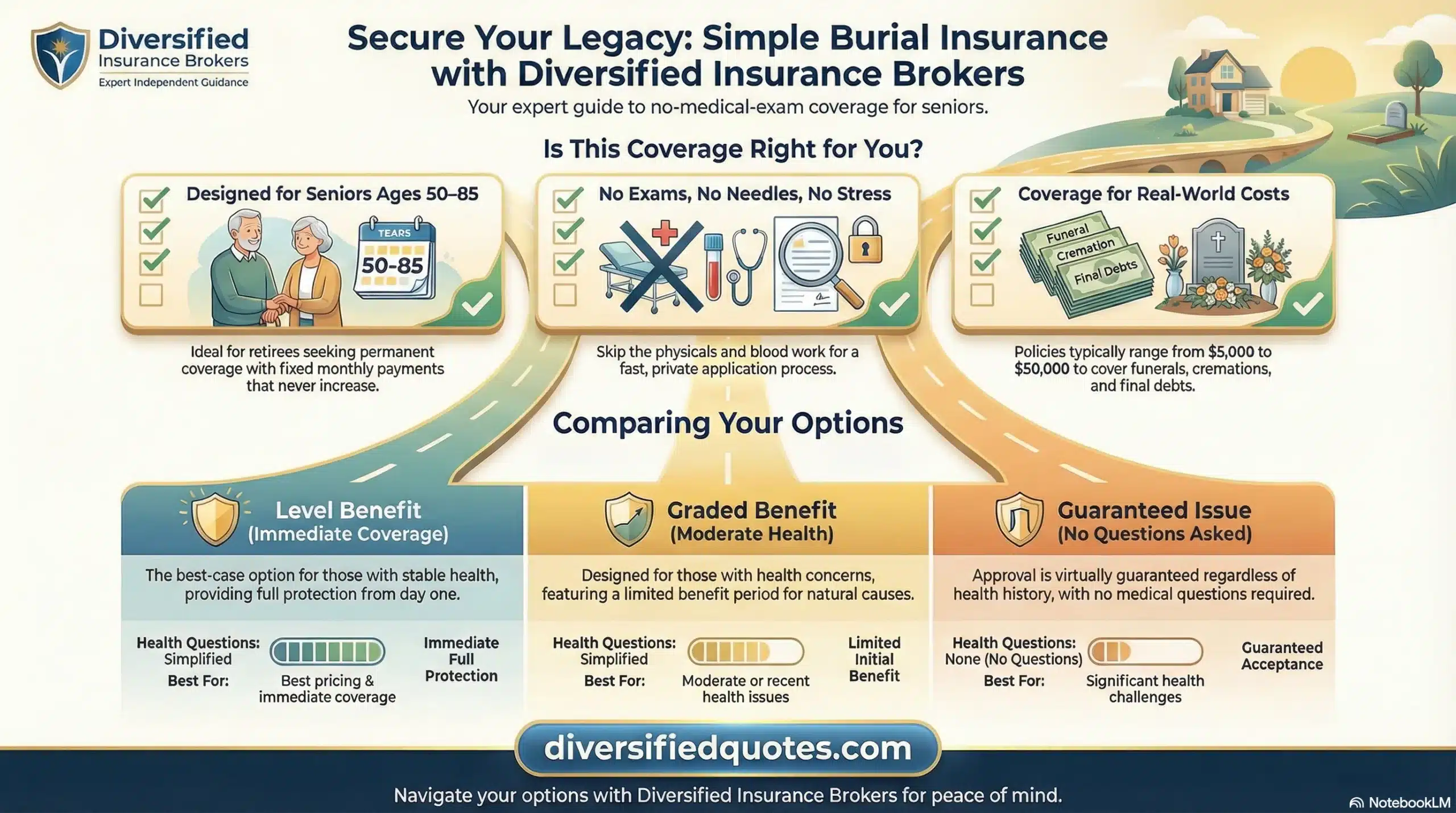
In many cases, yes—applicants with controlled hypertension can still qualify for level benefit burial insurance.
Level benefit generally means the full death benefit is in force immediately for natural causes of death, which is what most families want when buying final expense coverage.
The premium is level (it doesn’t increase over time), and the policy is designed to last for life as long as premiums are paid.
However, if there are other issues layered in—such as a recent cardiac event, a history of stroke, uncontrolled readings, or mobility limitations—some carriers may offer a graded benefit option.
Graded benefit plans can be a practical solution because they provide a path to coverage when simplified immediate coverage is not available.
The key is choosing graded coverage intentionally, rather than accidentally selecting a cheaper quote that has limitations you didn’t want.
If you are weighing final expense coverage against other life insurance approaches, the “whole life vs term” comparison can also clarify why burial insurance is different:
whole life burial insurance vs term.
How Much Coverage Do You Need?
Most people choose burial insurance to cover the essentials: funeral home expenses, burial or cremation costs, a memorial service, transportation, and “last bills” that show up after a loss.
While costs vary by location and preferences, many families target a face amount that prevents scrambling during grief.
That’s why common burial insurance amounts often fall between $10,000 and $25,000.
A practical starting point is $10,000, because it often creates meaningful protection with manageable premiums.
If you want to benchmark what that typically looks like, this guide is helpful:
monthly cost of a $10,000 burial insurance policy.
From there, you can test higher amounts in the calculator and decide whether it’s worth increasing the benefit to cover additional expenses.
If affordability is the main priority, it can also help to review strategies for keeping burial insurance within a fixed income budget:
affordable burial insurance for low-income seniors.
In many cases, simply right-sizing the benefit and selecting the right policy type is enough to find a comfortable long-term premium.
Case Study: Controlled Blood Pressure, Standard Pricing
A 62-year-old man taking two medications for high blood pressure applied for burial insurance after being told by another source that he would automatically face a waiting period.
He was concerned that a long treatment history would lead to higher premiums or limited options.
He wanted straightforward coverage that would protect his family from final expenses without adding stress or complicated requirements.
We matched him with a carrier that regularly approves controlled hypertension profiles for level benefit coverage.
The result was day-one coverage at a standard non-tobacco rate—no exam required, no waiting period, and level premiums designed to stay predictable long-term.
The biggest difference was not “finding a special product,” but choosing the right carrier for his exact stability profile.
This is one of the reasons working with an independent brokerage matters.
Carrier underwriting varies dramatically, and the same medical history that triggers a graded plan with one company may qualify for immediate coverage with another.
Common Mistakes to Avoid When Shopping With Hypertension
One of the biggest mistakes people make is assuming that a single online quote equals guaranteed approval.
Burial insurance calculators are useful for pricing estimates, but real eligibility depends on how an application’s questions line up with your health history.
That’s why it’s important to treat the calculator as a comparison tool, then confirm policy type and underwriting fit before applying.
Another common mistake is selecting the cheapest plan without confirming whether it’s a level benefit or graded benefit policy.
If the purpose of burial insurance is immediate protection, a lower premium is not always “better” if it creates a waiting period you didn’t intend.
Matching the policy design to your goal is the core decision—not just the monthly cost.
Finally, some people assume that high blood pressure is treated the same as severe cardiac disease.
In most cases, it is not.
Controlled blood pressure is often closer to a “standard” underwriting scenario, while complicated heart histories may be evaluated very differently.
If your history includes broader cardiac issues, this resource can help you compare underwriting logic:
burial insurance for people with heart conditions.
Who Burial Insurance Fits Best (When You Have High Blood Pressure)
Burial insurance is usually a strong fit for people who want a small permanent policy that is simple, stable, and designed for final expenses.
It’s especially useful for seniors who want level premiums and coverage that doesn’t expire after a fixed term.
Many families aren’t trying to create a large legacy policy—they simply want to cover practical expenses quickly and cleanly.
This type of coverage can also be helpful for people who want a streamlined underwriting process.
Final expense whole life is often simplified, meaning no medical exams and fewer steps.
And for those who don’t qualify for simplified coverage, there are still fallback options designed to provide protection when health history is more complicated.
If you are shopping for someone with multiple health challenges—not just hypertension—this related page can help frame what tends to be available:
burial insurance for disabled adults.
It’s a helpful reference point for understanding how carriers approach mobility limitations, chronic conditions, and medications.
Related Burial Insurance Pages
Helpful pages that explain pricing, policy types, and how to choose the right final expense plan.
Related Health & Approval Topics
If other conditions are part of the picture, these pages explain how approvals and pricing tend to work.
Financial Protection Essentials
Lawsuit funding solutions, annuity strategies, and carrier comparisons to help strengthen long-term financial security.
Talk With an Advisor Today
Choose how you’d like to connect—call or message us, then book a time that works for you.
Schedule here:
calendly.com/jason-dibcompanies/diversified-quotes
Licensed in all 50 states • Fiduciary, family-owned since 1980
FAQs: Burial Insurance for People with High Blood Pressure
Can I get burial insurance if I take blood pressure medication?
Yes. Most carriers accept applicants who take one or more blood pressure medications, and controlled hypertension often qualifies for level, day-one coverage.
Will I pay more for coverage if I have high blood pressure?
Usually no. When blood pressure is controlled and there are no major complications, many final expense carriers offer standard pricing.
What blood pressure details do carriers care about most?
Carriers typically focus on stability: whether your readings are controlled, how many medications you take, and whether you’ve had complications such as stroke, heart attack, heart failure, or kidney disease.
What if I had a recent hospitalization?
It depends on the reason. A hospitalization tied to a heart attack, stroke, or kidney failure can impact eligibility. If it was unrelated and your blood pressure is controlled, many carriers will still consider coverage.
Is there a waiting period for people with high blood pressure?
Many applicants qualify for immediate, day-one coverage. A waiting period (graded benefit) is more common when there are recent major cardiac events or multiple serious conditions.
Do burial insurance companies ask for medical records?
Most final expense policies are simplified issue, so they usually do not require medical exams or full records. Carriers often rely on health questions and prescription history checks.
Can high blood pressure plus diabetes affect approval?
Yes, multiple conditions can increase underwriting scrutiny. Even so, many carriers still approve level benefit burial insurance if both conditions are stable and well managed.
Does family history of hypertension matter?
Not usually for burial insurance. Most carriers focus on your personal health history, current stability, and medications.
What if I smoke and have high blood pressure?
Smoking can increase premiums and reduce carrier options, but coverage is still often available. The best approach is carrier selection—some companies price tobacco and controlled hypertension more reasonably than others.
Can I be declined for high blood pressure alone?
It’s uncommon when hypertension is controlled. Declines are more likely when blood pressure is uncontrolled or when there are serious complications or recent cardiovascular events.
About the Author:
Jason Stolz, CLTC, CRPC and Chief Underwriter at Diversified Insurance Brokers (NPN 20471358), is a senior insurance and retirement professional with more than two decades of real-world experience helping individuals, families, and business owners protect their income, assets, and long-term financial stability. As a long-time partner of the nationally licensed independent agency Diversified Insurance Brokers, Jason provides trusted guidance across multiple specialties—including fixed and indexed annuities, long-term care planning, personal and business disability insurance, life insurance solutions, Group Health, and short-term health coverage. Diversified Insurance Brokers maintains active contracts with over 100 highly rated insurance carriers, ensuring clients have access to a broad and competitive marketplace.
His practical, education-first approach has earned recognition in publications such as VoyageATL, highlighting his commitment to financial clarity and client-focused planning. Drawing on deep product knowledge and years of hands-on field experience, Jason helps clients evaluate carriers, compare strategies, and build retirement and protection plans that are both secure and cost-efficient. Visitors who want to explore current annuity rates and compare options across multiple insurers can also use this annuity quote and comparison tool.
