
Fixed Indexed and Income Annuity Rates

Jason Stolz CLTC, CRPC
When people search for fixed indexed and income annuity rates, they’re usually trying to answer a practical retirement question: What can I realistically earn, and what can I realistically receive as income? The challenge is that “rates” mean different things depending on the annuity type. A fixed indexed annuity (FIA) doesn’t usually publish a single interest rate the way a CD does; instead, it offers crediting terms—like caps, spreads, participation rates, and declared fixed rates—that determine how interest is credited over time. An income annuity (such as an immediate or deferred income annuity) focuses less on accumulation and more on payout levels, which are influenced by age, state, options selected, and interest-rate conditions at the time you lock it in.
At Diversified Insurance Brokers, we help retirees and pre-retirees compare both categories using the same lens: outcomes, trade-offs, and fit. Some people want principal protection plus a path to interest crediting without direct market losses (FIAs). Others want to convert savings into a stable, pension-like income stream that can last for one life or two (income annuities). Many plans use a blend—especially when the goal is to cover baseline expenses while leaving other assets more flexible.
This page breaks down what “rates” mean for each annuity type, what drives them up or down, how to compare options without getting misled by a single headline number, and how to model your own income scenarios using a retirement income calculator. If you’re already in comparison mode, you can also start with current annuity rates and then narrow your focus to (1) fixed-rate certainty, (2) bonus structures, or (3) lifetime income design.
Compare Fixed, Indexed, and Income Outcomes Side-by-Side
Start with today’s options, then model income. Use the quote request when you want carrier-level illustrations based on your age and state.
What “Rates” Mean for Fixed Indexed vs. Income Annuities
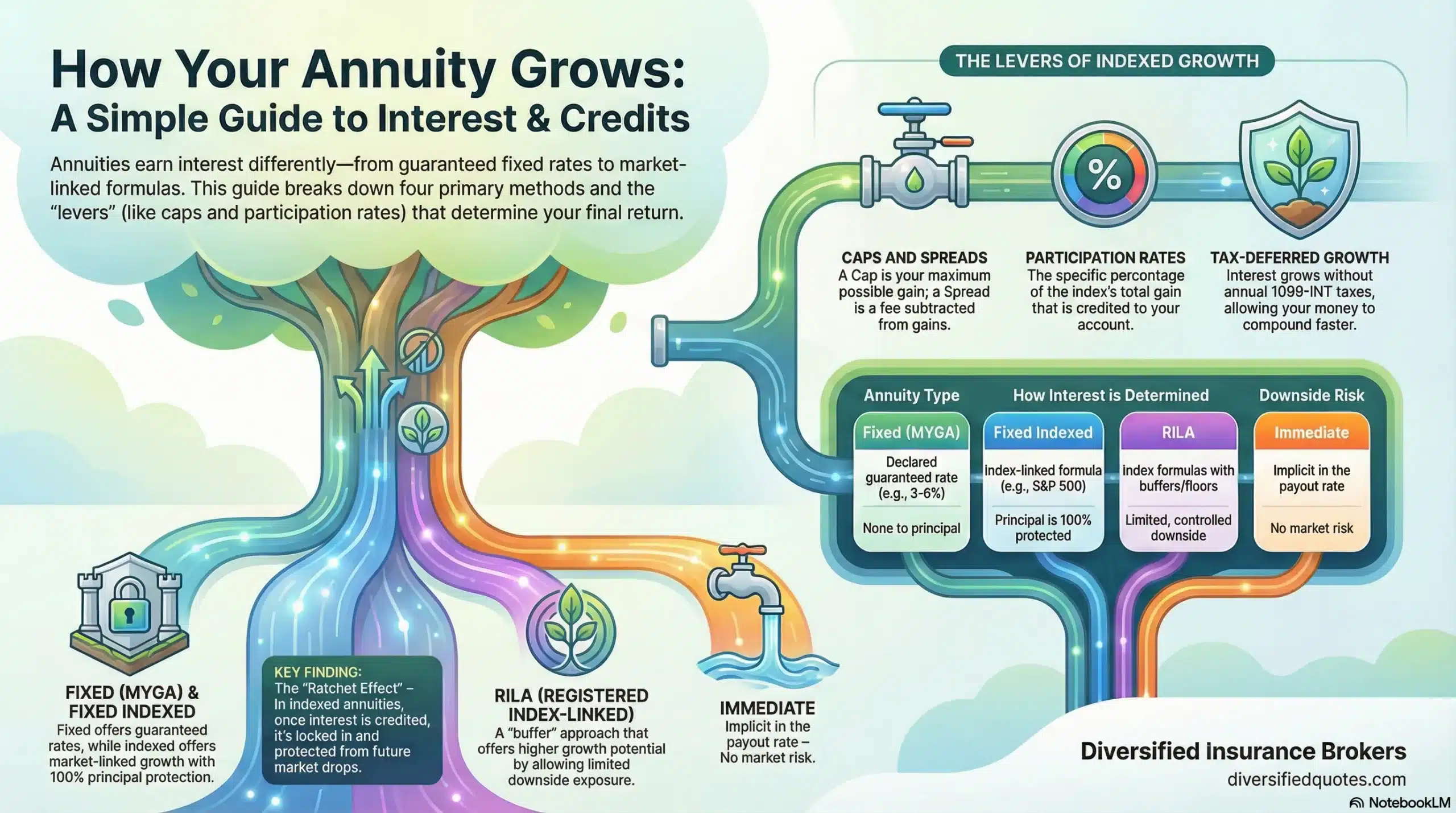
The word “rate” is helpful for fixed-rate products, but it can be misleading for FIAs and income annuities if you assume everything works like a savings account. A fixed annuity (including many MYGA-style contracts) often has a declared rate for a defined term, which makes comparisons straightforward. A fixed indexed annuity credits interest based on an index-linked formula, and the terms of that formula—caps, spreads, participation rates, and/or fixed interest buckets—are the real “rate” drivers. An income annuity is different again: it’s about payout rates—how much guaranteed income a given premium can generate for a chosen income start date and payout option.
That’s why a fair comparison needs two layers: (1) the contract mechanics (how crediting or income is calculated), and (2) the real-world outcome (the dollars you may earn or the dollars you may receive). When we compare fixed indexed and income options, we treat the contract as a tool in a broader plan—usually a retirement-income plan. If you’re building that plan from scratch, a helpful starting point is to evaluate how long assets need to last and how much volatility you want to tolerate. (If you’re modeling “how long will my account last” scenarios, this style of thinking aligns well with retirement drawdown planning tools and guaranteed-income layering.)
The rest of this page is designed to make those layers visible: what terms to look at, what drives them, and how to compare apples to apples.
Fixed Indexed Annuity Rates: The Terms That Actually Matter
A fixed indexed annuity is built around a simple promise: your contract value is protected from direct market losses, and interest is credited based on an index-linked method. Instead of showing “one rate,” FIAs typically show crediting strategies. Each strategy has rules that determine how much of the index movement can become interest in the contract. The most common levers are caps, participation rates, and spreads. Some contracts also offer a fixed-rate allocation option that behaves more like a traditional fixed account.
Here’s the cleanest way to think about it: if the index goes up, you may earn credited interest up to the strategy’s limits. If the index goes down, you generally credit zero for that period (not a negative). Over time, this can create a smoother path for people who want growth potential without direct downside exposure. The trade-off is that you give up “uncapped” market upside because the insurer is providing the downside protection and structuring the option budget that supports index-linked crediting.
In day-to-day shopping, the mistake people make is focusing on one attractive term (like a high cap on one index option) without asking how the entire product behaves. A stronger evaluation compares: the contract’s surrender schedule, penalty-free access, any rider costs, how often terms can change, and what happens when the initial term ends. If liquidity rules matter to you, it’s worth reviewing annuity free withdrawal rules while you compare. Liquidity details rarely feel urgent in year one—but they matter if you need access during years two through seven (or longer).
If you’re looking for the most direct “rate-like” comparison, you may prefer fixed-rate annuities first. A good baseline resource is best MYGA annuity rates, then you can compare whether the additional complexity of indexed crediting is worth it for your goals and time horizon.
Caps, Spreads, and Participation Rates: A Practical Explanation
Think of caps as a ceiling. If a strategy has a 7% annual cap and the index increases by 10% for that crediting period, the credited interest is limited to 7% (subject to the contract’s method). Participation rates are a share of the index movement. A 60% participation rate on a 10% index increase would credit 6% (again, subject to method and any additional limits). Spreads act like a subtraction. If the index return is 10% and the spread is 3%, you credit 7%—assuming the method applies the spread that way for the given strategy.
These levers are not automatically “good” or “bad.” They are part of the insurer’s pricing and option budget design. A contract may have a lower cap but a stronger fixed-rate bucket, or a higher cap on one strategy but weaker renewal history, or a great index menu but a longer surrender period than you want. This is why “best” is rarely a single number; it’s usually a fit decision.
Also important: most FIA terms are not guaranteed for the entire life of the contract. They’re often declared for a period (commonly one year for many strategies) and can change based on carrier discretion, competitive pressures, and interest-rate conditions. That doesn’t mean FIAs are unreliable; it means the evaluation should include the carrier’s renewal posture and product intent. If you’re comparing carriers and want to understand the “myths vs. reality” side, you may find this helpful: fixed indexed annuity myths debunked.
The most reliable way to compare is to run illustrations with consistent assumptions and then focus on what matters most to you: principal protection, liquidity, potential credited interest, and the availability (or not) of lifetime income features.
Want Fixed-Rate Certainty vs. Bonus vs. Indexed Credit Terms?
Compare the clean fixed-rate baseline first, then decide whether a bonus or indexed design fits the rest of your plan.
Income Annuity Rates: Understanding Payout Levels (Not Just Interest)
Income annuities are designed around a different job than most FIAs. Instead of focusing on credited interest, an income annuity is about turning a portion of savings into guaranteed payments. People often call these “income annuity rates,” but the more accurate phrase is payout level: how much monthly or annual income a given premium can create for the chosen payout design. The payout is influenced by factors like age, state, single-life vs. joint-life, period-certain options, refund features, and interest rates at the time you lock it in.
The reason income annuities can produce strong “pension-like” payments is that they combine two ideas: (1) current interest-rate conditions and (2) mortality pooling—where people who live longer are supported by the pricing assumptions across the pool. In plain language, income annuities can pay more than a “safe withdrawal” assumption from a market portfolio because they are designed specifically for lifetime payments. The trade-off is that the structure is less liquid, and the most pure income designs typically do not behave like an account you manage.
If you want a simple starting point, ask yourself this: do you want a guaranteed check that is designed to continue for life (or two lives), or do you want a protected account value that you can still access with some flexibility? That single question usually clarifies whether a person should begin the comparison with an income annuity, an indexed annuity with an income rider, or a blend that covers essential expenses while keeping additional assets more liquid.
When a plan is built around “baseline expenses,” many households coordinate guaranteed income sources—like Social Security and an annuity income layer—so that the rest of the portfolio can be managed with less pressure. This is one of the cleanest ways to reduce sequence-of-returns stress and to avoid making lifestyle decisions based on market volatility.
What Drives Fixed Indexed and Income Annuity Rates Up or Down?
Even though FIAs and income annuities are different tools, many of the forces that impact them are related. When interest rates in the broader bond market rise or fall, insurers’ portfolios and pricing assumptions change. That can influence the declared rates on fixed-rate annuities, the option budget that supports index-linked crediting, and the payout levels that income annuities can offer. In addition, carriers compete—sometimes aggressively—by adjusting product terms and features. That’s why “today’s best” can change, and why side-by-side comparisons are often more valuable than relying on one product you heard about from a friend.
The second major driver is product design. With FIAs, the design choices include whether the product emphasizes higher caps vs. stronger participation rates vs. a better fixed account option, and how the surrender schedule and rider costs are structured. With income annuities, the design choices include single-life vs. joint-life payouts, refund or period-certain options, inflation adjustments (if offered), and the chosen income start date. Every design choice is a trade-off. More guarantees or more optionality often means a lower initial payout or different pricing somewhere else.
The third driver is your personal profile—primarily age, state, and payout options. Income annuity payouts generally increase with age because the expected payment duration shortens. Joint income typically pays less than single-life income because payments are expected to last longer across two lives. Adding a period certain or refund feature can reduce payout because the insurer is adding a guarantee for beneficiaries if death occurs early. None of these are “bad”; they simply reflect what you value most: maximum income vs. income plus beneficiary protections.
This is why the best comparison approach is outcome-first: model a few realistic scenarios, then choose the structure and carrier options that match your priorities.
How to Compare Fixed Indexed and Income Annuity Rates Without Getting Fooled
If you only remember one rule, make it this: compare like-for-like outcomes. Two FIAs can quote attractive terms, but one may assume a strategy that rarely renews as advertised, or may require a rider fee to achieve the income goal you actually care about. Two income annuities can both be “lifetime,” but one might include a refund feature and the other might be life-only. Those are not comparable outcomes.
A practical comparison framework looks like this: First, choose a baseline fixed-rate option so you know what “no complexity” can accomplish. Many people start with best MYGA annuity rates because the terms are easy to understand. Second, compare bonus structures when you’re considering a longer holding period or a design that is intended to support income outcomes later. A clean place to start is bonus annuity comparison. Third, decide whether you need a dedicated income layer and model those outcomes directly using the calculator below. This keeps the conversation anchored to what you actually need: a check that shows up reliably.
Along the way, verify liquidity and withdrawal rules. Many annuities include penalty-free withdrawal provisions, but the timing and percentages differ by product. If you’re trying to preserve flexibility, you’ll want to understand how your contract handles withdrawals during the surrender period and what exceptions may apply. The single most helpful reference point for this is annuity free withdrawal rules.
Finally, don’t ignore beneficiary and legacy details. Even if income is the priority, beneficiary treatment affects how “safe” the decision feels. If you’re evaluating how annuities handle beneficiaries and death claims, this page provides a useful overview: annuity beneficiary death benefits.
Lifetime Income Calculator
Use this tool to estimate income scenarios. Start with a few different premium and start-date combinations, then compare product structures that support the outcome.
After you run a scenario, compare the inputs and assumptions to the product features you’re considering—especially liquidity, rider costs (if any), and how the contract treats beneficiaries.
Fixed Rates vs. Bonus Designs vs. Income Annuities: How to Choose the Right Starting Point
Many retirees get stuck because they try to pick “the best annuity” without first picking the job the annuity needs to do. The job usually falls into one of three buckets: (1) protected accumulation with simple terms, (2) protected growth with additional design elements like bonuses or index crediting, or (3) a dedicated income layer intended to create a predictable retirement paycheck. Choosing the bucket first makes the shopping process faster and more rational.
If you want the cleanest comparison, begin with fixed-rate options. Fixed-rate annuities can be a strong fit for people who prefer simplicity and predictability and who like to match terms to a timeline. If you prefer to see the most competitive fixed-rate baseline, start here: best MYGA annuity rates. Once you know the baseline, it becomes easier to decide whether additional complexity is worth it.
Bonus designs can make sense when the plan is built around a longer hold period or when a product is intended to support an income start later. The key is to evaluate bonus structures as part of a complete design, not as a stand-alone headline number. Use this resource as a starting comparison: bonus annuity comparison.
Income annuities are best evaluated by the outcome: the payment level, the payout option, and what beneficiary protections you want. If the goal is to build a pension-like paycheck to cover essential expenses, income annuities (or income-focused rider designs) can be a powerful tool—especially when coordinated with Social Security timing and other predictable income sources.
Get Carrier-Level Illustrations Based on Your State and Age
When you’re ready to move from “general research” to real numbers, request a comparison. We’ll line up fixed, indexed, and income outcomes so the trade-offs are obvious.
Common Planning Questions That Change the “Best Rate” Answer
People often ask for “the best fixed indexed annuity rate” or “the best income annuity payout rate,” but the best answer changes based on what you’re solving for. If the plan requires high liquidity, you may prefer products with more generous penalty-free access provisions or shorter surrender terms. If the plan is focused on building a future paycheck, you may prioritize income-focused designs rather than the highest short-term crediting assumptions. If leaving money to heirs is a major priority, you may avoid life-only income designs and instead evaluate refund or period-certain structures or different beneficiary strategies.
It’s also important to avoid the trap of comparing a “rate” from one category to a “payout” from another. A fixed-rate annuity may show a strong declared rate, but it isn’t designed to produce the same lifetime payment level as an income annuity. An income annuity may show a strong payout, but it isn’t designed to preserve liquidity the way an accumulation-focused product might. The right decision is the one that fits your plan constraints and your preferences—not the one with the biggest number in a vacuum.
If you want more clarity on annuity mechanics and long-run value, these pages complement this topic well: what is an annuity spread rate and are annuities a good investment.
Beneficiaries, Taxes, and the Rules That Affect Real-World Outcomes
Retirement decisions don’t happen in a vacuum. Beneficiary rules, tax rules, and distribution requirements can change which annuity design makes the most sense. If you’re using qualified money (like IRA funds), you’ll want to coordinate required distributions with contract withdrawal provisions and ensure the product is appropriate for your timeline. If you’re using non-qualified funds, you may focus more on tax deferral, legacy planning, and how withdrawals are treated.
Beneficiaries are another common blind spot. Some people assume all annuities work the same at death. In practice, beneficiary treatment depends on product design and contract features. If beneficiary planning is part of your decision, review annuity beneficiary death benefits so you understand what happens to remaining contract value, what options beneficiaries may have, and how income designs handle remaining guarantees (if any).
None of this is meant to make the decision feel complicated—it’s meant to prevent surprises. A good comparison makes these rules visible up front so you know what you’re buying and why.
Talk With an Advisor Today
Choose how you’d like to connect—call or message us, then book a time that works for you.
Schedule here:
calendly.com/jason-dibcompanies/diversified-quotes
Licensed in all 50 states • Fiduciary, family-owned since 1980
FAQs: Fixed Indexed and Income Annuity Rates
About the Author:
Jason Stolz, CLTC, CRPC and Chief Underwriter at Diversified Insurance Brokers (NPN 20471358), is a senior insurance and retirement professional with more than two decades of real-world experience helping individuals, families, and business owners protect their income, assets, and long-term financial stability. As a long-time partner of the nationally licensed independent agency Diversified Insurance Brokers, Jason provides trusted guidance across multiple specialties—including fixed and indexed annuities, long-term care planning, personal and business disability insurance, life insurance solutions, Group Health, and short-term health coverage. Diversified Insurance Brokers maintains active contracts with over 100 highly rated insurance carriers, ensuring clients have access to a broad and competitive marketplace.
His practical, education-first approach has earned recognition in publications such as VoyageATL, highlighting his commitment to financial clarity and client-focused planning. Drawing on deep product knowledge and years of hands-on field experience, Jason helps clients evaluate carriers, compare strategies, and build retirement and protection plans that are both secure and cost-efficient. Visitors who want to explore current annuity rates and compare options across multiple insurers can also use this annuity quote and comparison tool.
