
Guaranteed Issue Burial Insurance

Jason Stolz CLTC, CRPC
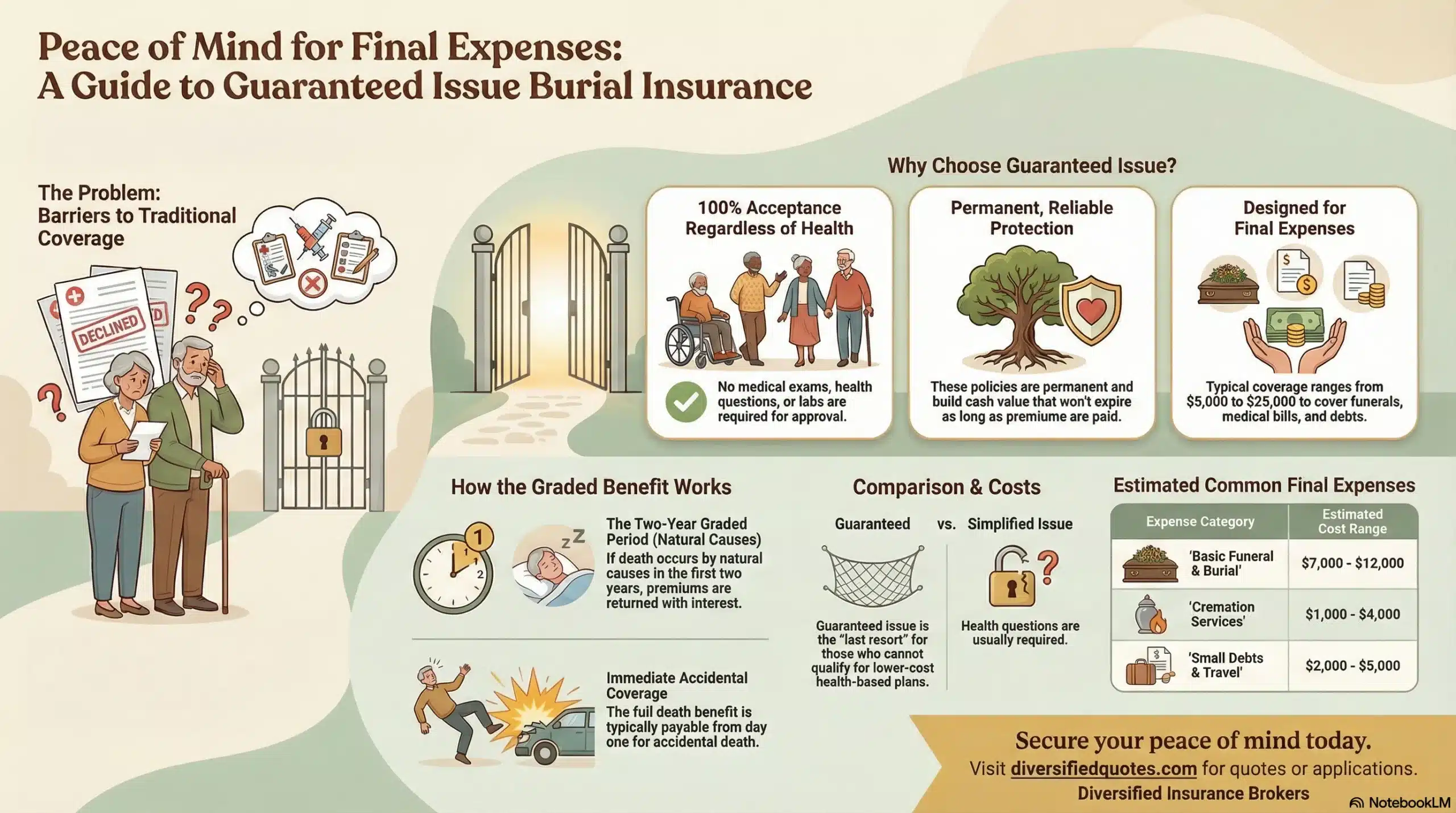
We help families secure protection even when traditional life insurance isn’t an option. Guaranteed Issue Burial Insurance is designed for people who need final-expense coverage with no medical exams, no health questions, and no underwriting. If you’ve been declined elsewhere, take multiple medications, or simply don’t want the uncertainty of approvals, guaranteed issue coverage can put a dependable benefit in place so your loved ones aren’t left scrambling to pay for funeral costs, medical balances, or other end-of-life expenses.
Although many families refer to this as “burial insurance,” it’s still life insurance. The purpose is simple: create cash for the person you choose, at the time they need it most. For many seniors, that means keeping coverage amounts modest, keeping premiums predictable, and keeping the enrollment process straightforward. When someone’s health history makes fully underwritten coverage difficult, guaranteed issue can be the most practical way to secure meaningful protection without delay.
At Diversified Insurance Brokers, we work with families nationwide to compare final-expense options and explain the real differences between guaranteed issue and other “no-exam” policies. Some applicants assume guaranteed issue is the only option because they’ve been declined before. In many cases, that’s true. But in other cases, a simplified-issue plan may be available at a lower cost, even with common conditions. If you’re not sure what you qualify for, we’ll help you understand your choices and select the path that makes the most sense for your budget and timeline.
Get Coverage Regardless of Health
Guaranteed acceptance within the eligible age range. No exams. No health questions.
What guaranteed issue burial insurance is (and what it is not)
Guaranteed issue burial insurance is typically a small, permanent life insurance policy intended to help with final expenses. The defining feature is the approval process: if you are within the carrier’s eligible age range and meet basic administrative requirements, acceptance is generally automatic. That means there is no medical exam, no lab work, and no health questionnaire that could trigger a decline. For clients who have serious conditions, a long medication list, or a history of insurance declines, that simplicity can be a major relief.
At the same time, guaranteed issue coverage is not built for large income replacement needs. It’s usually intended for smaller amounts—often in the range many families use for funeral and burial costs, cremation expenses, unpaid bills, travel costs for relatives, or a cushion so the family is not forced to use credit cards. If you need a larger policy, or if you are still working and supporting others, we typically explore other types of coverage first. Guaranteed issue is best viewed as a “get something in place” solution when health and time are constraints.
One of the most common misconceptions is that “burial insurance” is a special category that works differently than life insurance. In practice, it’s a label people use when the coverage amount is designed for final expenses. A policy can be described as burial insurance, final expense insurance, or guaranteed issue life insurance depending on the carrier and how it is marketed, but the core function is the same: a life insurance benefit payable to your chosen beneficiary.
It also helps to separate guaranteed issue from “no-exam” insurance in general. Many no-exam policies still ask health questions, review prescriptions, or rely on simplified underwriting rules. Guaranteed issue is distinct because it removes the medical gate entirely. If you want a quick overview of how “no questions” plans differ from other no-exam options, this guide is a helpful starting point: life insurance with no medical questions asked.
Why some seniors choose guaranteed issue instead of other “no exam” coverage
Many people hear “no exam” and assume all no-exam policies are the same. In reality, “no exam” can still involve health questions, prescription checks, and automated medical record lookups. A simplified-issue policy often skips the exam but asks a short list of questions. If your answers fit the carrier’s guidelines, you can get day-one coverage and sometimes lower premiums than guaranteed issue.
But if you cannot answer those questions favorably—or you’ve had recent hospitalizations, oxygen use, more advanced heart or lung conditions, or certain serious diagnoses—simplified issue may not be available. That’s where guaranteed issue becomes valuable. It removes the medical gate entirely, which makes it a reliable option for applicants who have been declined for traditional life insurance or who want to avoid the stress of “will I qualify?”
For many families, the decision is less about “finding the perfect policy” and more about ensuring the family is not left with sudden expenses at the worst possible moment. If you’ve seen friends or relatives struggle with funeral expenses, travel costs, or final bills, you know how quickly financial stress can show up after a loss. Guaranteed issue coverage is often purchased simply to prevent that scenario and to lock in a plan that will still be there later.
We also see guaranteed issue used when health changes over time. Someone who might have qualified for simplified issue at 55 may not qualify at 68 after additional diagnoses, prescriptions, or changes in stability. In those cases, guaranteed issue can re-open the door to coverage when other options become limited, and it can make the process dramatically less stressful.
How the graded benefit period works (the part most people misunderstand)
Most guaranteed issue policies include a graded benefit period, commonly during the first two years (though it can vary by carrier and state). This graded period is not designed to “trick” anyone—it’s how insurers manage risk when they accept applicants without health screening. Understanding it clearly matters, because it affects what your beneficiary receives if death occurs early in the policy.
During the graded period, coverage for accidental death is often payable for the full face amount from day one, while coverage for natural causes usually pays a limited benefit. In many designs, that limited benefit is a return of premiums paid plus an additional amount (often described as interest). After the graded period ends, the policy typically pays the full death benefit for covered causes of death, as long as premiums are paid and the policy remains in force.
It helps to view the graded period realistically. Guaranteed issue burial insurance is usually purchased to create permanent coverage that stays in place for years. The graded period is a short initial phase compared to the long-term life of the policy. For many seniors, the priority is locking in coverage they can keep, rather than hoping to qualify for something else later.
This is also why we emphasize matching coverage size to your budget. A policy works best when it remains active and premiums stay current. If you’re choosing between a larger benefit that feels financially tight and a smaller benefit that is comfortably affordable, the smaller benefit often provides better long-term protection. Final expense planning is not about buying the biggest number on paper; it’s about buying a policy you can keep.
Who guaranteed issue burial insurance is best for
This type of policy is typically best for seniors who have been declined for traditional coverage, or who expect declines due to serious or multiple conditions. It can also work well for people who want the simplest possible enrollment process and do not want medical calls, exam appointments, or repeated follow-ups. When the goal is to ensure a child or spouse is not left with funeral expenses, guaranteed issue can be the cleanest path to put a plan in place.
We also see guaranteed issue burial insurance used by families who are planning proactively. Sometimes an adult child wants to make sure there is a plan in place for a parent. Other times, the insured wants to remove uncertainty for everyone involved by putting a clear beneficiary and a clear benefit amount on paper. When this is done correctly, it can reduce stress and prevent financial strain during an already difficult time.
It can also be appropriate for people whose health history feels unpredictable. If you’ve had multiple diagnoses over time, or you are tired of seeing insurance decisions come down to carrier-specific rules, guaranteed issue can feel like the most direct route to a stable benefit.
Common coverage amounts and how families choose the right number
The right coverage amount depends on what you want the policy to accomplish. Many families start by estimating baseline funeral costs in their area, then add a cushion for related expenses like cemetery fees, a headstone, obituary costs, flowers, travel, or a small medical balance. Some seniors prefer a smaller policy—often in the $5,000 to $10,000 range—because it keeps premiums as low as possible and still provides meaningful relief. Others aim for $15,000 to $25,000 to cover the service plus a broader set of final bills.
If budget is tight, it’s often better to choose a smaller benefit you can comfortably maintain than to choose a larger benefit that becomes hard to pay. Final expense planning works best when the policy stays active, premiums remain current, and the beneficiary information is kept up to date. If you are unsure where to start, we can help you model a few realistic benefit amounts and choose the one that fits your monthly budget.
If you are comparing coverage across different senior ages, it can help to see how availability and expectations change by age band. These pages are useful starting points: burial insurance for seniors over 50 and burial insurance for seniors over 80. They help frame realistic expectations and explain why final expense products are structured the way they are.
Build can also influence what a person can qualify for outside of guaranteed issue. If this has been an issue in the past, this resource may help you understand why underwriting can be restrictive and why guaranteed issue is sometimes the simplest solution: burial insurance for overweight people. Similarly, blood pressure is a frequent factor in senior underwriting; this guide explains why: burial insurance for people with high blood pressure.
Cash value, ownership, and beneficiary planning
Most guaranteed issue burial insurance is permanent coverage, and permanent coverage may build cash value over time. Cash value is not the primary reason most families buy final expense insurance, but it can provide added flexibility later. Depending on the policy design, cash value may be accessible through policy loans or surrender. Any loans or withdrawals can reduce the death benefit, and policies have specific rules that govern how those features work.
It’s also important to think about ownership and beneficiary structure. Some families handle premiums together, and in other situations an adult child helps manage the paperwork to ensure the policy stays active. The most important step is keeping beneficiary designations current and making sure the beneficiary understands the basics of how a claim is filed when the time comes.
If taxes are a concern, most beneficiaries receive life insurance death benefits income-tax-free in common situations, but it still helps to understand the general rule. This page provides a clear overview: are life insurance benefits taxable.
What to expect when you apply
The application process is intentionally streamlined. In most cases, you’ll provide basic identifying information, confirm eligibility requirements, choose a benefit amount, select a payment method, and name your beneficiary. Because there is no medical underwriting, decisions are typically quicker and less stressful than traditional applications.
To avoid administrative delays, it helps to double-check the basics before submitting an application. Small details—like beneficiary spelling or payment information—can create unnecessary issues later. A little care at the enrollment stage can make things smoother now and much easier for your family down the road.
When guaranteed issue is the right move—and when it isn’t
Guaranteed issue burial insurance is usually the right move when health history makes other coverage unlikely, or when you want the certainty of acceptance without medical back-and-forth. It can also be a practical fit when you’ve had multiple declines, you’re tired of underwriting delays, or you simply want a dependable final expense plan that is easy to put in place.
However, if you can qualify for simplified issue, you may be able to secure a lower premium and sometimes avoid graded-benefit structures. If you need larger coverage amounts, or if you’re still in your working years and want long-term income protection, there may be better product types to explore. If you’re unsure, we can help you understand the tradeoffs so you can move forward without unnecessary complexity.
If you want additional context on how approvals behave when health history is involved, this overview is a helpful reference: life insurance with pre-existing conditions. It explains why carrier rules vary so much and why the “best option” depends on what you qualify for right now.
Why work with Diversified Insurance Brokers
Choosing final expense coverage should feel straightforward, but the details matter. Our team helps families compare coverage designs, understand graded benefit rules clearly, and select benefit amounts that match real budgets. We also help clients avoid paying for the wrong kind of coverage when a better option is available. If you’re weighing guaranteed issue versus other options, we’ll explain the differences in plain language so you can make a confident decision.
For many seniors, the most important outcome is not “perfect underwriting.” It’s making sure there’s a stable policy in place that loved ones can rely on. Guaranteed issue coverage is built for that goal.
Secure Guaranteed Coverage Today
Apply online in minutes with guaranteed acceptance within the eligible age range.
Financial Protection Essentials
Employer health planning, high-risk life insurance guidance, retirement transitions, and long-term care comparison tools.
Talk With an Advisor Today
Choose how you’d like to connect—call or message us, then book a time that works for you.
Schedule here:
calendly.com/jason-dibcompanies/diversified-quotes
Licensed in all 50 states • Fiduciary, family-owned since 1980
FAQs: Guaranteed Issue Burial Insurance
What is guaranteed issue burial insurance?
It’s typically a small permanent life insurance policy designed to help cover final expenses. Acceptance is generally guaranteed within the eligible age range, with no medical exam and no health questions.
Who is eligible?
Eligibility is usually based on age and state availability. Most guaranteed issue plans have minimum and maximum age limits that vary by carrier and by state.
How much coverage can I buy?
Guaranteed issue burial insurance is commonly offered in smaller benefit amounts intended for final expenses. Limits vary by carrier, state, and product design.
Are premiums level for life?
Most final expense whole life policies are designed with level premiums that stay the same as long as the policy remains in force and premiums are paid on time.
Is there a waiting period?
Many guaranteed issue policies include a graded benefit period. During that period, non-accidental death may pay a limited benefit (often premiums paid plus an additional amount), while accidental death is typically payable at the full face amount. After the graded period, the full death benefit is generally payable for covered causes of death.
Does it build cash value?
Many permanent burial insurance policies build cash value over time. Accessing cash value through loans or surrender can reduce the death benefit and may have other consequences depending on the policy.
How much does guaranteed issue burial insurance cost?
Pricing is based on factors like age, state, gender, tobacco status, and benefit amount. Because acceptance is guaranteed without health screening, guaranteed issue policies are typically priced higher than simplified-issue alternatives for the same coverage amount.
What can the death benefit be used for?
Your beneficiary can generally use the benefit for funeral and burial costs, cremation expenses, medical bills, unpaid debts, travel for family members, or any other needs.
Are there alternatives if I can answer a few health questions?
Yes. Simplified-issue final expense policies often ask a short list of health questions and may offer lower premiums and potentially immediate level coverage if you qualify. Comparing both options is usually the best approach.
Can I be declined for guaranteed issue?
Declines are uncommon when applicants meet age and state eligibility rules and complete the application accurately. Administrative requirements like residency and payment method rules still apply.
How fast can coverage start?
Many guaranteed issue applications are processed quickly once enrollment details are complete. Effective date rules vary by carrier and typically depend on the first premium payment.
About the Author:
Jason Stolz, CLTC, CRPC and Chief Underwriter at Diversified Insurance Brokers (NPN 20471358), is a senior insurance and retirement professional with more than two decades of real-world experience helping individuals, families, and business owners protect their income, assets, and long-term financial stability. As a long-time partner of the nationally licensed independent agency Diversified Insurance Brokers, Jason provides trusted guidance across multiple specialties—including fixed and indexed annuities, long-term care planning, personal and business disability insurance, life insurance solutions, Group Health, and short-term health coverage. Diversified Insurance Brokers maintains active contracts with over 100 highly rated insurance carriers, ensuring clients have access to a broad and competitive marketplace.
His practical, education-first approach has earned recognition in publications such as VoyageATL, highlighting his commitment to financial clarity and client-focused planning. Drawing on deep product knowledge and years of hands-on field experience, Jason helps clients evaluate carriers, compare strategies, and build retirement and protection plans that are both secure and cost-efficient. Visitors who want to explore current annuity rates and compare options across multiple insurers can also use this annuity quote and comparison tool.
