
How to Choose the Right Long Term Care Insurance Policy

Jason Stolz CLTC, CRPC
Choosing the right long term care insurance policy is not simply about comparing premiums — it is about protecting your retirement assets, preserving independence, and preventing a health event from turning into a financial crisis for your family. Long term care (LTC) planning sits at the intersection of healthcare, retirement income, estate planning, and family dynamics. The right policy can safeguard decades of disciplined saving. The wrong policy — or waiting too long to act — can leave you exposed to six-figure care costs that quickly erode even substantial portfolios. With Americans living longer and extended care needs becoming more common, planning for long term care is no longer optional for many households. It is a core pillar of retirement risk management.
Long term care insurance is designed to help cover the cost of assistance when you cannot perform certain activities of daily living (such as bathing, dressing, eating, transferring, toileting, or continence) or when cognitive impairment requires supervision. Care may occur at home, in assisted living, or in a nursing facility. Medicare provides only limited short-term coverage under specific circumstances, and traditional health insurance does not cover custodial care. That gap is where long term care insurance fits. The key is structuring a policy that aligns with your assets, your income plan, your risk tolerance, and your legacy goals — not simply choosing the lowest premium available.
Request a Long Term Care Insurance Review
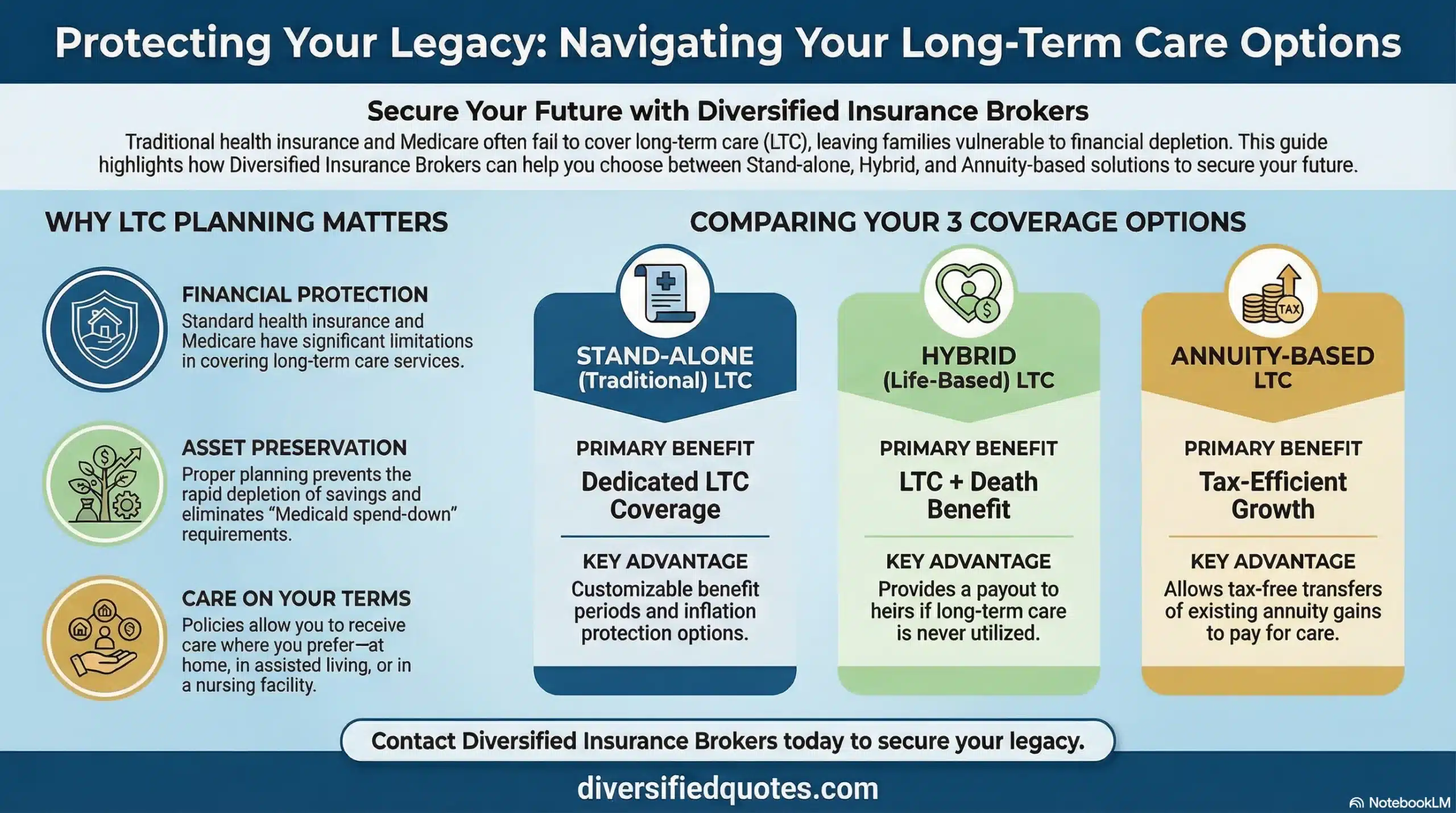
We’ll compare traditional LTC, hybrid life/LTC, and asset-based options to determine the most efficient structure for your retirement plan.
Start Your LTC ReviewWhen evaluating long term care insurance, the first decision is whether you even need it — and if so, how much risk you should self-insure versus transfer to an insurance carrier. For some households with substantial liquid assets and guaranteed income streams, partial self-funding may be reasonable. For others, a prolonged care event could rapidly deplete savings and force difficult choices. This is especially important when coordinating LTC planning with broader retirement strategies such as fixed annuity income planning or Social Security timing decisions outlined in our Maximize Social Security Benefits guide. Long term care costs do not occur in isolation — they interact directly with income distribution plans and survivor protection strategies.
One of the most misunderstood aspects of long term care insurance is the difference between traditional standalone policies and hybrid or asset-based designs. Traditional LTC policies focus purely on care coverage. You select a daily or monthly benefit amount, a benefit period (for example, three years, five years, or lifetime), and an elimination period before benefits begin. Premiums are typically lower at issue but may be subject to rate increases over time. Hybrid policies — often structured as life insurance or annuity contracts with long term care riders — provide a pool of money that can be used for care if needed, or a death benefit if care is never required. These policies may appeal to individuals who are uncomfortable paying premiums for something they may never use. Each structure has trade-offs involving flexibility, guarantees, liquidity, and tax treatment.
Benefit design matters far more than most consumers realize. A $150 per day benefit may have been sufficient twenty years ago. Today, many regions report home health and facility costs far exceeding that figure. Selecting the right monthly benefit requires analyzing local care costs, expected duration of care, and inflation assumptions. Inflation protection riders can increase benefits over time, helping preserve purchasing power, but they also increase premiums. For someone in their mid-50s, compound inflation protection may be appropriate. For someone in their early 70s, the math may look different. The “right” structure depends on age, health, and financial objectives.
Elimination periods function like deductibles measured in time rather than dollars. A 90-day elimination period means you are responsible for covering care costs during the first 90 days of eligibility. Shorter elimination periods reduce out-of-pocket exposure but increase premiums. Longer periods lower premiums but require greater liquidity. Coordinating this choice with emergency reserves and guaranteed income sources — such as those described in our annuity income planning guide — ensures your policy integrates smoothly with your retirement blueprint.
Underwriting for long term care insurance is more detailed than many expect. Carriers evaluate medical history, medications, mobility, cognitive screening results, and sometimes even phone interviews assessing memory and reasoning. Applying earlier — often in your 50s or early 60s — can significantly improve approval odds and pricing. Waiting until health changes occur can limit options or result in declines. This parallels the same principle discussed in our life insurance planning overview: locking in coverage while healthy protects insurability.
Another key factor is partnership-qualified policies. In many states, partnership LTC policies allow you to protect additional assets from Medicaid spend-down requirements if care costs exceed policy limits. This feature can be valuable for middle-to-upper-income households who want a safety net beyond the private policy. Understanding whether a policy is partnership-qualified — and how it interacts with Medicaid planning — should be part of the evaluation process.
Tax treatment also plays a role. Traditional LTC premiums may be partially tax-deductible depending on age and whether you itemize deductions. Certain hybrid structures may offer tax-free benefit distributions. Business owners may have additional planning opportunities if premiums are paid through an entity. As with other advanced planning strategies — such as those discussed in our Independent Insurance Broker resource — coordination with tax and legal advisors ensures your structure supports broader objectives.
Family dynamics must also be considered. Many people assume family members will provide care, but caregiving often carries emotional and financial strain. A properly designed LTC policy can fund professional care, allowing family members to remain supportive rather than overwhelmed. For couples, shared-care riders can allow one spouse to use unused benefits from the other’s policy, providing flexibility while potentially reducing overall cost.
Compare Long Term Care Policy Options
Traditional LTC, hybrid life/LTC, or asset-based annuity designs — we’ll show you side-by-side comparisons tailored to your health and retirement goals.
Get Your LTC ComparisonAffordability must be weighed carefully. The right policy is one you can maintain long term. Overextending into premiums that strain retirement savings can lead to lapses later. Sometimes a moderate benefit with strong inflation protection is preferable to a high initial benefit without growth. Layering strategies — similar to blending term and permanent life insurance — can also be considered, particularly when pairing LTC riders with existing policies.
Carrier strength is equally critical. Long term care policies may remain in force for decades before claims occur. Reviewing financial ratings, claims-paying history, and product stability helps ensure your carrier will be there when needed. Independent comparison across multiple insurers increases the likelihood of finding a financially strong company with competitive underwriting for your specific profile.
Ultimately, choosing the right long term care insurance policy is about clarity and alignment. Clarify what level of financial risk you are willing to retain. Clarify your retirement income structure. Clarify your estate and legacy priorities. Then design coverage that integrates with those goals. Long term care planning should not be isolated — it should coordinate with Social Security timing, annuity income planning, life insurance protection, and broader retirement cash flow strategies.
Related Pages
Talk With an Advisor Today
Choose how you’d like to connect—call or message us, then book a time that works for you.
Schedule here:
calendly.com/jason-dibcompanies/diversified-quotes
Licensed in all 50 states • Fiduciary, family-owned since 1980
Long Term Care Insurance FAQ
Long term care insurance helps pay for assistance with daily living activities such as bathing, dressing, eating, mobility, and cognitive supervision. Coverage may include in-home care, assisted living, or skilled nursing facilities. It fills gaps not covered by Medicare. Learn how it fits within broader retirement planning strategies like fixed annuity income planning and Social Security optimization.
Even substantial retirement savings can be eroded quickly by extended care costs. A policy helps protect income streams and legacy assets. Coordinating LTC coverage with guaranteed income planning — such as strategies explained in how annuity income is calculated — ensures your retirement plan remains stable if care is needed.
Traditional policies focus purely on care benefits and may offer lower upfront premiums. Hybrid policies combine life insurance or annuities with long term care riders, providing either care benefits or a death benefit. If you are comparing protection strategies, you may also review how life insurance planning and retirement income planning work together with LTC coverage.
Most people apply in their mid-50s to early 60s when premiums are more affordable and underwriting approval odds are higher. Waiting too long can lead to higher costs or limited eligibility. Similar to guidance in our life insurance overview, securing coverage while healthy protects insurability.
The appropriate benefit amount depends on local care costs, your retirement income structure, and how much risk you are willing to self-insure. Reviewing resources like Social Security timing strategies and guaranteed income planning helps determine how LTC fits into your overall retirement protection plan.
About the Author:
Jason Stolz, CLTC, CRPC and Chief Underwriter at Diversified Insurance Brokers, is a senior insurance and retirement professional with more than two decades of real-world experience helping individuals, families, and business owners protect their income, assets, and long-term financial stability. As a long-time partner of the nationally licensed independent agency Diversified Insurance Brokers, Jason provides trusted guidance across multiple specialties—including fixed and indexed annuities, long-term care planning, personal and business disability insurance, life insurance solutions, and short-term health coverage. Diversified Insurance Brokers maintains active contracts with over 100 highly rated insurance carriers, ensuring clients have access to a broad and competitive marketplace.
His practical, education-first approach has earned recognition in publications such as VoyageATL, highlighting his commitment to financial clarity and client-focused planning. Drawing on deep product knowledge and years of hands-on field experience, Jason helps clients evaluate carriers, compare strategies, and build retirement and protection plans that are both secure and cost-efficient.
