
Is Guarantee Issue Life Insurance Expensive

Jason Stolz CLTC, CRPC
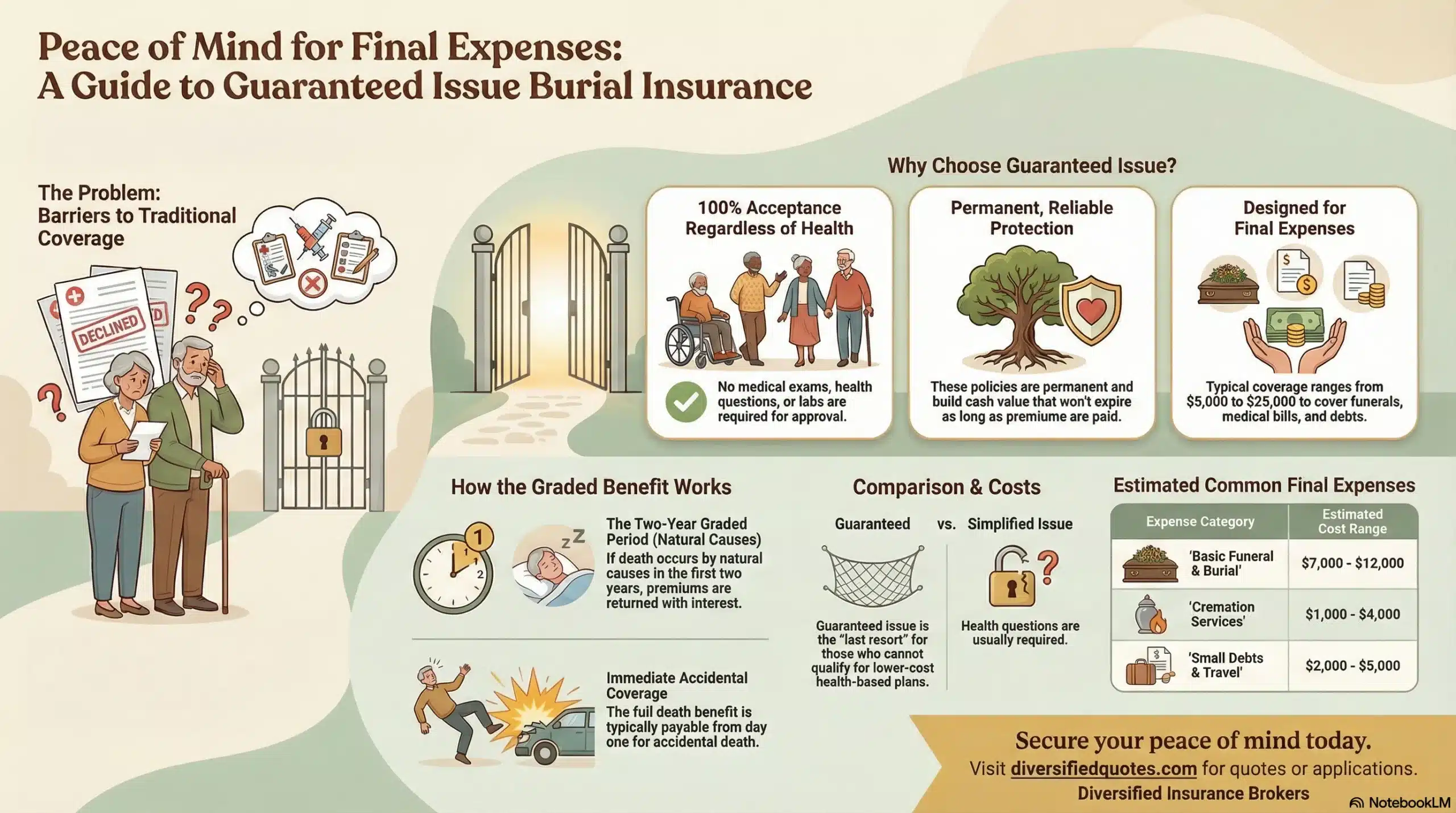
Is guarantee issue life insurance expensive? In most cases — yes, it can cost more than standard life insurance options. Guarantee-issue life insurance (also called guaranteed acceptance) allows you to obtain a policy without answering health questions or taking a medical exam. That convenience comes at a price: higher premiums, lower death benefits, and often waiting periods before full coverage applies. At Diversified Insurance Brokers, we help you compare guarantee-issue policies alongside simplified-issue and traditional options so you can decide whether the cost makes sense given your health, age, and coverage needs.
These policies are most often marketed to seniors, individuals with serious health issues, or those turned down for conventional life insurance plans. The trade-off: you get automatic acceptance and peace of mind—but you pay more per thousand dollars of coverage than someone who is in good health and can qualify for term or underwritten whole life. Below we break down how pricing works, when guarantee issue might make sense, and how you can evaluate if there’s a less‐expensive alternative with nearly as much value.
Explore Your Life Insurance Options
Compare guarantee‐issue policies, simplified‐issue, and conventional underwritten coverage—all side by side.
Why Guarantee Issue Policies Cost More
There are multiple factors that push the cost of guarantee issue life insurance above more standard policies:
- No medical underwriting: Because the insurer waives health questions and exams, they assume greater risk. That risk is priced into the premium.
- Older age brackets: These policies are commonly issued to applicants ages 50-85, a higher risk cohort that results in higher cost per coverage dollar.
- Smaller death benefits: Coverage amounts typically range from $5,000 to $25,000 or maybe up to $50,000, which means the cost per thousand dollars is higher than term life with larger face amounts.
- Graded or waiting benefit periods: Many policies include a 2-3 year waiting period; if the insured dies of natural causes during this time the full benefit may not be paid—only premiums plus interest. That limitation reduces value and increases effective cost.
Typical Pricing Illustrations
While exact premiums vary widely by age, gender, state, and coverage amount, here are some typical scenarios to give you a baseline:
- A 55-year-old female purchasing a $10,000 guarantee-issue whole life policy may pay a monthly premium of around $40-$70.
- A 70-year-old male purchasing the same face amount might pay $90-$150 + per month depending on the insurer.
- In contrast, a healthy 55-year-old female might qualify for a term or simplified-issue policy at far lower cost and much higher coverage—meaning the cost per thousand dollars of benefit is lower.
The bottom line: if you have serious health issues or advanced age and are unable to qualify for traditional life insurance, guarantee issue can provide coverage—but expect to pay significantly more per unit of death benefit.
When Guarantee Issue Makes Sense
Despite the higher cost, there are scenarios where guarantee issue life insurance is the right choice:
- You’re older (50-85) and have been denied traditional life coverage due to health conditions or age.
- You only need a small benefit to cover final expenses like burial, outstanding debts, or medical bills.
- You prefer guaranteed acceptance rather than risk being declined or undergoing underwriting.
- You want lifelong coverage (a permanent policy) rather than term that will expire.
When It May Not Make Sense
If you are in good health and can qualify for underwritten coverage, guarantee issue may not be the best value. Consider these warning signs:
- You’re paying high premiums for a small death benefit while a standard term policy may offer significantly more coverage for similar price.
- The graded death benefit or waiting period reduces the actual value of the policy in the early years.
- You have dependents or debt that require a substantial coverage amount—guarantee issue limits may not suffice.
- You want to build cash value or leave a legacy—other permanent life policies may be more efficient.
How to Evaluate Cost vs. Value
- Calculate cost per thousand of coverage: Take the annual premium and divide by the death benefit in thousands to compare across policies.
- Check the waiting/graded period: If you die within the first 2-3 years and only the premiums are refunded—or less—your effective value is lower.
- Compare alternative policy types: See if you qualify for simplified issue or standard term policies that may offer better value—linking your need to whether you actually need medical underwriting waived.
- Acknowledge coverage limits: If your goal is large coverage, guarantee issue might fall short—acknowledge the face-amount limit.
Related Coverage Types to Consider
If guarantee issue is too costly for your budget or coverage goals, you might explore:
- Is Life Insurance Expensive? – Benchmark general life insurance cost dynamics.
- What Is Critical Illness Insurance? – Another protection strategy worth comparing.
- Is Accidental Death Insurance Expensive? – A lower-cost death benefit alternative in certain cases.
- Life Insurance with Pre-Existing Conditions – Options when health history limits standard underwriting.
How We Help at Diversified Insurance Brokers
We review your age, health, coverage needs, and budget to determine whether a guarantee issue life policy is the best fit—or if you could qualify for a better value alternative. Our process includes:
- Assessing whether you qualify for underwritten or simplified-issue life policies.
- Comparing multiple carrier options for guarantee issue policies to find the best cost-benefit in your situation.
- Explaining graded benefit periods, face amount limits, and long‐term cost implications in clear terms.
With guarantee issue life insurance, you trade cost efficiency for assured acceptance. For some that trade is worth it—but for many there may be better value alternatives. Let us help you evaluate both sides.
Ready to compare your options? We’ll help you assess guarantee issue and compare alternatives side by side.
Talk With an Advisor Today
Choose how you’d like to connect—call or message us, then book a time that works for you.
Schedule here:
calendly.com/jason-dibcompanies/diversified-quotes
Licensed in all 50 states • Fiduciary, family-owned since 1980
FAQs: Guarantee Issue Life Insurance
Why are the premiums higher for guarantee issue life insurance?
Because there’s no medical underwriting, the insurer must price for higher risk of claim and older applicants—so premiums are higher per thousand dollars of death benefit.
Can I get more affordable coverage if I qualify for standard life insurance?
Yes. If you’re in good health and qualify for underwritten or simplified-issue life insurance, you will likely pay lower premiums and receive larger coverage amounts compared to guarantee issue.
What is a graded or waiting period in these policies?
Many guarantee issue policies have a waiting period (often 2 – 3 years) during which only a limited benefit or premium refund is paid if death occurs from natural causes—full benefit pays after the waiting period.
Are guarantee issue policies ideal for large death benefits?
No. These policies usually cap face amounts at relatively low levels (for example $25,000) and are primarily designed for final expenses rather than large financial dependents or estate planning.
Is there a point where guarantee issue policy cost becomes worth it?
Yes—when your health prevents underwriting, you need immediate acceptance, and you only require a small benefit to cover funeral costs or modest debts. In that case, the higher cost may be justified.
About the Author:
Jason Stolz, CLTC, CRPC and Chief Underwriter at Diversified Insurance Brokers (NPN 20471358), is a senior insurance and retirement professional with more than two decades of real-world experience helping individuals, families, and business owners protect their income, assets, and long-term financial stability. As a long-time partner of the nationally licensed independent agency Diversified Insurance Brokers, Jason provides trusted guidance across multiple specialties—including fixed and indexed annuities, long-term care planning, personal and business disability insurance, life insurance solutions, Group Health, and short-term health coverage. Diversified Insurance Brokers maintains active contracts with over 100 highly rated insurance carriers, ensuring clients have access to a broad and competitive marketplace.
His practical, education-first approach has earned recognition in publications such as VoyageATL, highlighting his commitment to financial clarity and client-focused planning. Drawing on deep product knowledge and years of hands-on field experience, Jason helps clients evaluate carriers, compare strategies, and build retirement and protection plans that are both secure and cost-efficient. Visitors who want to explore current annuity rates and compare options across multiple insurers can also use this annuity quote and comparison tool.
