
Is Nationwide a Good Insurance Company?

Jason Stolz CLTC, CRPC

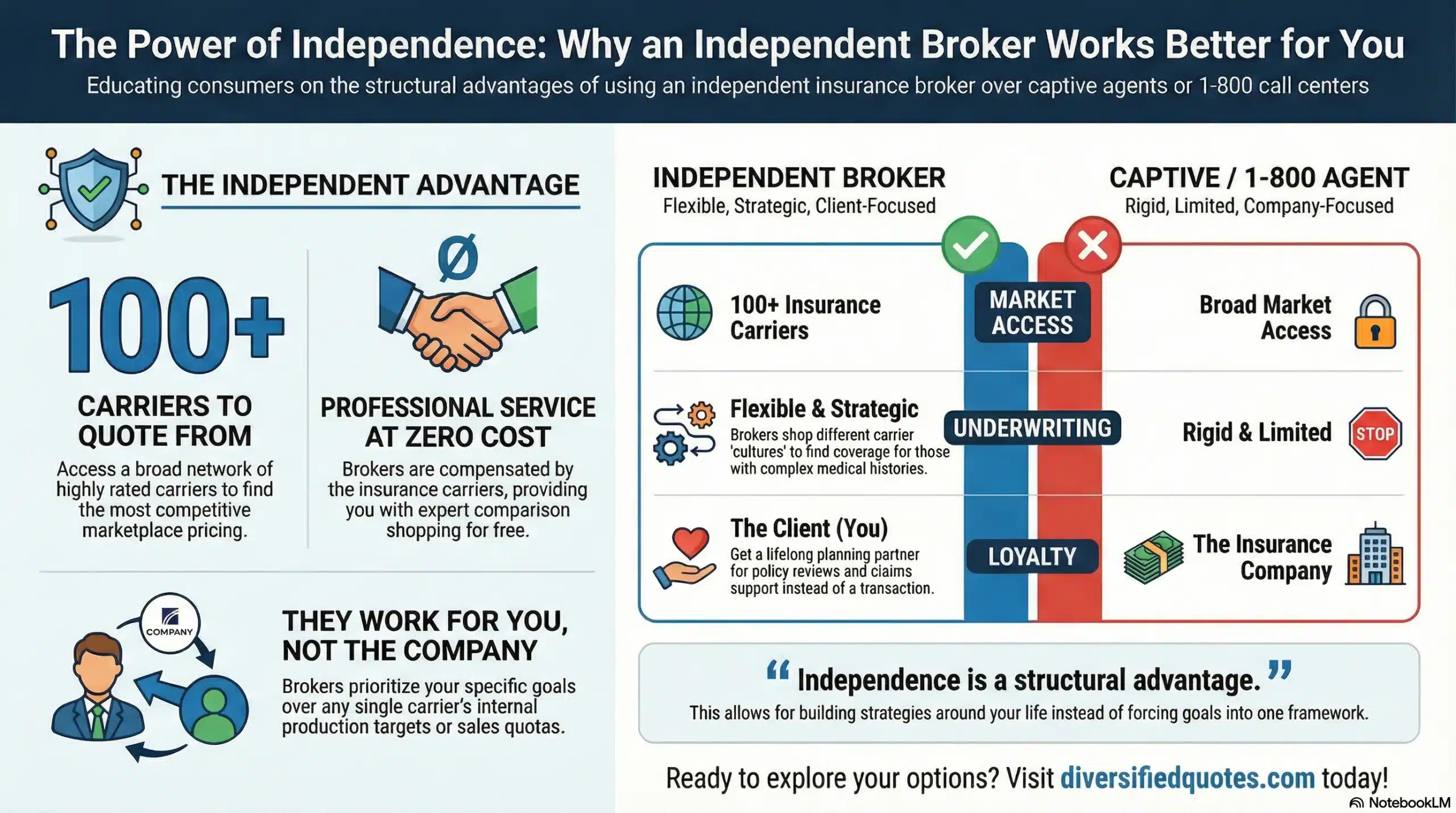
Is Nationwide a good insurance company? For many retirees, pre-retirees, and families, the answer can be yes—especially if you want a household-name carrier with broad product depth and a long history in retirement and protection markets. At Diversified Insurance Brokers, we work with over 100 top-rated carriers and evaluate Nationwide through the same lens we use for every insurer: guarantee strength, product clarity, retirement-income readiness, underwriting and service experience, and how well the contract terms match your timeline and liquidity needs.
Nationwide Life Insurance Company is one of the most recognized names in the industry, and the brand’s scale is a real advantage for many consumers. Nationwide’s lineup spans life insurance, annuities, and retirement solutions, and the company has developed a reputation for offering products built for long-term planning rather than short-term gimmicks. That said, a “good company” is not always the “best choice” for a specific objective. If your number-one goal is maximizing guaranteed income, locking in the strongest MYGA rate, or getting the most favorable indexed-crediting trade-offs, it’s smart to compare Nationwide side-by-side against carriers that specialize in those exact lanes.
This page is designed to help you make that comparison quickly and confidently. You’ll see interactive tools to run real numbers, plus guidance on what Nationwide tends to do well, what you should compare closely, and how to decide whether the specific Nationwide product you’re considering belongs in your retirement or protection strategy.
Overview: Nationwide’s Role in Retirement and Protection Planning
Nationwide has been operating for decades and is often viewed as a “full-service” insurer across multiple lines. For consumers, the practical advantage of a diversified carrier is that you may be able to address multiple planning needs under one umbrella—annuity income, protected accumulation, and life insurance coverage—without having to start from scratch with different brands. For some households, that type of simplicity is valuable. For others, the best outcome comes from choosing the best-in-class contract for each job, even if the carrier mix is broader.
When we evaluate Nationwide for annuities, we focus on how the contract behaves in real retirement planning: income start options, payout competitiveness, surrender and liquidity rules, and how the product fits into a layered strategy where guaranteed income covers essential expenses and other assets handle discretionary spending and legacy. When we evaluate Nationwide for life insurance, we focus on pricing for your specific risk profile and the practical underwriting experience—because a competitive product is only helpful if the application process is efficient and the final offer is acceptable.
If you’re specifically looking at Nationwide annuity designs, you may also find this product page useful as a reference point: Nationwide New Heights Annuity. The best evaluation approach is always contract-specific, because one Nationwide annuity may be an excellent fit while another is simply “fine” compared with stronger market alternatives for the same objective.
Ensure you are receiving the absolute top rates
Compare today’s strongest fixed and bonus annuity options, then request a personalized illustration so you can evaluate Nationwide side-by-side with other highly rated carriers available in your state.
Lifetime Income Calculator
Model guaranteed lifetime income by premium, age, and start date. Use this to compare Nationwide’s income outcomes against other carriers in your state.
Note: The calculator accepts premiums up to $2,000,000. If you’re investing more, results increase in direct proportion — for example, doubling your premium roughly doubles the guaranteed income at the same age and options.
Life Insurance Quoter
If part of your Nationwide evaluation includes life insurance, the most reliable way to start is a real-time, side-by-side comparison. Life insurance outcomes are driven by age, health, build, family history, and underwriting class. Even when two carriers look similar on paper, the final offer can differ meaningfully once underwriting is complete.
Use the quoter below to compare pricing across many carriers (including Nationwide where available) so you can see how your numbers look before you spend time on an application path that may not be the best fit.
What Nationwide Offers and Where It Tends to Fit Best
Nationwide’s reputation is built on being a broad, household-name insurer with a strong footprint across retirement and protection planning. From a consumer standpoint, that often translates into product variety and familiarity. From a planning standpoint, variety can be helpful—but only if you choose the contract that aligns with your objective rather than simply choosing “a Nationwide product” because the brand is recognizable.
In the annuity world, Nationwide is often evaluated across three broad use cases: protected accumulation, structured retirement income, and hybrid designs where principal protection is paired with some level of index-linked potential. In life insurance, Nationwide is often compared for term coverage, permanent coverage options, and how their underwriting and policy mechanics fit specific household needs.
Nationwide Annuities: How to Evaluate Them the Right Way
1) Protected accumulation versus income-first planning. Many annuity buyers unintentionally choose a contract optimized for the wrong job. If your primary goal is future income, you should evaluate the income mechanics: income base growth assumptions, payout factors, start dates, and any rider costs. If your primary goal is safe accumulation, you should evaluate the accumulation guarantee and the liquidity rules. Mixing those two categories is one of the most common ways consumers end up with a product that feels “fine” but isn’t optimized.
2) Surrender schedule and access rules. The biggest practical difference between annuities is not the marketing name of the product—it’s the surrender schedule and the rules for accessing your money. Before choosing any Nationwide annuity, confirm the length of the surrender period, the surrender charges by year, the annual penalty-free withdrawal amount, and any special waivers. If you want a clear explanation of how these rules typically work, see annuity free withdrawal rules.
3) Crediting terms and the “real” trade-offs. If you’re reviewing a fixed indexed annuity, the outcome is driven by caps, participation rates, spreads, index crediting method, and how the contract handles changes over time. This is where the same “category” can produce very different long-term results. If you want a plain-English framework, review fixed annuities vs fixed indexed annuities.
4) Beneficiary and legacy outcomes. Some annuity elections maximize income but limit beneficiary flexibility. Others preserve more death benefit flexibility but produce less income. If legacy planning matters, you want to confirm how beneficiaries are treated under each payout and rider design. For a deeper explanation, see annuity beneficiary death benefits.
Nationwide Life Insurance: How to Evaluate It Without Guessing
Life insurance is rarely a simple “which company is best” decision. It is a “which company underwrites my profile the most favorably and delivers the most value for the coverage goal.” Nationwide’s life insurance lineup can be a strong fit for many households, but the best way to know is to compare offers based on your age, health history, build, and desired term length or permanent policy type.
If you’re early in the evaluation process, a clean way to think about life insurance is to define the job first: income replacement, debt payoff, estate planning, or final expenses. Term is often the baseline for income replacement and debt payoff. Permanent policies may be more relevant when the need does not expire, when legacy planning is a priority, or when a household is building a long-term strategy that includes cash value considerations.
To build a stronger foundation, you can start with our Term Life Insurance Explained page and then expand into permanent options only if they match the purpose you are trying to solve.
Who Nationwide May Be a Good Fit For
Nationwide may be a strong fit if you want a widely recognized carrier and you’re choosing a contract that aligns with your goal and timeline. In practical terms, Nationwide can be a good fit for:
Retirees who want to establish a reliable income floor. If your goal is to convert a portion of savings into predictable income, Nationwide may be one of the carriers you compare, particularly when the income design aligns with your start date and risk preferences.
Pre-retirees seeking principal protection with planning flexibility. If you want to protect principal and position money for future income, fixed and fixed indexed strategies can be useful, provided the surrender schedule and access rules match your timeframe.
Households that value product variety. Some families prefer a carrier with broad product offerings. That can be helpful when a plan includes both protection and retirement solutions, but it is still important to choose the best-in-class contract for each job.
Consumers who want to compare numbers before committing. If you want clarity rather than guesswork, running quotes and modeling income scenarios is the most reliable way to decide whether Nationwide is the right fit.
Pros and Considerations When Evaluating Nationwide
Potential strengths. Nationwide is a recognizable national brand with broad product depth across retirement and protection planning. For many consumers, that translates into familiarity and a sense of stability. Nationwide also offers a range of annuity structures, including designs aimed at protected growth and retirement income flexibility, and the company is commonly included in competitive comparisons in multiple categories.
Considerations to review carefully. Like many large carriers, product versions and features can vary by state. Some annuity designs may include rider costs or fee structures that need to be weighed against income benefits. In certain niches, specialized carriers may deliver a stronger outcome for one very specific objective, such as the highest MYGA rate for a particular term or a more aggressive income-first design at a specific age and start date. The solution is not to assume one company is “better,” but to compare contracts that are built for the same job.
Our Take: Is Nationwide a Good Insurance Company?
Yes—Nationwide can be a good insurance company for annuity and life insurance buyers who want a well-known carrier with broad product availability and a history of long-term planning solutions. The most important step is to keep the evaluation product-specific: confirm the exact annuity or life policy being offered in your state, compare the contract mechanics side-by-side, and model your income goals using real numbers.
If you want to move from “general opinion” to a clear decision, use the income calculator above and the life insurance quoter on this page. Then request a personalized illustration. We’ll compare Nationwide against other top carriers so you can choose the best combination of guarantees, flexibility, and long-term value for your plan.
Related Retirement & Annuity Pages
Use these pages to compare annuity types, understand withdrawal rules, and see how guaranteed income planning works in real retirement decisions.
Related Nationwide & Insurance Comparison Pages
If you’re comparing Nationwide to other insurers, these pages provide additional context and product comparisons.
Talk With an Advisor Today
Choose how you’d like to connect—call or message us, then book a time that works for you.
Schedule here:
calendly.com/jason-dibcompanies/diversified-quotes
Licensed in all 50 states • Fiduciary, family-owned since 1980
FAQs: Is Nationwide a Good Insurance Company?
Is Nationwide a good company for annuities and retirement income?
Nationwide can be a strong choice for many annuity buyers, especially when the specific contract aligns with your timeline and income goals. The best approach is to compare Nationwide side-by-side with other carriers using the same premium, age, and income start date.
What should I compare before choosing a Nationwide annuity?
Focus on surrender schedule length, penalty-free withdrawal rules, any rider costs, and how the contract treats beneficiaries. If you are choosing the product for income, compare guaranteed income outcomes rather than just crediting features.
Does Nationwide offer MYGAs and fixed indexed annuities?
Nationwide offers multiple annuity categories, including fixed products and indexed designs. Specific products and features vary by state, so confirm the exact product version available where you live before making a decision.
Is Nationwide a good choice for life insurance?
Nationwide can be a solid option for life insurance, but the best carrier depends on your age, health, build, and underwriting class. The most reliable way to evaluate fit is a side-by-side quote comparison and a product-specific review.
Why do annuity and life insurance offers vary so much by state?
Insurance products are regulated at the state level, and carriers can file different versions of contracts in different states. Small variations in withdrawal provisions, riders, and crediting terms can materially change outcomes.
What’s the fastest way to decide if Nationwide is right for me?
Model income scenarios using the lifetime income calculator on the page, then request a personalized illustration so you can compare Nationwide against other top carriers available in your state. For life insurance, use the quoter tool to compare pricing across carriers for your profile.
About the Author:
Jason Stolz, CLTC, CRPC and Chief Underwriter at Diversified Insurance Brokers, is a senior insurance and retirement professional with more than two decades of real-world experience helping individuals, families, and business owners protect their income, assets, and long-term financial stability. As a long-time partner of the nationally licensed independent agency Diversified Insurance Brokers, Jason provides trusted guidance across multiple specialties—including fixed and indexed annuities, long-term care planning, personal and business disability insurance, life insurance solutions, and short-term health coverage. Diversified Insurance Brokers maintains active contracts with over 100 highly rated insurance carriers, ensuring clients have access to a broad and competitive marketplace.
His practical, education-first approach has earned recognition in publications such as VoyageATL, highlighting his commitment to financial clarity and client-focused planning. Drawing on deep product knowledge and years of hands-on field experience, Jason helps clients evaluate carriers, compare strategies, and build retirement and protection plans that are both secure and cost-efficient.
