
Life Insurance for Skydiving

Jason Stolz CLTC, CRPC
Life insurance for skydivers is absolutely possible—and in many cases it’s more affordable than people expect once the application is positioned correctly. At Diversified Insurance Brokers, we help active skydivers secure strong coverage from our network of 100+ A-rated carriers, including carriers that underwrite skydiving with real nuance instead of blanket assumptions. The biggest difference is rarely “who has the cheapest online quote.” The real difference is which carrier will evaluate your jump profile fairly, how your experience and safety habits are documented, and whether you avoid unnecessary flat extras or overly conservative decisions caused by vague disclosures.
Skydiving underwriting isn’t binary. A recreational jumper who goes a few weekends a year at a well-run drop zone is not the same underwriting case as a frequent jumper logging hundreds of jumps per year, a canopy pilot competing, or someone doing advanced disciplines. Even within skydiving, the details matter: how often you jump, the type of jumps you do, your training and licensing, and whether the carrier views your participation as controlled and standardized—or as unpredictable and high severity. Our job is to translate your real-world risk into a clean underwriting narrative and place the case with carriers that understand what your skydiving profile actually looks like.
If you’re exploring coverage because you have a family, a mortgage, or a business to protect, the goal is simple: get the right amount of coverage with pricing that reflects reality, not assumptions. If you’ve been overquoted or declined in the past, that doesn’t mean you’re out of options. It often means the case was sent to the wrong carrier, framed too broadly, or submitted without the detail underwriters need to evaluate your risk accurately. When underwriting is nuanced, experience and carrier selection matter—especially for adventure sports and other high-risk occupations and avocations.
Life Insurance for Skydivers
Active skydivers can still get excellent coverage—often at better rates than expected. We match your jump profile with insurers that underwrite skydiving fairly.
Get a Skydiving Life Insurance Quote
Work with an advisor who understands underwriting for skydiving and extreme sports.
How Skydiving Affects Life Insurance Underwriting
Most life insurance companies treat skydiving as an “avocation” factor—meaning it’s not your job, but it can still increase risk exposure and trigger additional underwriting review. From an insurer’s perspective, skydiving combines altitude exposure, equipment dependence, variable conditions, and the possibility of high-severity events. But a good underwriting decision isn’t made by simply labeling the sport “high risk.” A good underwriting decision is made by evaluating your actual profile: your experience level, how often you jump, what types of jumps you do, and whether your participation happens in a structured environment with recognized safety standards.
That nuance is the reason some skydivers get surprisingly reasonable offers—while others receive inflated premiums that don’t reflect their real-world behavior. The difference is often the carrier. Underwriting rules vary widely, and some companies apply conservative blanket rules to any mention of skydiving. Others evaluate skydiving with more granularity and will price the risk based on frequency, discipline, and training rather than assumptions.
It’s also important to remember that skydiving is only one piece of the risk puzzle. Your medical profile still matters. Age, blood pressure, cholesterol, family history, medications, and overall build are still the foundation of rate class. Skydiving is usually layered on top of that foundation—so when your health profile is strong, many carriers will be more comfortable treating skydiving as a manageable add-on rather than a reason to restrict the application. If you’re navigating underwriting with any medical history as well, this resource is a helpful overview: life insurance with pre-existing conditions.
The Skydiving Details Underwriters Actually Care About
When an underwriter reviews a skydiver, they’re trying to quantify exposure. One of the first items is annual jump volume. A person doing a handful of jumps a year typically looks very different than someone doing weekend jumping year-round. Frequency isn’t just about how much you enjoy the sport—it’s about how many times you’re exposed to the risk environment. More jumps generally means more total exposure, which can lead to a higher underwriting load, especially if the carrier’s rules are conservative.
Next comes jump type and discipline. Standard recreational jumping at established drop zones is often underwritten differently than higher-intensity disciplines. Underwriters are looking for variables that increase the chance of incident or increase severity if something goes wrong. Advanced forms of skydiving tend to be evaluated more strictly, and if an underwriter believes your jumping falls into a higher severity category, you may see a higher premium approach such as a flat extra in life insurance. A flat extra is typically a per-$1,000 charge added to the base premium, and it’s commonly used when carriers want to price an activity risk separately from health.
Training and licensing are another major factor. Underwriters like structure. When a file shows clear training, licensing, and a consistent pattern of safe participation, it helps the carrier treat skydiving as a managed risk rather than a wildcard. Experience isn’t a guarantee of lower pricing, but it provides context. It can also help differentiate someone who does skydiving occasionally from someone who participates in ways that are harder to quantify. Carrier selection matters here because some carriers actually use training and documentation as a real underwriting variable, while others barely do.
Underwriters may also consider whether you’ve had any past incidents, injuries, or near-miss events that required medical attention. Even when those were not severe, they can signal patterns—especially if there were repeated issues. A well-documented history that shows safe participation and no significant incidents often supports a smoother underwriting process. If the insurer finds medical records that suggest repeated injuries, the file can turn conservative quickly, even if the injuries were unrelated to jumping. That’s why we work to keep the narrative clean and consistent.
Why Skydivers Often Get Overquoted or Declined
The most common reason skydivers are overquoted is simple: the application is submitted without enough detail. When an underwriter sees “yes” next to skydiving with no context, the carrier has to protect itself. Many will default to worst-case assumptions—high frequency, high-risk disciplines, or a level of exposure that may not apply to you at all. Once the carrier starts from a conservative assumption, it’s hard to unwind the decision midstream.
Another common issue is carrier mismatch. Some companies don’t want skydiving on their books, regardless of how safe the profile is. Others will consider it, but their internal rules may automatically assign a flat extra or a table rating at jump volumes that other carriers would treat as moderate. This is why comparison shopping isn’t just about running a quote tool. It’s about comparing underwriting philosophy. Our job is to avoid carriers that overreact and focus on carriers that will evaluate you based on the reality of your participation.
Declines also happen when the carrier’s underwriting guidelines are simply restrictive, or when the application includes multiple risk layers—like a medical history plus skydiving, or a risky occupation plus skydiving. In those cases, it’s even more important to use a pre-underwriting approach and target carriers that are comfortable with your specific combination of risk factors rather than forcing the file into a narrow carrier box.
There’s also a hidden cost to applying the wrong way: a formal decline can follow you. Many insurers ask whether you’ve been declined in the past, and while a decline doesn’t make you uninsurable, it can narrow options and slow the next underwriting attempt. That’s why we focus on getting it right the first time by using the best carrier strategy for your jump profile and overall health.
What Life Insurance Coverage Can Look Like for Skydivers
Most skydivers want a practical outcome: a policy that covers the years where financial obligations are highest. For many families, that means term life insurance. Term offers the most coverage per dollar, which is why it’s often the preferred foundation for income protection, mortgage protection, and family stability. The carrier may treat skydiving as part of overall underwriting and still offer competitive term pricing depending on frequency and discipline.
Permanent coverage is also possible for some skydivers, particularly when the goal is lifetime protection or legacy planning. Permanent policies cost more, but they can be used for long-term needs where term life would eventually expire. Whether permanent is a good fit depends on budget, goals, and whether the carrier’s underwriting approach makes the pricing reasonable. If you’re not sure which direction makes sense, we can help you compare term versus permanent structure—and also evaluate hybrid strategies that make coverage more efficient.
If your skydiving profile is frequent or advanced enough that traditional pricing becomes less attractive, there may still be ways to build meaningful coverage. Sometimes that means adjusting the coverage mix. Sometimes it means choosing a carrier that prices the avocation differently. And sometimes it means using a policy design that creates coverage now while you evaluate whether to re-shop later based on changes in frequency. The right approach depends on your specific situation, but the key point is that skydiving rarely means “no.” It usually means “be strategic.”
Understanding Flat Extras and Table Ratings for Skydivers
Skydivers commonly hear two underwriting terms: table ratings and flat extras. A table rating is a percentage-based increase on the base premium tied to overall mortality risk factors. A flat extra is typically used to price an activity risk separately as a per-$1,000 charge. Some carriers prefer flat extras for skydiving because they can quantify the activity risk without changing your underlying health class. In practice, one structure can be better than the other depending on your age, the amount of coverage, and the carrier’s pricing model.
If you’re seeing a flat extra, it doesn’t automatically mean you’re “high risk.” It often means the carrier’s manual uses flat extras for adventure sports so they can price the activity exposure in a predictable way. The important point is that flat extras and table ratings are not uniform across the market. One carrier might assign a flat extra for a profile that another carrier underwrites with no additional cost, or with a smaller adjustment. That’s exactly why we compare carriers strategically instead of treating the first quote as final.
If you want to understand the concept in depth, this resource breaks it down: What Is a Flat Extra in Life Insurance?. When we evaluate your case, we’re looking at which carriers are likely to use a flat extra, which are likely to apply a table rating, and which are more likely to evaluate recreational skydiving in a more favorable way based on your jump profile.
When Skydiving Gets More Complex: Advanced Disciplines and Related Activities
For some skydivers, underwriting becomes more complicated because skydiving isn’t the only adventure activity in the file. Underwriters will often ask about related risk categories, especially if the application indicates participation in advanced disciplines. For example, there’s a significant difference between recreational skydiving at established drop zones and activities like life insurance for BASE jumping. Not because underwriters “judge” the activity, but because the risk environment and severity potential are dramatically different. Carriers that are comfortable with recreational skydiving may not be comfortable with BASE jumping at all.
Similarly, people who participate in multiple high-risk avocations—motorsports, aviation, climbing, diving—often need a more intentional underwriting strategy. We typically handle those cases the same way we handle complex occupation risk: by placing the file with carriers that actually have an underwriting appetite for the profile rather than carriers that will treat it as an automatic rejection. If you’re comparing skydiving to other adventure sports, you may also find these related resources helpful: life insurance for race car driving and life insurance for scuba diving.
What We Recommend Before You Apply
The best time to be strategic is before the application is submitted. If you’re buying life insurance while actively skydiving, we typically recommend gathering a clear snapshot of your profile: approximate annual jump volume, general jump types, your experience level, and any relevant training or licensing. You don’t need to overcomplicate it, but you do need enough detail that underwriting can evaluate you accurately. The goal is to prevent the underwriter from defaulting to conservative assumptions.
It also helps to confirm your broader risk profile. If you’re in excellent health, underwriting leverage is stronger. If you have medical factors that could affect class—blood pressure, cholesterol, sleep apnea, tobacco history, or other conditions—then the skydiving layer can become more sensitive. In those cases, carrier selection becomes even more important. The more complex the profile, the more valuable it is to work with an independent agency that can shop underwriting appetite across the market.
Finally, we recommend avoiding unnecessary “trial applications.” Submitting to multiple carriers without a strategy can create multiple medical record pulls, inconsistent files, and a higher chance of a formal decline that becomes part of your history. A more effective approach is to pre-evaluate and submit to the carriers most likely to treat your profile fairly.
Why Work With Diversified Insurance Brokers
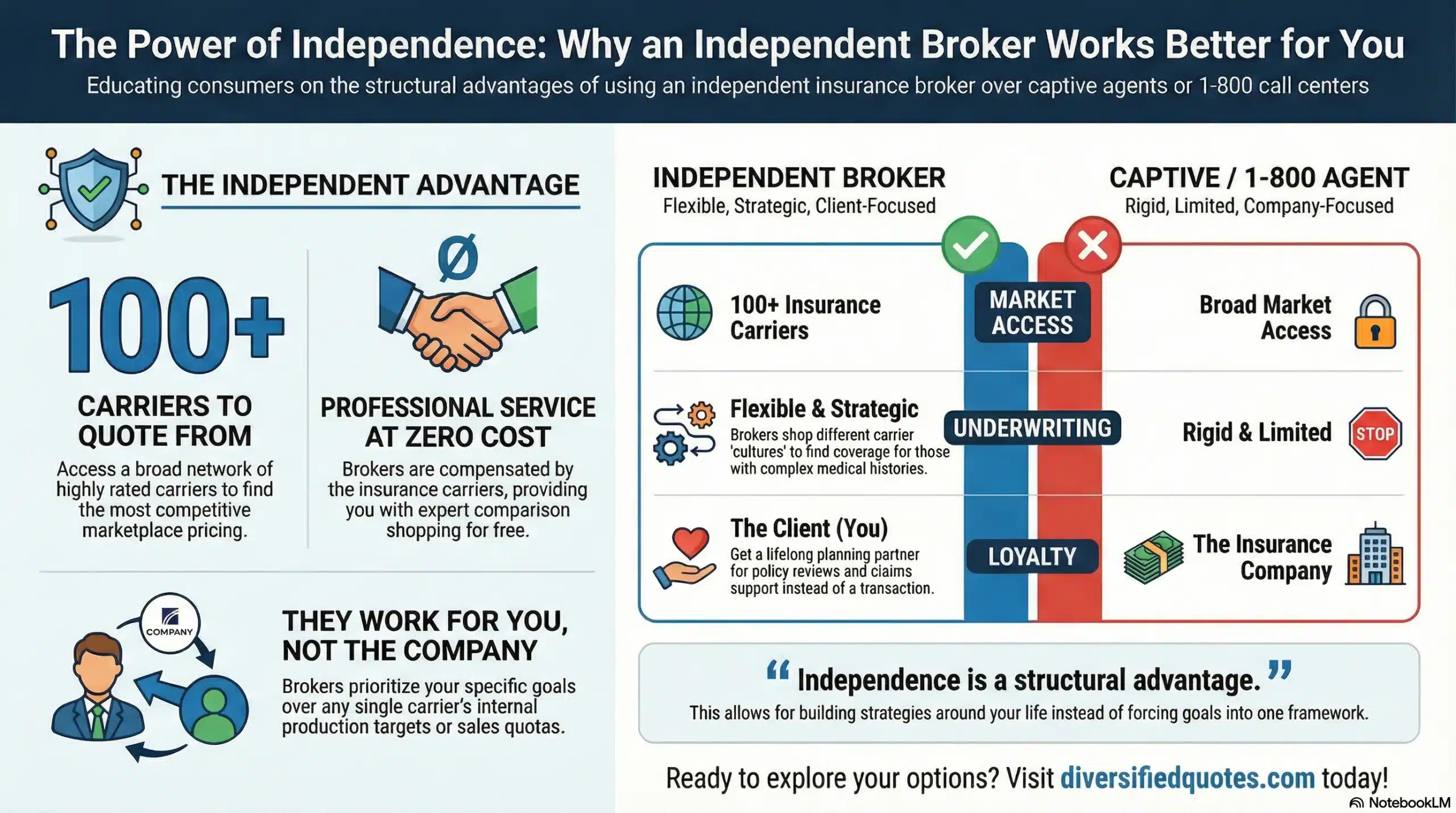
Most skydivers don’t need a special policy—they need a carrier that prices their avocation appropriately, and an application that tells the story clearly. At Diversified Insurance Brokers, we work nationally, we compare underwriting across a wide carrier network, and we focus on helping clients avoid the most common mistake: applying through a channel that can’t shop the market and doesn’t know which carriers overprice skydiving risk.
Our approach is underwriting-first. We look at the likely rate class based on your health, then we evaluate how your skydiving activity is likely to be priced by different carriers. If one carrier tends to apply a heavy flat extra for profiles like yours, we don’t waste time there. If another carrier has a history of evaluating recreational skydiving more favorably when documentation is strong, we prioritize that route. This is the same strategy we use for other risk profiles where generic quoting tools are misleading: matching your situation to the right underwriting appetite.
If you want a broader view of why the independent approach matters, this resource is a good read: How to Choose the Best Independent Insurance Agent. When the underwriting outcome can vary significantly by carrier, working with an independent advisor becomes less about convenience and more about getting a fair decision.
Example Case
A 35-year-old recreational skydiver averaging roughly 20 to 30 jumps per year was initially declined by a direct-to-consumer carrier that applied conservative adventure-sports guidelines and interpreted the activity as higher exposure than it actually was. By documenting his experience, keeping the jump profile clear and consistent, and placing the application with a carrier that evaluates recreational skydiving more precisely, we secured a $250,000 20-year term policy with only a modest flat extra. The result was meaningful coverage at a cost that reflected the true profile instead of broad assumptions.
Take the next step: Complete our secure skydiving life insurance request form and we’ll shop the market for your best options based on your jump profile and overall health. If you participate in other avocations as well, we can coordinate the underwriting approach so your file is consistent and carrier selection is aligned across the full risk picture.
Related Life Insurance Pages
If you’re comparing underwriting rules for avocations, these next pages can help you understand how carriers price activity risk.
Compare Term Life Insurance Lengths
Explore different term periods to find coverage that best matches your timeline and budget.
Talk With an Advisor Today
Choose how you’d like to connect—call or message us, then book a time that works for you.
Schedule here:
calendly.com/jason-dibcompanies/diversified-quotes
Licensed in all 50 states • Fiduciary, family-owned since 1980
Can I get life insurance if I skydive?
Yes. Many insurers will cover active skydivers. The final premium depends on jump frequency, type of jumps, training history, safety record, and overall health.
How does skydiving affect life insurance premiums?
Insurers often apply either a table rating or a flat extra for skydiving, especially for frequent jumpers or advanced jump types. Occasional recreational jumpers may receive more favorable outcomes.
Do certifications and training improve underwriting results?
Yes. Licensed jumpers with documented training, consistent safety practices, and a strong history often receive better underwriting consideration.
Which types of jumps are considered the highest risk?
Wingsuit flying and BASE jumping are typically viewed as higher risk than standard tandem or solo jumps at regulated drop zones.
What if I was declined before because of skydiving?
A prior decline does not automatically mean you cannot get coverage. Different insurers evaluate skydiving differently, and better documentation can improve outcomes.
About the Author:
Jason Stolz, CLTC, CRPC and Chief Underwriter at Diversified Insurance Brokers (NPN 20471358), is a senior insurance and retirement professional with more than two decades of real-world experience helping individuals, families, and business owners protect their income, assets, and long-term financial stability. As a long-time partner of the nationally licensed independent agency Diversified Insurance Brokers, Jason provides trusted guidance across multiple specialties—including fixed and indexed annuities, long-term care planning, personal and business disability insurance, life insurance solutions, Group Health, and short-term health coverage. Diversified Insurance Brokers maintains active contracts with over 100 highly rated insurance carriers, ensuring clients have access to a broad and competitive marketplace.
His practical, education-first approach has earned recognition in publications such as VoyageATL, highlighting his commitment to financial clarity and client-focused planning. Drawing on deep product knowledge and years of hands-on field experience, Jason helps clients evaluate carriers, compare strategies, and build retirement and protection plans that are both secure and cost-efficient. Visitors who want to explore current annuity rates and compare options across multiple insurers can also use this annuity quote and comparison tool.
