
Long Term Care Insurance for Couples

Jason Stolz CLTC, CRPC
For married couples and long-term partners, planning ahead for extended care is one of the most important “two-person” decisions you can make in retirement. Long term care insurance for couples is not just about covering the cost of care. It’s about protecting the household’s income, preserving retirement savings for the healthy spouse, and preventing a care event from turning into a financial crisis that forces rushed choices.
At Diversified Insurance Brokers, we help families compare long term care insurance designs built specifically for couples—including shared benefit pools, spousal discounts, and flexible coverage structures that can adapt as care needs change. Many couples want the same outcome: a plan that can support care at home first, then assisted living or facility care if needed, without draining assets or turning adult children into default caregivers.
One reason couples benefit from planning earlier is simple: long-term care risk is rarely “even.” One spouse may need help for a short period after a surgery, while the other could require years of cognitive supervision later in life. A coordinated plan reduces the odds that one person’s care expenses will jeopardize the other person’s standard of living.
Compare Long Term Care Insurance for Couples
We’ll help you evaluate shared benefits, spousal discounts, inflation options, and hybrid designs—matched to both partners’ goals.
Why Couples Need Long Term Care Coverage
Couples often assume long-term care is a “single-person problem,” but it’s usually a household problem. The financial impact doesn’t only come from the care bill itself. It can include reduced household income if the healthy spouse stops working to provide care, higher ongoing living expenses (housing, transportation, specialized food, home modifications), and the emotional cost of managing care decisions under pressure.
When one partner needs care, the other partner often becomes the coordinator—managing providers, schedules, prescriptions, and paperwork. If the care need becomes extended, couples can face hard trade-offs: paying for professional help versus relying on family, moving versus modifying the home, or drawing down retirement accounts faster than planned. A well-designed couple’s LTC plan provides cash flow or reimbursement support that can make those decisions far less disruptive.
Another overlooked point: long-term care risk is not only about “nursing homes.” Many couples prefer to receive care at home as long as possible. That’s often realistic early in the care journey, but it can become expensive quickly if supervision or hands-on assistance is needed for many hours per day. Planning for home care is one of the main reasons couples explore coverage in the first place.
If you want a broader overview of what long-term care insurance is designed to do, start here: Long-Term Care Insurance.
The “Caregiver Spouse” Risk Most Couples Miss
Even financially stable households can be vulnerable if one spouse becomes the primary caregiver. Caregiving can reduce the healthy spouse’s ability to manage their own health, maintain social routines, and continue income-producing work. It can also increase the likelihood that the caregiver spouse experiences burnout, injury, or a decline in health that creates a second care need.
This is why couples planning has a different goal than individual planning. It’s not only “Can we pay for care?” It’s “Can we pay for care while preserving the independence and financial stability of the spouse who is not receiving care?” Shared benefits and coordinated policy design can help accomplish that goal by creating flexibility if one spouse needs significantly more support than the other.
Couples also tend to make decisions together about where care should happen. Some spouses want a plan that strongly favors home care, while others want the option to transition into assisted living if the home environment becomes unsafe. The best LTC design for a couple often reflects these preferences explicitly rather than assuming both partners want the same care path.
How Long Term Care Insurance for Couples Typically Works
Most couples do not buy “one policy that covers two people.” Instead, couples typically apply for two coordinated policies (one for each spouse) with couple-friendly pricing and optional riders that connect the benefits. This is where the major planning advantage can appear: coordinated coverage can be more cost-efficient and more flexible than two separate policies designed in isolation.
Depending on carrier and design, couple-friendly structures may include a spousal discount for applying at the same time, shared benefit pool riders that allow one spouse to access more than their original benefit period, and built-in features that help keep coverage in place if one spouse experiences premium stress later.
Couples policies can be designed around a central objective: protect the retirement plan for both spouses. That means aligning daily or monthly benefit amounts, elimination periods, and inflation protection so the plan can realistically support the setting where you prefer to receive care.
Key Features Couples Should Prioritize
Every couple’s situation is different, but the same core design levers show up repeatedly when we compare options. The goal is not to “max out everything.” The goal is to select the features that produce the best real-world outcome when care is needed.
Shared benefits (shared care riders)
A shared care structure allows benefits to be pooled between spouses. In simple terms, it can let one spouse use more than their original benefit period if they have a longer care event. This can be valuable because the care risk is uneven—one spouse may use little to none, and the other may use more. Sharing creates flexibility without requiring both policies to be “oversized.”
If you want a deeper explanation of shared structures, this page is a helpful companion: Long-Term Care Insurance with Shared Benefits.
Spousal discounts
Many carriers offer meaningful discounts when both spouses apply together. The exact discount varies by carrier and state, but the general idea is consistent: coordinated enrollment can improve pricing. Even if you don’t select shared benefits, applying as a couple can still lower premiums.
Elimination period (waiting period)
The elimination period is essentially the “deductible” measured in days of care rather than dollars. A longer elimination period often reduces premium but requires more self-funding early in a claim. Couples frequently choose an elimination period that the household could absorb through cash flow or savings without destabilizing the retirement plan. The ideal period depends on liquidity, risk tolerance, and how quickly you expect to use professional care.
Inflation protection
Inflation protection is one of the most important decisions for couples because care costs can rise substantially over time. Couples planning is often long-horizon planning. Even if you think “We probably won’t need care for 10 or 15 years,” that is exactly when inflation features matter most. The best approach depends on age, budget, and the benefit amount you are starting with.
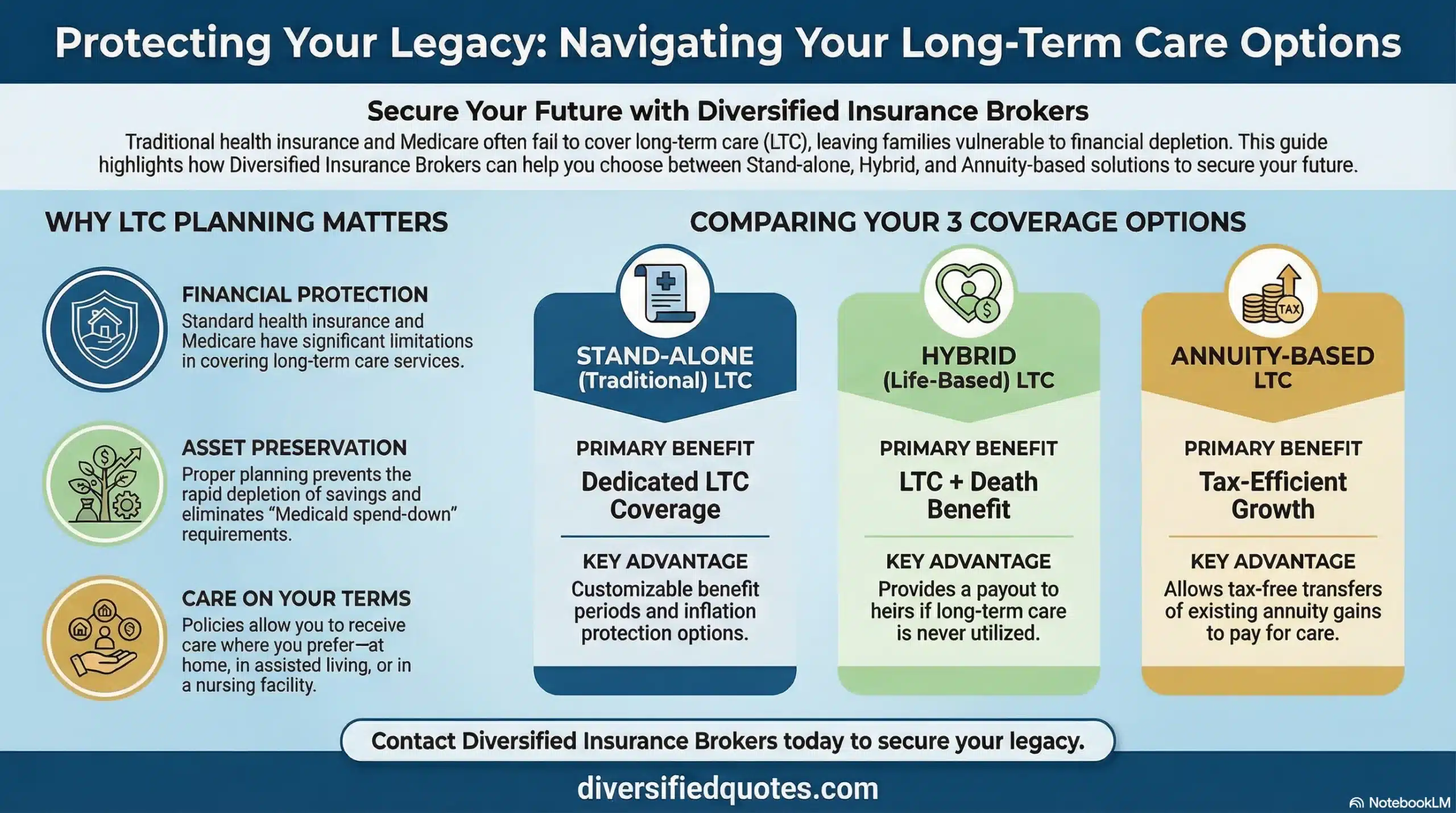
Hybrid options (life or annuity + LTC)
Some couples prefer a hybrid structure because it can preserve value if long-term care is never needed. Instead of paying ongoing premiums into a stand-alone policy, hybrid designs often reposition assets into a policy structure that can be used for care or paid to beneficiaries if care is never required. The tradeoffs usually involve larger upfront funding or different liquidity rules, so the fit depends on your balance sheet and priorities.
If you want to explore the tax and planning lens for hybrid designs, start here: Tax Advantages of Long-Term Care Insurance and Hybrid Policies.
Planning for the Care Settings Couples Actually Use
Couples planning is most effective when you design around how care is likely to unfold, rather than assuming “a nursing home stay” is the only outcome. Many care journeys start with small supports: help with bathing, dressing, meal preparation, transportation, and medication management. Over time, needs may increase—especially if cognitive impairment enters the picture.
Long-term care insurance is often triggered by loss of independence with Activities of Daily Living (ADLs) or cognitive impairment. ADLs are the most common functional measure carriers use. If you want clarity on how ADLs work and why they matter, this breakdown is useful: Activities of Daily Living.
One reason couples like shared benefits is that the care path can differ dramatically between spouses. One spouse could need brief home care after a surgery, while the other could experience years of supervision needs due to memory decline later. A shared structure can help the plan “bend” with reality rather than forcing you into two identical benefit periods that may not match how care actually occurs.
Why Medicare Doesn’t Solve the Long-Term Care Problem for Couples
Many couples assume Medicare will cover extended care needs. In reality, Medicare coverage is typically limited and focused on short-term skilled needs, not ongoing custodial care. This is one of the reasons long-term care planning matters: the largest and most common long-duration expenses are often not covered the way people expect.
If you want the details, this page explains the difference in plain language: Does Medicare Cover Long-Term Care?. Understanding this gap is often the “aha” moment for couples—because it clarifies why self-funding alone can become risky, especially if one spouse needs care for multiple years.
Couples also need to consider timing. A care event that occurs shortly after retirement can be especially disruptive because the household is still adjusting to a new income structure. Many couples build LTC planning as one layer of retirement protection, alongside other predictable-income tools and conservative allocations, so a care event doesn’t force major portfolio withdrawals at the wrong time.
The Real Cost of Care for Couples (And Why Duration Matters)
The most important cost variable is rarely the monthly rate. It’s the duration. A moderate care cost for a short period can be manageable. A similar monthly cost for several years can reshape the entire retirement trajectory, especially if it impacts the healthy spouse’s ability to work or manage finances.
Even when only one spouse needs care, the household may still carry two sets of living expenses: the cost of the home plus the cost of care. This is another reason couples planning is unique. You are not replacing one expense with another; you are often adding a major expense while still paying normal household bills.
If you are comparing “insure versus self-fund,” this page frames the decision well: Self-Insured Long-Term Care. Some couples choose to cover the first layer of risk with insurance (home care or the first couple years) and use savings for the rest. Others prefer stronger leverage. The right approach depends on assets, income stability, and how strongly you want to protect the spouse’s lifestyle.
Sample cost ranges (illustrative)
| Type of Care | Why It Matters for Couples |
|---|---|
| Home care (part-time to extended hours) | Often the first stage of care. Costs can rise quickly as supervision needs increase, especially with cognitive impairment. |
| Assisted living / memory care support | Can reduce caregiver burden on the spouse, but the household may still carry home expenses at the same time. |
| Skilled nursing / facility-based care | High-cost scenarios can create the “two-household budget” effect: regular living expenses plus facility care bills. |
Because these costs vary by state and care intensity, the more valuable planning step is modeling how long your savings could support the household if a care event lasts 2 years, 4 years, or longer. Couples coverage is meant to reduce the probability that a long-duration event forces the healthy spouse into a financial reset.
How Couples Design Coverage That Feels “Right” in the Real World
The best couple-focused LTC plan usually begins with a few practical questions. First: where do you want care to happen—at home, in assisted living, or wherever is safest at the time? Second: how much of the cost do you want insurance to cover? Third: how much premium feels comfortable for the household long-term?
Once those are clear, we align benefits around the household’s real objectives. Many couples do not need the policy to pay 100% of every possible cost. They want it to cover the “break the budget” portion—the layer that would force major investment liquidation or cause the healthy spouse to compromise their lifestyle.
For example, a couple might choose a benefit designed to cover meaningful home care and assisted living support, with an elimination period they can self-fund. Another couple might emphasize facility care. Another might choose a hybrid structure because preserving a legacy value matters and they prefer repositioning assets rather than paying open-ended premiums.
The point is not to chase a generic “best policy.” The point is to build a plan that matches the couple’s actual risk, priorities, and retirement cash flow.
When Couples Consider Hybrid LTC Instead of Traditional LTC
Hybrid long-term care strategies are common in couple planning because they can address a psychological barrier: “What if we never use the policy?” With stand-alone LTC, premiums may be paid for years and benefits might never be triggered. With hybrid life/LTC or annuity/LTC designs, there is often retained value in the form of a death benefit or remaining contract value if long-term care is not needed.
Hybrids are not automatically “better.” They are different. The tradeoffs often involve funding requirements, liquidity rules, and how benefit pools are calculated. But for couples who have assets set aside and want multi-purpose use, hybrid designs can be an efficient fit—especially when leaving something to heirs is a strong objective.
If you want a practical explanation of hybrid structures and why they’re used, this overview is useful: Understanding Hybrid Long-Term Care Insurance.
Why Work With Diversified Insurance Brokers?
Couples planning works best when you compare real options side-by-side, because carriers and designs vary more than most people expect. Since 1980, Diversified Insurance Brokers has specialized in helping couples and families evaluate long-term care solutions with clear tradeoff discussions, not one-size-fits-all recommendations.
We help couples compare traditional LTC policies, shared benefits and spousal discount designs, and hybrid strategies that combine long-term care with life insurance or annuities. We also help you align long-term care planning with broader retirement goals so you can make decisions confidently instead of reacting during a crisis.
If you’re building the “full picture,” these hubs can also be helpful: Long Term Care Insurance and Annuities.
Protect Your Future Together
Compare couple-friendly LTC policies and hybrid options to help safeguard retirement savings and reduce caregiver pressure.
Talk With an Advisor Today
Choose how you’d like to connect—call or message us, then book a time that works for you.
Schedule here:
calendly.com/jason-dibcompanies/diversified-quotes
Licensed in all 50 states • Fiduciary, family-owned since 1980
FAQs: Long Term Care Insurance for Couples
What is couples long-term care insurance?
Most couples are approved as two coordinated policies (one per spouse) with couple-friendly pricing and optional riders. The “couples” benefit comes from spousal discounts, coordinated design choices, and options like shared benefits that can increase flexibility if one spouse needs more care than the other.
What are shared benefits and why do couples like them?
Shared benefits allow spouses to access a combined pool of benefits rather than being locked into two rigid, separate benefit periods. If one spouse has a longer care event, shared benefits can help the plan adapt—especially when the other spouse uses little or none of their coverage.
Do we both need long-term care coverage?
Most couples choose to cover both spouses because the financial risk is household-based. Even if only one spouse needs care, costs can affect the healthy spouse’s lifestyle, retirement income, and long-term financial security. Coordinated coverage helps protect the entire plan.
How do spousal discounts work?
Many carriers offer discounted premiums when both spouses apply together. The discount varies by carrier and state, but the structure is common. Applying together can also simplify planning because benefit designs can be matched to household goals.
What customization options matter most for couples?
Couples typically focus on benefit amount (daily/monthly), elimination period, inflation protection, and whether to use shared benefits. The best design depends on where you prefer to receive care (home vs facility), your liquidity, and how strongly you want to protect the healthy spouse’s lifestyle.
What are hybrid long-term care options for couples?
Hybrid options combine long-term care benefits with life insurance or an annuity-based structure. Many couples consider hybrids because the plan can preserve value if long-term care is never needed, while still providing a dedicated pool of benefits for qualifying care.
Can a shared benefit pool be used up faster if both spouses need care?
Yes. Shared benefits create flexibility, but if both spouses need care at the same time or within a short window, a shared pool could be consumed faster than two fully separate “maxed-out” plans. This is why plan sizing matters and why we model more than one scenario.
How can couples reduce long-term care insurance cost?
Common levers include applying together for spousal discounts, selecting an elimination period the household can comfortably self-fund, choosing an inflation option that matches timeline and budget, and comparing traditional versus hybrid designs based on asset structure and goals.
How do we get started as a couple?
Start by clarifying goals: where you want care to happen, how much of the cost you want insurance to cover, and what premium level feels comfortable long-term. Then compare multiple carriers and structures. You can begin here: Request a quote.
About the Author:
Jason Stolz, CLTC, CRPC and Chief Underwriter at Diversified Insurance Brokers (NPN 20471358), is a senior insurance and retirement professional with more than two decades of real-world experience helping individuals, families, and business owners protect their income, assets, and long-term financial stability. As a long-time partner of the nationally licensed independent agency Diversified Insurance Brokers, Jason provides trusted guidance across multiple specialties—including fixed and indexed annuities, long-term care planning, personal and business disability insurance, life insurance solutions, Group Health, and short-term health coverage. Diversified Insurance Brokers maintains active contracts with over 100 highly rated insurance carriers, ensuring clients have access to a broad and competitive marketplace.
His practical, education-first approach has earned recognition in publications such as VoyageATL, highlighting his commitment to financial clarity and client-focused planning. Drawing on deep product knowledge and years of hands-on field experience, Jason helps clients evaluate carriers, compare strategies, and build retirement and protection plans that are both secure and cost-efficient. Visitors who want to explore current annuity rates and compare options across multiple insurers can also use this annuity quote and comparison tool.
