
Long Term Care Insurance with Lifetime Benefits

Jason Stolz CLTC, CRPC
Long Term Care Insurance with Lifetime Benefits is designed for one specific fear that many retirees and pre-retirees don’t say out loud until they see real numbers: “What if care lasts longer than we planned for?” Most long term care insurance policies place a time limit on benefits—often 2, 3, 5, or 6 years. That structure can be very effective for many families because a large portion of care events fall within a defined window. But some care situations don’t end in a tidy timeframe. A progressive cognitive condition, a long course of Parkinson’s, complications after a stroke, or a slow functional decline can stretch care needs well beyond a typical benefit period.
That is where lifetime benefit designs come in. Instead of solving for “most likely” duration only, they solve for “worst reasonable case.” They are built to keep paying as long as you remain eligible for benefits under the policy’s trigger definitions and claim requirements. For households that want the strongest possible backstop against extended care costs, lifetime benefit coverage can feel like the difference between hoping for the best and having a defined plan for the long tail risk.
At Diversified Insurance Brokers, we help clients compare long term care insurance with limited-term benefits vs lifetime benefits so you can decide what level of protection is appropriate for your assets, your income plan, and your family situation. In many cases, the best choice isn’t “the biggest benefit.” It’s the benefit design that protects the right outcome—whether that is preserving a healthy spouse’s lifestyle, reducing the burden on adult children, or protecting retirement savings from being drained by a multi-year care event.
Compare Lifetime Benefit LTC Options
See how lifetime benefit designs compare to 3–6 year benefit periods—and what it means for your retirement plan.
Request Lifetime LTC QuotesWhat Are Lifetime Benefits?
A lifetime benefit rider (or lifetime benefit structure) means your long term care coverage is not constrained by a pre-set benefit period like “3 years” or “5 years.” Instead, once you qualify for benefits under the policy, the plan continues paying as long as you remain eligible and as long as benefits are payable under the policy’s rules.
In practical terms, it’s helpful to separate three ideas that are often confused:
1) Triggering eligibility (how you qualify for benefits), 2) payment structure (how benefits are calculated and paid), and 3) duration (how long benefits can continue). Lifetime benefits primarily address the third category: duration.
Eligibility is most commonly tied to needing help with Activities of Daily Living (ADLs) or having a qualifying cognitive impairment that requires substantial supervision. If you want a clear, plain-language breakdown of ADLs and why insurers use them, start here: What Are Activities of Daily Living?
Once eligibility is established and the policy’s elimination period is satisfied, a lifetime benefit design is meant to remove the “clock” that families worry about when the care situation lasts longer than expected. That doesn’t mean every policy behaves identically. The exact language matters—monthly benefit limits, inflation options, and how the carrier administers claims can all affect the real-world experience. But the purpose is consistent: ongoing coverage for ongoing need.
Why Lifetime Benefit Coverage Exists (The Risk Most Families Underestimate)
Most families plan for long term care using a mental model that looks like this: “If we ever need care, it will probably be a short rehab stay, or maybe a couple years at most.” Sometimes that’s true. But the scenarios that create the most damage to retirement plans are the ones that last the longest and arrive at the worst possible time—when one spouse is already gone, when the healthy spouse is older and more vulnerable, or when adult children are already stretched by work and their own households.
Extended care can show up in different forms. It can be a long home-care journey that gradually expands from part-time support to daily assistance. It can be a move to assisted living that eventually transitions to memory care. It can be a nursing facility stay that begins after a hospitalization but continues because the person never fully regains independence. The “long duration” risk doesn’t always appear dramatic at the beginning. It often grows slowly—meaning families may not realize they are in a high-duration scenario until years have already passed.
That is why benefit period matters. A 3–5 year benefit can be very strong protection for many events, but it can still leave a gap in the high-duration cases. Lifetime benefit coverage exists to address that gap.
If you’re evaluating options and want a head-to-head comparison of limited term vs lifetime benefit structures, this is the best starting point: Limited-Term Benefits vs Lifetime Benefits.
Benefits of Long Term Care Insurance with Lifetime Benefits
Lifetime benefit coverage is not “right for everyone,” but for the right household it can be the strongest form of long-term protection against extended care costs. The benefits below are why some clients choose lifetime designs even when premiums are higher.
Unlimited duration (the “coverage doesn’t end” advantage)
The most obvious benefit is the one that matters most: the policy is designed to keep paying as long as you remain eligible for benefits. That can be a major relief in scenarios where care lasts far longer than the average. It also reduces the pressure to “time” decisions around a benefit period clock.
Peace of mind for spouses and caregivers
Long term care is rarely just a financial issue. It becomes a scheduling issue, a family issue, and often a caregiver burnout issue. Knowing there is coverage that can continue helps families make better decisions—choosing care based on safety and outcomes rather than panic over whether benefits are about to run out.
Asset protection and income protection
Many retirees aren’t just trying to “cover care.” They are trying to protect the retirement plan that supports the healthy spouse’s lifestyle. A long care event can cause accelerated withdrawals, forced liquidation of investments, and a permanent decline in the healthy spouse’s standard of living. Lifetime benefit designs can help reduce the odds that a long-duration claim turns into a retirement plan collapse.
More appropriate for higher-duration risk profiles
Some households are simply more concerned about longer care duration. This could be due to family history of cognitive decline, a desire to protect a spouse who may outlive the other by many years, or a plan that relies heavily on maintaining stable retirement income. While no one can predict exactly how long care will last, lifetime benefit coverage is designed for families who want to protect against the long tail risk, not just the most likely scenario.
Who Should Consider Lifetime Benefit LTC Coverage?
Lifetime benefit designs are most often considered by households that care deeply about protecting a specific outcome over decades. That doesn’t always mean “the wealthiest families only.” It means families who have something meaningful to protect and who don’t want long-term care to rewrite their retirement plan.
Here are common “fit” profiles we see:
Households with significant retirement assets they want to protect. If you have built savings carefully over a lifetime, you may want the strongest long-term backstop against those assets being spent down by a prolonged care scenario.
Couples who want to protect the healthy spouse. Many plans are designed around the question: “If one spouse needs care for a long time, what happens to the other spouse’s lifestyle and housing stability?” Lifetime benefits can be a direct answer to that concern.
Families with higher concern about cognitive decline. Cognitive impairment often creates longer, more expensive care journeys, especially when memory care is involved. Lifetime benefit designs are sometimes chosen specifically as protection against a longer cognitive claim.
People who want fewer “moving parts” later. A limited benefit period can require families to shift strategies once benefits approach exhaustion. Lifetime benefits can reduce that complexity by keeping coverage available for the duration of need.
If you’re still figuring out how to frame the decision, we often start with benefit period comparisons and elimination period strategy. Elimination periods, in particular, can dramatically change cost. If you want that concept explained clearly, this companion page is helpful: LTC Elimination Periods Explained.
Not Sure if Lifetime Benefits Are Worth It?
We’ll show you the premium difference and what you actually gain—so you can decide confidently.
Request a Lifetime vs Limited ComparisonCost Considerations (And What Actually Drives Premiums)
Lifetime benefit designs usually come with higher premiums than a limited-term benefit period, because the insurer is taking on a longer payout risk. However, cost isn’t just about “lifetime vs 3 years.” The premium can swing significantly based on a handful of levers that you can control.
Benefit amount (monthly or daily benefit). The amount the policy can pay each month is one of the biggest drivers. A lifetime benefit plan with a moderate monthly benefit can sometimes be a stronger overall strategy than an extremely high monthly benefit with a short duration, depending on what you’re trying to protect.
Elimination period. A longer elimination period can reduce premium. Many families choose to self-fund the first part of care and use insurance for the longer duration risk. That is often a rational strategy when the household has assets or income that can absorb the early phase.
Inflation protection. Inflation is critical in long-term planning, but it also increases premium. Some clients prefer to prioritize lifetime duration first and then choose an inflation approach that fits budget. Others place inflation first and accept a limited duration. The “right” answer depends on age and how you expect care to show up (home care vs facility).
Health and age at application. The sooner someone applies—before functional issues begin—the more options are generally available. Late applications can be limited or may push families toward alternative structures.
If you want to explore broader LTC strategy design (beyond just lifetime benefits), our main overview page is a good resource: Long-Term Care Insurance.
It’s also important to note that “lifetime benefits” can be achieved in different ways depending on product chassis. Some are traditional LTC structures with lifetime benefit periods. Others are hybrid structures designed to provide extended benefits or benefit multipliers. The real question is not the label. The real question is what the plan does during a claim and how long meaningful benefits can continue.
Hybrid and Linked-Benefit Alternatives (Extended Coverage Without a Traditional Lifetime Rider)
Some families want protection against long duration care, but they also want the plan to preserve value if care is never needed. That is often where hybrid long-term care designs enter the conversation. Hybrids can be built on a life insurance chassis or an annuity chassis, and they may provide long-term care benefits through acceleration of value, benefit multipliers, or rider-based benefit pools.
Hybrid solutions are not automatically “better.” They are different tools. They can be attractive when someone dislikes the idea of paying premiums for years without any retained value. They can also be useful when someone wants a repositioning strategy rather than an ongoing premium strategy. But the structure matters: how benefits are triggered, how they are paid, and how long meaningful benefits can continue are the details that determine whether the plan actually solves the long-duration risk you’re trying to address.
If you want a clear explanation of hybrid LTC design fundamentals, this is the best companion page: Understanding Hybrid Long-Term Care Insurance.
We also see couples explore shared approaches where each spouse has coverage and the design supports a combined family protection strategy. If you’re planning as a couple, this page is often helpful: Long-Term Care Insurance for Couples.
A Simple Planning Framework (How Families Decide)
Lifetime benefit coverage decisions become easier when you decide what you are trying to protect. We typically use a planning framework that keeps the conversation grounded in outcomes rather than product features.
First, define the primary goal. Is the goal to protect the healthy spouse’s lifestyle? Preserve a home? Reduce reliance on adult children? Avoid a forced spend-down of retirement accounts? Or simply create more certainty around what a long care event would do to the plan?
Second, decide how much of the risk you want to transfer. Some families want to cover the majority of care costs. Others want the policy to absorb enough of the cost to prevent a financial emergency. Lifetime benefits are usually chosen by families who want to transfer a larger portion of the long-duration risk.
Third, design around the most likely care path for your household. Many care journeys start at home and evolve. If you want to understand how home care often fits into the long-term picture, this resource can help: What Are In-Home Care Services?
Fourth, choose the funding approach you can maintain. The most carefully designed plan fails if the funding structure is uncomfortable or unclear. That’s why we often model multiple scenarios—lifetime benefits with a longer elimination period, lifetime benefits with a moderate monthly benefit, or limited-term benefits with stronger inflation. Seeing the tradeoffs on paper typically makes the best choice obvious.
How Diversified Insurance Brokers Helps
Diversified Insurance Brokers is a family-owned, fiduciary agency licensed nationwide. Our advisors help households compare traditional long term care insurance, hybrid life/LTC designs, and annuity-based LTC strategies so the plan matches both the care risk and the retirement plan behind it.
When it comes to lifetime benefits, our job is not to “sell the biggest plan.” It’s to help you understand what you gain, what it costs, and whether that tradeoff makes sense for your family. Some clients choose lifetime benefit coverage because they want the strongest possible backstop. Others choose a limited-term structure that still provides strong protection at a more comfortable premium. Both can be smart decisions—when they are aligned to the outcome you actually care about.
If you want to move forward, we’ll help you compare benefit periods, inflation approaches, elimination periods, and funding methods—and we’ll keep the conversation centered on what the coverage should accomplish in real life.
Explore Lifetime Long Term Care Insurance Options
Protect against extended care costs with coverage designed to continue as long as care is needed.
Learn More About LTC Coverage Get a Quote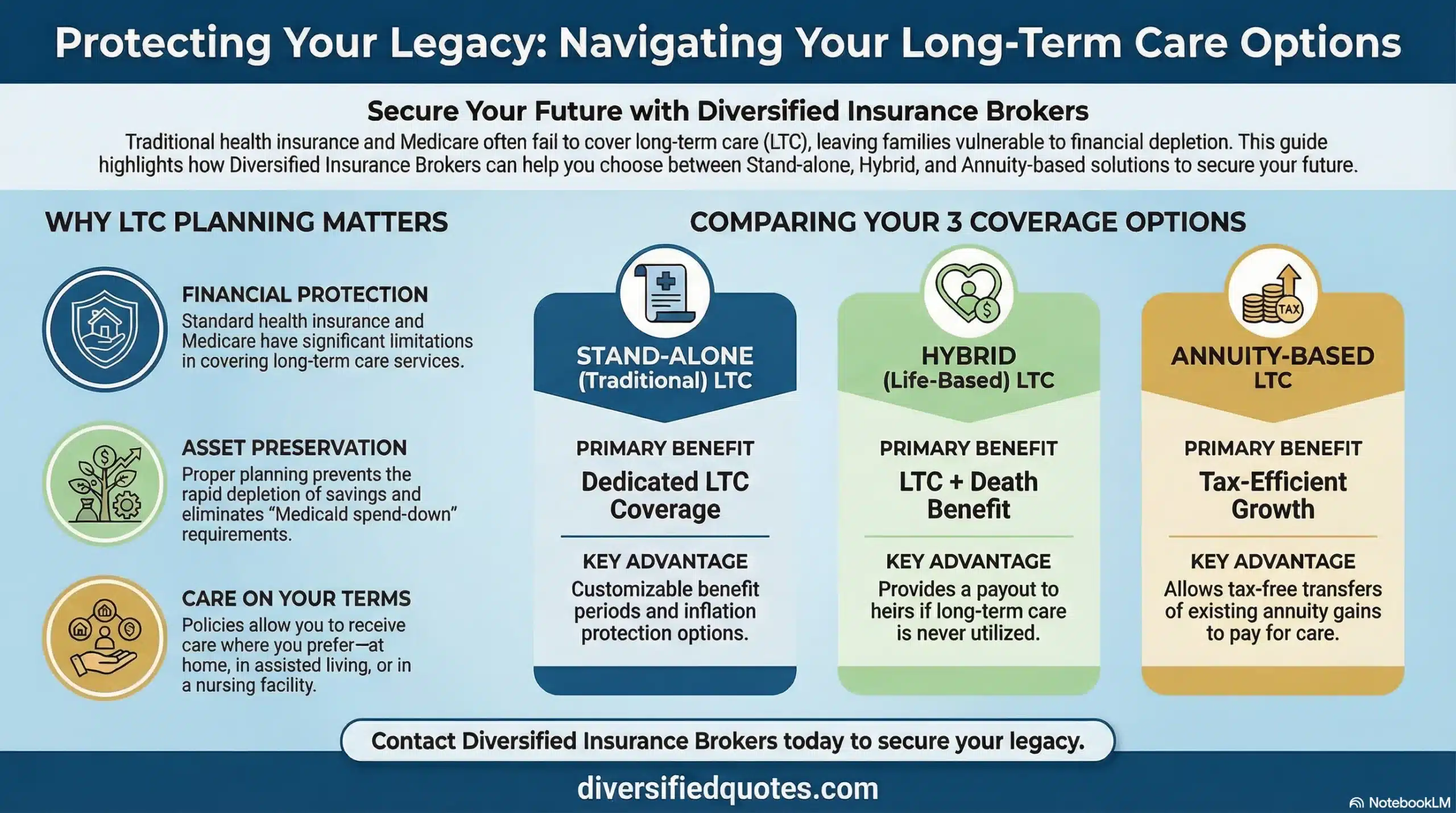
Talk With an Advisor Today
Choose how you’d like to connect—call or message us, then book a time that works for you.
Schedule here:
calendly.com/jason-dibcompanies/diversified-quotes
Licensed in all 50 states • Fiduciary, family-owned since 1980
FAQs: Long-Term Care Insurance with Lifetime Benefits
What does “lifetime benefits” mean in a long-term care policy?
“Lifetime benefits” generally means the policy is designed to continue paying eligible long-term care benefits as long as you remain benefit-eligible under the policy terms, rather than stopping after a set benefit period like 3 or 5 years.
How is this different from a standard LTC policy?
Most standard LTC policies limit benefits to a defined number of years. Lifetime benefit designs focus on removing the duration cap so coverage can continue in longer care scenarios.
Who should consider LTC coverage with lifetime benefits?
It’s often considered by people who want protection against long-duration care risk, couples focused on protecting the healthy spouse, and households that want the strongest backstop against a prolonged claim.
What are the trade-offs of lifetime benefit coverage?
Lifetime benefit designs typically cost more. Premium is influenced by benefit amount, elimination period, inflation approach, age at purchase, and health underwriting.
How do premiums compare to limited-duration LTC?
Premiums are usually higher for lifetime benefit designs because the insurer is assuming longer potential payout duration. The size of the monthly benefit and inflation features often drive the biggest differences.
Are there hybrid or linked-benefit options that help with extended duration risk?
Yes. Some hybrid life/LTC or annuity/LTC structures can provide extended benefit pools or benefit multipliers and may preserve value if care is never needed, depending on the design.
What policy details should I check before choosing lifetime benefits?
Key items include: elimination period, monthly benefit limits, how benefits inflate, how qualification is defined (ADLs or cognitive impairment), how claims are administered, and whether premiums are designed to be stable based on policy terms.
How does inflation protection interact with lifetime benefits?
Inflation protection can increase benefits over time to help keep pace with rising care costs. It also increases premium, so many families compare multiple combinations to find the best balance.
Will age or health status limit eligibility for lifetime benefit coverage?
Eligibility depends on the carrier and design. Age and health history can affect approval and pricing, and some options may narrow at older ages or when functional limitations are already present.
What happens if I never use the LTC benefits?
With traditional LTC, benefits may simply never be used. With some hybrid designs, value may remain as a death benefit or retained value, depending on the policy structure and terms.
About the Author:
Jason Stolz, CLTC, CRPC and Chief Underwriter at Diversified Insurance Brokers (NPN 20471358), is a senior insurance and retirement professional with more than two decades of real-world experience helping individuals, families, and business owners protect their income, assets, and long-term financial stability. As a long-time partner of the nationally licensed independent agency Diversified Insurance Brokers, Jason provides trusted guidance across multiple specialties—including fixed and indexed annuities, long-term care planning, personal and business disability insurance, life insurance solutions, Group Health, and short-term health coverage. Diversified Insurance Brokers maintains active contracts with over 100 highly rated insurance carriers, ensuring clients have access to a broad and competitive marketplace.
His practical, education-first approach has earned recognition in publications such as VoyageATL, highlighting his commitment to financial clarity and client-focused planning. Drawing on deep product knowledge and years of hands-on field experience, Jason helps clients evaluate carriers, compare strategies, and build retirement and protection plans that are both secure and cost-efficient. Visitors who want to explore current annuity rates and compare options across multiple insurers can also use this annuity quote and comparison tool.
