
Medicare Supplement Plan G vs Plan N

Medicare Supplement Plan G vs Plan N is one of the most common comparisons retirees make when deciding how to reduce out-of-pocket costs that Original Medicare does not cover. Both options are popular Medigap plans designed to help with deductibles, copays, and coinsurance. The right choice usually comes down to how often you use care, how much you value predictability, whether you want protection from certain “surprise billing” situations, and how you feel about paying a higher monthly premium versus occasional copays.
At Diversified Insurance Brokers, we help retirees compare Plan G and Plan N based on real-world considerations—your doctors, travel habits, prescription needs, budget style, and how likely you are to use specialists or outpatient services in the coming years. If you want a clean side-by-side that focuses on total value instead of marketing language, we can run quotes in your ZIP code and help you make a decision you’ll still feel good about a few years from now.
Compare Medicare Supplement Plan G and Plan N
See side-by-side quotes for Plan G and Plan N and match your Medigap plan to your doctors, travel needs, and budget.
Still working at 65? Timing matters. Review Medicare enrollment for people still working before you choose a start date.
How Medicare Supplement Plans Work
Original Medicare (Part A and Part B) provides essential hospital and medical coverage, but it also leaves you responsible for certain deductibles, copays, and coinsurance. Those “gaps” are the reason Medicare Supplement (Medigap) plans exist. Medigap is offered by private insurers and is designed to step in after Medicare pays its share, reducing what you owe out of pocket for Medicare-approved services.
The simplest way to think about Medigap is that it does not replace Medicare. You remain on Original Medicare as your primary coverage, and your Medigap plan provides additional financial protection. That structure is especially appealing for retirees who want broad provider access (any provider who accepts Medicare) and a more predictable experience when they see doctors, specialists, or hospitals.
Medigap plans are standardized by letter in most states, which means a Plan G from one company must provide the same core medical benefits as Plan G from another company. The differences are typically price, how the company prices increases over time, customer service, and any underwriting rules at the time you apply. That’s one reason independent comparison is useful—you’re not comparing “benefits” so much as comparing which carrier offers the best value for your situation in your state.
If you’re early in the learning process, it can help to step back and understand how all the parts fit together. Many retirees start with enrolling in Medicare at age 65, then decide between Original Medicare + Medigap (plus Part D) versus Medicare Advantage (Part C). If you’re still weighing those two paths, you may also want to review low-cost Medicare plans for retirees as part of the bigger “premium versus total annual cost” conversation.
Plan G and Plan N: What They Have in Common
Before we talk differences, it’s helpful to understand what Plan G and Plan N share. Both plans are designed to reduce your cost exposure under Original Medicare. Both allow you to use Original Medicare’s broad provider access (any provider who accepts Medicare). Both can dramatically reduce surprise bills compared to Original Medicare alone. And both are often chosen by retirees who value predictability and flexibility without the networks and plan rules that can come with managed-care designs.
Both Plan G and Plan N also share one important limitation: neither plan covers the annual Medicare Part B deductible. That deductible is typically the first out-of-pocket medical cost you pay each year under Part B before most cost-sharing protection begins. After the Part B deductible is satisfied, Plan G and Plan N differ in how they handle remaining costs.
What Medicare Supplement Plan G Covers
Plan G is widely considered the “high-coverage, low-friction” Medigap choice for people who are new to Medicare. After you pay the annual Part B deductible, Plan G generally pays nearly all remaining Medicare-approved cost-sharing for Part A and Part B services. In real life, that often means fewer bills and fewer decisions at the point of care—especially if you see specialists, have imaging, need outpatient procedures, or simply want the calmest budgeting experience.
Plan G commonly covers the Part A hospital deductible, Part A coinsurance, additional hospital days after Medicare benefits are used, skilled nursing facility coinsurance, hospice cost-sharing, and Part B coinsurance for doctor and outpatient services. One of the most meaningful differentiators for Plan G is that it generally covers Part B excess charges when they apply. Excess charges can occur if a provider does not accept Medicare assignment and bills more than the Medicare-approved amount (where permitted). Many retirees never encounter this issue, but those who do often wish they had understood it earlier—especially if they see certain specialists or travel and end up with a provider that bills differently.
For many households, Plan G’s biggest advantage is not a specific line item—it’s the overall experience. Once you handle the Part B deductible, your costs for Medicare-approved services often become very small and predictable. That predictability can be a major stress-reducer in retirement, when many people prefer stable budget categories rather than variable monthly medical spending.
What Medicare Supplement Plan N Covers
Plan N is also a strong Medigap plan, but it is designed to trade a bit of “maximum coverage” for a lower monthly premium. After you pay the Part B deductible, Plan N generally covers much of the remaining Part A and Part B cost-sharing, but it may require small copays for certain visits. Those copays are usually tied to office visits and emergency room visits that do not result in admission. For retirees who see doctors only occasionally, that tradeoff can be attractive: you keep solid protection while lowering monthly premium, and you pay modest amounts only when you actually use care.
There is one other important difference: Plan N generally does not cover Part B excess charges. That does not automatically mean Plan N is “risky.” Many doctors accept Medicare assignment, and many people never face excess charges. But if you want the broadest protection against that scenario—or you prefer not to worry about whether a particular provider might bill above the Medicare-approved amount—Plan G’s extra protection can feel worth the additional premium.
In practice, Plan N often fits retirees who are comfortable with a little variability, are generally healthy, and want to keep monthly premiums lower. Plan G often fits retirees who want a “set it and forget it” experience and are willing to pay more each month to reduce point-of-service costs and reduce potential billing friction.
Plan G vs Plan N: The Real Decision (Predictability vs Premium)
Most Plan G vs Plan N decisions can be reduced to one question: do you prefer to pay more each month to minimize bills when you receive care, or do you prefer to pay less each month and handle modest copays in exchange for that lower premium?
If you know you see doctors frequently, or you have multiple specialists, or you have ongoing outpatient care patterns, Plan G is often the easier plan to live with. You may also prefer Plan G if you want the greatest protection against billing variation, including excess charges where applicable. Retirees who worry about “surprise bills” often gravitate toward Plan G because it narrows what can surprise you.
If you rarely see doctors and you’re comfortable with modest copays when you do, Plan N can be a smart value. But the value depends on the spread between Plan G premiums and Plan N premiums in your ZIP code, at your age, and with the specific carrier you choose. That’s why we like to compare the two as an annual math exercise: premium difference across 12 months versus the likely number of visits you’ll have and whether excess charges are a meaningful risk in your provider ecosystem.
Side-by-Side Comparison (Clean View)
| Feature | Plan G | Plan N |
|---|---|---|
| Part A coinsurance & hospital costs | Covered | Covered |
| Part A deductible | Covered | Covered |
| Part B deductible | Not covered | Not covered |
| Part B coinsurance | Covered after deductible | Covered after deductible (copays may apply) |
| Office visit / ER copays | Typically none after deductible | Modest copays may apply |
| Part B excess charges | Covered (where allowed) | Not covered |
| Typical monthly premium | Higher | Lower |
Which Plan Is Right for You?
There is no one “best” plan for every retiree. The right plan is the one that matches how you actually use healthcare and how you prefer to budget. Some retirees care more about monthly affordability; others care more about minimizing bills at the time of service. Some want the broadest billing protection possible; others are comfortable confirming assignment and paying modest copays if needed.
Plan G may fit better if you want maximum predictability, you see doctors frequently, you visit specialists, you anticipate procedures or imaging, or you simply want the smoothest experience after the Part B deductible. Many retirees pick Plan G because it turns healthcare costs into a more stable monthly budget item and reduces the odds of receiving multiple small bills throughout the year.
Plan N may fit better if you are generally healthy, you have fewer visits per year, and you prefer to keep monthly premiums lower even if it means paying modest copays at certain visits. Plan N can also be a strong choice when the premium spread between G and N in your area is substantial—so your “savings” from choosing N comfortably covers the occasional copays and still leaves you ahead.
If you’re also comparing Medigap to Medicare Advantage, it helps to understand how those plans handle extras like dental and vision. You can review Medicare plans with dental and vision coverage to see typical arrangements and how those benefits factor into total value.
Other Factors That Matter More Than People Expect
1) Your doctors’ billing habits. Many providers accept Medicare assignment, which reduces the likelihood of excess charges. But if you see a specialist practice that does not accept assignment—or you travel and end up with a provider that bills differently—Plan G’s excess charge protection can matter. If you’re leaning Plan N, one of the best “risk reducers” is to confirm that your main doctors accept assignment and that your care is likely to stay in that ecosystem.
2) Your “budget style.” Some retirees strongly prefer a predictable monthly premium and minimal point-of-service bills. Others prefer to keep monthly expenses as low as possible and are comfortable paying small amounts when they use care. Neither preference is wrong—what matters is choosing the plan that fits how you want retirement to feel.
3) Your future flexibility. In many situations, switching Medigap plans later can involve medical underwriting (depending on your state rules and timing). That means your best opportunity to choose the plan you truly want is often at the beginning. If you’re unsure, we can help you weigh the “start with G for predictability” approach versus “start with N for premium savings” based on your health profile and your comfort with underwriting risk later.
4) Rate trends and company pricing philosophy. Even though benefits are standardized, companies price plans differently and may have different patterns of increases over time. The “best” carrier in one state may not be the best in another. Comparing multiple carriers is usually the easiest way to find a strong value that fits your situation.
5) Part D prescriptions still matter. Medigap does not include drug coverage. Even if you’re focused on G vs N, prescription planning remains a parallel decision. If you want help sequencing those choices, we can help you map out a simple approach so your Medigap selection and Part D selection work together without gaps.
Real-World Scenarios (How People Decide)
Scenario A: Frequent specialist use. A retiree sees a cardiologist and an endocrinologist several times per year, plus routine labs and imaging. In this case, Plan G often wins on peace-of-mind and predictability because the retiree is likely to use Part B services regularly. Paying a higher premium for fewer bills can be worth it.
Scenario B: Healthy, minimal visits. A retiree has routine annual checkups, maybe one or two specialist visits per year, and no planned procedures. Plan N can be a strong value if the premium difference between G and N is meaningful in the local market. The retiree saves monthly and pays small copays only when care is used.
Scenario C: Frequent traveler or snowbird. A retiree spends significant time across multiple states and wants broad provider access without thinking about networks. Both G and N can fit well because both keep Original Medicare as primary, but Plan G may be preferred if the retiree wants the broadest protection against provider billing variation and doesn’t want to worry about copays while moving around.
Scenario D: Tight budget but risk-averse. A retiree wants predictability but is also very sensitive to monthly cost. This is where we compare actual premium spreads and help the retiree decide whether Plan N’s savings are large enough to justify the tradeoffs. In some ZIP codes, the premium difference is small—making Plan G the easier choice. In others, the difference is large—making Plan N a practical, budget-friendly solution.
Use the Medicare Plan Comparison Tool (Plan G vs Plan N in Your Area)
Comparing Medigap premiums by hand can be time-consuming, especially because pricing varies by ZIP code, age, carrier, and household discount rules. You can use the tool below as a quick orientation to see options in your area. Then, if you want a clean “Plan G vs Plan N” short list, we can run side-by-side quotes from multiple carriers and confirm which plan lines up best with your doctors and budget style.
Need Help Deciding Between Plan G and Plan N?
Medicare is a core part of your retirement plan, and the wrong fit can quietly raise costs over time. The team at Diversified Insurance Brokers compares plans from multiple carriers, checks your doctors and prescriptions, and helps you decide whether Plan G, Plan N, or another strategy fits best.
Talk With a Medicare Specialist
Get one-on-one help comparing Plan G vs Plan N, Medicare Advantage, drug plans, and more—at no additional cost to you.
📞 Call us at 800-533-5969
Related Medicare Pages
Continue researching the Medicare decisions that most impact cost, timing, and flexibility.
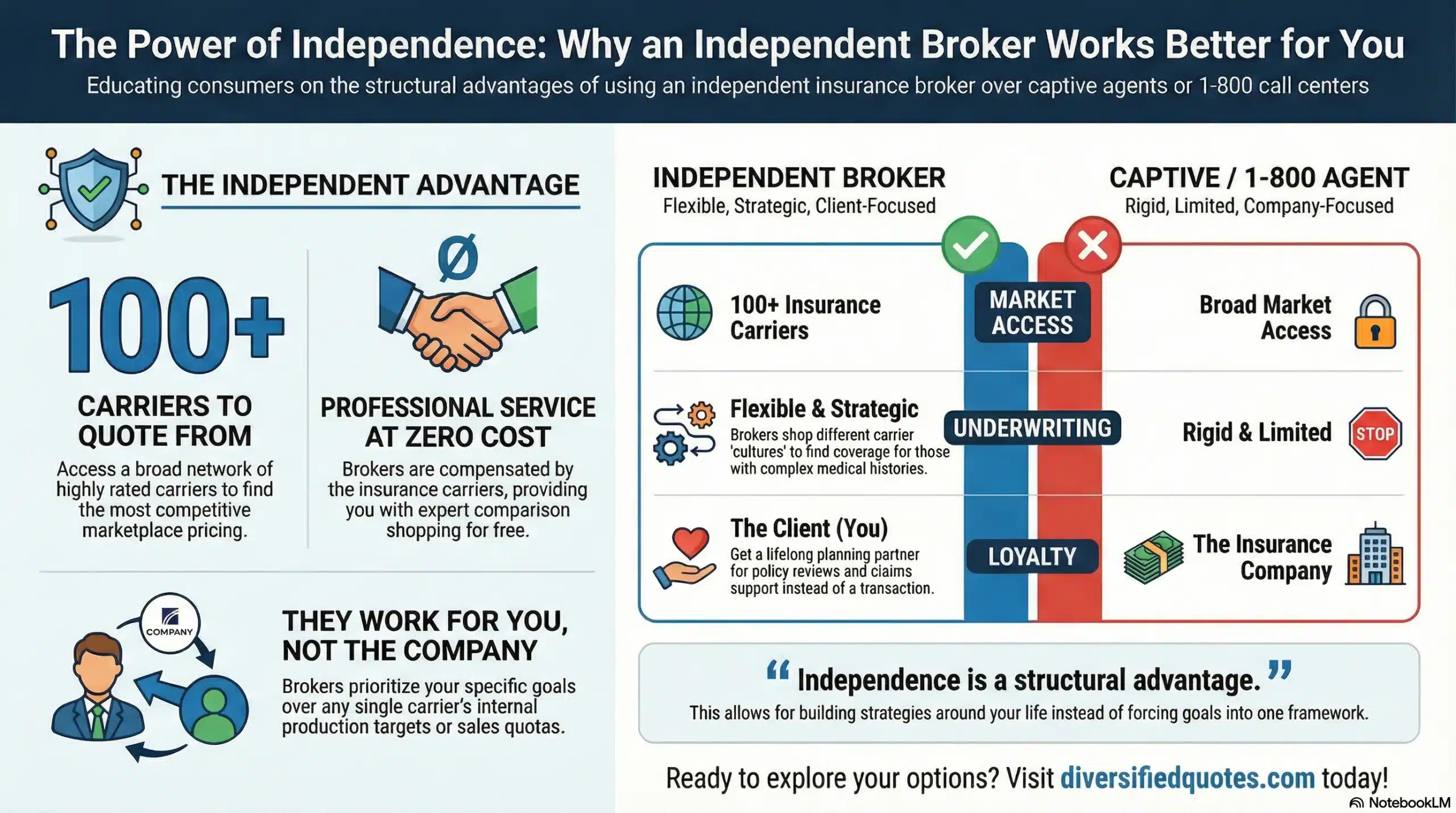
Compare Medicare Carriers
Book a free consultation with Tonia to review highly-rated Medicare Advantage plans and choose the best fit for your retirement.
FAQs: Medigap Plan G vs Plan N
What are the main differences between Plan G and Plan N?
Both Plan G and Plan N cover most of the gaps in Original Medicare. The big differences are that
Plan G covers Part B excess charges and does not have office or ER visit copays after the Part B
deductible, while Plan N usually has small copays for some visits and does not cover Part B excess
charges. Premiums for Plan N are typically lower.
Which plan usually has lower premiums?
Plan N generally has lower monthly premiums than Plan G because you share a bit more of the cost
through office and ER copays and by not having excess charge coverage. Plan G costs more each month
but provides broader protection.
What kinds of copays might I pay with Plan N?
Plan N can include modest copays for some doctor visits and for ER visits that do not result in a
hospital admission. Exact amounts and when they apply depend on how the carrier designs the plan and
how the claim is processed under Medicare rules.
Does either plan cover the Medicare Part B deductible?
No. Under current rules, neither Plan G nor Plan N covers the Medicare Part B deductible. You pay
that deductible out of pocket each year before Medigap benefits apply to Part B services.
What are Part B excess charges and why do they matter?
Some providers are allowed to bill up to a certain percentage above the Medicare-approved amount.
These additional amounts are called Part B excess charges. Plan G covers those extra charges where
they apply; Plan N does not. In many areas, most doctors accept Medicare assignment and never bill
excess charges, but it is still something to verify if you are considering Plan N.
Who is a good candidate for Plan G?
Plan G often works best for people who see doctors frequently, prefer predictable costs, or simply
want the highest level of Medigap protection available to new Medicare beneficiaries. It is also
appealing for retirees who travel and do not want to worry about potential excess charges.
Who is a good candidate for Plan N?
Plan N can be attractive for retirees who are relatively healthy, do not expect frequent visits, and
are comfortable with small copays in exchange for lower monthly premiums. It is especially appealing
when your main doctors accept Medicare assignment, so excess charges are less of a concern.
Can I switch from Plan N to Plan G later?
In many states, switching Medigap plans after your initial enrollment period requires health
underwriting. That means a change from Plan N to Plan G later may depend on your health at the time.
It is important to choose carefully now and to review state-specific rules with a licensed advisor.
How do I compare total costs between the two plans?
Look at the difference in annual premiums, then estimate how many doctor and ER visits you are likely
to have. Add expected copays and any potential excess charges to the Plan N total, and compare that
to Plan G’s higher premium but lower point-of-service costs. A licensed Medicare specialist can help
you run these comparisons for plans available in your ZIP code.
Can Plan G or Plan N be combined with a Part D drug plan?
Yes. Medigap plans like Plan G and Plan N pair with stand-alone Part D prescription drug plans.
You can choose the Part D plan that best matches your medications while your Medigap policy handles
your Medicare Part A and Part B cost gaps.
About the Author:
Tonia Pettitt, CMIP©, is a seasoned Medicare specialist with more than 40 years of hands-on experience guiding individuals and families through the complexities of Medicare planning. As a senior advisor with the nationally licensed independent agency Diversified Insurance Brokers, Tonia provides clear, dependable guidance across all areas of Medicare—including Medicare Advantage, Medicare Supplement (Medigap), and Part D prescription coverage. Leveraging active contracts with dozens of highly rated insurance carriers, she helps clients compare options objectively and secure the most suitable coverage for their health and budget.
Known for her patient, education-first approach, Tonia has built a reputation as a trusted resource for retirees seeking reliable, unbiased Medicare support. With four decades of experience across evolving Medicare laws, carrier changes, and plan structures, she brings unmatched insight to every client conversation—ensuring clients feel confident, protected, and fully prepared for each stage of their retirement healthcare journey.
