
Pension Replacement | Turn Savings Into Guaranteed Lifetime Income

Jason Stolz CLTC, CRPC
Pension replacement is no longer a technical planning concept reserved for Fortune 500 executives with frozen defined-benefit plans. It has become one of the most important structural decisions facing modern retirees. For decades, Americans retired with a predictable monthly pension check layered on top of Social Security. Today, that promise has largely disappeared in the private sector. What remains is a defined-contribution world—401(k)s, IRAs, rollover accounts—where responsibility shifts from employer to employee.
The question is no longer whether pensions are disappearing. The question is how to recreate one.
Pension replacement is the deliberate conversion of a portion of retirement assets into guaranteed lifetime income. It is the engineering process of transforming savings into a personal paycheck—one that continues regardless of stock market cycles, economic headlines, or geopolitical uncertainty. It restores predictability to retirement.
Compare Today’s Guaranteed Annuity Rates
Review competitive fixed and bonus annuity rates from highly rated insurance carriers.
View Current Fixed Annuity RatesExplore Bonus Annuity Options
The Disappearance of the Traditional Pension
In prior generations, retirement planning was structured around what financial professionals called the “three-legged stool.” Social Security formed one leg. Employer pensions formed the second. Personal savings filled the third. The strength of retirement security came from balance. If one leg weakened, the others compensated.
Today, most retirees stand on two legs—sometimes one and a half. Social Security remains, though its future adjustments are often debated. Personal savings exist, but they are subject to market fluctuation and behavioral risk. The pension leg, however, is frequently absent.
Without a pension, retirees assume risks that previous generations never fully faced: longevity risk (outliving savings), sequence-of-returns risk (market downturns early in retirement), withdrawal risk, and emotional risk. Pension replacement addresses these vulnerabilities directly.
What Pension Replacement Really Means
At its core, pension replacement is not about buying a product. It is about building an income floor. The objective is to ensure that essential living expenses—housing, utilities, groceries, healthcare premiums, property taxes, insurance—are covered by guaranteed income streams. Social Security forms the base. Structured annuity income fills the gap.
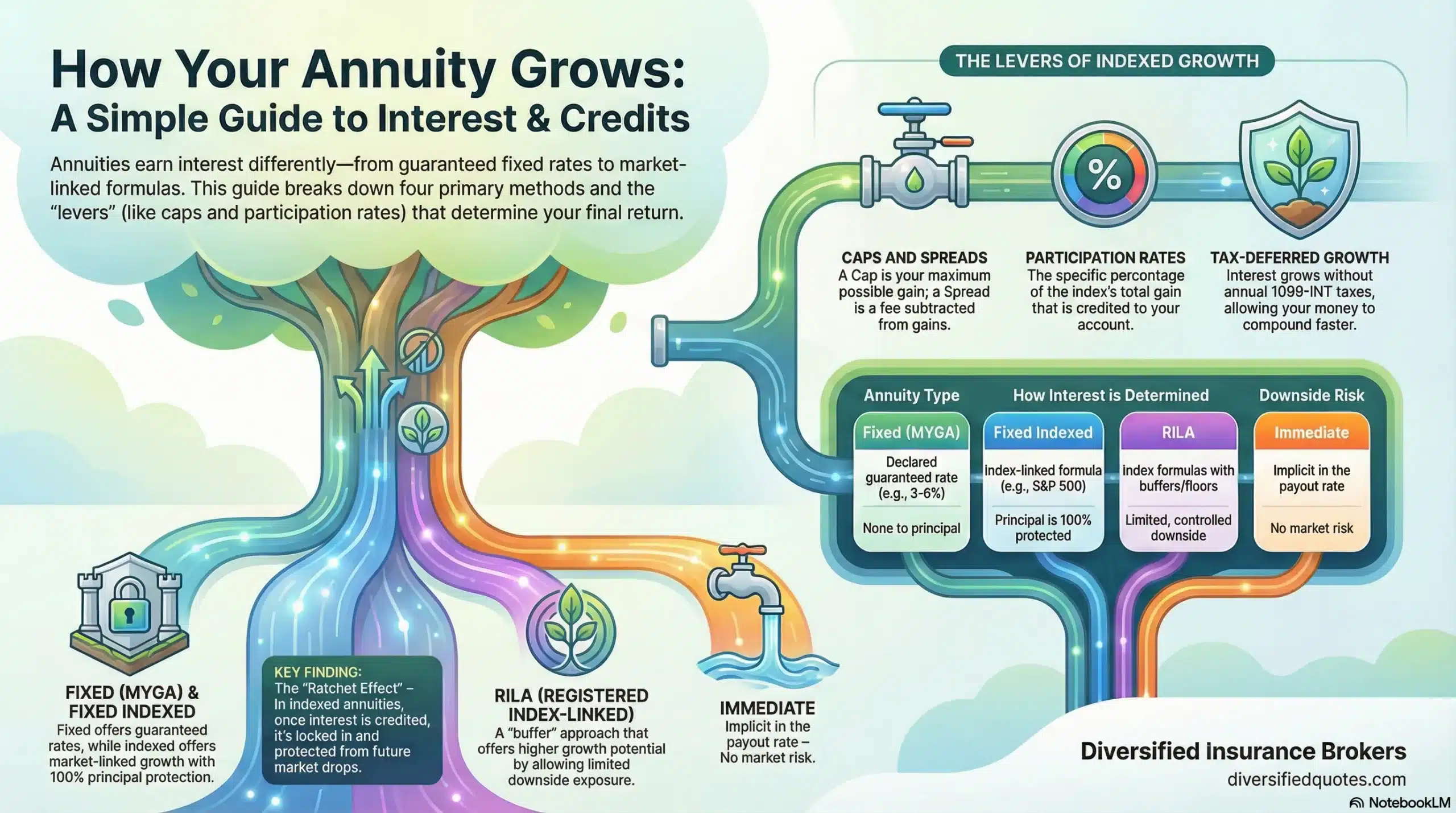
Instead of relying entirely on systematic withdrawals from volatile accounts, retirees convert a portion of assets into contracts designed to pay for life. These may include multi-year guaranteed annuities, income annuities, or indexed annuities with lifetime income riders.
For those unfamiliar with fixed annuity structures, reviewing how guarantees are built into contracts can be helpful. You can compare competitive rate environments directly on our current annuity rates page, where fixed yields are updated regularly.
The Mechanics Behind the Strategy
There are several structural pathways to recreate a pension.
A retiree may allocate funds to a multi-year guaranteed annuity (MYGA), locking in a competitive fixed interest rate for a defined term. At maturity, that accumulated value can be converted into lifetime income. Those who want to understand how fixed indexed structures behave during volatility can explore what happens to indexed annuities when markets decline.
Some individuals prefer to activate income immediately upon retirement. Others stage income in layers—using guaranteed growth vehicles first, then triggering income when needed. Understanding principal protection features often clarifies which structure fits best.
The strategy does not eliminate growth investing. Instead, it separates assets into two categories: protected income capital and growth-oriented capital. The former builds security. The latter maintains flexibility and potential appreciation.
The Role of Interest Rates
Interest rates influence payout levels. When rates rise, fixed annuity yields and income payouts generally improve. Locking in competitive environments can significantly enhance lifetime cash flow.
Bonus annuities, for example, may provide upfront premium credits or enhanced income bases under certain conditions. Reviewing current bonus annuity programs can illustrate how starting values differ between carriers.
Rates fluctuate by age, gender, state, and insurer. Side-by-side comparisons ensure income potential is maximized rather than assumed.
Using the Pension Replacement Calculator
Clarity begins with numbers. Before allocating capital, retirees should model income potential based on real carrier pricing.
Pension Replacement Income Calculator
Estimate lifetime income using live insurer data.
This calculator reflects current insurer pricing—not theoretical assumptions. Adjust allocation amounts, ages, and structures to see how income changes. The goal is not to annuitize everything, but to identify how much capital is required to secure essential expenses.
How Much Should Be Converted?
Most retirees do not convert all savings. Instead, they calculate essential monthly needs, subtract Social Security, and allocate enough capital to close the gap. Remaining funds stay invested for growth, liquidity, or legacy objectives.
This balanced approach protects core income while maintaining opportunity. It also reduces emotional decision-making during market downturns.
Tax Efficiency and RMD Coordination
Qualified retirement funds must follow required minimum distribution rules. Coordinating pension replacement with distribution timing ensures compliance while stabilizing cash flow. Those navigating retirement account transitions may also benefit from reviewing how other income-generating financial products distribute earnings, as income taxation varies across structures.
Longevity Risk and Joint-Life Planning
Married couples face extended longevity horizons. Pension replacement strategies often incorporate joint-life income structures to ensure surviving spouses maintain stability. Income does not cease upon the first death, preserving household security.
Psychological Stability
Numbers matter, but behavior matters more. Retirees with guaranteed income streams often experience reduced anxiety during volatility. Market downturns do not affect fixed monthly deposits. That psychological buffer prevents panic-driven liquidation of growth assets.
Who Benefits Most from Pension Replacement?
Pre-retirees within five years of retirement frequently benefit from staged implementation. Those already retired but uncomfortable with withdrawal risk also find value. Business owners who sold enterprises, professionals rolling over large 401(k)s, and individuals seeking conservative restructuring often adopt this strategy.
Even those evaluating insurance carriers may review comparisons such as carrier financial strength insights to understand claims-paying capacity before committing funds.
Liquidity Considerations
Not all annuities eliminate access. Many contracts provide annual free-withdrawal provisions. Understanding surrender schedules and withdrawal allowances ensures informed decisions. For deeper structural comparisons, reviewing how fixed indexed annuity rates adjust can clarify expectations over time.
Inflation and Income Growth
Some contracts offer increasing income riders or cost-of-living adjustments. Others rely on growth before activation. Modeling multiple income start dates through the calculator provides perspective on trade-offs between higher starting payouts and inflation-sensitive increases.
Rebuilding the Pension Promise
Pension replacement restores predictability. It transforms uncertainty into structure. It converts volatile account balances into dependable income streams that mirror the pensions previous generations relied upon.
Markets will fluctuate. Headlines will change. Economic cycles will continue. But a properly structured personal pension continues depositing income every month.
Design Your Personal Pension Plan
Receive a customized side-by-side comparison of guaranteed income strategies.
Request a Custom Income IllustrationRelated Pages
Continue exploring guaranteed income strategies and annuity structures:
Talk With an Advisor Today
Choose how you’d like to connect—call or message us, then book a time that works for you.
Schedule here:
calendly.com/jason-dibcompanies/diversified-quotes
Licensed in all 50 states • Fiduciary, family-owned since 1980
Pension Replacement: Frequently Asked Questions
What is pension replacement?
How does pension replacement differ from investing?
What annuities are used in pension replacement planning?
Can I protect my spouse with pension replacement?
Does pension replacement protect against inflation?
How much of my savings should I allocate?
Are there risks?
When is the best time to set up pension replacement?
About the Author:
Jason Stolz, CLTC, CRPC and Chief Underwriter at Diversified Insurance Brokers (NPN 20471358), is a senior insurance and retirement professional with more than two decades of real-world experience helping individuals, families, and business owners protect their income, assets, and long-term financial stability. As a long-time partner of the nationally licensed independent agency Diversified Insurance Brokers, Jason provides trusted guidance across multiple specialties—including fixed and indexed annuities, long-term care planning, personal and business disability insurance, life insurance solutions, Group Health, and short-term health coverage. Diversified Insurance Brokers maintains active contracts with over 100 highly rated insurance carriers, ensuring clients have access to a broad and competitive marketplace.
His practical, education-first approach has earned recognition in publications such as VoyageATL, highlighting his commitment to financial clarity and client-focused planning. Drawing on deep product knowledge and years of hands-on field experience, Jason helps clients evaluate carriers, compare strategies, and build retirement and protection plans that are both secure and cost-efficient. Visitors who want to explore current annuity rates and compare options across multiple insurers can also use this annuity quote and comparison tool.
