
Short Term Disability

Jason Stolz CLTC, CRPC
Short-term disability insurance (STD) helps replace part of your income when a covered illness or injury keeps you out of work for a short, defined period—often 13 or 26 weeks, and sometimes up to 52 weeks depending on plan design. The goal of STD is simple: keep cash flow steady when paychecks pause, so you can focus on recovery instead of scrambling to cover bills.
Most people think an income disruption is something they can “power through,” but even a few weeks without pay can create a chain reaction. The mortgage doesn’t pause. Utilities still draft. Childcare still costs money. Groceries still happen. Short-term disability coverage is designed to absorb that shock and give you time to recover without turning a medical event into a financial crisis.
At Diversified Insurance Brokers, we help clients nationwide compare disability income options and structure a plan that matches real-world needs—your budget, your occupation, your paid time off policies, and the length of time you could realistically go without earned income. Short-term disability works best when it’s designed to “fit” your financial life: it should start when paid leave ends and last long enough to bridge you into long-term disability protection when needed.
Get a Short-Term Disability Quote
Compare benefit amounts, waiting periods, and pricing across multiple carriers—fast, unbiased, nationwide.
Designed for real cash-flow gaps • Clear trade-offs • No pressure
Short-Term Disability Basics
Most short-term disability plans are built around three levers: how much the policy pays, how soon it starts paying, and how long it can pay. Many plans replace roughly 50%–70% of gross income, subject to a weekly or monthly cap. The elimination period (the waiting time before benefits begin) is often around 7–14 days for illness, and sometimes shorter for accidents depending on the plan. The benefit period is typically 13 or 26 weeks, with some structures extending to 52 weeks.
STD is usually intended for off-the-job illnesses and injuries—think unexpected medical events, surgeries, or recovery periods that temporarily prevent you from performing the duties of your occupation. A well-designed STD plan is meant to prevent coverage gaps: the benefit should begin when your paycheck (or paid leave) stops, and it should carry you far enough into the future that you can either return to work or transition into longer-term disability protection if recovery takes longer than expected.
It also helps to think about STD in terms of timing. Many people have some PTO or sick leave, but not enough to cover a meaningful recovery. STD is often most valuable when it starts right after paid leave runs out, because that’s when the bills keep coming but income drops sharply. When the timing is right, STD can feel less like “insurance” and more like a stabilization tool that keeps everything else in your plan from slipping.
Important note about these offerings: Maternity and childbirth are not covered under short-term disability offerings for this page’s request.
Short-Term Disability vs. Long-Term Disability
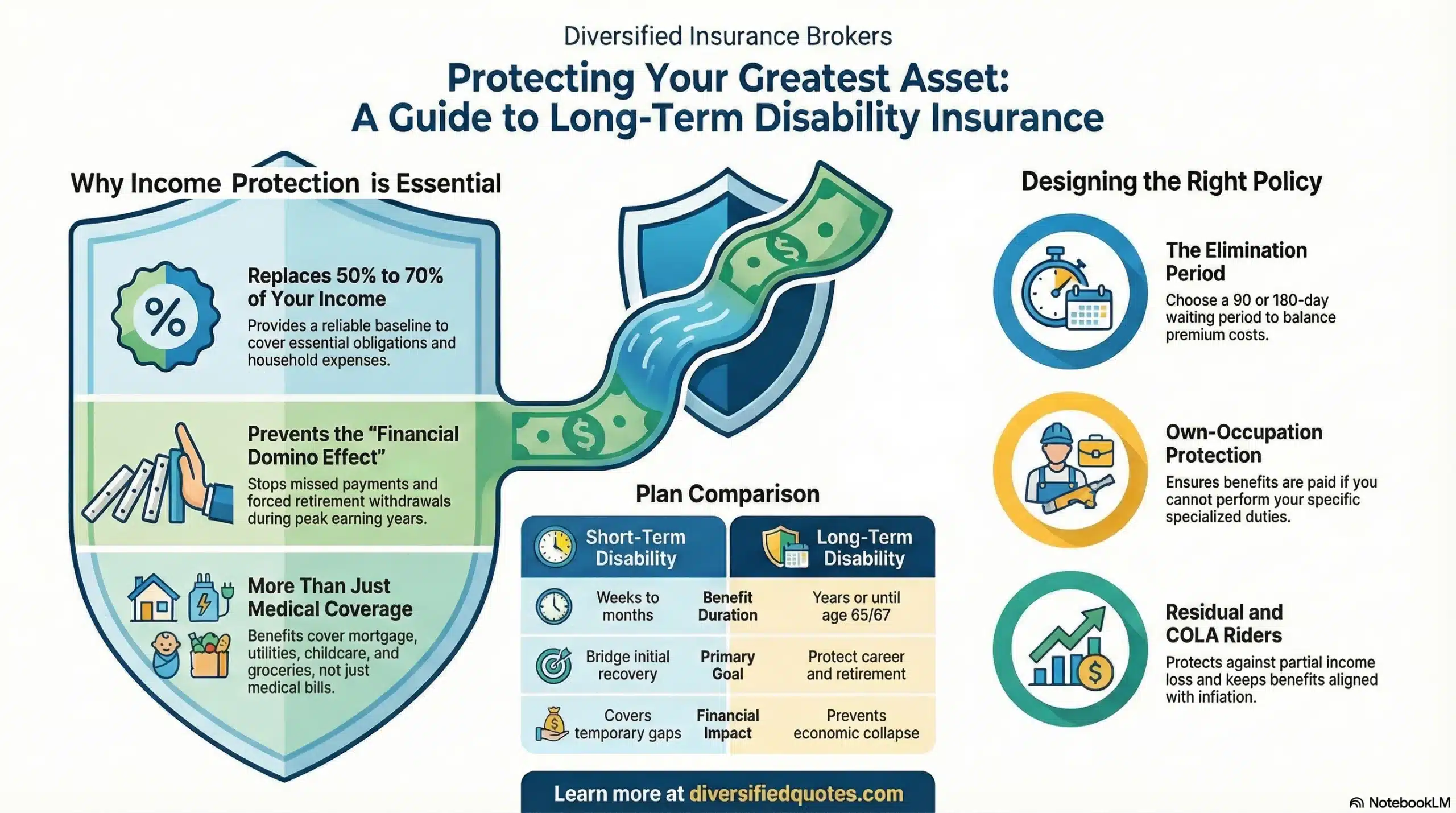
Short-term disability and long-term disability solve two different problems. STD handles short recoveries and short pay disruptions. Long-term disability (LTD) is for severe or prolonged conditions that can take someone out of work for years. Many people build the two together, using STD as the “bridge” into LTD so coverage doesn’t fall off in the middle of recovery.
| Feature | Short-Term Disability (STD) | Long-Term Disability (LTD) |
|---|---|---|
| When it pays | Weeks to months | Months to years (often to retirement age) |
| Elimination period | 0–14 days is common | 60–180 days is common |
| Income replacement | Often 50%–70% (caps apply) | Often 50%–60% (caps apply) |
| Best use | Short recoveries and short income gaps | Serious or extended disabilities |
If you’re building a full disability plan, it often makes sense to align STD duration with your LTD waiting period so benefits don’t drop off right before long-term benefits would begin. For a broader overview of disability planning and how different policy types coordinate, you can review our core disability hub page: Disability Insurance.
Taxes on Short-Term Disability Benefits
Tax treatment is one of the most misunderstood parts of disability coverage, and it matters because the benefit is designed to replace income. In many cases, the taxation of benefits depends on who paid the premium and how it was paid. If an employer pays the premium, benefits are often taxable. If you pay premiums with after-tax dollars, benefits are often received tax-free. If premiums are paid using pre-tax payroll deductions, some or all benefits may be taxable.
The most useful way to evaluate a plan is to focus on the after-tax benefit—that’s what actually hits your bank account when you need it. Two plans can look similar on paper, but if one produces a meaningfully higher after-tax benefit, it can provide more real-world stability even if the premium is slightly higher.
Who Short-Term Disability Coverage Helps Most
Short-term disability is most useful for people who have a real income dependency and limited paid leave. That includes employees who don’t have a robust employer STD plan, professionals who use PTO quickly when something unexpected happens, and anyone whose household budget relies on consistent paychecks. STD can also be extremely valuable for households that carry fixed obligations like mortgage payments, childcare costs, and ongoing debt payments where even a temporary income interruption creates stress.
STD can also be a smart layer for people who already have long-term disability protection but want better coverage for the early months of a claim. Many LTD plans don’t begin paying until 60 to 180 days after disability begins. STD can fill that waiting-period gap so the household doesn’t have to “white-knuckle” the early months of recovery.
For higher-income earners and specialized occupations, STD is often part of a bigger protection strategy that includes long-term disability and (in many cases) stronger definitions and riders. If you’re self-employed and want more detail on how coverage is structured when employer benefits aren’t available, see: Disability Insurance for Self-Employed.
Short-Term Disability for Self-Employed and 1099 Workers
If you don’t have an employer plan, STD can still play a meaningful role. Many self-employed professionals and 1099 workers can handle a short disruption using a small reserve fund, but a multi-month health event can create a cascade: missed invoices, delayed client projects, and a longer runway before income returns to normal. In those cases, an individual disability plan structured for short-term needs can protect cash flow and reduce pressure to return to work before recovery is complete.
Because income documentation can vary for self-employed individuals, underwriting and benefit sizing may depend on how earnings are reported. The goal is to design a plan that reflects real income—not just what’s easiest to document—and coordinate it with longer-term disability protection so short events and major events are both addressed.
Common Exclusions and Limitations to Watch
Most STD plans have exclusions and limitations that can surprise people if they haven’t reviewed the fine print. Work-related injuries are often handled under workers’ compensation rather than STD. Pre-existing condition limitations are common during the early policy period, meaning a condition you were treated for before coverage began may not be covered immediately. Some plans also limit benefits for certain categories of claims or require specific documentation to support the severity and duration of a disability.
It’s also important to align expectations with the contract. STD is designed to cover short-to-medium recovery windows, not every possible life event. And as noted above for this page’s offering request, maternity and childbirth are not covered under these STD offerings.
The practical takeaway is simple: understand how the policy defines “disability,” what documentation is required to support a claim, and how return-to-work or partial disability provisions work. The best plans are predictable: you know when benefits start, how long they last, and what triggers a benefit.
How to Choose the Right Short-Term Disability Policy
Choosing STD is less about chasing the maximum benefit and more about creating a plan that fits your real-world cash flow. A practical approach is to estimate your “must-pay” monthly costs—housing, utilities, minimum debt payments, insurance, childcare, groceries—and then design a benefit that covers the gap if your pay stops. From there, align the elimination period with the resources you already have, like paid leave or emergency savings, so you’re not paying extra to insure a time window you can comfortably self-fund.
Next, choose a benefit duration that matches your risk. Many people assume “I’ll be back in a few weeks,” but recoveries don’t always follow a predictable schedule. A 13-week plan can be appropriate when savings are strong and the goal is covering shorter disruptions. A 26-week or 52-week plan can be appropriate when household finances are tighter, when job duties are physically demanding, or when the consequences of a longer recovery would create major strain.
Finally, coordinate STD with long-term disability planning. If your goal is comprehensive protection, STD should function as a bridge into LTD so you don’t face a coverage cliff mid-recovery. Even if you ultimately decide not to carry both, you want the decision to be intentional—not accidental.
Compare Short-Term Disability Options
We’ll help you select the right waiting period and benefit duration, then compare pricing across multiple carriers.
Current Fixed Annuity Rates
Compare today’s fixed annuity rates from top carriers if you’re also planning for long-term income stability.
Current Bonus Annuity Rates
See which annuities offer the highest upfront bonuses if you’re comparing accumulation strategies.
Related Disability Insurance Pages
Explore disability planning resources to coordinate short-term protection with long-term income strategy.
Related Planning Pages
Short-term income protection is strongest when it’s part of a wider protection plan.
Talk With an Advisor Today
Choose how you’d like to connect—call or message us, then book a time that works for you.
Schedule here:
calendly.com/jason-dibcompanies/diversified-quotes
Licensed in all 50 states • Fiduciary, family-owned since 1980
FAQs: Short-Term Disability Insurance
What does short-term disability insurance cover?
Short-term disability insurance typically covers income loss caused by a covered off-the-job illness or injury that prevents you from working. Coverage applies according to the policy’s definition of disability and does not include work-related injuries.
How much of my income does short-term disability replace?
Most short-term disability policies replace approximately 50%–70% of your gross income, subject to weekly or monthly benefit caps set by the carrier.
How long do short-term disability benefits last?
Benefit periods commonly last 13 or 26 weeks. Some policies extend coverage up to 52 weeks depending on carrier and plan design.
Are short-term disability benefits taxable?
If premiums are paid by an employer, benefits are generally taxable. If you pay premiums personally with after-tax dollars, benefits are typically received tax-free. Pre-tax payroll deductions usually make benefits taxable.
Does short-term disability insurance cover maternity or childbirth?
No. Short-term disability insurance policies offered here do not include maternity or childbirth coverage.
Can self-employed or 1099 workers get short-term disability coverage?
Yes. Individual short-term disability policies are available for self-employed professionals and independent contractors and can be paired with long-term disability insurance for extended protection.
How do I choose the right elimination (waiting) period?
The waiting period should align with your paid time off, sick leave, or emergency savings. Common waiting periods range from 7–14 days for illness and 0–7 days for accidents.
What’s the difference between short-term and long-term disability insurance?
Short-term disability covers temporary income loss for weeks or months. Long-term disability begins after a longer waiting period and can pay benefits for years or until retirement age.
About the Author:
Jason Stolz, CLTC, CRPC and Chief Underwriter at Diversified Insurance Brokers (NPN 20471358), is a senior insurance and retirement professional with more than two decades of real-world experience helping individuals, families, and business owners protect their income, assets, and long-term financial stability. As a long-time partner of the nationally licensed independent agency Diversified Insurance Brokers, Jason provides trusted guidance across multiple specialties—including fixed and indexed annuities, long-term care planning, personal and business disability insurance, life insurance solutions, Group Health, and short-term health coverage. Diversified Insurance Brokers maintains active contracts with over 100 highly rated insurance carriers, ensuring clients have access to a broad and competitive marketplace.
His practical, education-first approach has earned recognition in publications such as VoyageATL, highlighting his commitment to financial clarity and client-focused planning. Drawing on deep product knowledge and years of hands-on field experience, Jason helps clients evaluate carriers, compare strategies, and build retirement and protection plans that are both secure and cost-efficient. Visitors who want to explore current annuity rates and compare options across multiple insurers can also use this annuity quote and comparison tool.
