
Social Security Advice

Smart Social Security advice can add meaningful lifetime income — not because of secret tricks, but because timing, coordination, and sequencing decisions compound across decades of retirement. Social Security is one of the few income sources designed to last for life and adjust for inflation. That makes it one of the most valuable financial decisions most retirees will ever make. At Diversified Insurance Brokers, our advisors help households evaluate filing ages, coordinate spousal and survivor benefits, and align Social Security with Medicare timing, taxes, and retirement income withdrawals so every piece works together instead of against each other.
Many retirees are surprised to learn that Social Security decisions are rarely isolated. Filing earlier or later changes how much you may need to withdraw from retirement accounts. It can change Medicare premium exposure. It can influence how much of your benefit becomes taxable. For married couples, it can change how much income a surviving spouse may receive years later. The right strategy is rarely just about maximizing a monthly check today — it is about building durable lifetime income that supports real retirement risks, including longevity, healthcare costs, and market uncertainty.
We often see people treat Social Security as a standalone decision when it is really part of an income ecosystem. In real planning, Social Security timing interacts with IRAs, Roth accounts, taxable investments, pensions, and guaranteed income sources. If annuities are part of your income structure — or something you are considering — this overview provides context for how guaranteed income tools fit into retirement planning: Annuities Income Planning Overview.
Schedule an Appointment with a Social Security Expert
Get a personalized filing and coordination strategy based on your age, work status, spouse (if applicable), retirement timeline, and income needs.
Social Security Planning Services Schedule a Free Consultation
Prefer to talk first? Call 800-533-5969
Why Social Security Planning Has Long-Term Financial Impact
For many retirees, Social Security becomes the foundation layer of retirement income. Unlike portfolio withdrawals, it does not depend on market performance. Unlike many pensions, it includes cost-of-living adjustments. Because of that, optimizing this income stream often reduces pressure on every other part of a retirement plan. When Social Security is optimized, retirees often withdraw less from investment accounts early in retirement, which can help protect against sequence-of-returns risk during market volatility.
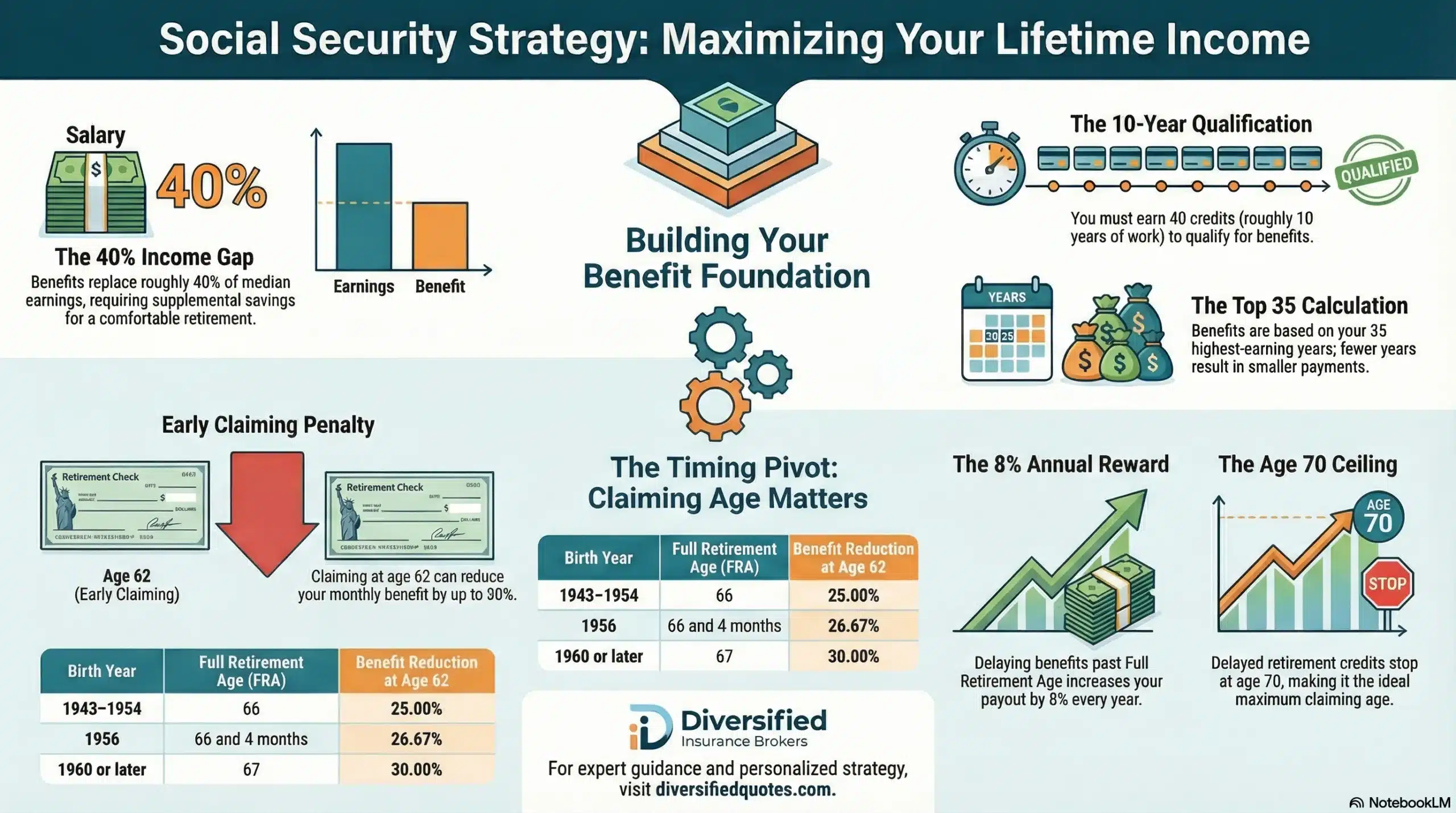
Another major factor is permanence. Social Security decisions are difficult to undo. While there are limited correction windows, most households should assume the decision is long-term. Filing early permanently reduces the base benefit. Filing later permanently increases it. For married couples, the higher earner’s decision often becomes the survivor benefit, meaning the decision can affect household income for decades beyond the first retirement phase.
Social Security decisions also intersect with healthcare costs. Income levels influence Medicare premium tiers. Medicare premiums are often withheld directly from Social Security benefits, meaning filing strategy can affect net retirement income. If you want to see how these systems overlap, this resource explains the connection clearly: How Medicare and Social Security Work Together .
Who Gains the Most from Social Security Advice
While almost every retiree benefits from reviewing their strategy, certain households have significantly more financial leverage in the decision. Pre-retirees choosing between age 62, full retirement age, and 70 often see the largest lifetime differences because the decision affects decades of payments. Many people focus only on break-even math, but the bigger consideration is long-term household income durability and survivor protection.
Married couples often benefit from coordinated claiming strategies because the higher earner’s benefit frequently becomes the surviving spouse’s benefit later. Strategic timing can increase total household lifetime income while improving financial stability during widowhood.
Widowed, divorced, or blended families also benefit from deeper planning because benefit eligibility rules become more complex. Many retirees either miss benefits entirely or claim them inefficiently simply because they were unaware of timing options. Families with dependent children may also have access to additional benefits under specific circumstances, explained here: Survivor Benefits for Children .
Retirees working past traditional retirement ages should also evaluate strategy carefully. Earnings rules, Medicare enrollment timing, and employer coverage coordination can all influence the best path.
How Filing Age Shapes Retirement Income
The choice between filing early, at full retirement age, or delaying toward age 70 is one of the most important retirement income decisions most people will make. Early filing increases near-term cash flow but permanently reduces lifetime benefits. Filing at full retirement age eliminates early reduction penalties. Delaying increases monthly benefits through delayed retirement credits, which can significantly increase lifetime income, particularly for higher earners and married households.
Delaying benefits often creates the strongest lifetime income floor, but it requires a plan to fund the years before Social Security begins. Some households use retirement accounts. Some use part-time work income. Some coordinate guaranteed income tools to stabilize early retirement years while waiting for higher Social Security benefits.
If you want a deeper technical explanation of how benefit growth works when delaying, this guide explains delayed retirement credits in detail: Delayed Retirement Credits and Benefit Growth .
How Taxes Affect Social Security Income
Social Security taxation is based on combined income formulas that include other retirement withdrawals and certain investment income. Because of this, filing timing can influence how much of your benefit becomes taxable. Strategic withdrawal sequencing, Roth conversion timing, and charitable distribution planning can all affect long-term tax outcomes.
If you want to understand how Social Security taxation works at a baseline level, start here: Is Social Security Taxable .
What You Get from Diversified Insurance Brokers Social Security Planning
Our process is built around coordination, not single-variable recommendations. We evaluate household structure, retirement timing, income needs, existing retirement assets, and healthcare planning. From there, we model multiple filing timelines and explain how each option affects lifetime income, survivor protection, and withdrawal pressure from other assets.
If guaranteed income tools are part of your retirement planning conversation, we help compare options across carriers and structures while ensuring they support — not conflict with — Social Security strategy.
Build Your Social Security Income Plan
We build filing timelines that coordinate with Medicare, taxes, and retirement income so you can make decisions confidently.
Prefer to talk now? Call 800-533-5969
Schedule a Free Consultation
Choose a time that works for you. We’ll review your situation, model filing options, and map a clear plan.
FAQs: Social Security Advice & Timing
When should I claim—62, full retirement age, or 70?
There’s no one-size-fits-all answer. The best timing depends on your cash-flow needs, health and longevity expectations, whether you’re married, and how delaying affects survivor protection. We model multiple start dates and show you the tradeoffs so you can choose confidently.
Does working before full retirement age reduce my check?
It can. Before full retirement age, the earnings test may temporarily withhold benefits if wages exceed the annual limit. In many cases, withheld amounts are later reflected through benefit recomputation at full retirement age, but cash-flow timing and tax impact still matter.
Do spousal benefits grow if I delay?
Spousal benefits generally do not increase with delayed retirement credits the way a worker’s own benefit can. However, delaying the higher earner’s benefit can increase survivor protection, which is often a major planning priority for married couples.
Can I enroll in Medicare without filing for Social Security?
Yes. Medicare and Social Security are separate programs. Many retirees enroll in Medicare around 65 while delaying Social Security to increase their long-term benefit.
How are Social Security benefits taxed?
Depending on your “combined income,” a portion of benefits may be taxable. Planning matters because Social Security timing can affect how you sequence other income sources, including IRA withdrawals, pensions, and annuity distributions.
How does delaying benefits help a surviving spouse?
In many households, the surviving spouse keeps the higher of the two benefits. If the higher earner delays and increases their benefit, that can increase the survivor benefit later—often creating a stronger long-term income floor.
Can I change my mind after I file?
There are limited situations where changes are possible, but most filing decisions are difficult to unwind after certain windows. That’s why it’s typically best to model the decision carefully before filing.
Do divorced spouses qualify for benefits on an ex-spouse’s record?
In some cases, yes—depending on factors like the length of the marriage and current marital status. The rules can be nuanced, so we review eligibility and timing carefully when this applies.
What should I prepare for a Social Security planning call?
Helpful items include your age, marital status, expected retirement date, whether you’re still working, and a general outline of other income sources (pension, retirement accounts, annuities). If you have an SSA estimate, that’s helpful too.
About the Author:
Jason Stolz, CLTC, CRPC and Chief Underwriter at Diversified Insurance Brokers (NPN 20471358), is a senior insurance and retirement professional with more than two decades of real-world experience helping individuals, families, and business owners protect their income, assets, and long-term financial stability. As a long-time partner of the nationally licensed independent agency Diversified Insurance Brokers, Jason provides trusted guidance across multiple specialties—including fixed and indexed annuities, long-term care planning, personal and business disability insurance, life insurance solutions, and short-term health coverage. Diversified Insurance Brokers maintains active contracts with over 100 highly rated insurance carriers, ensuring clients have access to a broad and competitive marketplace.
His practical, education-first approach has earned recognition in publications such as VoyageATL, highlighting his commitment to financial clarity and client-focused planning. Drawing on deep product knowledge and years of hands-on field experience, Jason helps clients evaluate carriers, compare strategies, and build retirement and protection plans that are both secure and cost-efficient. Visitors who want to explore current annuity rates and compare options across multiple insurers can also use this annuity quote and comparison tool.
