
Travel Medical and Evacuation from Ukraine

Jason Stolz CLTC, CRPC
Travel Medical and Evacuation Insurance from Ukraine
Ukraine is a beautiful and resilient country with rich history, vibrant cities, and a strong culture—but it is also a location where travel conditions can change quickly. For travelers, families, journalists, contractors, aid workers, students, and business professionals, having travel medical and evacuation insurance from Ukraine can be one of the most important preparations you make before your trip.
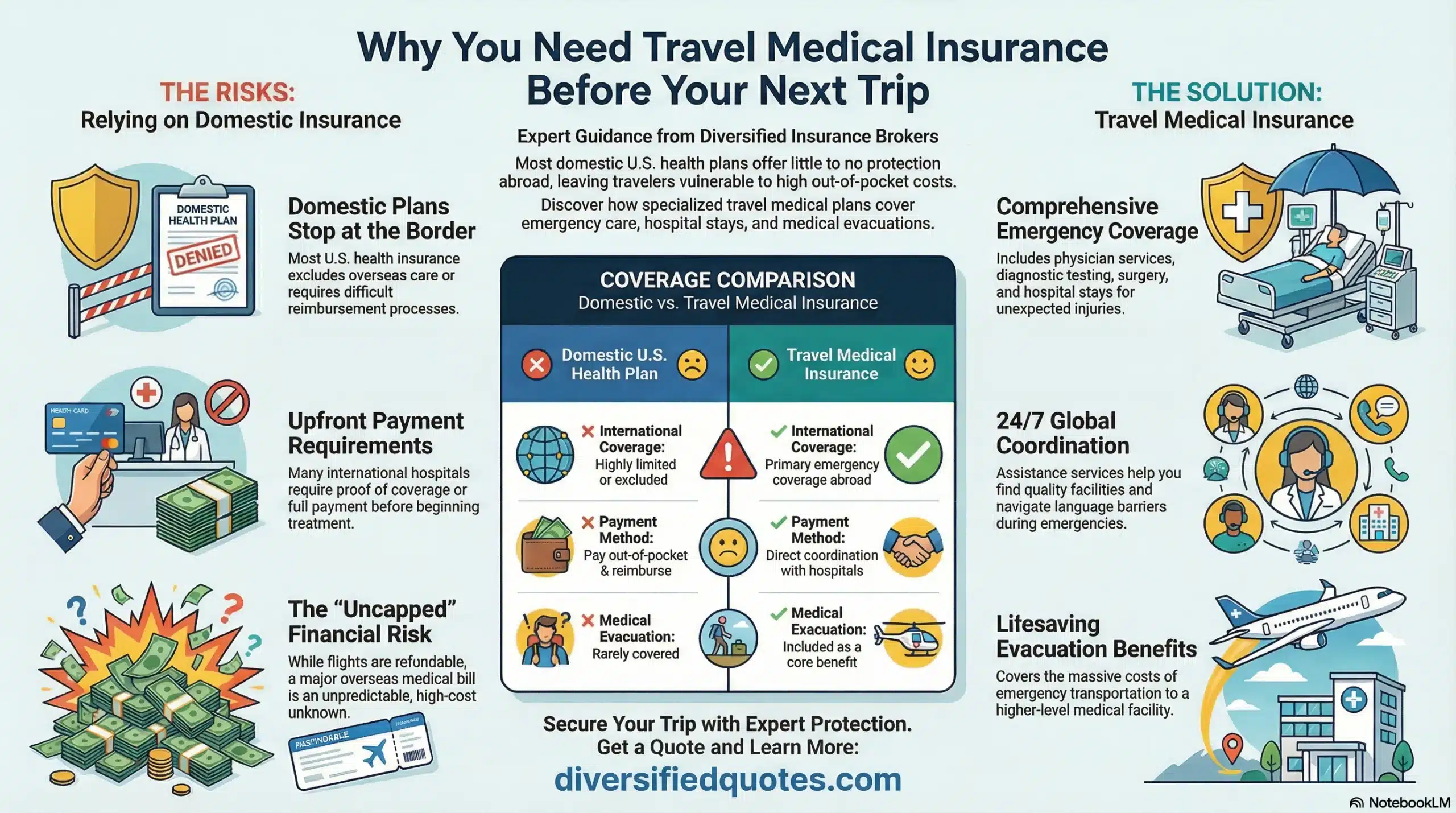
When you are traveling internationally, your U.S. health insurance may not cover you at all—or it may only cover limited emergency services with complicated reimbursement rules. In a higher-risk environment, you need a plan that can respond immediately with access to emergency medical care, hospital coverage, and medical evacuation coordination when local care is not available or not safe. At Diversified Insurance Brokers, we help travelers secure protection designed for real-world international scenarios, including emergency medical treatment and the ability to evacuate to another country for advanced care if needed.
If you are traveling to Ukraine for work, family, or humanitarian reasons, you are not just buying “travel insurance.” You are building a medical safety net that includes emergency support, 24/7 coordination, and coverage for medical bills that could otherwise become financially devastating.
Why Travel Medical and Evacuation Coverage Matters in Ukraine
In many countries, travel medical coverage is recommended. In Ukraine, it can be essential depending on where you are going, how long you will be staying, and what your purpose is. Even outside of major incidents, everyday emergencies such as appendicitis, broken bones, infections, dehydration, or severe allergic reactions can happen anywhere. The difference is that in a high-risk area, the normal “next step” in medical treatment may require transport to another city—or even another country.
Here are some of the most common reasons travelers choose travel medical and evacuation insurance when going to Ukraine:
1) Healthcare access can vary drastically by location.
Major cities may have more developed hospital networks, but access can be inconsistent in smaller areas. Even when care is available, certain facilities may lack specialty services, equipment, medication inventory, or predictable staffing.
2) You may need evacuation for treatment quality—not just urgency.
Many travelers assume evacuation is only used in extreme scenarios. In reality, evacuation is often triggered because a necessary level of care is not available locally. That could be advanced imaging, surgical specialty services, trauma capabilities, or intensive monitoring.
3) Medical evacuation can be extremely expensive.
Air ambulance evacuations can easily cost tens of thousands of dollars—and in more complex situations it can be significantly higher. Without coverage, the traveler (or their family) may be forced to pay out-of-pocket or delay care while trying to coordinate funds.
4) The biggest risk is the delay.
In emergencies, time is everything. Travel medical plans typically include a 24/7 assistance team that can coordinate care, locate appropriate facilities, and help arrange evacuation quickly. That speed can be critical in a serious illness or injury.
5) Your regular medical plan may not help at all overseas.
Even “good” domestic health coverage often does not operate smoothly internationally. Travel medical coverage fills that gap and provides benefits specifically designed for international treatment, emergency medical transportation, and coordination services.
What This Coverage Can Protect You From
When we talk about travel medical and evacuation insurance from Ukraine, we’re really describing protection against the types of situations that create two major problems:
1) The medical problem (your health and safety)
2) The logistical problem (how to get proper care quickly and safely)
Some of the most common events that can trigger a travel medical claim include:
• Sudden illness such as infections, respiratory issues, dehydration, or gastrointestinal illness.
• Accidental injury such as falls, fractures, lacerations, and head injuries.
• Emergency surgery needs like appendicitis or gallbladder problems.
• Serious complications of common conditions such as asthma attacks, severe allergic reactions, or cardiac symptoms.
• Transportation to another country when local treatment options are not adequate.
Even in “minor” emergencies, costs can add up quickly once testing, medications, specialist consultations, or overnight hospitalization is involved. Travel medical coverage is designed to help pay for those costs and provide access to emergency support.
Example Scenario (Realistic Ukraine Travel Situation)
Imagine a contractor working outside a major city in Ukraine who suffers a severe injury from a fall. The nearest clinic provides basic stabilization but does not have the equipment or orthopedic surgical specialists needed for proper treatment. The traveler requires urgent transport to a facility that can handle surgical repair and follow-up care.
With travel medical and evacuation insurance in place, the emergency assistance team can coordinate transport to the nearest appropriate hospital and, if necessary, arrange evacuation to another country where advanced care can be delivered immediately. Medical expenses, hospital fees, and transportation costs are covered under the policy’s benefits.
Without coverage, the traveler and family may face a financial crisis—potentially needing to pay tens of thousands of dollars out-of-pocket while also trying to navigate international medical coordination under stress.
The purpose of this coverage is not just to pay bills. It is to provide a structured emergency response plan when time, distance, and uncertainty become major challenges.
Need Travel Medical & Evacuation Coverage for Ukraine?
Apply online in minutes and secure emergency medical and evacuation protection before your trip.
What Travel Medical Insurance Typically Covers
Travel medical coverage is built to respond to unexpected illness or injury while you are outside your home country. While every plan has specific limits and exclusions, many travel medical policies include benefits such as:
Emergency hospital care: Coverage for inpatient admissions when medically necessary.
Doctor visits and specialist care: Treatment for urgent medical issues that need attention while traveling.
Emergency surgery and testing: Coverage may include imaging, lab work, emergency surgical procedures, and supporting services.
Prescription medication: Assistance with covered medications related to the eligible condition.
Emergency medical transportation: Included when medically required (this differs from full evacuation coverage, which is addressed below).
In an overseas medical scenario, the “hidden” cost is often the combination of urgent care plus coordination. This is why travelers should prioritize plans with strong assistance support and clear wording for emergency medical services.
How Medical Evacuation Works in Ukraine-Related Travel
Medical evacuation is one of the most valuable parts of this coverage—especially for a destination where access to advanced care can be inconsistent. Evacuation is triggered when a traveler requires treatment that is not available locally, or when staying in the same location is unsafe from a medical perspective.
Medical evacuation can include:
• Ground ambulance transfer to a higher-level facility within the region.
• Air ambulance or medically supervised transport when time and distance make ground transfer unrealistic.
• Cross-border evacuation if the nearest appropriate care is in another country.
• Medical escort services when the traveler needs supervision during transport.
• Coordination support for admitting hospitals, travel documentation, and routing logistics.
In a complicated international emergency, most people do not want to rely on “figuring it out as they go.” The evacuation assistance team is designed to take control of coordination when the traveler or family cannot.
Who Should Consider Travel Medical and Evacuation Insurance for Ukraine?
This type of travel coverage is not only for tourists. In fact, the most common travelers who need high-quality protection are those who are going for work, long stays, or high-risk assignments.
Travelers who often benefit from this coverage include:
Journalists and media teams who may be working in unpredictable environments.
Humanitarian workers and NGO staff who may be stationed in areas with limited medical networks.
Contractors and consultants supporting infrastructure, rebuilding, logistics, or technical projects.
Families visiting relatives who want medical security during their stay.
Students and long-term travelers living abroad and needing a reliable emergency plan.
Business travelers who may not have time to coordinate care and need immediate assistance services.
Even when travelers are experienced, the most overlooked part of planning is what happens when you need care right now and your next best hospital option isn’t local.
Choosing the Right Limits for Ukraine Travel
Many travelers ask, “How much coverage do I really need?” The answer depends on the purpose of your trip and how much risk exposure you have. With that said, for international travel that includes higher-risk regions, it is often wise to prioritize higher limits because the cost of evacuation alone can be substantial.
Common minimum targets travelers consider include:
Emergency medical coverage: $100,000 or more
Medical evacuation / repatriation coverage: $250,000 to $500,000+ (higher limits are often preferred for complex scenarios)
When you’re traveling somewhere with uncertainty, you’re not just buying benefits—you’re buying flexibility. Higher limits can mean more options if you need to move quickly to another country for care.
Important Exclusions Travelers Should Understand
Travel medical and evacuation coverage can be extremely valuable, but it is also important to understand what these plans are typically not designed to cover. This is especially relevant for travel involving higher-risk areas.
Common exclusions or limitations may include:
War or hostilities exclusions depending on the plan wording.
Political or security evacuation (this is not the same as medical evacuation and often requires a separate benefit or policy).
Pre-existing condition limitations depending on stability rules and look-back periods.
Non-emergency routine care such as regular checkups or elective treatments.
That’s why we always recommend reviewing the plan details before travel—so there are no surprises when you need coverage most.
Smart Pre-Travel Steps for Ukraine Travelers
Even with the right insurance, preparation matters. Travelers going to Ukraine (or anywhere with higher risk) should consider these simple, practical steps before departure:
Keep your emergency hotline accessible.
Save it in your phone, write it down, and carry it with your passport.
Carry digital and printed copies of your policy.
In a serious situation, you may need it even if you lose phone access.
Bring an adequate supply of prescriptions.
Don’t rely on local availability. Bring original packaging whenever possible.
Know where you would evacuate to.
For many travelers, evacuation could involve treatment in a neighboring country depending on care availability.
Have your personal medical information ready.
Allergies, medications, past surgeries, and emergency contacts should be easily accessible.
The goal is simple: eliminate delays when action is needed.
How Diversified Insurance Brokers Helps Ukraine Travelers
At Diversified Insurance Brokers, we help clients compare travel medical options with a focus on real-world usability—not just what looks good on paper. The right plan is the one that can actually coordinate care, support emergency logistics, and provide meaningful financial protection if something goes wrong.
We help travelers consider:
• How long you are staying and whether you need short-term or longer coverage
• Your medical needs including medication access and pre-existing conditions
• Your risk profile based on location, work responsibilities, and travel schedule
• Evacuation planning and higher-limit recommendations for complex scenarios
If you are traveling to Ukraine and want a policy that is built for emergency response—not just basic reimbursement—we can help you get it in place quickly.
Get Covered for Your Trip to Ukraine
Apply online now for travel medical and emergency evacuation protection.
Related Travel Medical Pages
If you’re comparing coverage options, these pages can help you understand how travel medical and evacuation plans work in different regions and travel scenarios.
Related Destination Pages
Traveling to other higher-risk regions soon? These destination pages explain why evacuation matters and how coverage can respond when local care is limited.
Talk With an Advisor Today
Choose how you’d like to connect—call or message us, then book a time that works for you.
Schedule here:
calendly.com/jason-dibcompanies/diversified-quotes
Licensed in all 50 states • Fiduciary, family-owned since 1980
Travel Medical & Evacuation Insurance — Ukraine (FAQ)
Do I need travel medical & evacuation insurance for Ukraine?
Yes. Access to advanced care can be disrupted, and medical evacuation to another country may be required after a serious illness or injury. Coverage helps pay for emergency treatment and coordinates transport when local resources are strained.
How much coverage is recommended for Ukraine travel?
Many travelers choose at least $100,000 for emergency medical expenses and $250,000–$500,000+ for medical evacuation/repatriation. If you’ll be working in remote locations or high-risk areas, higher evacuation limits are often a smart move.
What does “medical evacuation” typically include?
Medical evacuation usually includes stabilization at the nearest appropriate facility, ground or air ambulance transport, a medical escort if needed, coordination with airports/borders, and transfer to a facility capable of providing adequate care—often outside the country—followed by repatriation when medically cleared.
Is medical evacuation the same as security or political evacuation?
No. Medical evacuation is triggered by a medical emergency and medical necessity. Security/political evacuation is related to unrest, conflict, or government advisories and is typically a separate benefit that is not included on most medical-only policies unless specifically added.
Are war/hostilities or sanctions covered?
Many travel medical plans have exclusions related to war/hostilities and may have restrictions tied to sanctioned regions. Some specialty plans may offer narrower carve-outs or modified wording. Review your policy exclusions carefully before purchase, especially if your travel involves higher-risk zones.
Will hospitals in Ukraine bill my insurer directly?
Direct billing varies by facility and region. Some providers may require payment up front or a guarantee of payment through the insurer’s assistance team. Keep your policy number and emergency hotline readily available and save all receipts and medical reports.
Are pre-existing conditions covered?
It depends on the plan. Some policies cover stable pre-existing conditions, while others exclude them or limit coverage to acute-onset events. Check look-back periods, stability rules, and any waivers that must be activated by buying coverage within a certain window.
What documents should I carry?
Carry your passport/visa, proof of coverage, insurance ID/policy number, emergency assistance contacts, a medication list with prescriptions, and secure digital copies of key documents. If you have chronic conditions, keep a brief physician summary and medication letter as well.
How do I initiate an evacuation or start a claim?
Call the insurer’s 24/7 emergency assistance line as soon as possible. Provide your location, condition, treating facility information, and contact details for a companion. Follow the coordinator’s instructions for medical transfer and documentation, and keep copies of all bills, reports, and discharge notes.
When should I buy coverage and how long should it last?
Buy before departure and make sure the policy covers your full itinerary, including transit days and possible delays. If you’ll be moving between cities or traveling near border regions, higher evacuation limits and a strong assistance provider can make a meaningful difference.
Does this type of plan cover routine care or preventive visits?
Most travel medical plans focus on unexpected illness or injury. Some offer limited benefits for urgent care, while routine checkups and elective services are often excluded or capped. If you need broader benefits for an extended stay, consider an international medical plan with stronger day-to-day coverage.
About the Author:
Jason Stolz, CLTC, CRPC and Chief Underwriter at Diversified Insurance Brokers (NPN 20471358), is a senior insurance and retirement professional with more than two decades of real-world experience helping individuals, families, and business owners protect their income, assets, and long-term financial stability. As a long-time partner of the nationally licensed independent agency Diversified Insurance Brokers, Jason provides trusted guidance across multiple specialties—including fixed and indexed annuities, long-term care planning, personal and business disability insurance, life insurance solutions, Group Health, and short-term health coverage. Diversified Insurance Brokers maintains active contracts with over 100 highly rated insurance carriers, ensuring clients have access to a broad and competitive marketplace.
His practical, education-first approach has earned recognition in publications such as VoyageATL, highlighting his commitment to financial clarity and client-focused planning. Drawing on deep product knowledge and years of hands-on field experience, Jason helps clients evaluate carriers, compare strategies, and build retirement and protection plans that are both secure and cost-efficient. Visitors who want to explore current annuity rates and compare options across multiple insurers can also use this annuity quote and comparison tool.
