
Trip Cancellation Insurance

Jason Stolz CLTC, CRPC
At Diversified Insurance Brokers, we know that even the best-planned trips can be disrupted by events completely outside your control. Flights get canceled, storms close airports, family members get sick, and sometimes life simply changes your plans. When that happens, the financial impact can be just as frustrating as the change in itinerary—especially if you’ve already paid for non-refundable flights, hotels, cruises, tours, or special-event tickets.
Trip Cancellation Insurance—offered through International Medical Group (IMG)—is designed to help protect that investment by reimbursing covered prepaid expenses if your trip is canceled or interrupted for a covered reason. Whether it’s an unexpected illness, an injury, severe weather, or another unforeseen event, the right plan helps you travel with more confidence, knowing your money is not completely at risk.
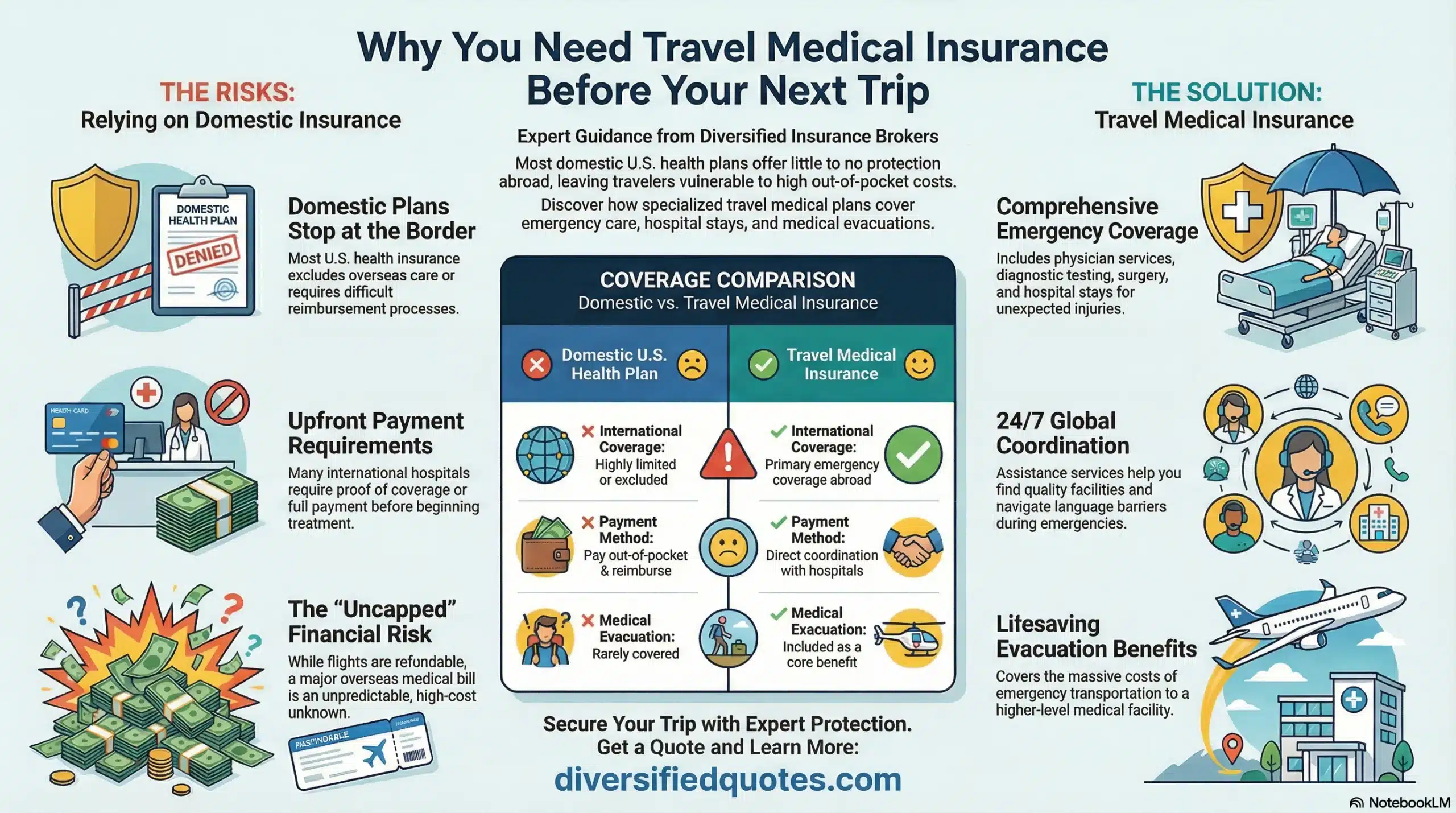
Trip cancellation coverage also fits best when it’s coordinated with the right health protection while traveling. If you’re building a complete travel safety plan, pair trip cancellation with travel medical insurance so you’re protecting both your trip costs and your exposure to medical bills abroad.
Trip Cancellation — International Medical Group (IMG)
Safeguard your travel plans with coverage for non-refundable expenses when life’s surprises interrupt your trip.
If you’re unsure which level is right, request help and we’ll point you to the best fit for your itinerary.
Why trip cancellation insurance matters
Today’s trips often involve a chain of non-refundable or partially refundable costs—discounted airfares, cruise deposits, prepaid resort packages, guided tours, and excursions that must be booked months ahead. If you have to cancel, many of these expenses cannot be recovered through the travel vendor alone. Without protection, a family emergency or disrupted itinerary can mean losing thousands of dollars on a trip you never get to take.
Trip Cancellation Insurance is designed to step in when specific covered events force you to cancel before departure or return home earlier than planned. Instead of absorbing the full loss, you can file a claim for eligible prepaid, non-refundable costs and recoup much of what you’ve invested. For frequent travelers, families, and retirees planning higher-cost “bucket list” trips, this type of protection can be an important part of a broader travel risk strategy.
If you’re also concerned about worst-case scenarios while traveling—like getting injured in a remote area—consider how trip cancellation coordinates with emergency medical evacuation insurance, especially for international itineraries where local access and transport can become a major expense.
Common covered reasons
Policies vary by plan, but many IMG trip cancellation options include protection for major disruptions such as illness, injury, or death affecting you, a traveling companion, or a close family member when it prevents you from starting or continuing your trip. This is one reason many travelers coordinate cancellation coverage with health coverage—because medical events are among the most common trip disruptors.
Severe weather and natural disasters can also trigger coverage when conditions materially impact your departure, your destination, or even your home—making travel unsafe or impossible. For travelers who plan around hurricane season, winter storms, or unstable shoulder seasons, cancellation coverage can reduce the financial damage of a last-minute change.
Other covered triggers can include certain employment-related events like unexpected job loss or mandatory work obligations, as well as transportation disruptions beyond your control such as strikes, mechanical failures, or carrier cancellations that significantly affect your itinerary. Some plans may also address emergency evacuation or certain government-issued travel restrictions depending on the policy language and the scenario.
The goal is not to cover minor inconveniences. The goal is to help when a major disruption makes it unreasonable or impossible to take the trip as planned—and to help you avoid losing a large prepaid investment in the process.
Key benefits of trip cancellation coverage
The primary benefit is reimbursement for eligible prepaid, non-refundable expenses if you must cancel or interrupt your trip for a covered reason. This can include flights, cruises, hotels, group tours, resort packages, and prepaid excursions—depending on what you insured and how the plan defines covered expenses.
Trip interruption benefits can matter just as much. If you need to cut your trip short and return home, a strong plan can help with the unused portion of the trip and additional transportation costs to get you back safely. This is especially important for multi-stop itineraries where one interruption can trigger a chain reaction of losses.
Many plans also include 24/7 travel assistance—helpful for coordinating documentation, accessing support while abroad, and understanding what steps to take when something goes wrong. The value here is clarity and speed when you’re under pressure and don’t want to guess what to do next.
Finally, the best cancellation strategy is the one that matches your trip design. Coverage can be structured around total trip cost, destination, length of travel, and your risk tolerance—so you’re not paying for more coverage than you actually need.
Build a Complete Travel Protection Plan
Trip cancellation protects your prepaid investment. Travel medical coverage protects you from medical bills abroad. Many travelers combine both for full-spectrum protection.
Start here: Emergency travel health insurance or explore international travel health coverage if you want a broader plan design.
Trip cancellation vs. travel medical insurance
Trip Cancellation Insurance focuses on your financial investment in the trip—your prepaid, non-refundable costs. Travel medical insurance focuses on emergency medical care and evacuation while you’re outside your home country. They solve different problems, which is why combining them can be so effective for travelers who want real protection instead of hoping vendors will refund everything.
If your trip involves international travel, consider whether your itinerary calls for a more robust health design. Some travelers want a narrow emergency plan, while others want broader medical coverage depending on trip length and destination. If you’re a U.S. citizen traveling internationally, review emergency travel medical insurance for U.S. citizens. If you’re a foreign national traveling, explore emergency travel health insurance for foreign nationals.
For longer stays, expat scenarios, or recurring international travel, you may also want to compare international health insurance and international major medical insurance so you’re not trying to stretch a short-term plan beyond what it’s designed to do.
Who benefits most from trip cancellation insurance?
Almost any traveler can benefit, but trip cancellation coverage tends to be especially valuable when you’ve locked in meaningful non-refundable costs months in advance. Retirees planning cruises, tours, or international itineraries often fall into this category because the bookings are larger and the planning timeline is longer.
Families coordinating multi-ticket itineraries also benefit because a single illness can cancel the entire trip. Travelers heading to destinations exposed to storms and seasonal weather disruptions may also see more value, because a single airport closure or regional event can unravel a complicated itinerary quickly.
If you’re doing specialized travel—like missions, humanitarian work, or youth travel—trip disruption can become more complicated due to group schedules and prepaid programs. In those cases, it can help to review plans built for those travel types, such as mission trip travel insurance, travel insurance for humanitarian aid workers, or travel insurance for youth mission trips.
How to think about cost and value
Trip cancellation coverage is usually most valuable when the potential loss is meaningful relative to your budget. If you’ve insured a high-cost itinerary with large prepaid expenses, a covered cancellation can prevent a painful financial hit. If your trip is modest and mostly refundable, you may decide the value is lower. That’s a reasonable decision—what matters is matching coverage to the actual risk you’re trying to solve.
If cost is a primary concern, it may help to compare broader options across travel plans. Start with cheap travel insurance to see how pricing can shift by coverage level and structure, and use that baseline to decide whether cancellation benefits are the right priority for your itinerary.
Why work with Diversified Insurance Brokers?
At Diversified Insurance Brokers, we help travelers avoid the most common mistake in trip protection: buying a plan that sounds good, but doesn’t match how the trip is built. We’ll help you understand what is and isn’t covered, how to calculate the right trip cost to insure, and how trip cancellation coordinates with travel medical insurance and evacuation benefits for a complete strategy.
If you’re planning a single dream vacation or you travel several times a year, we can walk you through IMG options and clarify the differences between plan levels so you can choose protection that aligns with your budget and your risk tolerance. The result is simple: you can look forward to your trip, knowing that if life forces you to change your plans, your financial investment doesn’t automatically disappear.
Related Travel Pages
Explore travel medical, evacuation, international, and specialty travel coverage options to round out your protection strategy.
Talk With an Advisor Today
Choose how you’d like to connect—call or message us, then book a time that works for you.
Schedule here:
calendly.com/jason-dibcompanies/diversified-quotes
Licensed in all 50 states • Fiduciary, family-owned since 1980
Trip Cancellation Insurance — Frequently Asked Questions
What is trip cancellation insurance?
It’s coverage that reimburses your prepaid, non-refundable trip costs if you must cancel for a covered reason (e.g., illness, injury, severe weather). It’s typically purchased as part of a travel insurance plan before final payment or soon after booking.
What reasons are usually covered?
- Unexpected illness, injury, or death of you or a traveling companion.
- Severe weather or natural disaster making your destination or home uninhabitable.
- Common carrier cancellations due to strike, mechanical issues, or weather (per policy terms).
- Jury duty, subpoena, military duty, or required work reasons (if included).
- Destination or home evacuation orders; documented theft of passport/visa.
Exact triggers vary by insurer—review your certificate for the full list and definitions.
What expenses can be reimbursed?
Prepaid, non-refundable items such as flights, cruises, tour packages, hotel stays, event tickets, and certain excursions. Some plans also cover non-refundable taxes/fees and supplier change penalties up to the plan limit.
How is “trip interruption” different from “trip cancellation”?
Cancellation applies before departure when you must scrap the trip. Interruption applies after departure when you must return home early or pause the trip, and can reimburse unused portions plus additional return travel costs (subject to limits).
Are pre-existing conditions covered?
They’re often excluded unless you qualify for a pre-existing condition waiver. Waivers typically require buying the plan shortly after your first trip payment and being medically able to travel when you purchase.
What is “Cancel For Any Reason” (CFAR)?
CFAR is an optional upgrade that lets you cancel for reasons not otherwise covered and receive a partial reimbursement (commonly 50–75%) if you buy within a set window and insure 100% of prepaid costs. CFAR must be purchased before events become foreseeable.
Does trip cancellation cover COVID-19 issues?
Many plans treat a COVID-19 diagnosis like any covered illness with proper documentation. Government travel bans or fear of travel are generally not covered unless you add CFAR. Check your policy’s infectious disease wording.
When should I buy coverage?
As soon as you make your first trip payment. Early purchase preserves eligibility for time-sensitive benefits (like pre-existing waivers or CFAR) and covers subsequent payments if you keep your insured trip cost updated.
How much does it cost?
Plans typically cost about 4%–10% of your total insured trip cost. Price depends on traveler ages, trip price/duration, destinations, and added options like CFAR.
What are common exclusions?
- Known or foreseeable events at the time of purchase.
- Change of mind or fear of travel (unless CFAR is added).
- Unapproved medical procedures or elective surgery timing.
- Financial insolvency of a supplier unless specifically covered.
What documentation will I need to file a claim?
- Proof of loss (doctor’s note, test results, airline/cruise cancellation notice).
- Receipts and invoices for all non-refundable costs insured.
- Refund/credit statements from suppliers showing amounts not returned.
- Proof of payment (credit card statements) and itinerary.
Is coverage primary or secondary?
Some plans pay primary (faster, no requirement to collect elsewhere first), while others are secondary and coordinate with supplier refunds or other insurance. Your certificate will specify which applies.
About the Author:
Jason Stolz, CLTC, CRPC and Chief Underwriter at Diversified Insurance Brokers (NPN 20471358), is a senior insurance and retirement professional with more than two decades of real-world experience helping individuals, families, and business owners protect their income, assets, and long-term financial stability. As a long-time partner of the nationally licensed independent agency Diversified Insurance Brokers, Jason provides trusted guidance across multiple specialties—including fixed and indexed annuities, long-term care planning, personal and business disability insurance, life insurance solutions, Group Health, and short-term health coverage. Diversified Insurance Brokers maintains active contracts with over 100 highly rated insurance carriers, ensuring clients have access to a broad and competitive marketplace.
His practical, education-first approach has earned recognition in publications such as VoyageATL, highlighting his commitment to financial clarity and client-focused planning. Drawing on deep product knowledge and years of hands-on field experience, Jason helps clients evaluate carriers, compare strategies, and build retirement and protection plans that are both secure and cost-efficient. Visitors who want to explore current annuity rates and compare options across multiple insurers can also use this annuity quote and comparison tool.
