
What Is Premium Financing Life Insurance

Jason Stolz CLTC, CRPC
Confidential Premium Financing Strategy Review
Premium financing is a sophisticated estate and liquidity strategy designed for high-net-worth individuals and closely held business owners. Before implementing leverage, it is critical to evaluate structure, rate exposure, collateral requirements, and exit timing.
Premium Financing Life Insurance is a capital management strategy used to fund large permanent life insurance policies through third-party lending rather than direct out-of-pocket premium payments. It is most often implemented in estate planning, wealth transfer, business succession, and high-net-worth liquidity design where death benefit needs are substantial and the policy owner prefers not to reposition significant investment capital in order to pay premiums annually.
For affluent families, liquidity is rarely idle. Capital may be invested in operating businesses, private equity, real estate, marketable securities, or alternative holdings that are expected to compound at attractive long-term rates. Redirecting millions of dollars per year into insurance premiums can create opportunity cost, disrupt portfolio design, or trigger taxable gains. Premium financing seeks to solve this tension by introducing structured leverage. Instead of liquidating assets, the client borrows the premium from a lender, pays interest on that loan, and allows core assets to remain positioned for growth.
It is important to understand that premium financing is not a method of making life insurance inexpensive. It is a method of reallocating how premiums are funded. The insurance cost does not disappear; it is replaced by borrowing cost and structural risk. When designed prudently, this trade-off can improve estate efficiency. When designed carelessly, it can introduce unnecessary exposure. The distinction lies in modeling discipline and long-term oversight.
The Strategic Purpose Behind Premium Financing
The primary reason families use premium financing is to solve estate liquidity problems without eroding investment positioning. High net worth estates frequently contain illiquid assets such as business equity or real estate partnerships. Upon death, federal or state estate taxes may be due within a short timeframe. Without sufficient liquidity, heirs may be forced to sell assets under pressure or at unfavorable valuations. Permanent life insurance provides liquidity at death. Financing provides a method to acquire that coverage while preserving balance sheet flexibility during life.
In other cases, financing is used within irrevocable trust structures to keep death benefits outside the taxable estate while allowing the grantor to avoid large annual gift outlays. In business settings, financing may support buy-sell arrangements or key-person protection when coverage amounts are significant and cash flow allocation must remain focused on operational growth.
Unlike simplified coverage solutions such as no exam life insurance, premium financing is reserved for cases where the scale of planning justifies structural complexity.
How the Financing Structure Operates
In a typical arrangement, a permanent life insurance policy is established—often structured for strong early cash value efficiency through properly designed whole life insurance with cash value or indexed universal life. A third-party lender advances funds to pay annual premiums directly to the insurance carrier. The borrower is responsible for interest payments on the outstanding loan balance. Depending on the agreement, interest may be paid annually or capitalized.
Because policy cash value builds gradually, lenders usually require collateral beyond the policy itself in the early years. This collateral may consist of cash or marketable securities. As the policy matures and cash value accumulates, collateral requirements may decline, though this depends on performance and loan terms. The borrower retains ownership rights according to the structure established, often through a trust vehicle for estate planning purposes.
Premium financing is therefore not simply borrowing money to buy insurance. It is a coordinated legal, lending, and insurance design strategy requiring alignment between policy structure, collateral positioning, and loan covenants.
The Economics: Spread, Risk, and Discipline
The financial premise behind premium financing rests on comparative cost of capital. If the borrower expects retained assets to generate returns that exceed the long-term borrowing cost, preserving investment capital may enhance net estate value. However, this expectation must be modeled conservatively. Borrowing costs fluctuate. Interest rate cycles rise and fall. Policy performance assumptions must be realistic rather than optimistic.
Sound planning stress-tests multiple rate environments and policy performance scenarios. It considers what happens if borrowing costs increase materially. It evaluates collateral sufficiency under lower policy crediting assumptions. It defines clear decision points at which partial loan repayment, refinancing, or strategic unwind may be appropriate. Without this discipline, financing becomes speculative rather than strategic.
Interest Rate Exposure and Structural Risk
Interest rate volatility represents the central risk variable. Many premium finance loans are tied to floating benchmarks. Rising rate environments increase carrying costs. Higher borrowing expense may require additional collateral contributions or accelerate repayment timing. Clients must be capable of sustaining the structure even if rates move beyond today’s assumptions.
For this reason, financing is generally appropriate only for individuals with substantial liquidity reserves and a tolerance for leverage. It is not designed for clients who require certainty or who are uncomfortable with ongoing monitoring obligations.
Exit Strategy: The Core Planning Requirement
Every premium financing structure must include a defined exit strategy before implementation. Some borrowers intend to repay loans upon sale of a business or other liquidity event. Others design the strategy to remain in place until death, allowing the death benefit to extinguish the outstanding loan balance. Still others plan phased repayment using accumulated policy values combined with outside capital.
The chosen exit path influences policy funding design, collateral planning, and loan structure from the outset. Financing without a defined exit strategy introduces unnecessary uncertainty. Financing with a clearly articulated repayment plan transforms leverage into a managed planning instrument.
Comparing Financing to Direct Premium Funding
Direct premium payment eliminates borrowing risk and interest exposure but requires capital deployment that may interrupt portfolio strategy. Financing preserves liquidity but introduces leverage and monitoring requirements. The correct decision depends on projected after-tax investment returns, estate tax exposure, asset concentration, and personal risk tolerance. There is no universal answer. There is only analysis.
Tax and Trust Coordination
Premium financing is frequently coordinated with irrevocable life insurance trusts to remove death benefits from the taxable estate. Interest deductibility and gift implications depend on structure and must be reviewed by qualified tax counsel. The strategy should never be implemented without coordination among insurance advisors, estate attorneys, and CPAs to ensure compliance and structural integrity.
When Premium Financing Is Not Appropriate
This strategy should not be pursued by individuals without substantial net worth, by those lacking liquidity flexibility, by those uncomfortable with leverage exposure, or by households whose insurance needs can be satisfied through straightforward funding approaches. In many cases, traditional funding methods or alternative strategies such as split dollar life insurance may be more appropriate depending on the objectives involved.
Evaluate Whether Premium Financing Strengthens Your Estate Plan
We conduct structured modeling, conservative interest-rate stress testing, and policy efficiency analysis before recommending financing. If leverage improves your position, we will show you how. If it does not, we will recommend alternatives.
Ongoing Oversight and Monitoring
Premium financing is not static. Interest rates shift, collateral values fluctuate, and policy performance evolves over time. Annual review is mandatory. Adjustments may include partial loan repayment, refinancing, collateral repositioning, or strategic redesign. Properly supervised, financing can function as a disciplined estate tool. Neglected, it can drift outside intended parameters.
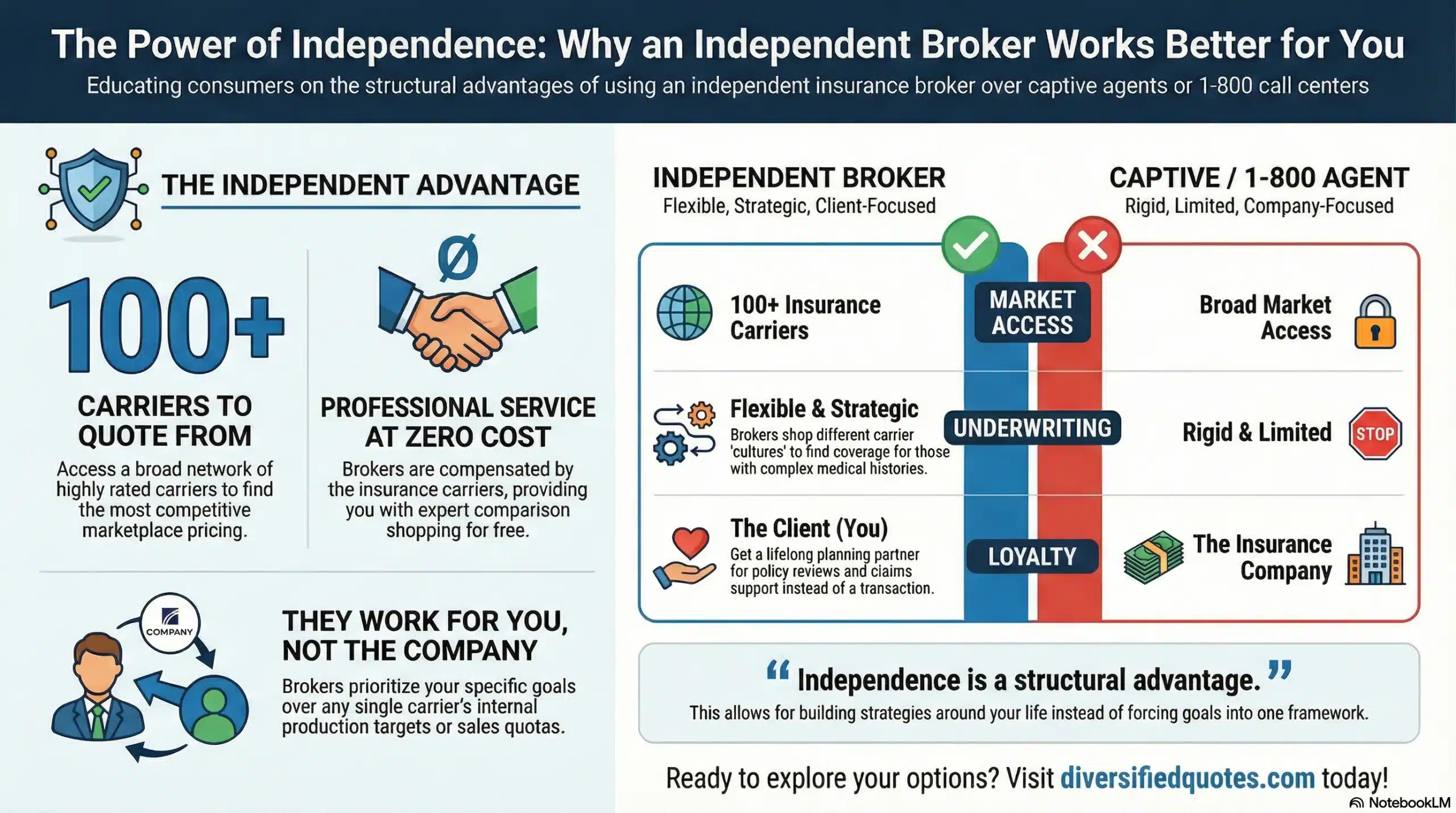
Diversified Insurance Brokers operates independently across carriers and structures, allowing objective evaluation rather than product-driven recommendations. Our role is to ensure that leverage, if used, is justified, sustainable, and aligned with long-term estate objectives.
Sophisticated strategies require careful analysis. We will review your estate exposure, liquidity profile, and long-term objectives to determine whether premium financing meaningfully improves your planning structure.
Talk With an Advisor Today
Choose how you’d like to connect—call or message us, then book a time that works for you.
Schedule here:
calendly.com/jason-dibcompanies/diversified-quotes
Licensed in all 50 states • Fiduciary, family-owned since 1980
Premium Financing Life Insurance – FAQs
Who is premium financing designed for?
What type of life insurance is used for premium financing?
Do I have to provide collateral?
What are the main risks?
Can the loan be repaid using the policy?
Is premium financing right for everyone?
About the Author:
Jason Stolz, CLTC, CRPC and Chief Underwriter at Diversified Insurance Brokers (NPN 20471358), is a senior insurance and retirement professional with more than two decades of real-world experience helping individuals, families, and business owners protect their income, assets, and long-term financial stability. As a long-time partner of the nationally licensed independent agency Diversified Insurance Brokers, Jason provides trusted guidance across multiple specialties—including fixed and indexed annuities, long-term care planning, personal and business disability insurance, life insurance solutions, Group Health, and short-term health coverage. Diversified Insurance Brokers maintains active contracts with over 100 highly rated insurance carriers, ensuring clients have access to a broad and competitive marketplace.
His practical, education-first approach has earned recognition in publications such as VoyageATL, highlighting his commitment to financial clarity and client-focused planning. Drawing on deep product knowledge and years of hands-on field experience, Jason helps clients evaluate carriers, compare strategies, and build retirement and protection plans that are both secure and cost-efficient. Visitors who want to explore current annuity rates and compare options across multiple insurers can also use this annuity quote and comparison tool.
