
What Is the Safest Type of Annuity?

Jason Stolz CLTC, CRPC
What is the safest type of annuity? The answer depends on what you are trying to protect. For some retirees, “safe” means absolute protection of principal with no exposure to market losses. For others, safety means creating an income stream that cannot be outlived. And for many pre-retirees, safety means locking in strong interest rates today without worrying about volatility tomorrow. In practical retirement planning, the annuities most often described as the safest are multi-year guaranteed annuities (MYGAs), traditional fixed annuities, and certain income-focused annuities such as single premium immediate annuities (SPIAs). Each protects against market losses, but they protect different risks.
Understanding what makes an annuity safe begins with understanding what makes investments feel unsafe. Most retirement risk comes from three sources: market volatility, longevity risk, and income instability. If your portfolio drops 20% just before retirement, that is market risk. If you live longer than expected and run out of money, that is longevity risk. If your income depends on variable returns, that is income instability. The safest annuity for you is the one designed to eliminate the specific risk that concerns you most.
Before comparing structures, it helps to review current rate environments. The strength of a fixed annuity often depends on prevailing interest rates, which is why reviewing current annuity rates is a logical first step in any safety-focused strategy. Locking in strong rates can materially improve long-term outcomes while maintaining principal protection.
Ensure you are receiving the absolute top rates
Compare fixed rates, bonus structures, and run income projections instantly.
Lifetime Income Calculator
Premiums up to $2,000,000 are supported. Larger amounts scale proportionally.
Defining Safety in Annuities
An annuity is considered safe when it contractually protects principal and clearly defines either a guaranteed interest rate or a guaranteed income amount. Unlike market-based accounts, fixed annuities are not reduced by stock declines. That structural protection is the foundation of safety. However, safety also includes clarity. A product that guarantees principal but contains complex, poorly understood terms may not feel safe to the person who owns it.
Insurance-based annuities derive their guarantees from the financial strength of the issuing insurance company. They are not FDIC-insured like bank CDs, but they are regulated at the state level and supported by state guaranty associations within certain limits. This distinction matters because many conservative investors compare MYGAs to CDs. The mechanics differ, but both emphasize preservation and predictability.
MYGAs: Rate Certainty and Principal Protection
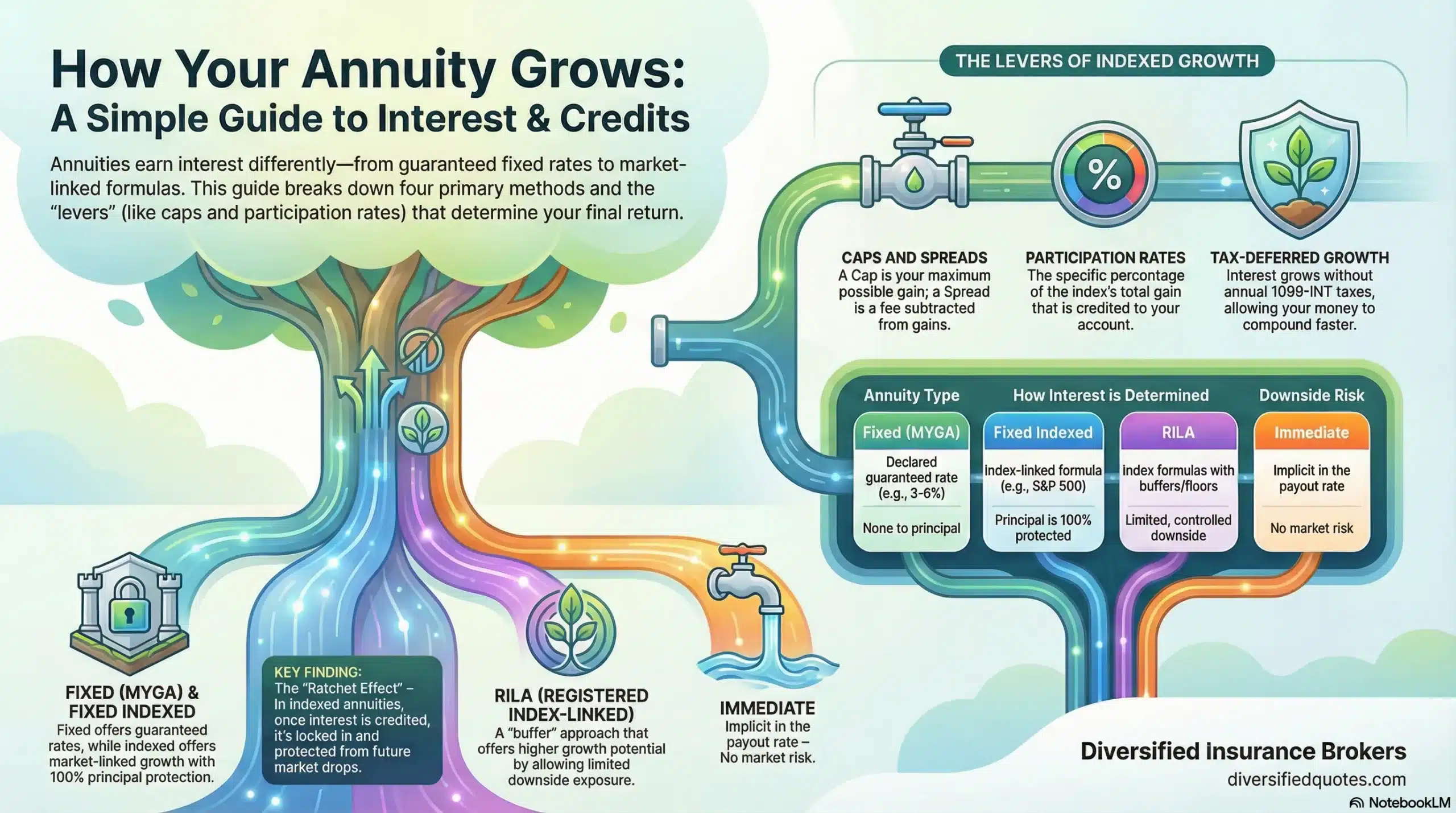
Multi-year guaranteed annuities, commonly called MYGAs, are widely viewed as one of the cleanest safety tools available in retirement planning. A MYGA locks in a stated interest rate for a defined period, typically between two and ten years. During that period, your principal does not fluctuate with markets, and your credited rate does not change. You know exactly what you will earn if you hold to maturity.
This clarity is powerful. When rates are strong, locking them in through a MYGA can outperform leaving money in short-term instruments that reset frequently. Reviewing current fixed annuity rates often reveals opportunities that are competitive with or superior to traditional bank alternatives. For conservative retirees who want defined growth without exposure to equity risk, MYGAs are frequently the most straightforward solution.
However, safety comes with structure. MYGAs include surrender schedules that limit large withdrawals during the guarantee period. Most allow penalty-free withdrawals up to a certain percentage annually, but they are designed for funds you can commit. When aligned with your timeline, that structure reinforces safety rather than detracts from it.
Traditional Fixed Annuities: Flexibility with Protection
Traditional fixed annuities also protect principal and credit guaranteed interest, but instead of locking in one rate for an entire multi-year period, they may reset periodically according to contract provisions. This creates a balance between predictability and adaptability. In rising rate environments, renewal rates may adjust upward. In falling environments, they may decline, though minimum guarantees remain in place.
For retirees who want safety but are hesitant to commit to longer guarantee terms, traditional fixed annuities can provide a middle ground. They eliminate market-loss risk while allowing some responsiveness to changing economic conditions. Like MYGAs, they are often evaluated alongside rate updates found on the current annuity rates page.
Single Premium Immediate Annuities: Income Safety Above All
When safety is defined not by account growth but by income reliability, single premium immediate annuities stand out. A SPIA converts a lump sum into a stream of payments that can last for life or for a defined period. Once payments begin, they do not depend on market returns. This creates a pension-like structure that addresses longevity risk directly.
For retirees concerned about running out of money, SPIAs create an income floor. They remove uncertainty around withdrawal rates and market performance. If understanding lifetime income mechanics is your priority, reviewing how annuities pay income for life provides valuable context. Income safety is often more psychologically powerful than growth guarantees because it stabilizes retirement cash flow.
Fixed Indexed Annuities: Principal Protection with Conditional Growth
Fixed indexed annuities occupy a middle ground. They protect principal from market losses but link interest crediting to an external index, subject to caps, spreads, or participation rates. In negative market years, credited interest can be zero, but principal typically does not decline due to index performance. This is why many consider FIAs safe from a loss perspective.
However, FIAs introduce complexity. Understanding how crediting methods work is essential. Safety is preserved at the principal level, but potential returns depend on contractual formulas. When paired with income riders, FIAs can create guaranteed lifetime withdrawal income while maintaining growth potential. For deeper comparisons, see fixed indexed annuity myths debunked.
Matching Safety to Your Personal Objective
The safest annuity is not universal. It is objective-driven. If your primary concern is protecting a large principal sum for heirs while earning predictable interest, a MYGA may be ideal. If your primary concern is replacing a paycheck, a SPIA or FIA with income rider may be more appropriate. If flexibility matters but you still want principal guarantees, a traditional fixed annuity could strike the balance.
Many retirees use layered strategies. For example, part of the portfolio may be allocated to a MYGA for defined-term growth while another portion funds a SPIA for lifetime income. Reviewing how much income an annuity can pay helps determine allocation percentages that align with spending needs.
Understanding the Role of Insurance Company Strength
Safety also depends on carrier quality. Annuity guarantees are backed by the financial strength of the issuing insurer. Independent rating agencies evaluate insurers’ claims-paying ability. Choosing well-rated carriers enhances confidence in contractual guarantees. While state guaranty associations provide certain protections, they are not substitutes for selecting strong companies at the outset.
Inflation and the Limits of “Safety”
One overlooked risk in safety discussions is inflation. An annuity that guarantees a fixed income may lose purchasing power over decades. Some products allow increasing income options, though initial payouts may be lower. Safety in retirement planning therefore requires balancing stability with purchasing power awareness.
When Safety May Not Be the Only Goal
It is also important to recognize that maximum safety may not equal maximum growth. Variable annuities offer market participation but introduce volatility. For conservative retirees, that tradeoff may not align with priorities. Evaluating whether annuities are worth it depends on whether guarantees are more valuable to you than upside potential.
Putting It All Together
Ultimately, the safest type of annuity is the one that eliminates the specific financial risk you fear most while fitting your liquidity timeline. MYGAs provide rate certainty and principal protection. Traditional fixed annuities offer safety with periodic flexibility. SPIAs deliver income certainty. FIAs protect principal while allowing conditional growth. Each has a place in conservative retirement design.
Safety is not about finding the single “best” product. It is about aligning guarantees with goals. When structured properly, annuities can transform uncertainty into predictability. Whether you prioritize growth certainty, income stability, or a blend of both, today’s rate environment and product landscape offer strong options for conservative retirees.
Compare the Safest Annuities Today
See side-by-side comparisons built around principal protection and guaranteed income.
Request Personalized QuotesRelated Pages
Explore these guides to compare safe annuity structures and income options:
Talk With an Advisor Today
Choose how you’d like to connect—call or message us, then book a time that works for you.
Schedule here:
calendly.com/jason-dibcompanies/diversified-quotes
Licensed in all 50 states • Fiduciary, family-owned since 1980
FAQs: What Is the Safest Type of Annuity?
Are MYGAs the safest type of annuity?
MYGAs are among the safest because they guarantee a fixed interest rate for a defined term and protect your principal from market volatility.
Are fixed indexed annuities safe?
Yes. FIAs guarantee principal protection but offer index-based returns. While growth varies, your account cannot lose value due to market declines.
What is the safest annuity for lifetime income?
SPIAs and FIAs with income riders offer the safest lifetime income because payments are contractually guaranteed and unaffected by market swings.
How do I know if an annuity company is safe?
Look for strong financial ratings, long operating history, and clear liquidity rules. You can also compare options with pages like our analysis on Physicians Mutual.
Are annuities safer than the stock market?
Yes. Fixed annuities, MYGAs, SPIAs, and FIAs with protection features eliminate the possibility of market loss, making them safer for conservative investors.
About the Author:
Jason Stolz, CLTC, CRPC and Chief Underwriter at Diversified Insurance Brokers (NPN 20471358), is a senior insurance and retirement professional with more than two decades of real-world experience helping individuals, families, and business owners protect their income, assets, and long-term financial stability. As a long-time partner of the nationally licensed independent agency Diversified Insurance Brokers, Jason provides trusted guidance across multiple specialties—including fixed and indexed annuities, long-term care planning, personal and business disability insurance, life insurance solutions, Group Health, and short-term health coverage. Diversified Insurance Brokers maintains active contracts with over 100 highly rated insurance carriers, ensuring clients have access to a broad and competitive marketplace.
His practical, education-first approach has earned recognition in publications such as VoyageATL, highlighting his commitment to financial clarity and client-focused planning. Drawing on deep product knowledge and years of hands-on field experience, Jason helps clients evaluate carriers, compare strategies, and build retirement and protection plans that are both secure and cost-efficient. Visitors who want to explore current annuity rates and compare options across multiple insurers can also use this annuity quote and comparison tool.
