
Affordable Burial Insurance for Low-Income Seniors

Jason Stolz CLTC, CRPC
Living on a fixed income doesn’t mean burial insurance is out of reach. If you’re relying on Social Security, a modest pension, disability income, or limited savings, there may still be realistic options that fit a tight monthly budget. Many seniors assume they can’t qualify, or assume every policy will be expensive. In practice, the biggest difference is not “company A vs. company B,” but the type of final expense policy you choose and whether your health profile can qualify for the lower-cost path.
If you want a faster route to coverage without tests and medical follow-ups, affordable burial insurance with no medical exam may be available. At Diversified Insurance Brokers, we help low-income seniors secure final-expense coverage that fits real budgets—so loved ones aren’t left covering funeral costs, medical balances, and last-minute expenses out of pocket.
Burial insurance—often called final expense life insurance—is designed to do one thing well: create a dependable payout when it’s needed most. These policies are intentionally simple, typically permanent, and usually built with level premiums so costs don’t increase year after year. Whether your goal is to cover basic cremation expenses or ensure your family has breathing room for final bills, there are options that prioritize affordability and long-term stability.
Request a Personalized Low-Cost Burial Insurance Quote
We’ll size coverage to your budget and compare multiple final-expense plans for you.
Prefer a call? Call 800-533-5969
Affordable burial insurance options for low-income seniors
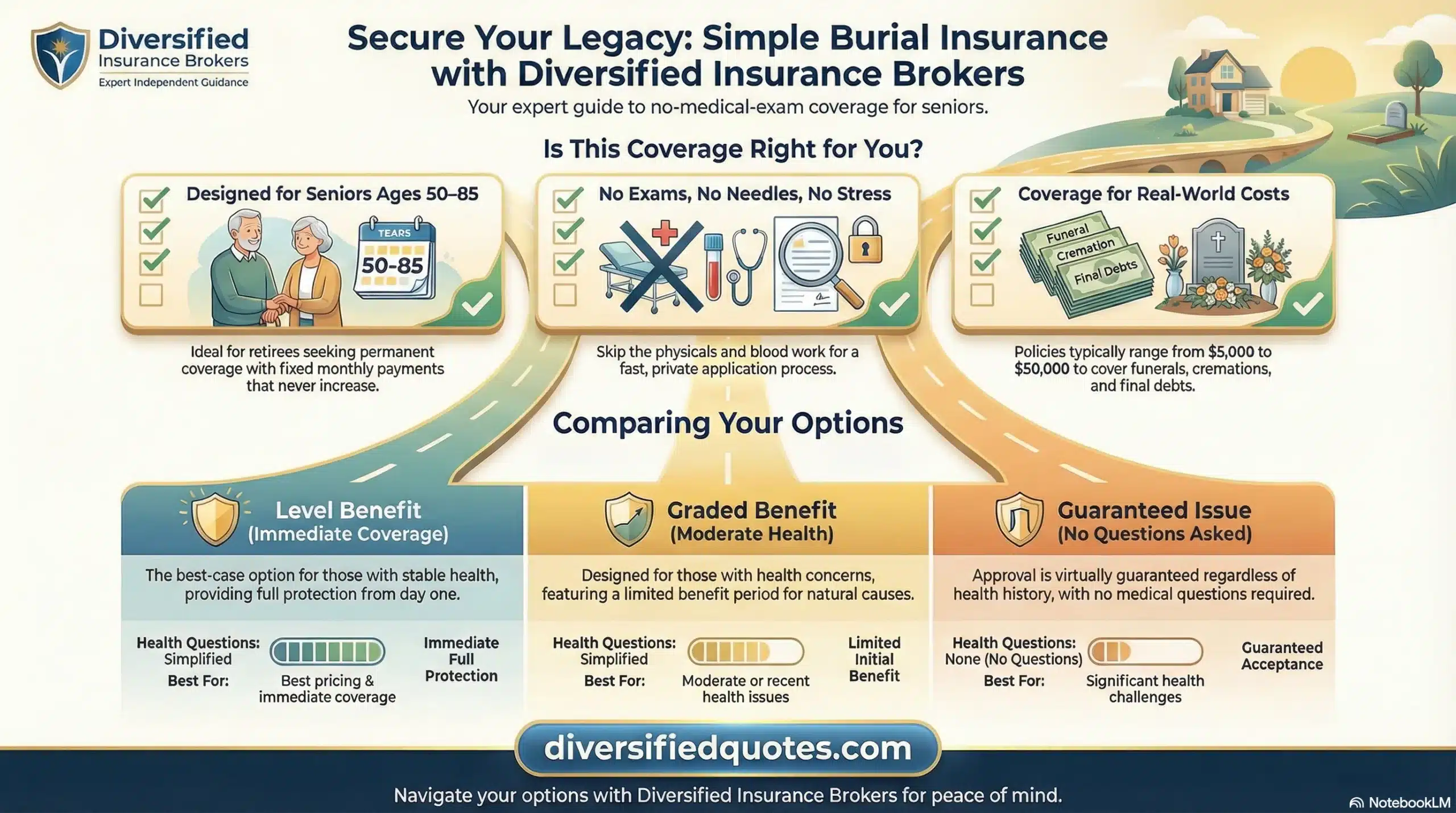
For seniors on limited income, affordability comes from choosing the right kind of final expense policy—not simply hunting for the lowest advertised price. Two policy types typically show up in budget-friendly final expense planning. They can both be valid choices, but they behave differently, cost differently, and often pay benefits differently in the early years.
Guaranteed issue burial insurance is designed for certainty. It’s available without health questions or medical exams, and approval is usually automatic within the eligible age range. Because the insurer is accepting applicants without screening health risk, premiums are typically higher per $1,000 of coverage, and many guaranteed issue plans include a graded waiting period for natural causes of death in the first one to two years. Accidental death coverage is often immediate, but exact definitions vary.
Simplified issue burial insurance is often the “best value” when health allows. These policies still avoid a medical exam, but they require answering a short health questionnaire. Seniors who qualify may receive lower premiums and immediate full coverage. For many low-income seniors with manageable conditions and no major red flags, simplified issue can provide a stronger balance of cost and protection.
Our job is to help you determine which route is realistic before you apply, so you don’t waste time and don’t get pushed into a policy type that costs more than you need to pay.
Use our burial insurance calculator for instant pricing
This tool gives a quick estimate based on age and state. Once you see a range, we can narrow it down to plans that fit your budget and match your underwriting eligibility.
How much does low-cost final expense life insurance typically cost?
Burial insurance premiums vary, but they are usually designed to remain level for life. That predictability matters when you’re living on a fixed income because it keeps planning simple. Instead of “starting low and rising,” most final expense plans are structured so the monthly cost stays the same.
Age and state are major pricing drivers. Tobacco use is another big factor, with non-tobacco rates typically being meaningfully lower. Health answers matter for simplified issue policies, while guaranteed issue policies “bake the risk into the premium” because the carrier does not screen health.
Many low-income seniors choose coverage between $5,000 and $20,000 because it aligns with realistic final expense goals. A common budget target is a monthly premium that stays within a range your household can maintain comfortably. The right plan is not the one with the biggest face amount—it’s the one that stays in force.
Keeping burial insurance affordable long-term
The most affordable burial insurance policy is the one you can keep year after year. That starts with right-sizing coverage. Buying more than you truly need can strain monthly cash flow. Buying too little can leave a gap. The best approach is to decide what the policy is meant to solve—basic cremation, a simple service, a modest cushion for bills—and size the benefit to that reality.
Timing can also matter. Applying sooner rather than later can lock in a lower lifetime rate. Because these policies are permanent, premiums generally do not increase due to age or changes in health after the policy is issued. That “lock-in” feature is one reason final expense coverage can be so valuable for seniors who want predictable planning.
Finally, comparing carriers is important. “Guaranteed issue” and “simplified issue” are categories, not one single policy. Plans vary by acceptance rules, pricing, and how benefits are paid during early years. Comparing your realistic options usually produces the best result without increasing complexity.
Case example: staying under $40 per month
Rose, age 76, lives on Social Security income of approximately $1,100 per month. She wanted burial coverage that would not exceed $40 per month. After reviewing her situation, we focused on simplified issue first because it often provides better pricing and immediate full benefits when someone can qualify. We placed a simplified-issue burial policy providing $10,000 of coverage for about $35 per month. The benefit was designed to be enough for a basic service and related expenses, while keeping the premium comfortably inside her monthly budget.
The most important part of this type of planning is not “finding the cheapest policy.” It’s matching the plan type to the situation so the policy stays active. In Rose’s case, the premium remained predictable and the benefit was structured to do what she needed it to do—protect her family from immediate out-of-pocket costs.
Why work with Diversified Insurance Brokers?
Diversified Insurance Brokers is a family-owned, fiduciary insurance agency licensed nationwide. Since 1980, we have helped families navigate insurance decisions with clarity, transparency, and access to a wide range of carriers. When budgets are tight, clarity matters even more—because small differences in pricing and benefit rules can have a big impact over time.
We are not tied to a single insurance company. That means we can objectively compare pricing, underwriting requirements, and policy structures to help low-income seniors find coverage that truly fits. Whether you’re planning for yourself or helping a parent, we keep the process straightforward and respectful, with a focus on stability and affordability.
Secure affordable burial coverage today
We’ll recommend budget-friendly options and help you enroll in minutes.
Questions now? Call 800-533-5969
Related Pages
Explore these resources to compare low-cost burial plans, understand no-exam options, and see what’s realistic based on your situation.
Talk With an Advisor Today
Choose how you’d like to connect—call or message us, then book a time that works for you.
Schedule here:
calendly.com/jason-dibcompanies/diversified-quotes
Licensed in all 50 states • Fiduciary, family-owned since 1980
FAQs: Affordable Burial Insurance for Low-Income Seniors
What is burial insurance?
Burial insurance is a small whole life policy designed to cover funeral and final expenses. Premiums are level, coverage lasts for life, and benefits are paid directly to your beneficiary.
How much burial insurance do most seniors buy?
Most seniors choose between $5,000 and $15,000—enough to cover funeral costs without creating high monthly premiums.
Is there a medical exam?
No. Most burial insurance uses simplified underwriting or guaranteed issue approval, meaning no medical exam is required.
What is a graded waiting period?
Some guaranteed-issue policies limit payouts for natural death during the first 2–3 years, usually returning premiums plus interest. After the waiting period, full benefits apply.
Do premiums ever increase?
No. Burial insurance premiums are typically locked in for life and never increase as you age.
Can a family member pay for the policy?
Yes. An adult child or trusted individual can own or pay for the policy with your consent.
How fast are claims paid?
Once a death certificate is submitted, benefits are often paid within days, allowing families to handle expenses immediately.
About the Author:
Jason Stolz, CLTC, CRPC and Chief Underwriter at Diversified Insurance Brokers, is a senior insurance and retirement professional with more than two decades of real-world experience helping individuals, families, and business owners protect their income, assets, and long-term financial stability. As a long-time partner of the nationally licensed independent agency Diversified Insurance Brokers, Jason provides trusted guidance across multiple specialties—including fixed and indexed annuities, long-term care planning, personal and business disability insurance, life insurance solutions, and short-term health coverage. Diversified Insurance Brokers maintains active contracts with over 100 highly rated insurance carriers, ensuring clients have access to a broad and competitive marketplace.
His practical, education-first approach has earned recognition in publications such as VoyageATL, highlighting his commitment to financial clarity and client-focused planning. Drawing on deep product knowledge and years of hands-on field experience, Jason helps clients evaluate carriers, compare strategies, and build retirement and protection plans that are both secure and cost-efficient.
