
Can You Get a 50-Year Term Life Insurance Policy?

Jason Stolz CLTC, CRPC
Can you get a 50-year term life insurance policy? In the United States, the honest answer is no. No major carrier currently offers a level term policy that guarantees premiums and coverage for a full 50 years. The longest level term available in today’s marketplace is 40 years. That said, the absence of a true 50-year term does not mean you cannot design coverage that effectively protects your family for 50 years or longer. The key is understanding how term life insurance is structured, why carriers cap it at 40 years, and how permanent life insurance can be strategically layered to accomplish the same long-term objective.
At Diversified Insurance Brokers, we structure life insurance planning around time horizons. Some clients need coverage for 10 or 20 years to protect income during their highest earning period. Others want coverage that lasts until retirement. And some — particularly younger applicants in their 20s or early 30s — ask for protection that extends 50 years into the future. When that happens, we compare every available level term option alongside permanent designs that can deliver guaranteed protection well beyond the 40-year maximum. You can explore all current options on our Life Insurance Services page.
Compare the Longest Term Policies Available Today
See side-by-side pricing for 30-year, 35-year, and 40-year term policies — plus permanent options that can extend coverage 50 years or longer.
Why doesn’t 50-year term life exist? It comes down to risk modeling and pricing stability. Insurance companies price term policies based on actuarial tables that estimate mortality over a defined window of time. The longer that window extends, the higher the probability of a claim. At 40 years, carriers are already pushing the outer limit of affordable, level premium guarantees. Extending that guarantee another decade would dramatically increase premiums, reduce affordability, and limit demand. Most buyers align coverage with specific obligations such as mortgages, dependent children, business loans, or retirement timelines — rarely a full half century. As a result, carriers stop at 40 years.
If your goal is long-duration protection, the longest available options include 30-year, 35-year, and 40-Year Term Life Insurance. A 40-year term purchased at age 30 can protect you until age 70. Purchased at age 35, it protects you until 75. For many families, that effectively covers the majority of income-earning years. However, if you are 25 or 30 and want coverage to age 80 or beyond, we often design a layered solution combining a long term policy with a permanent foundation.
Permanent life insurance differs fundamentally from term. Instead of expiring at the end of a set duration, it is designed to remain in force for life — or for a guaranteed period such as 50 years, 60 years, or to age 100 or 121. Some clients explore indexed universal life designs, including Indexed Universal Life in Qualified Plans, when appropriate. Others prefer guaranteed whole life structures. The objective is simple: lock in premiums that do not increase and secure a death benefit that will not expire.
Another important consideration is flexibility. Many long-term planners ask whether they can start with term and convert later. The answer is yes — if the policy includes a conversion rider. Conversion allows you to exchange some or all of your term coverage for permanent coverage without new medical underwriting. That strategy is helpful if your health changes. For example, individuals with conditions such as atrial fibrillation may review underwriting guidance on Life Insurance for Atrial Fibrillation to understand how future insurability could be impacted.
For high-income professionals, 50-year planning may also intersect with estate considerations. Survivorship policies such as Survivorship Joint Whole Life Insurance can provide guaranteed legacy protection extending decades beyond retirement. Likewise, business owners sometimes coordinate life insurance with buy-sell agreements or succession plans to ensure long-term liquidity.
Life Insurance Quoter
Use our live quoting tool to compare 20-year, 30-year, 35-year, and 40-year term policies — plus permanent structures that can effectively replace a 50-year term strategy.
Some applicants who request 50-year term coverage are actually trying to solve a different problem — permanent financial security. If your objective is ensuring final expenses are covered no matter when death occurs, you may also consider smaller whole life policies like those discussed on our Burial Insurance for Mom and Dad planning guide. While burial insurance is not a replacement for income protection, it highlights the broader principle: permanent coverage never expires.
There are also structural considerations. If you plan to use life insurance in trust planning, you may explore how an Irrevocable Life Insurance Trust (ILIT) works. ILIT strategies are often designed with multi-decade horizons — another example where 50-year planning concepts apply even if a 50-year term contract does not exist.
When evaluating whether to stretch for the longest available term or pivot toward permanent coverage, cost matters. A 40-year term will always be less expensive initially than permanent insurance. However, if your goal truly extends 50 years or longer, buying term now and permanent later could be more expensive overall — especially if health changes. Applicants engaged in high-risk activities may review underwriting considerations such as Life Insurance for Extreme Sports before choosing a long-duration strategy.
Design a 50-Year Protection Strategy
If your goal extends beyond the 40-year term limit, we’ll structure a layered plan combining long-term term insurance and permanent guarantees.
Ultimately, the question is not whether a 50-year term policy exists — it does not — but whether your coverage timeline can be engineered to achieve the same result. In many cases, the answer is yes. By combining the longest available term (up to 40 years) with a properly structured permanent base, you can lock in affordable protection today while ensuring guarantees that extend 50 years or more into the future. Diversified Insurance Brokers has been structuring long-horizon protection strategies since 1980, comparing carriers, underwriting niches, and design structures to match each client’s timeline and financial objectives.
Related Life Insurance Planning Guides
Financial Protection Essentials
Specialized life insurance solutions, disability coverage comparisons, and international travel protection strategies to strengthen financial security.
Talk With an Advisor Today
Choose how you’d like to connect—call or message us, then book a time that works for you.
Schedule here:
calendly.com/jason-dibcompanies/diversified-quotes
Licensed in all 50 states • Fiduciary, family-owned since 1980
No. U.S. carriers currently cap level term policies at 40 years. If you need coverage lasting 50 years or longer, you can combine a long-term policy such as 40-Year Term Life Insurance with permanent life insurance designed to provide guaranteed protection beyond that timeframe.
The longest level term available today is 40 years. Carriers typically offer 10-, 15-, 20-, 25-, 30-, 35-, and 40-year options. You can compare all durations through our Life Insurance Services page to determine which term length aligns with your financial goals.
Most clients use a layered strategy: purchase the longest available term (up to 40 years) and add permanent coverage. Many also include a conversion rider, allowing them to convert term to permanent life insurance without new medical underwriting.
If your goal is guaranteed lifetime protection, permanent insurance may be more appropriate. Policies such as indexed universal life can be structured for extended guarantees. Learn how advanced designs like Indexed Universal Life in Qualified Plans work when evaluating long-term strategies.
Health changes can impact future eligibility. That’s why conversion privileges matter. If you have specific medical concerns, review underwriting examples such as Life Insurance for Atrial Fibrillation to understand how carriers assess long-term risk.
About the Author:
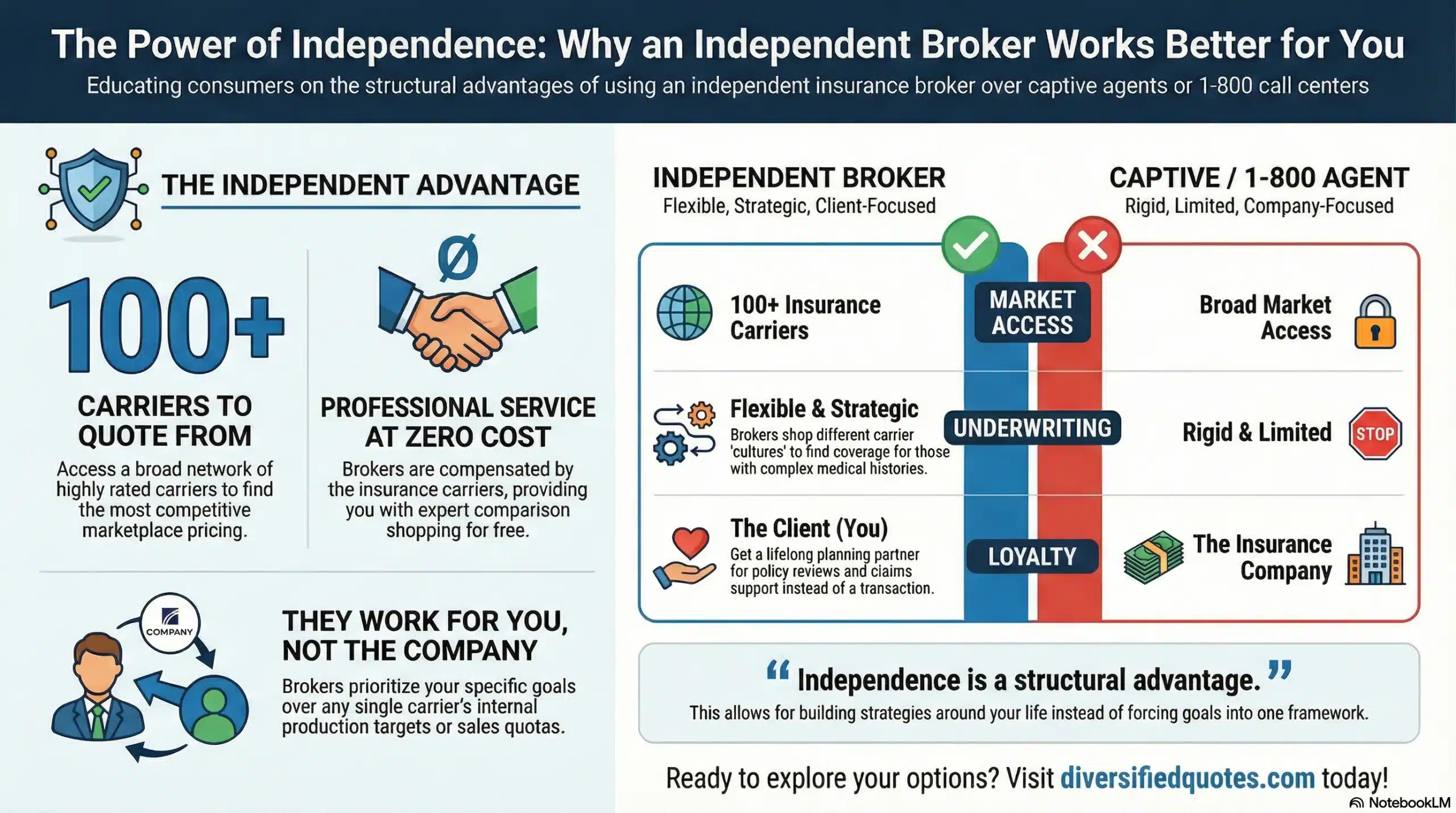
Jason Stolz, CLTC, CRPC and Chief Underwriter at Diversified Insurance Brokers (NPN 20471358), is a senior insurance and retirement professional with more than two decades of real-world experience helping individuals, families, and business owners protect their income, assets, and long-term financial stability. As a long-time partner of the nationally licensed independent agency Diversified Insurance Brokers, Jason provides trusted guidance across multiple specialties—including fixed and indexed annuities, long-term care planning, personal and business disability insurance, life insurance solutions, Group Health, and short-term health coverage. Diversified Insurance Brokers maintains active contracts with over 100 highly rated insurance carriers, ensuring clients have access to a broad and competitive marketplace.
His practical, education-first approach has earned recognition in publications such as VoyageATL, highlighting his commitment to financial clarity and client-focused planning. Drawing on deep product knowledge and years of hands-on field experience, Jason helps clients evaluate carriers, compare strategies, and build retirement and protection plans that are both secure and cost-efficient. Visitors who want to explore current annuity rates and compare options across multiple insurers can also use this annuity quote and comparison tool.
