
Group Health Insurance for 2 Person Business

Jason Stolz CLTC, CRPC
Group health insurance for a 2 person business can be one of the most efficient ways to get comprehensive coverage when individual plans feel overpriced, narrow, or unpredictable. For many partnerships and small teams, a two-person group can unlock stronger carrier access, broader PPO networks, and more business-friendly plan structures—if you qualify under your state and carrier guidelines.
Two-person group coverage is not “one-size-fits-all.” In some states, it’s straightforward. In others, the rules are strict about who counts as an eligible employee or owner. The biggest mistake small businesses make is assuming that “two people means no options.” In reality, many carriers will consider a two-person group when the business is legitimate, both participants are active in the company, and documentation supports the payroll or ownership structure.
At Diversified Insurance Brokers, we help two-person businesses navigate carrier rules, underwriting standards, and funding structures to design a plan that fits your budget and benefit goals. We’ll show you how fully insured, level-funded, and self-funded concepts differ, what “eligibility” really means for a two-person group, and how to avoid common disqualifiers. For background on plan structures, review what self-funded group health insurance is before choosing your setup.
This page is built to answer the questions two-person businesses actually ask: “Do we qualify?” “What documentation is required?” “Is group coverage really cheaper than individual plans?” “Can owners enroll?” “What if one person is older?” “What if we’re married?” and “How do we avoid getting denied at underwriting?”
Compare Small Group Health Plans
We’ll verify eligibility for your 2-person business and compare small-group options from multiple carriers.
Eligibility Rules for a 2 Person Business Group Plan
Eligibility is the most important part of two-person group health insurance. Most states and carriers follow a basic standard: if your business is legitimate and you have two eligible participants who are actively working in the company, you may qualify for a small-group plan. “Eligible” is the key word, and it usually means the carrier can validate that both participants are real employees or real owners—not just family members added for coverage.
In many states, the two participants must be unrelated employees (or owners treated as eligible participants). In other states, two owners can qualify. Some states treat spouses as a single household and do not count them as “two separate employees,” which is why the “not married to each other” rule often comes up. This is one of the most common points of confusion and one of the most common reasons groups get declined.
While exact rules vary, carriers commonly require that both people:
First, be actively working in the business, typically full-time or near full-time. Many carriers want to see 20+ hours per week per participant, and some require 30+ hours. If one person is mostly passive (for example, an owner who doesn’t materially work in the business), underwriting may treat them differently.
Second, be verifiable in the payroll or ownership structure. W-2 wages are typically easiest. Some carriers accept K-1 partners or owners when documentation clearly supports active participation. The carrier’s goal is to confirm this is a real employer group, not a coverage workaround.
Third, meet any state-specific definitions of “small group.” If you want broader context, review minimum employees required for group health insurance and how definitions shift by state and carrier.
If you qualify, a two-person group can often access stronger networks and better plan control than individual policies, especially when the exchange options are limited or expensive in your area.
Why “Not Married to Each Other” Matters
Many states and carriers treat a married couple as one household rather than two separate eligible employees. That means if your only two participants are spouses, you may not qualify for a two-person group plan. It’s not a judgment call—it’s how the carrier applies state small-group definitions and anti-adverse-selection rules.
This doesn’t mean married business owners are out of options. In many cases, there are alternative strategies depending on your state, business structure, and whether there are other eligible employees. If you’re a married owner couple, the correct approach is to verify state and carrier eligibility before assuming the group path is closed.
When we review eligibility, we look at the ownership structure, payroll approach, and whether there are other participants who can meet the carrier’s definition. Small changes in structure or documentation can sometimes open or close eligibility, which is why a quick review before quoting can save time and frustration.
Plan Options for Two-Person Businesses
Two-person group coverage generally falls into a few common structures. The best one depends on your health profile, budget preferences, risk tolerance, and how stable you want monthly costs to feel.
Fully insured plans are the simplest: the carrier sets a fixed premium and assumes the claims risk. Fully insured can be a clean fit if you want minimal complexity, but it is not always the most efficient option for a healthy two-person group.
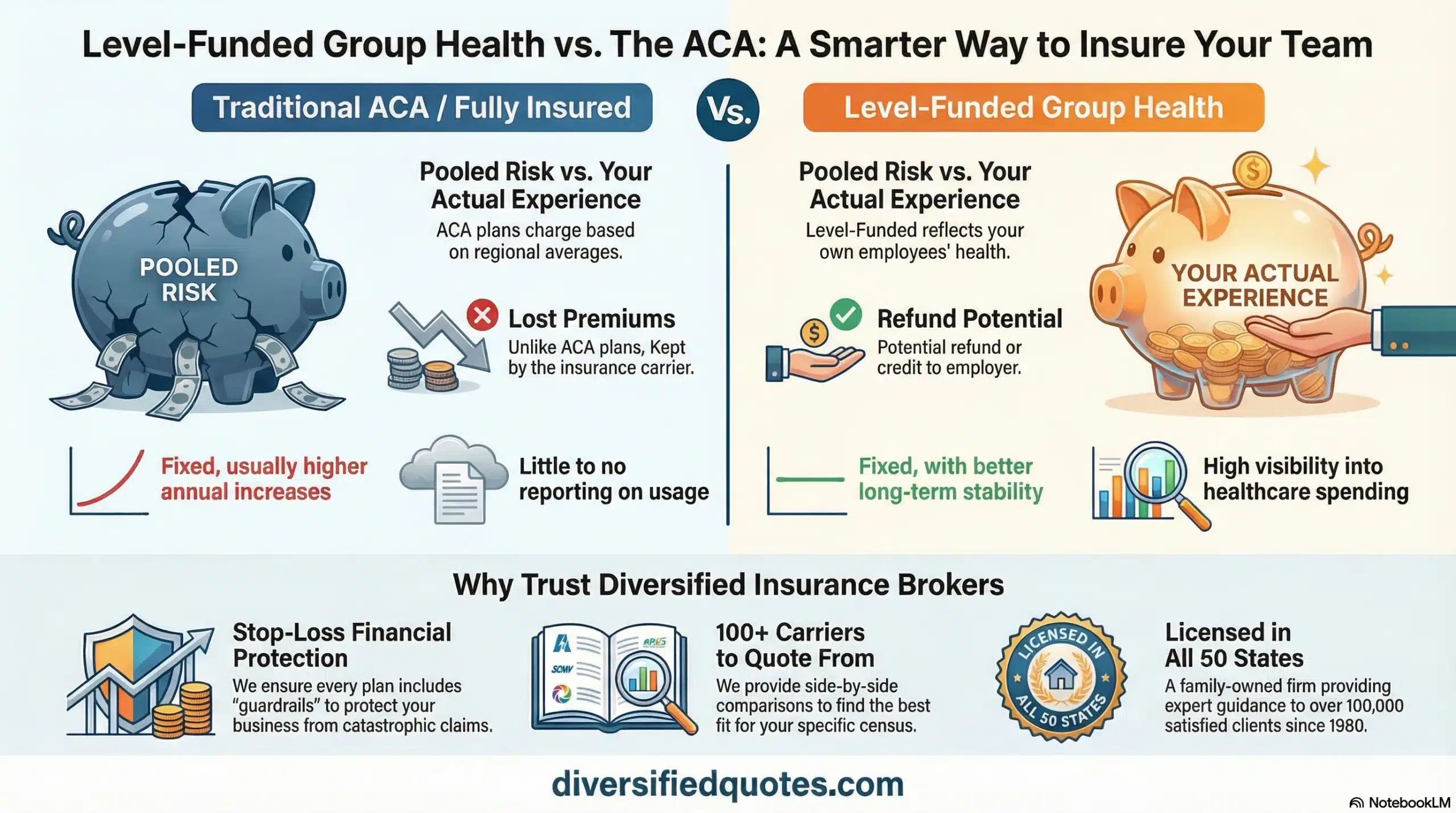
Level-funded plans combine a predictable monthly payment with a claims-funding structure and stop-loss protection. In favorable claim years, some programs can return unused claim funds as a credit or refund, depending on the contract. Level-funded can be attractive for two-person groups that want predictable billing while still aligning cost more closely to performance.
Self-funded concepts exist in the market, but for two-person groups they must be designed carefully. For very small groups, risk concentration is real: one major claim can swing results dramatically. That is why stop-loss design and plan selection matter so much if you move in this direction. If you want the framework behind the concept, revisit self-funded group health insurance and how risk is typically controlled.
For many two-person businesses, the goal is not to chase complexity—it’s to find the best balance of cost, coverage, and stability while keeping eligibility clean and underwriting-friendly.
When a Two-Person Group Plan Can Beat Individual Coverage
Two-person group plans can outperform individual plans when the individual market is narrow, expensive, or lacks strong PPO options. Many small-business owners discover that the individual exchange carriers in their area have limited networks and higher out-of-pocket exposure than they expected. If your doctors or hospitals are out-of-network on individual options, group coverage can open access.
Group plans can also create business-friendly mechanics. Employers can often contribute toward premiums and treat those contributions as a business expense. Employees can sometimes pay their share pre-tax via a Section 125 arrangement. These mechanics can reduce the “true cost” of coverage compared to paying individual premiums with after-tax dollars.
That said, group is not automatically cheaper. The right comparison is always apples-to-apples: same network tier, similar benefits, similar drug coverage, and similar out-of-pocket maximum exposure. The best plan is the one that fits your real usage patterns, not just the one with the lowest headline premium.
Benefits of Group Coverage for a 2 Person Business
Group coverage can deliver advantages that matter even for a two-person team. The value is not only about premium; it’s also about carrier access, benefit structure, and long-term flexibility.
Broader carrier access is one of the biggest benefits. Many strong PPO options and employer-style networks are not available on the individual exchange in certain areas, but they can be accessible through a group plan.
Business expense treatment can improve the effective cost of coverage. For many businesses, employer-paid premiums are treated as a business expense, which changes the math versus paying for individual coverage personally. The correct treatment depends on your entity type and how premiums are paid, but group coverage often creates cleaner employer mechanics than individual coverage.
Plan control and flexibility can also be better in group plans. Employers can often choose plan tiers, adjust contributions, and create a benefits approach that matches budget realities. Even with only two people, having control can matter if premiums are rising quickly year over year.
Recruiting and retention becomes real sooner than many owners expect. A two-person business may not be “hiring tomorrow,” but having a group plan in place can simplify growth if you add a third employee later. When you have a benefits foundation, you don’t have to scramble when hiring opportunities arise.
Compliance and Documentation for Two-Person Group Coverage
Carriers usually require documentation that proves the business is real and that both participants are eligible. The documentation required varies, but the goal is consistent: verify that the business is operating legitimately and that both people are legitimately connected to the business through payroll or ownership.
Documentation often includes proof of the entity (such as articles of incorporation or an operating agreement), proof of payroll or wages (pay stubs, payroll reports, or equivalent), and proof of tax filing or employer status (such as quarterly filings or business registration). For owners, proof of ownership and active work in the business may also be required.
If paperwork is incomplete, underwriting can stall or decline. One of the easiest ways to improve approval odds is to prepare documentation before quoting, because it prevents delays and reduces the chance of back-and-forth that causes a carrier to lose interest in the case.
If you’re unsure which documents matter most for your specific situation, we can tell you what is typically required based on your state and carrier choices so you don’t waste time gathering unnecessary items.
The Big Issue in Two-Person Plans: Risk Concentration
Two-person group coverage has one unique reality: the risk is concentrated. In a 50-person group, one high claim gets diluted. In a two-person group, one high claim can dominate the year. This is why the plan structure matters so much and why some carriers are stricter on underwriting for the smallest groups.
Risk concentration does not mean you shouldn’t pursue group coverage. It means you should pursue it intentionally. Plan design choices, carrier selection, and funding structure should match your risk profile and your preference for predictability. If stability is the priority, you may lean more fully insured or toward a conservative structure. If you want more performance-based alignment, level-funded may be worth exploring depending on carrier rules and your state.
The best strategy is to evaluate the plan as a system: premium, benefits, pharmacy, network access, and risk protection. When the system fits your reality, two-person group coverage can be both stable and efficient.
Comparison: Individual vs. 2-Person Group Coverage
| Feature | Individual Plan | 2-Person Group Plan |
|---|---|---|
| Underwriting / Pricing Basis | Based on each individual’s rating factors and market rules | Small-group rating rules plus carrier eligibility guidelines |
| Carrier / Network Access | Often limited to exchange carriers and narrower networks | May access broader PPO networks and employer-style options |
| Business Mechanics | Typically paid personally | Employer contribution and payroll mechanics may apply |
| Growth Readiness | Not designed for employer expansion | Group platform can scale if you add employees later |
Check Eligibility Before You Waste Time Quoting
We’ll verify state rules and carrier requirements first, then compare plans that actually fit.
How We Build a Two-Person Group Health Strategy
When we help a two-person business, we start by clarifying what “better” means for you. Some groups care most about premium. Others care most about keeping a specific doctor or hospital system. Others prioritize prescription coverage, predictable out-of-pocket costs, or simply avoiding the narrow networks that sometimes show up on individual plans.
Next, we confirm eligibility. That step prevents wasted time. If a carrier won’t accept a spouse-only group in your state, we’ll know before we run quotes that won’t be issued. If a carrier needs payroll documentation, we’ll tell you what qualifies as acceptable proof. If owner participation rules apply, we’ll verify how the carrier treats owners under that contract.
Then we compare structures in a way that makes sense. Fully insured may be the best fit for predictability. Level-funded may be attractive when the carrier’s rules allow it and the group profile is stable. If alternative structures are available, we’ll explain the risk control mechanics so you know what you’re choosing, not just what you’re buying.
Finally, we focus on a smooth setup. Two-person groups should be simple to implement. When eligibility is clear and documents are ready, installation is usually straightforward and the employee experience feels normal.
Ready to Qualify Your 2-Person Group?
We’ll verify eligibility, compare carriers, and help you choose a plan that protects your team and your budget.
Financial Protection Essentials
International travel protection, critical illness education, group coverage strategies, and carrier reviews.
Talk With an Advisor Today
Choose how you’d like to connect—call or message us, then book a time that works for you.
Schedule here:
calendly.com/jason-dibcompanies/diversified-quotes
Licensed in all 50 states • Fiduciary, family-owned since 1980
FAQs: 2-Person Group Health Insurance
Can two business partners qualify for group health insurance?
Yes. Most states allow a legitimate business with two non-married partners to qualify for small group coverage, provided they meet employment and documentation requirements.
Can married couples count as two employees?
Typically no. Carriers view spouses as one tax household. To qualify as a two-person group, participants must not be married to each other.
Are 1099 contractors eligible for group health insurance?
Generally not. Carriers require W-2 employees or legitimate business owners on payroll or partnership status to qualify for group coverage.
Is group health cheaper than individual plans?
Often, yes. Group plans pool risk across employees and may qualify for tax deductions that reduce the net cost compared to individual coverage.
What paperwork do I need to apply?
Carriers usually request proof of business ownership (EIN, articles of incorporation, or partnership agreement) and recent payroll documentation such as a Form 941 or pay stubs.
Can I switch from an individual plan to a group plan mid-year?
Yes, qualifying businesses can apply for group coverage at any time, even outside open enrollment, as long as all eligibility documents are provided.
About the Author:
Jason Stolz, CLTC, CRPC and Chief Underwriter at Diversified Insurance Brokers (NPN 20471358), is a senior insurance and retirement professional with more than two decades of real-world experience helping individuals, families, and business owners protect their income, assets, and long-term financial stability. As a long-time partner of the nationally licensed independent agency Diversified Insurance Brokers, Jason provides trusted guidance across multiple specialties—including fixed and indexed annuities, long-term care planning, personal and business disability insurance, life insurance solutions, Group Health, and short-term health coverage. Diversified Insurance Brokers maintains active contracts with over 100 highly rated insurance carriers, ensuring clients have access to a broad and competitive marketplace.
His practical, education-first approach has earned recognition in publications such as VoyageATL, highlighting his commitment to financial clarity and client-focused planning. Drawing on deep product knowledge and years of hands-on field experience, Jason helps clients evaluate carriers, compare strategies, and build retirement and protection plans that are both secure and cost-efficient. Visitors who want to explore current annuity rates and compare options across multiple insurers can also use this annuity quote and comparison tool.
