
Group Life Insurance

Jason Stolz CLTC, CRPC
Group life insurance is one of the most common benefits offered by employers, and for many families it becomes their “default” life insurance plan without much thought. That’s understandable. Enrollment is usually simple, payroll deductions can make premiums feel painless, and coverage often starts quickly. But group life insurance has tradeoffs that matter, especially when you change jobs, retire, reduce hours, or experience a health change that makes it harder to buy individual coverage later. At Diversified Insurance Brokers, we help people understand what group life insurance really covers, what it does not cover, and how to build a plan that remains reliable across job changes and life stages.
For some households, group life is a strong foundation. For others, it is a helpful supplement. And for many families, the smartest approach is a blended strategy: use group life for what it does best, then add an individual policy to fill the gaps that group plans often leave behind. The goal is not to criticize employer benefits. The goal is to understand the limits of group life insurance so you don’t discover them at the worst possible time.
Review Your Group Life Coverage
We’ll help you understand what you have, what happens if you leave employment, and whether adding individual coverage makes sense.
What Group Life Insurance Is (And Why It’s So Common)
Group life insurance is a life insurance policy offered through an employer or association that covers a defined group of people. In many workplaces, the employer provides a base amount of life insurance at little or no cost to the employee, and then employees can often buy additional coverage through the same program. In practice, it can feel “automatic” because it is tied to employment and enrollment windows. For busy families, that convenience is a real benefit.
Group life insurance typically comes in two broad forms: employer-paid basic life and employee-paid voluntary life. Basic life often provides a flat amount of coverage (such as $25,000 or $50,000) or a multiple of salary (such as 1x or 2x). Voluntary life allows the employee to elect additional coverage and pay premiums—commonly through payroll deduction. Some employers also offer voluntary spouse and child coverage as part of the same program.
Because group life is negotiated for a group, underwriting rules can be different than individual policies. Many group programs include a guaranteed-issue amount where employees can enroll without a medical exam (and sometimes with limited health questions). This can be especially valuable for younger employees enrolling early, or for employees who want to get some coverage in place before exploring an individual policy.
The important planning detail is that group life insurance is tied to employment. That link has pros and cons. While you are employed and eligible, it may be easy to maintain. When employment ends or eligibility changes, the plan can change or end too—often with limited options to keep the same coverage.
Why Group Life Insurance Can Fall Short for Many Families
Many people assume their group life insurance “is their life insurance.” The challenge is that group life is not always built to follow you through the real transitions of life. If you change jobs, retire, go part-time, take a leave, or become ineligible for the benefit class, group coverage can be reduced or terminated. The policy language may include conversion or portability options, but those options are not always simple, and the cost can change in ways people do not expect.
Another common issue is that group life insurance may decrease with age. It’s not unusual for a plan to reduce coverage at certain age milestones, such as in the late 60s or early 70s. That can create an uncomfortable situation: coverage drops at the exact time many families want more certainty, not less.
Group life insurance is also repriced and adjusted based on the group’s demographics and plan experience. Employers periodically renew benefits, and premium structures and plan features can change. Employees may not notice those changes until the next open enrollment, when costs increase or options shift. This is not a “bad” thing; it’s simply how group benefit economics work. But it means your long-term plan is being influenced by factors outside your household’s control.
Finally, group life insurance limits can be an issue for primary wage earners or families with large financial responsibilities. A policy that equals one year of salary may feel meaningful, but for many households it would not replace income for long. For families with a mortgage, childcare costs, long-term education goals, or a spouse who depends heavily on the primary earner’s income, group life may be a starting point rather than a complete plan.
Group Life vs. Individual Life Insurance: The Key Differences
The clearest way to evaluate group life insurance is to compare it to an individual policy that you own personally. Individual policies are built around one insured person, one owner, and defined contract guarantees. When structured correctly, individual coverage is designed to remain in force even if you change employers, change careers, or retire. Group coverage, by contrast, is built around your participation in a group and the employer’s ongoing plan.
With individual coverage, you control the carrier selection, the policy type, the term length, the underwriting process, and the features you want. With group coverage, you are selecting from what the employer offers. Sometimes that menu is great. Sometimes it’s limited. Either way, your ability to customize is usually less flexible.
Pricing behavior can differ as well. Individual term life insurance commonly offers level premiums for a fixed period (such as 10, 20, or 30 years), assuming you choose a level term structure. Group coverage can be structured as a flat rate, an age-banded rate, or a rate schedule that changes as you age or as the plan renews. That doesn’t mean group is always more expensive. It means the pricing mechanics and long-term predictability are different.
There’s also a planning mindset difference. Group life often feels like “a benefit.” Individual life insurance is usually purchased as a strategy—designed around income replacement, debt protection, family stability, and long-term financial goals. Many of our clients keep both: group life as a workplace benefit and an individual policy as the anchor that stays in place regardless of employment changes.
If you want a baseline for what individual coverage options look like, our life insurance resource hub is a useful place to explore policy types and planning scenarios, and our 20-year term life insurance and 25-year term life insurance guides can help you compare term length strategies.
Voluntary Life Insurance and Payroll Deduction Programs
In addition to employer-paid basic life insurance, many workplaces offer voluntary life insurance. Voluntary life is typically employee-paid coverage offered through the workplace, often with premiums collected through payroll deduction. For employees, the benefit is convenience. You can enroll during open enrollment, choose coverage amounts within plan limits, and pay as part of your normal payroll process.
Well-designed payroll deduction life insurance programs can also extend coverage options to family members. Some programs allow employees to purchase coverage for a spouse, dependent children, and even grandchildren, depending on eligibility rules. This can be valuable for families who want a simple baseline of protection without managing separate policies across multiple carriers.
Many payroll deduction programs are designed to reduce friction at enrollment by limiting underwriting requirements for smaller coverage amounts. It is common to see programs with “no medical exam” thresholds where a medical exam is not required, though coverage may still depend on health-related application questions. For larger coverage amounts, programs may require additional underwriting steps such as labs or exams, depending on the plan’s structure.
Another strong feature some payroll deduction programs offer is portability. Portability means the employee owns the policy and can continue coverage if they leave the employer or retire by paying premiums directly. This is an important distinction because not all group life insurance is fully portable. Some plans allow conversion to an individual policy, but the coverage amount, cost, or product type may change. When evaluating a voluntary program, portability language is one of the first items we look at.
Voluntary payroll deduction programs often include a choice of coverage types such as level term insurance, return-of-premium term designs, and whole life coverage with guaranteed cash values. Some programs also include optional riders such as accelerated benefit riders, accidental death benefits, children’s term riders, or waiver-of-premium features. These options vary by employer and by program design, but the overall planning concept remains the same: payroll deduction makes it easier for employees to implement coverage, and portability can help the policy remain meaningful even after employment changes.
How Much Group Life Insurance Do You Actually Need?
Coverage need is not a one-size-fits-all number. It depends on income, household expenses, debt obligations, dependents, and what you want the death benefit to accomplish. Some families want to replace income for a defined period so a spouse has time to adjust, children can remain stable, and major bills can be paid without disruption. Other families want coverage primarily to eliminate debts like a mortgage or to fund a specific goal such as education.
A practical way to evaluate group life insurance adequacy is to start with a simple question: “If my income stopped tomorrow, what bills would continue for the next few years?” Most households have recurring expenses—housing, utilities, food, insurance, transportation, childcare—that do not pause during grief. If your group life benefit is one year of salary, ask whether one year is enough to carry those obligations while your family rebuilds. For many households, it’s not.
Another way to evaluate is to compare coverage to your largest fixed obligations. If you have a mortgage, consider whether group life would eliminate it. If you have young children, consider the cost of childcare or the loss of one spouse’s ability to work full-time. If you have a non-working spouse, consider how long it would take for that spouse to become financially independent if the primary wage earner passed away.
When group life insurance falls short, adding an individual term policy is often the most direct solution for income replacement. Term policies are built for affordability and clarity: you choose a term length that matches your financial risk window and a benefit amount that matches your family’s responsibilities. If you’re deciding between term lengths, our 35-year term life insurance guide can help frame longer horizon planning for younger families, while other households may focus on a shorter window.
What Happens to Group Life Insurance When You Leave a Job?
Job change is one of the most important stress tests for group life insurance. If your coverage is tied to employment, you need to know what happens when employment ends. Many group plans end coverage shortly after termination. Some offer conversion options that allow you to convert to an individual policy. Some offer portability options. Some offer neither, or provide options that are limited in time and expensive.
Even when conversion is available, it can come with tradeoffs. Converted policies may be a different product type than what you had under the group. The premium may increase substantially compared to what you were paying under the group. The coverage amount may be limited. In addition, conversion windows are often time-limited—meaning you have to act quickly after leaving employment. If you miss the window, the option may be gone.
This is one reason individual coverage plays a critical role in long-term planning. If you own your own policy, job change does not create coverage disruption. Your family’s protection remains intact even if your employment situation changes. For many people, that stability is worth building into the plan early, before health changes make individual coverage more expensive or harder to obtain.
If you have a medical history that could complicate underwriting, it can be especially important to explore individual coverage sooner rather than later. If you want to understand how medical history impacts life insurance planning, our life insurance with pre-existing conditions resource can help you set realistic expectations and avoid common application mistakes.
Check Portability and Conversion Options
Not all group policies can be continued after employment ends. We’ll help you confirm your plan’s terms and the safest next steps.
Age-Based Reductions: A Hidden Problem for Many Employees
Some group life plans reduce benefits at certain ages. The logic is straightforward: mortality risk increases with age, and group plans may manage costs by reducing coverage. The problem is practical. Many people still have meaningful financial responsibilities at the age when reductions begin. A mortgage may still be in place. A spouse may still be relying on retirement income planning. Adult children may still need support. If group coverage drops in the late 60s or early 70s, families can be exposed when they least expect it.
This is one reason many households build a long-term plan that does not depend entirely on employer benefits. For some, that means an individual term policy that lasts until retirement. For others, it means layering permanent life insurance to maintain coverage for final expenses or legacy goals. The right approach depends on goals, budget, and overall retirement strategy.
Some families consider converting a portion of term coverage to a permanent policy as retirement approaches, while others maintain term coverage for a defined period and self-insure later. If conversion is part of the plan, it helps to understand how conversion works and what it means for future premiums and underwriting. Our guide on converting term to permanent life insurance can help frame this strategy.
Guaranteed Issue in Group Plans: Helpful, But Not a Complete Solution
Many group plans offer guaranteed issue coverage, especially at initial enrollment or during major life events. Guaranteed issue can be valuable because it may allow employees to obtain coverage without a medical exam and with minimal health screening, up to a certain amount. For employees who have not purchased individual coverage yet, this can be a strong starting point.
The limitation is that guaranteed issue amounts are often not enough to meet full family needs. A guaranteed issue amount might provide meaningful protection for final expenses or partial income replacement, but it may not fully protect a household’s long-term obligations. Also, guaranteed issue availability can be tied to enrollment timing. If you skip enrollment and try to enroll later, you may face evidence-of-insurability requirements.
This is where a balanced strategy helps. You can use group guaranteed issue to create a baseline and then build an individual policy for the larger portion of the need. That allows you to keep the simplicity of group coverage while building portability and long-term stability through individual coverage.
Common Mistakes People Make With Group Life Insurance
Assuming the coverage follows you forever is the first and most common mistake. Many people don’t realize how quickly coverage can end after employment changes or retirement. If your group plan is not truly portable or if conversion is expensive, the “forever coverage” assumption can be costly.
Underestimating coverage needs is another common issue. A one-year salary benefit sounds meaningful, but many families need more time and resources to stabilize. If the primary wage earner passes away, the financial transition can last years, not months.
Waiting until later to buy individual coverage is also a frequent problem. If health changes or new diagnoses occur, individual insurance can become more expensive or harder to obtain. Many people plan to “get individual coverage later” and never do—until they need it and discover it’s more difficult than expected.
Not understanding supplemental voluntary options can also leave coverage on the table. Some employers offer voluntary payroll deduction life insurance that is individually owned and portable, with optional riders and simplified underwriting. Employees may skip these options because they’re busy or assume basic life is enough.
Not coordinating benefits for a spouse and children can create household imbalance. Some families insure the employee but leave a spouse underinsured, even if the spouse provides childcare, household management, or income. A well-designed plan considers the financial impact of losing either spouse.
What Business Owners Should Know About Offering Group or Voluntary Life
If you are a business owner, offering group life insurance can be a meaningful benefit that supports employee retention and family stability. Many employers choose a basic group life policy and then add voluntary options. Voluntary payroll deduction programs can be attractive because they may offer simplicity and low administrative burden while still giving employees access to coverage they can own personally.
From an employee perspective, low-pressure enrollment and clear portability can matter. From an employer perspective, a voluntary option can expand employee access to coverage without requiring the employer to pay for large benefit amounts. The key is transparency: employees should understand whether coverage is portable, whether premiums change with age, how much guaranteed issue is available, and what happens at retirement.
We often help business owners evaluate options across group designs and voluntary designs so the benefit program matches workforce demographics and administrative preferences. The best workplace benefit is the one employees understand and can actually use effectively.
How to Build a Smart “Group + Individual” Coverage Plan
A strong plan starts with clarity. Confirm your group benefit amount, whether it is a flat benefit or salary multiple, and whether it reduces with age. Confirm whether voluntary supplemental coverage is available, and whether it is portable. Then identify what your household actually needs if income stopped tomorrow.
Once you know the gap, decide how you want to fill it. Most families use individual term insurance for the gap because it can provide large benefit amounts at a predictable level premium for a defined period. The term length should match the years when your family is most exposed: mortgage years, child-raising years, and peak income dependency years.
For some families, it also makes sense to add a smaller permanent policy to create coverage that lasts beyond the term window. This can be useful for final expenses, legacy goals, or estate planning needs. The correct mix depends on household goals and budget.
If you want to understand how underwriting, exams, and application steps can affect outcomes, our guide on what a life insurance exam is can help set expectations and reduce surprises during the application process.
Group Life Insurance FAQs People Ask (Without the “Fine Print” Confusion)
People typically ask whether group life is “enough,” whether it’s cheaper than individual insurance, and what happens if they leave a job. The simplest answer is that group life can be a useful foundation, but it should be evaluated like any other financial tool: how long does it last, what can change, and what happens in the scenarios that matter most.
If your group plan is stable, generous, and truly portable, you may rely on it more heavily. If the plan is small, subject to reduction, unclear on portability, or likely to end at retirement, building an individual anchor policy is often the safer long-term move.
Another question we hear often is whether group coverage is “guaranteed.” While group plans can make enrollment easier, eligibility rules still matter. Coverage can end if you are no longer actively at work or if you move out of the eligible class. These rules can be especially important during medical leaves, disability periods, or employment transitions.
Finally, many people wonder whether they should buy voluntary coverage for a spouse and children through work. That can be helpful, especially if the program offers individually owned policies with clear portability. The key is to coordinate coverage so the household is protected in a balanced way, not just the employee.
Make Sure Your Coverage Survives Job Changes and Retirement
If group coverage reduces or ends later, an individual plan can keep your family protected without relying on employer eligibility.
Related Life Insurance Pages
Explore term length choices, underwriting topics, and planning guides to build coverage that lasts beyond workplace benefits.
Related Planning Topics
Use these related resources to understand underwriting, conversion strategies, and coverage planning for medical history.
Talk With an Advisor Today
Choose how you’d like to connect—call or message us, then book a time that works for you.
Schedule here:
calendly.com/jason-dibcompanies/diversified-quotes
Licensed in all 50 states • Fiduciary, family-owned since 1980
FAQs: Group Life Insurance
What is group life insurance?
Group life insurance is coverage offered through an employer or association that insures a group of eligible employees. Many plans include employer-paid basic life insurance and optional employee-paid supplemental (voluntary) coverage.
Is group life insurance enough for most families?
Often it is a helpful foundation, but not always enough by itself. Many employer plans provide a flat amount or a salary multiple that may not fully replace income, pay off a mortgage, or cover long-term obligations. Many families add an individual policy to close the gap.
What is the difference between basic life and voluntary (supplemental) group life?
Basic life is commonly employer-paid coverage with a set benefit amount. Voluntary life is additional coverage you elect and pay for, often through payroll deduction, and it may also offer spouse and child options.
What happens to my group life insurance if I leave my job?
Coverage usually ends when employment ends or eligibility changes, unless the plan offers portability or conversion. Portability may allow you to continue coverage by paying premiums directly, while conversion may allow a switch to an individual policy under specific rules and time limits.
What is the difference between portability and conversion?
Portability typically means you can keep coverage in place after leaving by continuing premium payments, often under the same general plan structure. Conversion typically means you can convert to an individual policy after leaving employment, but the product type and pricing may change.
Does group life insurance require a medical exam?
Many group plans offer a guaranteed-issue amount that may not require a medical exam, especially when enrolling as a new hire or during open enrollment. Higher coverage amounts may require evidence of insurability, which can include health questions and sometimes exams.
Can group life insurance be reduced as I get older?
Some plans reduce coverage at certain ages, such as in the late 60s or early 70s. It depends on the employer’s plan design. This is one reason many families want at least some individually owned coverage that does not depend on employer rules.
Is group life insurance cheaper than individual life insurance?
It depends. Group life can feel inexpensive because employers often subsidize basic coverage and payroll deduction spreads the cost. Individual level-term insurance can be very cost-effective for larger benefit amounts and offers long-term predictability and portability.
Should I rely on group life if I have a health condition?
Group coverage can be valuable if you qualify for guaranteed-issue amounts. However, relying exclusively on group life can create risk if coverage ends with employment. Many people explore adding an individual policy while they are still healthy enough to qualify.
How much life insurance should I have beyond my group plan?
That depends on income replacement needs, debt obligations, dependents, and goals. A common approach is to treat group life as a baseline and then add individual coverage to protect the highest-risk years (mortgage and child-raising years).
About the Author:
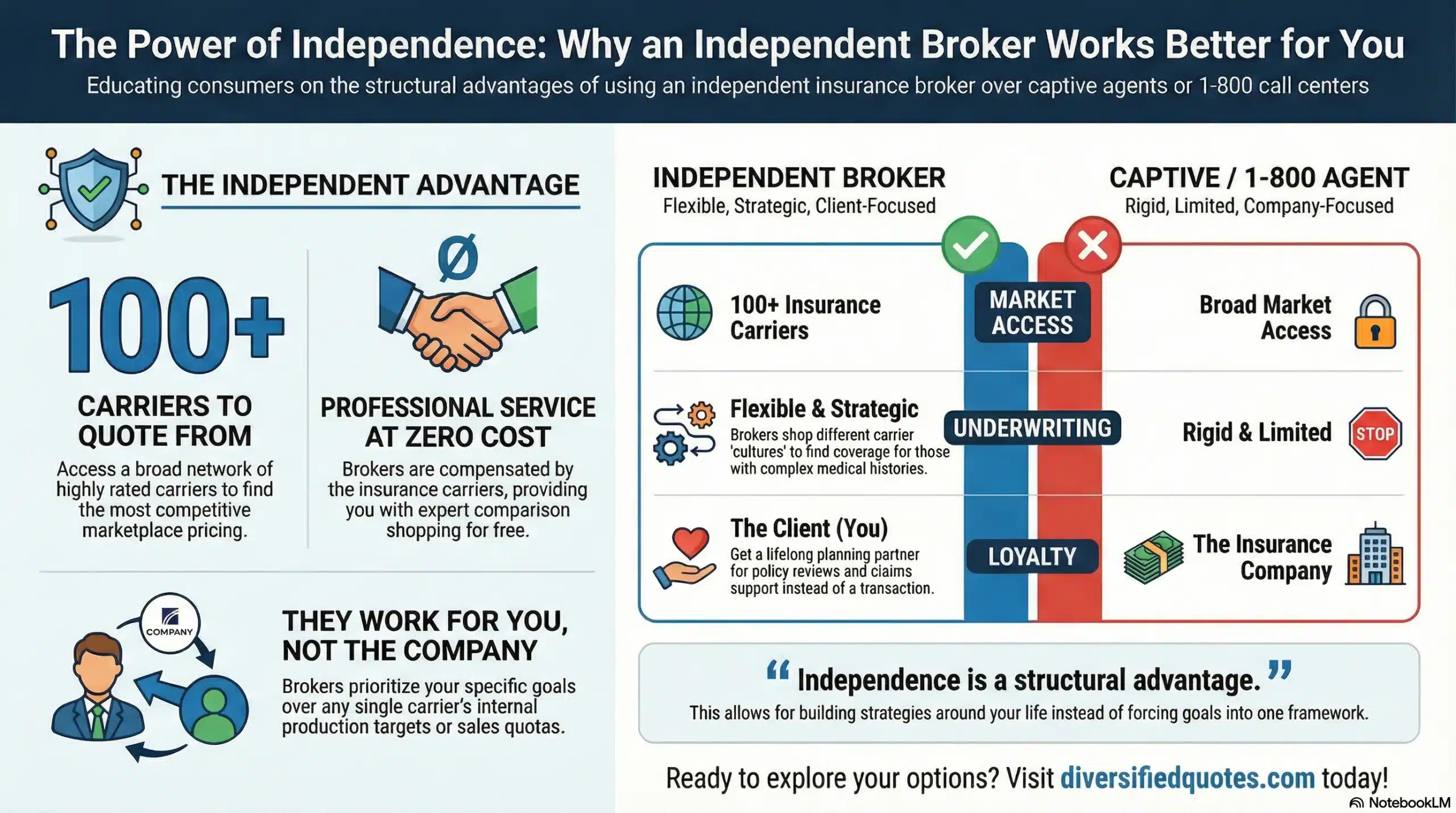
Jason Stolz, CLTC, CRPC, is a senior insurance and retirement professional with more than two decades of real-world experience helping individuals, families, and business owners protect their income, assets, and long-term financial stability. As a long-time partner of the nationally licensed independent agency Diversified Insurance Brokers, Jason provides trusted guidance across multiple specialties—including fixed and indexed annuities, long-term care planning, personal and business disability insurance, life insurance solutions, and short-term health coverage. Diversified Insurance Brokers maintains active contracts with over 100 highly rated insurance carriers, ensuring clients have access to a broad and competitive marketplace.
His practical, education-first approach has earned recognition in publications such as VoyageATL, highlighting his commitment to financial clarity and client-focused planning. Drawing on deep product knowledge and years of hands-on field experience, Jason helps clients evaluate carriers, compare strategies, and build retirement and protection plans that are both secure and cost-efficient.
