
Guaranteed Income at age 60

Jason Stolz CLTC, CRPC
At Diversified Insurance Brokers, we understand that reaching age 60 often changes the way you think about money. The focus typically shifts from growth at all costs to reliability, stability, and income you can count on. Guaranteed income at age 60 isn’t just about locking in a payout percentage — it’s about designing a retirement paycheck that supports the next 25–35 years of your life without forcing you to depend entirely on market performance. Whether you are planning to retire immediately, phase into part-time work, or bridge the years before Social Security and Medicare, the structure of your income matters just as much as the amount.
Many pre-retirees arrive at age 60 with substantial assets in IRAs, 401(k)s, brokerage accounts, or pension rollover accounts but no clear plan for turning those balances into predictable monthly income. A portfolio can generate withdrawals, but withdrawals are not guarantees. Market volatility, sequence-of-returns risk, and emotional decision-making can erode confidence quickly. That’s why many retirees explore whether shifting a portion of assets into a guaranteed income annuity can provide the psychological and financial stability that investment-only strategies sometimes lack.
When we talk about “guaranteed income at age 60,” we are typically referring to an annuity structure that provides contractual lifetime income beginning at or around age 60. Depending on the product design, that income may be immediate or deferred for several years to increase the payout amount. Some retirees want income to begin immediately to replace employment income. Others want to defer until 62, 65, or even 70 to coordinate with Social Security timing and maximize lifetime payout factors. The right design depends on your timeline, liquidity needs, and whether income is intended to cover essential expenses only or your full lifestyle.
Compare Guaranteed Income Options at Age 60
Review current annuity structures, payout ranges, and income rider designs from top-rated carriers.
Before choosing a guaranteed income structure, it helps to clarify what role the income will play in your plan. Some clients want to replicate a pension by covering housing, utilities, insurance premiums, and food with guaranteed dollars. Others want income only to supplement Social Security, leaving investment accounts available for discretionary spending or legacy planning. The more precisely you define the purpose of the income, the easier it becomes to compare product designs objectively.
One of the most common questions we hear is: “How much income can I actually get at 60?” The answer depends on your premium amount, whether income is single life or joint life, whether withdrawals begin immediately or are deferred, and whether an income rider is used. If you want a deeper breakdown of payout mechanics, you can review how much income an annuity can pay and how payout factors are determined. The short version is this: annuities convert assets into contractual income streams, and the math is driven by age, actuarial assumptions, and contract structure.
For example, if a 60-year-old invests $1,000,000 into a lifetime income annuity, the payout may be structured as level lifetime income or joint lifetime income for a married couple. If income is deferred for five years instead of starting immediately, the contractual payout amount may increase significantly because the carrier has fewer expected payout years. But deferral only makes sense if you do not need the income right away. Timing decisions change outcomes more than many retirees realize.
Another important distinction is the difference between annuitization and income riders. Annuitization permanently converts your premium into an income stream, typically giving up access to the remaining principal in exchange for lifetime payments. Income riders, on the other hand, define a guaranteed withdrawal amount while keeping the underlying contract active. Each structure has trade-offs involving flexibility, death benefits, and liquidity. There is no universally superior approach — only the one that fits your objectives best.
Estimate Guaranteed Lifetime Income
Use this tool to model income starting at age 60 or later. Then request a personalized illustration to confirm carrier-specific results.
Beyond the payout number itself, you’ll also want to evaluate liquidity rules. Most income-focused annuities allow annual penalty-free withdrawals up to a defined percentage, commonly 10% after the first contract year. Withdrawals above that amount during the surrender period may trigger surrender charges. If flexibility is critical — for example, if you anticipate large lump-sum expenses — contract design matters just as much as payout size.
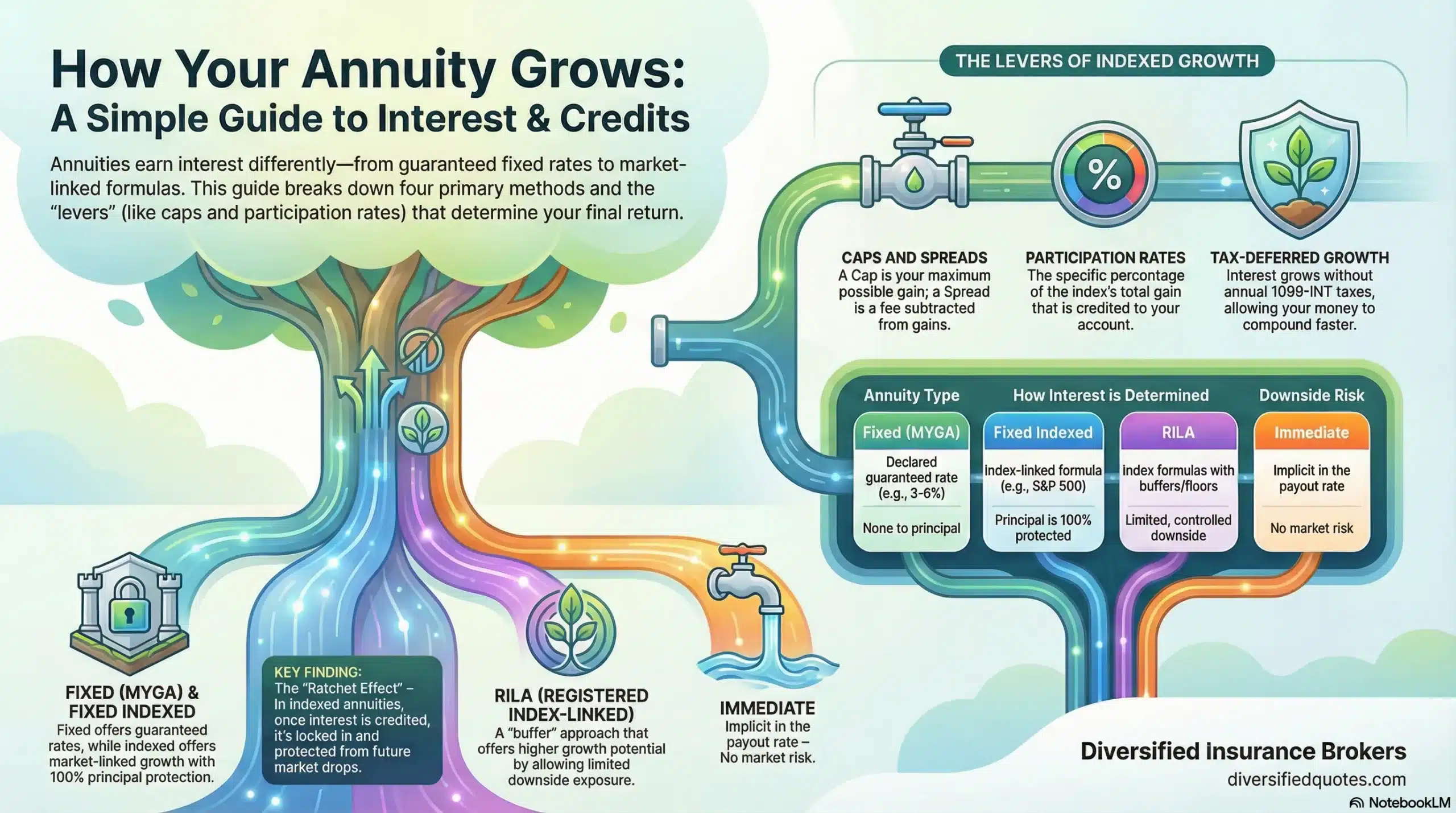
It also helps to compare guaranteed income strategies against simpler alternatives. In some cases, a multi-year guaranteed annuity (MYGA) may provide predictable accumulation without committing to lifetime withdrawals. In other cases, a fixed indexed annuity with a rider may produce higher long-term income. If you want to compare guaranteed-rate alternatives, you can review highest guaranteed annuity rates to see how fixed-rate structures differ from income-driven designs.
Another major consideration at age 60 is Social Security timing. Some retirees use annuity income as a bridge strategy, allowing them to delay Social Security to increase future monthly benefits. Others coordinate income so that annuity payments and Social Security together create a strong lifetime floor. The decision should be evaluated holistically, not in isolation.
Market risk is often the catalyst that pushes retirees toward guaranteed income. If you want to revisit how indexed annuities protect principal from market downturns, you can review how fixed indexed annuities protect against market losses. Principal protection can reduce stress during volatile years — especially early in retirement when withdrawals can amplify portfolio damage.
That said, guaranteed income should not automatically replace all investment exposure. Many retirees build a “floor and upside” approach: guaranteed income covers essential expenses, while market-based investments fund growth and discretionary spending. The balance between these components depends on risk tolerance, other income sources, and legacy goals.
Design Your Guaranteed Income Plan at Age 60
See side-by-side income comparisons based on your age, premium, and income start date.
Retirement Income & Account Transition Planning
Explore rollover decisions and income strategies across retirement account types.
Advanced Retirement & Income Strategy Topics
Deepen your understanding of diversification, Medicare timing, and income planning mechanics.
Talk With an Advisor Today
Choose how you’d like to connect—call or message us, then book a time that works for you.
Schedule here:
calendly.com/jason-dibcompanies/diversified-quotes
Licensed in all 50 states • Fiduciary, family-owned since 1980
FAQs: Guaranteed Income at Age 60
What does “guaranteed income at age 60” mean?
It means converting part of your savings into a contractual income stream that can begin around age 60 and pay for a defined period or for life, depending on the payout option you select.
Is an annuity the only way to create guaranteed income?
No. Social Security and pensions are also forms of guaranteed income. Annuities are commonly used to create a “personal pension” when employer pensions are limited or unavailable.
How is my payout amount determined?
Payouts depend on your age, the premium amount, the carrier, the payout option (single vs joint life, period certain, refund features), and whether income starts immediately or after a deferral period.
Will guaranteed income payments increase with inflation?
Some options are level payments; others may offer increasing income features or step-up designs. Whether increases apply—and how they’re calculated—depends on the product and payout option.
What if I need access to principal later?
Liquidity depends on the product design. Some contracts have penalty-free withdrawal features while others are more restrictive, especially once income is irrevocably turned on. Matching liquidity needs to product design is a key part of the planning process.
How can guaranteed income help me delay Social Security?
Some retirees use annuity income to fund the “gap years” so they can delay Social Security longer and potentially increase the monthly benefit. The best approach depends on your health, household income needs, and other assets.
Is “8% payout at age 60” realistic?
Payout levels vary widely by carrier, state, payout option, and timing. Rather than relying on a single percentage, it’s best to compare real illustrations for your age, premium, and desired income start date.
What happens to beneficiaries if I die early?
It depends on the payout option you select. Options like period-certain or refund features can provide remaining value to beneficiaries, while some maximum-income lifetime options may not.
Can I use IRA or 401(k) money to fund an annuity?
Many annuities can be funded with qualified retirement dollars via rollover. The structure and tax treatment depend on whether the annuity is inside a retirement account and how distributions are taken.
What information do I need to get an accurate guaranteed income quote?
Typically: your age (and spouse’s age if joint), state, premium range, when you want income to start, whether you want single or joint lifetime income, and whether liquidity or beneficiary features are important.
About the Author:
Jason Stolz, CLTC, CRPC and Chief Underwriter at Diversified Insurance Brokers (NPN 20471358), is a senior insurance and retirement professional with more than two decades of real-world experience helping individuals, families, and business owners protect their income, assets, and long-term financial stability. As a long-time partner of the nationally licensed independent agency Diversified Insurance Brokers, Jason provides trusted guidance across multiple specialties—including fixed and indexed annuities, long-term care planning, personal and business disability insurance, life insurance solutions, Group Health, and short-term health coverage. Diversified Insurance Brokers maintains active contracts with over 100 highly rated insurance carriers, ensuring clients have access to a broad and competitive marketplace.
His practical, education-first approach has earned recognition in publications such as VoyageATL, highlighting his commitment to financial clarity and client-focused planning. Drawing on deep product knowledge and years of hands-on field experience, Jason helps clients evaluate carriers, compare strategies, and build retirement and protection plans that are both secure and cost-efficient. Visitors who want to explore current annuity rates and compare options across multiple insurers can also use this annuity quote and comparison tool.
