
How Lawsuit Loans Work – Fast Cash Advances Explained

Jason Stolz CLTC, CRPC
When you’re in the middle of a legal case, financial pressure can build quickly. Medical bills, rent, utilities, transportation, and everyday living expenses don’t pause just because your lawsuit is still pending. For many plaintiffs, understanding how lawsuit loans work is the first step toward regaining financial stability while waiting for a settlement or court decision.
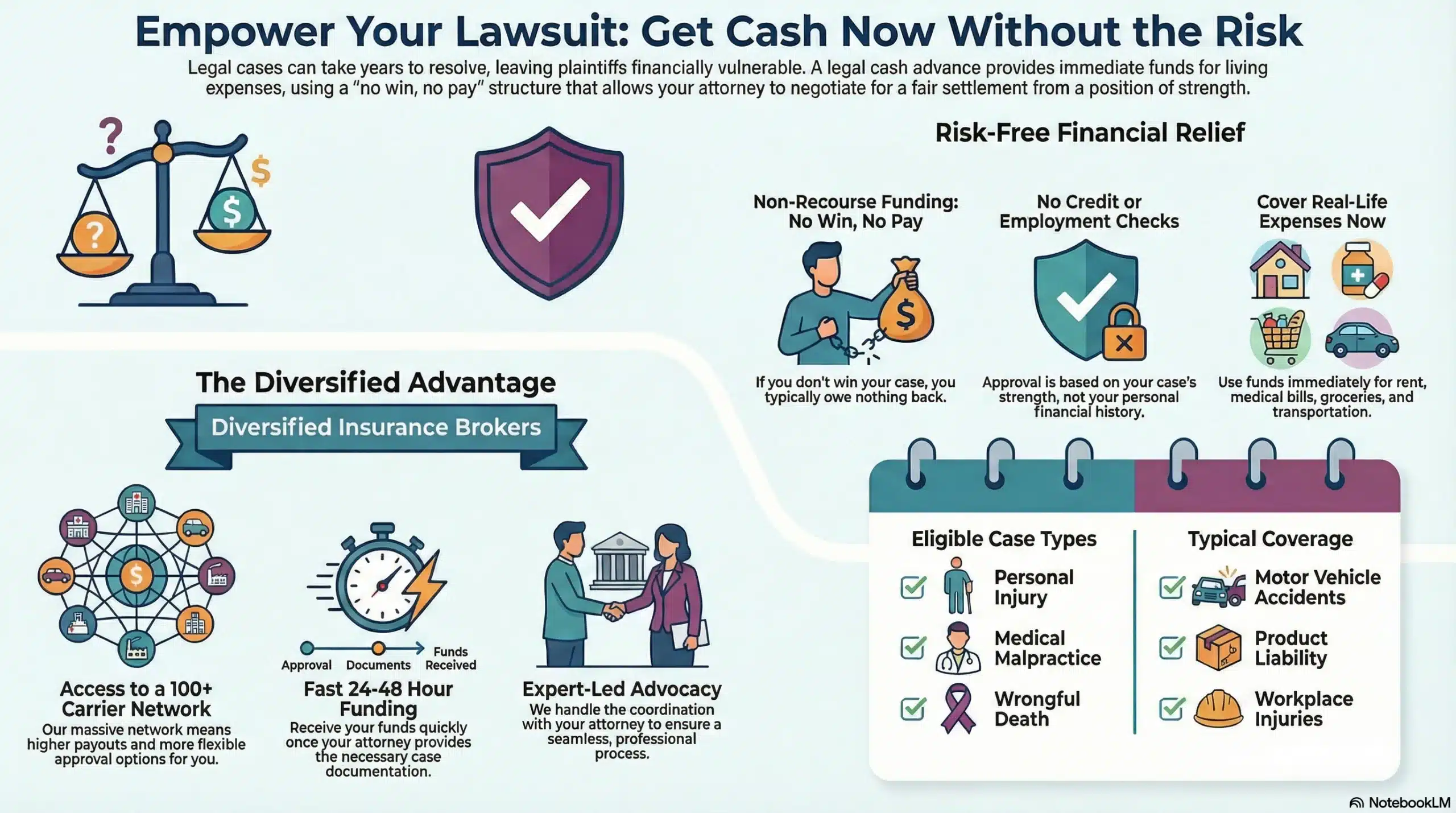
Despite the name, lawsuit loans are not traditional loans. They are better described as non-recourse pre-settlement cash advances. That distinction matters. Instead of being based on your credit score, employment history, or income, approval is based almost entirely on the strength and expected value of your legal claim. If your case is successful, repayment comes from the settlement or judgment. If your case does not recover any money, you typically owe nothing.
This structure allows injured plaintiffs to access money now—without monthly payments, credit checks, or personal liability—while their attorney continues working toward a fair outcome.
Need Cash While Your Lawsuit Is Pending?
Explore non-recourse funding options with no monthly payments and repayment only if you recover.
What a Lawsuit Loan Really Is
A lawsuit loan is a cash advance provided to plaintiffs who have an active, attorney-represented legal claim. The advance is secured by the anticipated settlement or judgment—not by your personal assets or creditworthiness. Because it is non-recourse, repayment occurs only if your case results in a financial recovery.
This is fundamentally different from bank loans, payday loans, or personal lines of credit. With those products, repayment is required regardless of outcome, and missed payments can damage credit or lead to collections. Lawsuit funding removes that personal financial risk.
Instead of asking, “Can you afford to repay this loan?” funders ask, “Is this case likely to recover money, and how much?” That shift in focus is what makes pre-settlement funding accessible to plaintiffs who might otherwise have no realistic borrowing options.
Why Plaintiffs Use Lawsuit Loans
Legal cases—especially personal injury and liability claims—often take months or even years to resolve. During that time, plaintiffs may be unable to work, face mounting medical costs, or struggle to keep up with basic household expenses.
Insurance companies and defendants are well aware of this financial pressure. In many cases, delays are strategic. The longer a case drags on, the more likely a financially stressed plaintiff may accept a lower settlement just to get money in hand.
Pre-settlement funding helps level the playing field. By securing cash now, plaintiffs can avoid desperation-driven decisions and give their attorney the time needed to pursue the full value of the claim.
Common Expenses Covered by Pre-Settlement Funding
Clients use lawsuit loan proceeds for a wide range of essential needs, including:
• Rent or mortgage payments • Utilities and household bills • Groceries and daily living costs • Medical co-pays and treatment expenses • Transportation and vehicle payments • Childcare and family support obligations
By stabilizing day-to-day finances, plaintiffs can focus on recovery and legal strategy rather than short-term survival.
The Step-by-Step Lawsuit Loan Process
Understanding how lawsuit loans work also means understanding the approval process. While details vary by funder and case type, the general process follows a predictable path.
Step 1: Application
You complete a short application providing basic information about your case and your attorney. There is no credit check, income verification, or employment requirement.
Step 2: Attorney Verification
The funding provider contacts your attorney to confirm representation, liability facts, damages, insurance coverage, and estimated case value.
Step 3: Case Evaluation
Underwriters assess the strength of the claim, likelihood of recovery, expected timeline, and jurisdiction. This determines approval and advance size.
Step 4: Funding
If approved, you review and sign the funding agreement. Funds are typically sent via ACH or wire—often within 24 to 48 hours.
Types of Cases That Commonly Qualify
Lawsuit loans are most commonly available for cases with clear liability and insurance-backed recovery potential, including:
• Auto, truck, and motorcycle accidents • Slip and fall and premises liability claims • Workplace injury cases (third-party claims) • Medical malpractice lawsuits • Product liability cases • Wrongful death claims
Cases involving speculative damages, disputed liability, or limited insurance coverage may be more difficult to fund.
How Advance Amounts Are Determined
Funding amounts are typically limited to a percentage of the estimated net settlement value after accounting for attorney fees and liens. This conservative approach protects both the plaintiff and the funder.
Key factors include:
• Strength of liability evidence • Documented medical treatment and damages • Available insurance limits • Jurisdiction and venue tendencies • Estimated time to resolution
Borrowing responsibly is critical. Taking more funding than necessary can significantly reduce your net recovery later.
Costs, Fees, and Transparency
Lawsuit loans can be expensive compared to traditional credit, primarily because they carry significant risk for the funder. If your case fails, the funder absorbs the loss.
That said, reputable providers disclose all costs up front. There are no application fees and no out-of-pocket payments while the case is pending. Repayment—advance plus agreed fees—comes from settlement proceeds through your attorney’s trust account.
Before signing, plaintiffs should always request projected payoff amounts at multiple time intervals and review them with counsel.
Will a Lawsuit Loan Affect My Case?
Pre-settlement funding does not change liability, damages, or legal strategy. It does not give funders control over settlement decisions, and they cannot force a case to settle.
In many situations, access to funding actually strengthens negotiation posture by reducing financial urgency. Your attorney remains fully in control of the case at all times.
When Lawsuit Loans Make Sense—and When They Don’t
Lawsuit loans are best suited for plaintiffs facing genuine financial strain who expect a favorable outcome but need time. They are not ideal for short cases, low-value claims, or situations where alternative support is available at lower cost.
Used strategically and conservatively, pre-settlement funding can be a powerful financial bridge. Used recklessly, it can erode settlement proceeds.
Understanding how lawsuit loans work allows plaintiffs to make informed decisions instead of reactive ones.
Related Lawsuit Funding Resources
Explore additional guides and funding options to help you manage finances while your case is pending.
Financial Protection Essentials
Carrier reviews, occupational disability planning, supplemental accident protection, and senior-focused burial options.
Talk With an Advisor Today
Choose how you’d like to connect—call or message us, then book a time that works for you.
Schedule here:
calendly.com/jason-dibcompanies/diversified-quotes
Licensed in all 50 states • Fiduciary, family-owned since 1980
FAQs: How Lawsuit Loans Work
Are lawsuit loans real loans?
No. They are non-recourse cash advances, not traditional loans. Repayment only occurs if your case results in a recovery.
Do I need good credit to qualify?
No. Approval is based on your case strength, not your credit score, income, or employment history.
What happens if I lose my case?
If your case does not result in a settlement or judgment, you typically owe nothing under a non-recourse agreement.
How fast can I receive funds?
Many plaintiffs receive funding within 24–48 hours after attorney verification and approval.
Will a lawsuit loan reduce my settlement?
The loan does not reduce case value, but repayment comes from your proceeds. Borrowing conservatively helps preserve net recovery.
Can I get more than one advance?
In some cases, additional funding may be available if the case value supports it and your attorney agrees.
About the Author:
Jason Stolz, CLTC, CRPC and Chief Underwriter at Diversified Insurance Brokers, is a senior insurance and retirement professional with more than two decades of real-world experience helping individuals, families, and business owners protect their income, assets, and long-term financial stability. As a long-time partner of the nationally licensed independent agency Diversified Insurance Brokers, Jason provides trusted guidance across multiple specialties—including fixed and indexed annuities, long-term care planning, personal and business disability insurance, life insurance solutions, and short-term health coverage. Diversified Insurance Brokers maintains active contracts with over 100 highly rated insurance carriers, ensuring clients have access to a broad and competitive marketplace.
His practical, education-first approach has earned recognition in publications such as VoyageATL, highlighting his commitment to financial clarity and client-focused planning. Drawing on deep product knowledge and years of hands-on field experience, Jason helps clients evaluate carriers, compare strategies, and build retirement and protection plans that are both secure and cost-efficient.
