
How Much Life Insurance Do I Need

Jason Stolz CLTC, CRPC
How much life insurance do I need? It’s a simple question with life-changing consequences. If you buy too little, your family may be forced into decisions they never should have to make—selling a home, draining retirement accounts, pulling kids out of activities, or taking on debt just to stay afloat. If you buy too much, you can end up paying for coverage that doesn’t match your timeline, your obligations, or your actual risk. The goal is not a “big number.” The goal is the right number—coverage that protects the people who rely on you for exactly as long as they need it, without wasting money along the way.
At Diversified Insurance Brokers, we help families and business owners build clear, practical life insurance plans. That usually means starting with a needs analysis—income replacement, debts, dependents, time horizon—and then turning that into a structured approach (often using term life) that fits your budget. This page will walk you through that process in a way you can actually use, then you can model real pricing using the embedded Life Insurance Calculator below.
Estimate Coverage + Compare Real Quotes
Use this page to estimate how much coverage you need, then run the calculator to compare rates from multiple carriers.
Why “10× Income” Is a Starting Point, Not an Answer
You’ll often hear rules of thumb like “buy ten times your income” or “buy enough to pay off the mortgage.” Those shortcuts can be helpful for quick thinking, but they’re incomplete because they don’t address duration or purpose. A 42-year-old with three kids, a single household income, and a 25-year mortgage is in a different situation than a 42-year-old with no dependents, a paid-off home, and significant savings. Both may earn the same income. Their life insurance needs can still be radically different.
What you’re truly measuring is financial dependency. If you weren’t here tomorrow, what financial value disappears, and what obligations remain? For most households, the biggest dependency is income. But there are also debts, childcare costs, education planning, retirement timing, and, for many families, the desire to keep options open so survivors aren’t forced into rushed decisions. When you design life insurance around those real-world realities, the coverage amount and term length become much clearer.
Step 1: Calculate Income Replacement in a Way That Matches Real Life
Income replacement is the foundation of most life insurance planning. The question isn’t just “how much do I make?” It’s “how long would my family rely on my income to maintain stability?” That timeframe is usually tied to children reaching adulthood, a spouse reaching retirement, or a major debt like a mortgage being paid down. Many families want to replace income for 10, 15, 20, or 25 years because those timeframes align with the years they’re most financially exposed.
A common approach is to target a replacement range such as 10–12× annual income. That range often works for families with young children and limited savings, because it can provide a long runway. But it may be too high if you already have significant assets, and it may be too low if your household has a large single-income dependency and high fixed costs. This is why we encourage people to treat “10× income” as a starting estimate, then adjust based on debts, savings, and how much stability you want to create for a survivor.
It’s also important to think about how a surviving spouse would realistically respond. Many survivors return to work sooner, work longer, or change work hours. Others need more time at home, especially with younger children. The right coverage amount is the one that supports a realistic transition without forcing immediate lifestyle changes.
Step 2: Add Debts and Obligations That Would Change a Survivor’s Life
After income, debts are the most common factor. The mortgage is the biggest one for many families. Some people want life insurance to pay off the mortgage entirely so the family can remain in the home without financial stress. Others prefer partial mortgage coverage, using the insurance benefit to cover payments while keeping assets invested. Either approach can work—the key is understanding what the mortgage payment represents in your household budget and how painful it would be without your income.
Student loans, credit balances, auto loans, and personal loans can also matter, especially if they would fall to a spouse or co-signer. For business owners, life insurance needs can include personally guaranteed business debts or obligations that might survive you. Those liabilities aren’t always obvious, which is why many owners evaluate coverage alongside broader planning topics like group vs. individual life insurance, where employer coverage may not be portable or sufficient for real obligations.
Debt planning is not about paying off every dollar in existence. It’s about removing the debts that would materially reduce a survivor’s ability to maintain stability, keep children in the same schools, and preserve retirement savings.
Step 3: Include Childcare and the “Invisible Income” of a Non-Working Spouse
Life insurance isn’t only for the person who earns the paycheck. A stay-at-home parent provides enormous economic value through childcare, scheduling, meal planning, household management, transportation, and day-to-day logistics. If that parent were gone, the surviving spouse might need to pay for childcare, reduce work hours, or hire help. That can be expensive, and it can last for years—especially with younger children.
This is why it often makes sense to insure both spouses, even if one is not working outside the home. Coverage on a non-working spouse is less about replacing wages and more about replacing services and preserving flexibility. It gives the surviving spouse options: the ability to buy time, maintain routine, and make decisions without immediate financial pressure.
If you’re building coverage on both spouses, you’ll often structure it differently—more income replacement on the primary earner, and more “support and stability” coverage on the non-working spouse. The amounts are different, but the purpose is equally important.
Step 4: Decide How Much (If Any) to Allocate to Education Funding
College funding is a frequent part of life insurance discussions, but it’s not mandatory to include it. Some families want life insurance to fully fund future education costs because it’s a high priority and they want certainty. Others prefer to prioritize household stability and let education decisions adapt to circumstances. Both approaches can be rational.
The best approach is to be intentional. If you want education funding protected, include a defined number in the plan rather than vaguely assuming “it’ll work out.” If your priority is keeping the family financially stable, focus first on income replacement and housing security. In practice, many families choose a blended strategy: protect stability first, and add some additional coverage to keep education options available.
Step 5: Choose the Right Term Length Based on When the Risk Declines
Coverage amount is only half the decision. Term length is the other half. Most life insurance needs are temporary: kids grow up, mortgages get paid down, retirement accounts grow, and your household becomes less financially dependent on your income. Term life is designed to match that reality: high protection during the highest-risk years, at the lowest cost.
If your biggest risk window is the next 20 years—until children are grown and the mortgage is mostly paid—then a 20-year term often fits naturally. If you’re closer to retirement or have older children, 10- or 15-year coverage may be sufficient. If you want maximum stability through a long transition, 25- or 30-year terms can be appropriate. For people thinking about moving from term to longer coverage later, it’s worth understanding how conversion works. Our page on converting term to permanent life insurance is a helpful companion resource.
Many families also use a ladder strategy—two policies with different term lengths—so coverage steps down as obligations shrink. That approach can reduce cost while preserving protection in the years you need it most. If you’re comparing different underwriting approaches, it’s also useful to understand how “instant decision” models differ from traditional term life underwriting. You can see that discussed in the context of online carriers on Is Ladder Life a Good Insurance Company, which explains how simplified underwriting can affect pricing, limits, and long-term flexibility.
Step 6: Understand Underwriting, Because Rate Class Changes Everything
Two people can buy the same coverage amount and term length and pay completely different premiums. That’s because life insurance is priced primarily by underwriting class: age, build, blood pressure, cholesterol, family history, nicotine use, medications, driving record, and other risk factors. When you use a calculator, you’ll typically see pricing tiers like Preferred Plus, Preferred, and Standard, along with nicotine categories. The difference between top classes and average classes can be dramatic—sometimes a modest monthly payment versus a meaningfully larger one.
If you’re wondering how the process works, it can help to understand what happens during the underwriting stage. Some applicants qualify for accelerated underwriting, which may skip an exam depending on profile and coverage amount. Others will complete a standard underwriting process with a paramedical visit. If you’re preparing for that step, our guide on what a life insurance exam is explains what to expect, what insurers typically check, and how to avoid unforced mistakes that can impact rate class.
Underwriting also ties directly to the value of shopping. Different carriers treat different factors differently. That’s why comparing multiple carriers can be as important as choosing the right amount and term length.
Step 7: Think About Taxes and Beneficiaries the Right Way
Life insurance is designed to create immediate financial stability. That stability often comes from how proceeds are paid. In many cases, death benefits are received by beneficiaries in a tax-advantaged way, which makes the payout more efficient than many other assets. Still, beneficiary planning matters. The beneficiary decision affects speed, simplicity, and how well your plan actually works when it’s needed.
If you want a deeper explanation of how taxation works in common scenarios, see Is Life Insurance Death Benefit Taxable?. It’s also smart to review beneficiaries any time there is a major life change—marriage, divorce, new children, business changes, or estate planning updates—because outdated beneficiary designations are one of the most common “silent” issues we see.
Life Insurance Calculator
Once you have a working estimate for coverage and term length, the next step is validating cost. The calculator below lets you model real quotes by age, state, coverage amount, term length, and health category. You can compare carriers side-by-side and see how pricing changes when you adjust term length or reduce coverage by using a ladder approach.
Compare Term Life Quotes Side by Side
Use the live quoter below to compare carriers, term lengths, and health classes.
A Practical Example of Building the “Right” Coverage
Imagine a household with two young children, a mortgage, and one primary income. Their biggest risk is the next 15–20 years, because that’s when childcare costs are highest, the mortgage is still large, and the kids are not financially independent. In a scenario like this, the most effective structure is often a larger base policy that lasts through the core risk window, combined with a smaller policy that expires earlier. This creates a strong protection “floor” while controlling long-term premium cost.
Contrast that with someone who is closer to retirement, has older children, and has already accumulated significant assets. Their need may be smaller and shorter. They may only need enough insurance to cover final expenses, protect a spouse’s transition, or create legacy planning certainty for a defined period. In that scenario, the right coverage amount can be far lower, and the term length may be 10 or 15 years rather than 20 or 30.
The goal is matching insurance to a real risk window, not buying a one-size-fits-all amount.
When Employer Life Insurance Is Not Enough
Many people assume their employer-provided life insurance solves the problem. It’s a helpful benefit, but it has limitations: it may be tied to your job, it may not be portable, and it’s often a small multiple of income that may not align with real family obligations. Employer plans also vary widely in underwriting rules and may not provide the long-term stability families expect.
If you have employer coverage, it’s typically best used as a supplement—not the foundation—unless you’re sure it is portable and sufficient. This is one reason our clients often evaluate group vs. individual life insurance when building a plan, especially when coverage needs extend well beyond employment timelines.
How Your Plan Should Evolve Over Time
Your life insurance needs today will not be identical ten years from now. The biggest mistake people make is buying a policy, then never reviewing it. As debts decrease and assets grow, you may be able to reduce coverage or let a laddered policy expire without replacing it. On the other hand, if responsibilities grow faster than expected—new children, a larger mortgage, a business expansion—you may need to increase coverage.
Periodic reviews help you stay intentional. You’re not trying to “have insurance forever.” You’re trying to have the right amount of insurance for the years your family is most exposed.
When reviews lead to changes, the best strategies usually fall into one of two categories: add a new term layer to cover a new obligation, or replace coverage with a better-structured policy if pricing and underwriting allow. If conversion privileges matter to your long-term plan, it’s worth understanding conversion windows and how they work in practice, which is covered in Convert Term to Permanent Life Insurance.
The Bottom Line
Determining how much life insurance you need is about building a plan that supports your family’s stability without overpaying. Start with income replacement, add the debts and obligations that would change a survivor’s life, consider childcare and education priorities, and choose a term length that matches the years you’re actually financially exposed. Then, validate cost and options using the calculator and compare carriers, because underwriting and pricing can vary significantly.
When your life insurance is structured correctly, it feels simple: a clear amount, a clear time horizon, and a clear purpose. That’s what makes it powerful.
Want a Clean, Personalized Coverage Number?
We’ll translate income, debts, and timelines into a simple coverage plan you can feel confident about.
Related Pages
Talk With an Advisor Today
Choose how you’d like to connect—call or message us, then book a time that works for you.
Schedule here:
calendly.com/jason-dibcompanies/diversified-quotes
Licensed in all 50 states • Fiduciary, family-owned since 1980
FAQs: How Much Life Insurance Do I Need?
Is 10 times my income enough life insurance?
It depends on your situation. Ten times income is a rough rule of thumb, but you may need more or less depending on your debts, family size, goals, and existing assets.
What factors should I consider when deciding how much life insurance I need?
Consider your income, number of dependents, debts, mortgage balance, college funding goals, existing savings, current life insurance, and how long your family would need support.
How often should I review my life insurance coverage?
Review coverage after major life events—marriage, birth of a child, home purchase, career changes, or approaching retirement—and at least every few years to keep your protection aligned with your goals.
Do I need life insurance if my spouse also works?
Usually yes. Even in dual-income households, losing one income can make it difficult to cover the mortgage, childcare, debts, and long-term savings goals without life insurance.
Should I have both term and permanent life insurance?
Many families benefit from a mix of term and permanent coverage. Term is often used for large, temporary needs like income replacement, while permanent policies cover lifelong needs such as final expenses or legacy goals.
What if I can’t afford the amount of life insurance I really need?
You can start with a smaller policy that fits your budget and focus on the most important goals. Adding more coverage later is usually better than waiting years with no protection in place.
Does my life insurance need change in retirement?
Yes. As debts shrink and children become independent, you may need less coverage, but you may want to maintain protection for a spouse, final expenses, or specific legacy goals in retirement.
About the Author:
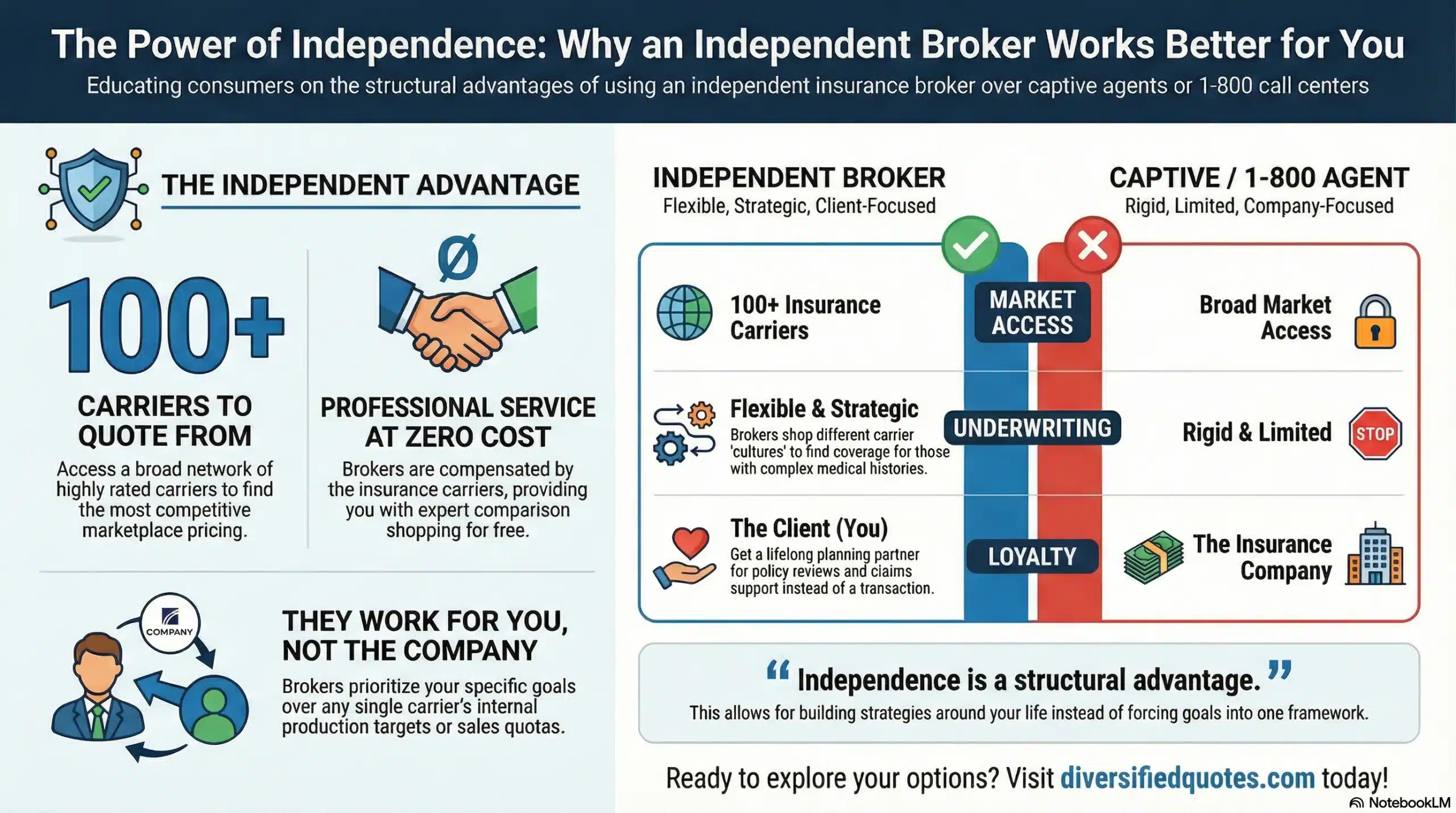
Jason Stolz, CLTC, CRPC and Chief Underwriter at Diversified Insurance Brokers (NPN 20471358), is a senior insurance and retirement professional with more than two decades of real-world experience helping individuals, families, and business owners protect their income, assets, and long-term financial stability. As a long-time partner of the nationally licensed independent agency Diversified Insurance Brokers, Jason provides trusted guidance across multiple specialties—including fixed and indexed annuities, long-term care planning, personal and business disability insurance, life insurance solutions, Group Health, and short-term health coverage. Diversified Insurance Brokers maintains active contracts with over 100 highly rated insurance carriers, ensuring clients have access to a broad and competitive marketplace.
His practical, education-first approach has earned recognition in publications such as VoyageATL, highlighting his commitment to financial clarity and client-focused planning. Drawing on deep product knowledge and years of hands-on field experience, Jason helps clients evaluate carriers, compare strategies, and build retirement and protection plans that are both secure and cost-efficient. Visitors who want to explore current annuity rates and compare options across multiple insurers can also use this annuity quote and comparison tool.
