
How Multi-Year Guaranteed Annuities (MYGAs) Compare to CDs
MYGA vs. CDs: Which Is Better for Conservative Savers in 2025? For conservative savers, the choice between a Certificate of Deposit (CD) and a Multi-Year Guaranteed Annuity (MYGA) can feel confusing—especially when interest rates are competitive and both options advertise “guaranteed returns.” On the surface, they appear nearly identical: fixed rate, fixed term, protection from market volatility. But once you move beyond the headline rate and look at taxation, flexibility, long-term compounding, retirement income potential, and legacy planning, MYGAs begin to separate themselves in meaningful ways. If you are approaching retirement, rolling over an IRA, repositioning cash, or simply looking for a higher-efficiency alternative to bank CDs, understanding the structural differences is critical before locking in a multi-year commitment.

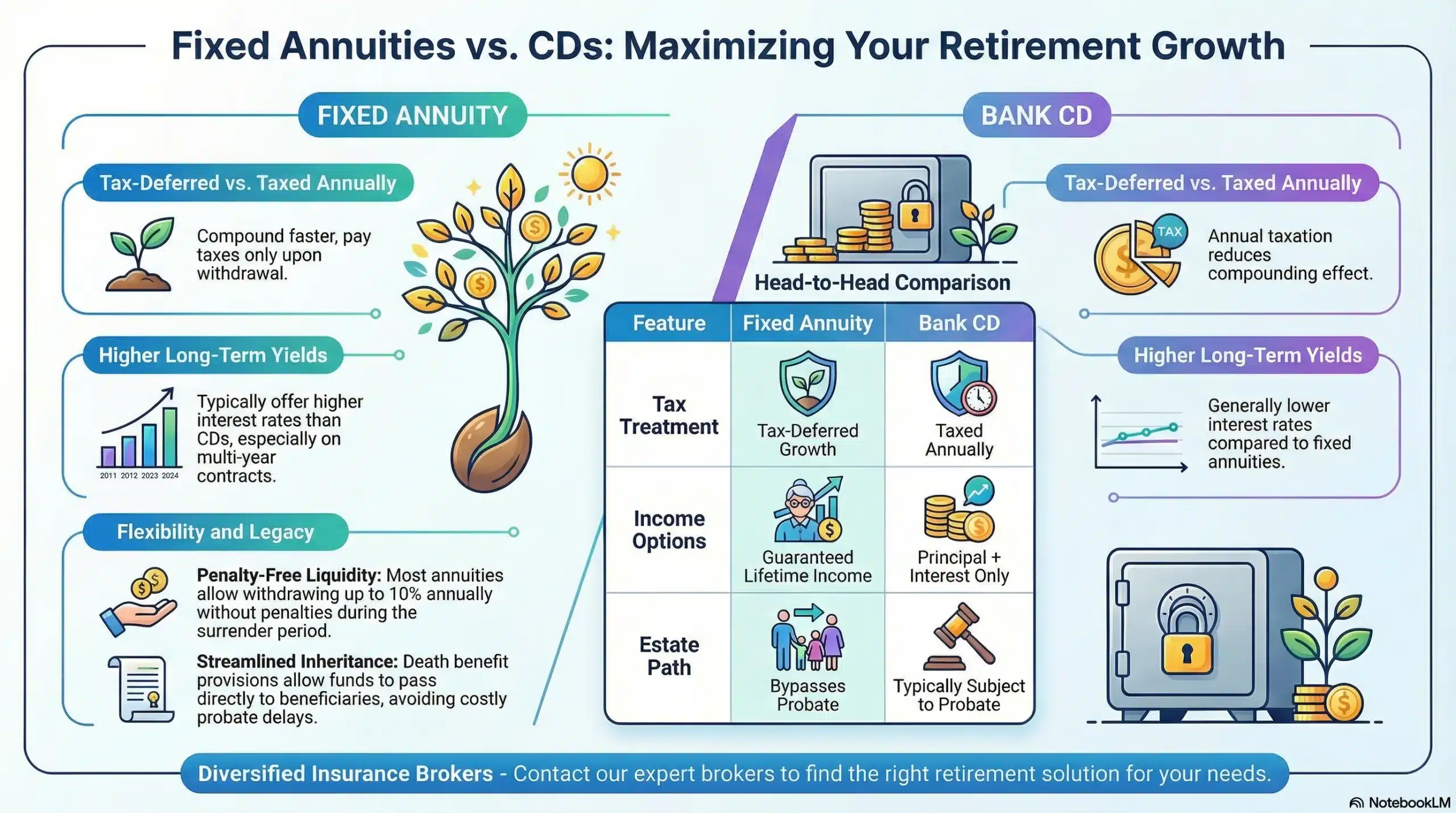
Both MYGAs and CDs offer a fixed interest rate over a defined period—often 2 to 10 years. Both are designed for principal protection. Both appeal to savers who want stability and predictability rather than stock market exposure. However, CDs are bank products insured by the FDIC (within limits), while MYGAs are insurance contracts backed by the claims-paying ability of the issuing carrier. That structural difference changes how interest compounds, how withdrawals work, how taxes are handled, and what options exist at maturity. In a CD, interest is typically taxed annually unless it’s inside a retirement account. In a MYGA, growth is tax-deferred, meaning you do not pay taxes each year on interest earned. That tax deferral allows compounding to occur on a larger base, which can materially increase total accumulation over time—especially for savers in higher tax brackets.
Tax deferral is not just a minor benefit; it is one of the most powerful structural advantages MYGAs have over CDs. When interest compounds without annual taxation, you are effectively earning “interest on money that would have otherwise gone to taxes.” Over five to ten years, that difference can be substantial. For example, if you are earning competitive fixed rates and do not need current income, a MYGA allows uninterrupted growth until you decide to withdraw or annuitize. CDs, unless held in an IRA, create a yearly taxable event. For savers in accumulation mode, that annual drag reduces efficiency. If you are comparing rates today, make sure you look beyond the headline percentage and evaluate after-tax outcomes. You can monitor competitive products on our Current Annuity Rates page to see how MYGAs are stacking up in the present interest rate environment.
Another key difference is flexibility at the end of the term. When a CD matures, your options are generally simple: withdraw funds or roll into another CD at the prevailing rate. A MYGA, by contrast, often includes multiple pathways at maturity. You can take the money, renew into another guaranteed term, perform a tax-free 1035 exchange into a different annuity product, or convert the contract into a stream of guaranteed lifetime income. That final option—income conversion—is something a CD simply cannot provide. Insurance-based guarantees allow MYGAs to serve not just as accumulation vehicles but also as foundational retirement income tools. For savers nearing retirement, this flexibility adds strategic value beyond the rate itself.
Liquidity is another area where clarity matters. CDs typically impose early withdrawal penalties calculated in months of interest. MYGAs use surrender schedules that decline over time, but many contracts allow penalty-free withdrawals—often up to 10% annually after the first year. Understanding how free withdrawal provisions work is essential before committing. Not all contracts are structured the same way, and details matter. You can review deeper guidance on liquidity rules here: Annuity Free Withdrawal Rules. Comparing liquidity structures side by side ensures you are not sacrificing flexibility for a marginal rate difference.
Safety is often the first concern conservative savers raise. CDs are backed by the FDIC up to statutory limits per depositor, per institution. MYGAs are backed by highly rated insurance carriers and regulated at the state level, with additional protections through state guaranty associations (subject to limits). When properly diversified among strong carriers, MYGAs provide a high level of contractual security. Many top carriers offering MYGAs have decades-long track records of financial strength and disciplined reserve management. If you are evaluating company quality, do not just focus on rate; consider ratings, tenure, and capitalization. Strong carriers combine competitive crediting with long-term claims-paying stability.
Interest rate environments also change the analysis. In 2025, rates remain elevated compared to the prior decade, giving savers a rare opportunity to lock in multi-year guarantees at attractive levels. With CDs, banks can adjust rates quickly in response to monetary policy. MYGAs allow you to lock a guaranteed rate for the full contract term—shielding you from reinvestment risk during that window. If rates decline in coming years, a locked MYGA may outperform rolling short-term CDs repeatedly at lower yields. If rates rise further, laddering strategies can help manage timing risk. Strategic placement, rather than guessing rate direction, is often the smarter approach.
Retirement accounts represent another major differentiator. While CDs can be used inside IRAs, MYGAs are frequently utilized specifically for IRA rollovers and 401(k) transfers because they combine tax deferral with principal protection and predictable growth. For individuals leaving an employer or seeking to reposition conservative assets within their retirement portfolio, MYGAs provide simplicity without market volatility. They also eliminate the behavioral risk many retirees face—panic selling during downturns. Stability has emotional value, especially when income planning is approaching.
If you are evaluating whether a MYGA fits your retirement strategy, you can request personalized rate comparisons and illustrations here:
Request a Personalized MYGA Quote
Beyond accumulation, MYGAs integrate well with broader annuity strategies. Some savers use MYGAs as the conservative anchor of their portfolio while allocating separate funds to fixed indexed annuities for upside potential. If you want to understand how indexed products differ structurally, review How Does a Fixed Indexed Annuity Work?. While MYGAs provide straightforward fixed guarantees, indexed annuities tie growth to market indexes with principal protection. Each has a role depending on timeline and objective.
Another overlooked advantage of MYGAs is estate efficiency. Upon death, beneficiaries typically receive the contract value without probate delay, and payout options can allow continued tax deferral in certain circumstances. Understanding beneficiary options can significantly improve intergenerational planning outcomes. For a deeper dive into distribution structures, review Annuity Beneficiary Death Benefits. Compared to CDs, which simply pass as cash assets, annuities may provide more structured settlement choices for heirs.
Fees are often misunderstood. Traditional MYGAs do not have annual management fees. The insurance carrier earns through spread management—similar in concept to how banks operate with CDs. There is no market participation calculation in a basic MYGA; the rate is declared upfront and guaranteed for the term. This simplicity appeals to savers who want clarity. If you are comparing multiple products, always confirm whether the contract is a true MYGA or a different annuity design with optional riders or crediting methods.
Reinvestment risk deserves special mention. CD investors frequently ladder short maturities to stay flexible. However, when rates decline, maturing CDs must be reinvested at lower yields. A longer-term MYGA locks in the guaranteed rate for the full duration. In uncertain monetary cycles, that stability can be advantageous. Strategic laddering of MYGAs across different carriers and terms can replicate CD ladder flexibility while preserving tax deferral and contractual guarantees.
At maturity, MYGAs typically offer a renewal window where funds can be repositioned without surrender penalties. This allows active management of your conservative allocation. If rates are favorable, you may renew. If income is needed, you may convert. If you wish to explore competitive options at that time, you can compare updated offerings on our Top Annuity Rates as of Today page.
Conservative savers often ask: “Are MYGAs only for retirees?” The answer is no. While retirees use them frequently, pre-retirees and even younger conservative investors may use MYGAs for capital earmarked for future known expenses. The key is alignment between liquidity needs and contract structure. Funds that may be needed in the short term should not be locked into multi-year surrender schedules. However, funds designated for medium-term growth with stability can be ideal candidates.
Finally, MYGAs can serve as a foundation that supports broader financial planning across generations. As you build safe, predictable retirement assets, coordinating education planning for children or grandchildren may also be part of your strategy. Our partner firm, Diversified College Planning, works alongside retirement strategies to help families align long-term goals on both ends of the generational spectrum.
Speak With a MYGA Specialist Today
In summary, while CDs and MYGAs share surface similarities—fixed rates, principal protection, defined terms—the structural advantages of tax deferral, maturity flexibility, income conversion options, estate efficiency, and strategic retirement integration often give MYGAs the edge for long-term conservative savers. The right choice depends on your time horizon, tax bracket, income goals, and liquidity needs. Rate alone should never be the sole deciding factor. Structure, flexibility, and efficiency matter just as much.
Related Pages
Explore additional retirement and annuity planning resources.
Financial Protection Essentials
Explore life insurance strategies for seniors, global travel medical protection resources, and financial planning tools that help manage risk and long-term coverage needs.
Talk With an Advisor Today
Choose how you’d like to connect—call or message us, then book a time that works for you.
Schedule here:
calendly.com/jason-dibcompanies/diversified-quotes
Licensed in all 50 states • Fiduciary, family-owned since 1980
FAQs: MYGA vs CDs
What is the main difference between a MYGA and a CD?
A MYGA is a multi-year guaranteed annuity that offers tax-deferred growth and guaranteed interest for a set term. A CD is a bank product that offers guaranteed interest but taxes gains annually. MYGAs are insurance contracts; CDs are bank deposits.
Which typically pays higher interest: MYGAs or CDs?
MYGAs often offer higher guaranteed rates than CDs of similar terms because insurers can invest longer-term and price guarantees differently than banks.
Are MYGAs tax-deferred?
Yes. MYGA interest grows tax-deferred until withdrawn, which allows compounding without annual taxation. CD interest is taxed each year as it is earned.
Are MYGAs FDIC-insured?
No. MYGAs are backed by the financial strength of the issuing insurance company. CDs are backed by FDIC insurance up to applicable limits.
Do MYGAs have liquidity options?
Most MYGAs include annual penalty-free withdrawal limits, while CDs typically restrict any withdrawal until maturity or impose bank penalties.
Can you lose money in a MYGA?
MYGAs guarantee principal and the stated interest rate if held for the full term. Early surrender could incur charges or an MVA, depending on the contract.
Are MYGAs better for retirement planning?
Often yes, because tax-deferred growth, predictable guarantees, and optional income features make MYGAs a stronger fit for long-term planning than CDs.
Do MYGAs require a medical exam?
No. MYGAs are not underwritten for health and are available regardless of medical history.
Are CDs easier to open than MYGAs?
CDs are typically simpler to open through a bank. MYGAs require licensed insurance agent involvement and standard suitability review.
Which is better for short-term savings?
CDs may be better for very short durations. MYGAs often shine for 3–10 year savings goals where higher guaranteed rates and tax deferral matter most.
About the Author:
Jason Stolz, CLTC, CRPC and Chief Underwriter at Diversified Insurance Brokers (NPN 20471358), is a senior insurance and retirement professional with more than two decades of real-world experience helping individuals, families, and business owners protect their income, assets, and long-term financial stability. As a long-time partner of the nationally licensed independent agency Diversified Insurance Brokers, Jason provides trusted guidance across multiple specialties—including fixed and indexed annuities, long-term care planning, personal and business disability insurance, life insurance solutions, Group Health, and short-term health coverage. Diversified Insurance Brokers maintains active contracts with over 100 highly rated insurance carriers, ensuring clients have access to a broad and competitive marketplace.
His practical, education-first approach has earned recognition in publications such as VoyageATL, highlighting his commitment to financial clarity and client-focused planning. Drawing on deep product knowledge and years of hands-on field experience, Jason helps clients evaluate carriers, compare strategies, and build retirement and protection plans that are both secure and cost-efficient. Visitors who want to explore current annuity rates and compare options across multiple insurers can also use this annuity quote and comparison tool.
