
Talcott EverGuard Assurance Annuity
As an Independent Annuity Broker, we compare rates across 100+ carriers and 1,000 different annuities— not just one company’s product offerings — to find the best fit for your goals.
Talcott EverGuard Assurance Annuity
Talcott’s EverGuard Assurance Annuity, issued by Talcott Financial Group, is a fixed indexed annuity built for retirees and pre-retirees who want two things at the same time: protection from market losses and a clear path to guaranteed lifetime income. It is designed to help you convert a portion of your savings into a more predictable retirement paycheck — while still allowing market-linked growth potential through index strategies.
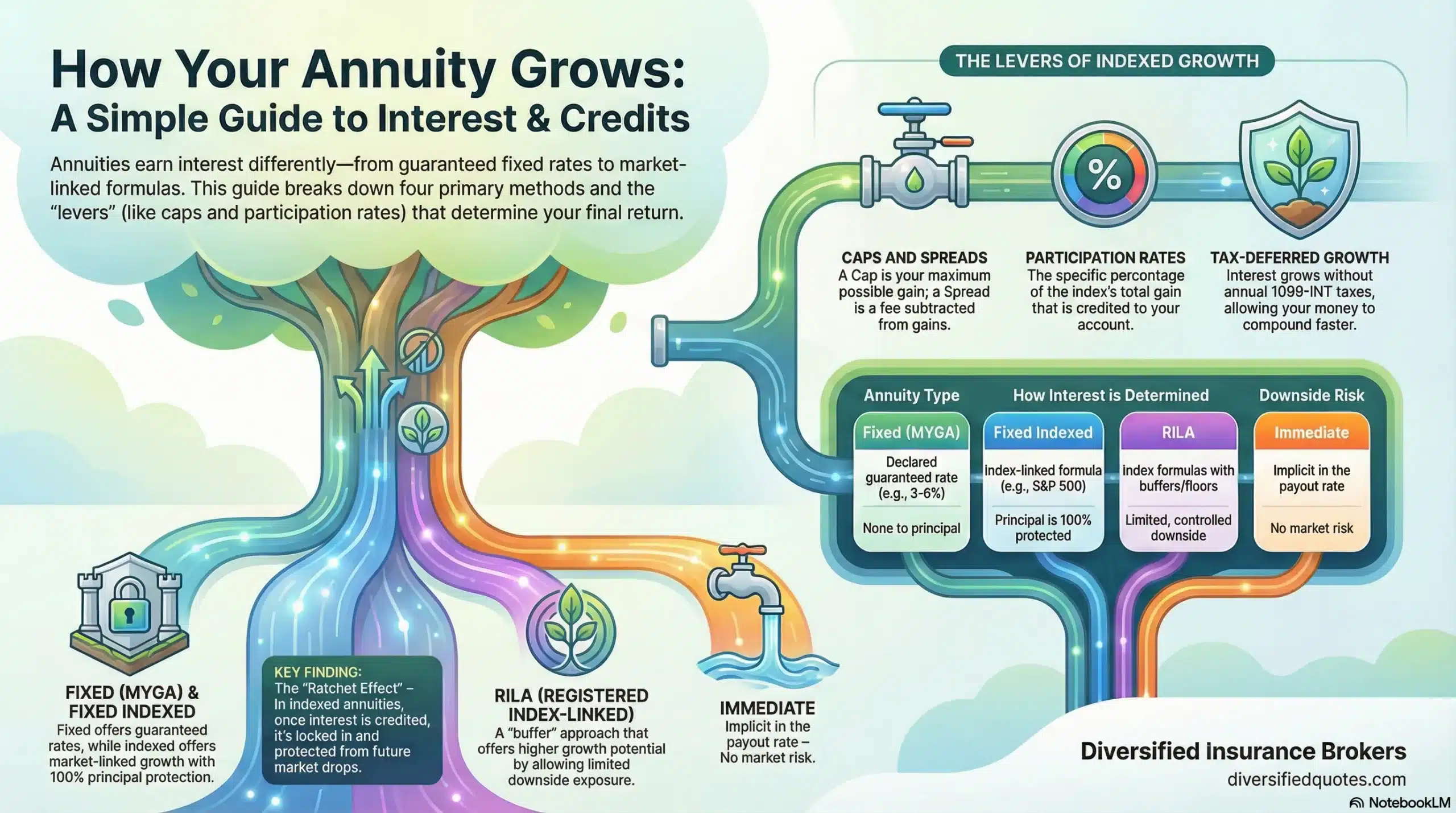
Unlike market-based accounts, a fixed indexed annuity does not participate directly in the stock market. Your contract value can grow based on the performance of selected indices, but it does not decline due to index losses. When interest is credited, it is locked in through the annual reset mechanism — which can be especially valuable for clients who want growth potential but do not want to relive the stress of major market downturns in retirement. If you want to understand the mechanics behind this structure, start here: How fixed indexed annuities work.

Ensure you are receiving the absolute top rates
Current Fixed Annuity Rates
Compare today’s best fixed annuity rates from top carriers.
Current Bonus Annuity Rates
See which annuities offer the highest upfront bonus today.
Request an Annuity Quote
Submit our annuity request form to get personalized rate options.
Lifetime Income Calculator
Use our calculator to see how much guaranteed income your annuity can provide.
Talcott EverGuard Assurance 10: Key Product Features at a Glance
| Product Feature | Details |
|---|---|
| Issuing Carrier | Talcott Resolution Life and Annuity Insurance Company (NAIC #71153), Hartford, Connecticut. AM Best: A- (Excellent), affirmed December 2024, Stable outlook. Fitch: A- (Stable). S&P: BBB+ (Positive outlook, December 2025). $127 billion in assets under management. Backed by Sixth Street. Issued in 49 states and DC (excluding New York). Not FDIC insured. Guarantees backed by claims-paying ability of Talcott Resolution Life and Annuity Insurance Company. Launched January 2026. |
| Product Type | Single-premium deferred fixed indexed annuity (FIA) with a built-in Guaranteed Lifetime Withdrawal Benefit (GLWB). Income-focused design — principal protected from negative index performance, with a guaranteed income structure built around a separate income base (Benefit Base) that grows through guaranteed Deferral Credits independent of market performance. |
| Withdrawal Charge Period | 10-year withdrawal charge period (single term — no 5- or 7-year option on the Assurance 10). Withdrawal charges apply to amounts above the free withdrawal provision during the 10-year period. MVA may also apply on excess withdrawals. |
| Minimum / Maximum Premium | Minimum: $25,000 single purchase payment. Maximum: $2,000,000 without prior company approval. Single premium — no additional premiums accepted after issue. |
| Issue Ages / Ownership | Qualified (IRA/Roth IRA): Owner and annuitant must be the same individual. Non-qualified and non-natural ownership accepted. Joint owners must be spouses. Eligible account types: Traditional IRA, Roth IRA, Non-Qualified, Inherited IRA, and other qualified rollovers. |
| GLWB Rider (Required) | At issue, one GLWB rider must be selected (for an additional annual fee). Two options: Early Path — designed for clients who need income sooner, with terms favoring nearer-term income activation; Future Path — designed for clients planning to defer income until a later date, with terms that reward longer deferral. GLWB must be selected at application — cannot be added or changed after issue. The rider creates a separate Benefit Base (income base) used solely to calculate lifetime income payments. |
| Deferral Credits | The income base (Benefit Base) grows through guaranteed Deferral Credits that increase it independent of market performance — the income base grows on a predetermined contractual schedule regardless of how the market index performs. This provides more certainty for lifetime income planning than purely market-linked income base designs: the income amount available at activation is predictable from the contract terms, not dependent on index credits or market conditions during the deferral period. |
| Index Crediting Strategies | S&P 500 and S&P 500 Engle 15% VT TCA Index (volatility-targeted). Nasdaq-linked index strategies also available. Crediting subject to caps or participation rates. Annual reset locks in credited interest. If the index is negative, credited interest is zero — principal protection floor. Index credits grow the contract value (accumulation value) independently from the income base’s Deferral Credit growth. |
| Fixed Interest Option | A declared fixed interest rate option is available alongside the indexed strategies. Allows blended allocation between fixed and indexed, or full allocation to the fixed option for maximum predictability on the contract value side. |
| Free Withdrawal Provision | After the first contract anniversary: up to 10% of the contract value annually without withdrawal charges or MVA. Free Withdrawal Amount is based on the contract value at the beginning of the most recent contract year. Systematic withdrawals available on monthly, quarterly, semiannual, or annual basis. Taking free withdrawals outside the GLWB structure may affect the Benefit Base and future guaranteed income amounts — confirm interaction with your advisor before taking ad hoc withdrawals during the deferral period. |
| RMD Compatibility | RMDs may be taken without withdrawal charges or MVA beginning in the first contract year. After Lifetime Income Payments begin, RMDs are not considered excess withdrawals under the GLWB rider — a meaningful provision for IRA holders who must take RMDs during or after income activation. |
| Health Event Waivers | After the first contract anniversary: nursing home and hospital confinement waiver (90 consecutive days of qualifying confinement required, starting after contract issue date); terminal illness waiver (diagnosis must occur after issue date, with life expectancy of 12 months or less per physician certification). ADL-based enhanced income benefit: the contract includes enhanced income benefits if the owner becomes unable to perform activities of daily living, subject to rider terms. |
| Market Value Adjustment (MVA) | MVA may apply to withdrawals in excess of the free withdrawal amount. Applied after withdrawal charges are deducted. May increase or decrease the net amount received. Does not apply to free withdrawals, RMDs, death benefit, or health event waiver amounts. |
| Death Benefit | Death benefit is free of withdrawal charges or MVA. Equals the greater of the contract value or the minimum amount required by state law. If income was not fully utilized, remaining contract value passes to named beneficiaries. The Benefit Base (income calculation value) is not the death benefit and is not inherited by beneficiaries. |
| Tax Treatment | Interest grows tax-deferred until withdrawal. Lifetime Income Payments taxed as ordinary income in the year received. Non-qualified: LIFO taxation. Qualified accounts: full distributions taxed as ordinary income. Withdrawals before age 59½ subject to 10% IRS early withdrawal penalty. Not FDIC insured. |
What the EverGuard Assurance Annuity Is Designed to Do
Most retirement plans eventually run into the same question: how do I create income I cannot outlive? The EverGuard Assurance Annuity is designed around that need. It combines protected accumulation with a structured lifetime-income approach that can help reduce reliance on withdrawals from volatile portfolios during retirement. Many clients use annuities as part of an income foundation strategy, pairing guaranteed annuity income with Social Security so essential expenses stay covered no matter what markets do. For a deeper look at how this can fit together, see: How Social Security and annuities work together.
The defining structural feature of the EverGuard Assurance 10 that distinguishes it from most competing income FIAs is the Deferral Credit mechanism. In most income-focused FIAs, the income base (Benefit Base) grows either through a guaranteed roll-up rate, through index credits, or through a combination — meaning the income base growth is partially or fully tied to how the market index performs. In the EverGuard Assurance 10, the income base grows through guaranteed Deferral Credits that are predetermined in the contract and accrue independently of market performance. The income base grows at a contractually defined rate regardless of what the index does in any given year. This means the income amount available at activation can be modeled with a high degree of certainty at the time of purchase — the Deferral Credits do not depend on favorable index years to build the income base. For clients who want predictability in both the accumulation period and the income period, this design provides certainty that purely market-linked income base designs cannot.
Guaranteed Lifetime Income Options — Early Path vs. Future Path
A standout feature of this annuity is its focus on lifetime income through a Guaranteed Lifetime Withdrawal Benefit. With a GLWB, income is calculated from a separate Benefit Base value that grows through the contractual Deferral Credits. When you choose to turn on income, you receive a set withdrawal amount — Lifetime Income Payments — that can continue for life, even if the contract value is eventually depleted to zero through sustained withdrawals. If you want to understand GLWBs in plain English — what they are, how they differ from annuitization, and what to watch for — read: What is a GLWB?
The EverGuard Assurance 10 requires selection of one of two built-in GLWB rider options at issue — this selection is permanent and cannot be changed after the contract is issued. The Early Path rider is designed for clients who need income sooner — its terms and Deferral Credit structure are calibrated to support stronger income for clients who plan to activate Lifetime Income Payments within a relatively short deferral window after purchase. The Future Path rider is designed for clients who plan to defer income for a longer period — its Deferral Credits and income activation terms are structured to reward extended deferral with meaningfully higher guaranteed income amounts when income eventually begins. The choice between Early Path and Future Path should be made based on a realistic assessment of when you expect to need income — not on which rider sounds more appealing at the time of purchase. A personalized illustration comparing projected Lifetime Income Payments under both riders at your anticipated income activation age — using your specific premium and current Deferral Credit rates — is the most reliable basis for this decision. For couples, lifetime income can be structured as joint income so payments continue for as long as either spouse lives. You can explore the concept here: What is a joint lifetime income annuity?
Principal Protection with Market-Linked Growth Potential
Fixed indexed annuities are designed for people who want upside potential without accepting market downside. With EverGuard Assurance 10, your contract value is linked to the performance of selected indices through crediting strategies — the S&P 500, the S&P 500 Engle 15% VT TCA Index (volatility-targeted and risk-controlled), and Nasdaq-linked index strategies. The core concept is index participation with a zero floor: if an index performs negatively during a crediting term, your credited interest for that term is zero, but you do not take a loss in principal due to the index decline. A fixed declared-rate account is also available for the portion of premium where predictability matters more than upside potential.
It is important to understand that in the EverGuard Assurance 10, index credits to the contract value and Deferral Credits to the income base are separate and independent. A year where the index produces a zero credit does not reduce the income base — the Deferral Credits continue to grow the income base on schedule regardless. This separation means the income planning certainty of the EverGuard Assurance 10 does not depend on the contract value growing through index credits during the deferral period. The no-loss-from-index-declines structure on the contract value side is one reason fixed indexed annuities remain popular for retirement income planning. If you have heard conflicting opinions about fixed indexed annuities, this guide can help separate myths from reality: Fixed indexed annuity myths debunked.
Tax-Deferred Growth and Retirement Efficiency
Like other annuities, EverGuard Assurance 10 grows tax-deferred. Interest can compound without annual taxation until money is withdrawn. For many retirees, deferring taxes may help improve the long-term efficiency of accumulation and income planning — especially when the goal is stability rather than constant trading or rebalancing. Tax treatment depends on whether the annuity is funded with qualified retirement money (like an IRA) or non-qualified funds. If the annuity is inside an IRA, the IRA rules drive taxation. If it is non-qualified, earnings are typically taxed when distributed. Lifetime Income Payments are taxed as ordinary income in the year received, regardless of the funding source. Either way, the contract is designed around long-term retirement planning rather than short-term speculation.
Liquidity, Withdrawal Rules, and the ADL Enhanced Benefit
Liquidity matters, even in a long-term retirement strategy. After the first contract anniversary, the EverGuard Assurance 10 allows withdrawals of up to 10% of the contract value annually without withdrawal charges or MVA. The Free Withdrawal Amount is based on the contract value at the beginning of the most recent contract year. Systematic withdrawals are available on monthly, quarterly, semiannual, or annual schedules. RMDs from qualified accounts may be taken without withdrawal charges or MVA beginning in the first contract year — and after Lifetime Income Payments begin, RMDs are not considered excess withdrawals under the GLWB rider, which is a meaningful planning provision for IRA holders. For a broader comparison of how surrender schedules work, here is a helpful resource: Annuity surrender charges explained.
The contract includes an enhanced income benefit tied to activities of daily living: if the owner becomes unable to perform a qualifying number of activities of daily living, enhanced income benefits may be available subject to rider terms. The nursing home and hospital confinement waiver provides access without withdrawal charges or MVA after the first contract anniversary if the owner is confined to a qualifying facility for 90 or more consecutive days beginning after the contract issue date. A terminal illness waiver also applies when the owner is diagnosed with a qualifying terminal illness with a physician-certified life expectancy of 12 months or less, provided the diagnosis occurs after the contract issue date. For a broader comparison of how these waivers work across annuity products, our resource on annuities with nursing home care riders covers the comparison framework.
Death Benefit and Legacy Planning
For many families, an annuity needs to do two things: provide income and still offer a clean path for beneficiaries. The EverGuard Assurance 10 death benefit is free of withdrawal charges or MVA. It pays the greater of the contract value or the minimum amount required by state law. If income was not fully utilized during the owner’s lifetime, any remaining contract value passes to named beneficiaries outside of probate in most cases when beneficiary designations are properly completed. One important distinction: the Benefit Base (the income calculation value) is not the death benefit and is not inherited by beneficiaries as a lump sum — only the contract value (accumulation value) constitutes the death benefit. This means a client who has been receiving Lifetime Income Payments for many years — and whose contract value has been drawn down over time — may leave a smaller death benefit than expected if they conflate the growing income base with the death benefit value. If you want to understand how annuity beneficiary rules generally work, this overview is a helpful starting point: Annuity beneficiary death benefits.
How Diversified Insurance Brokers Helps You Compare This Annuity
The right annuity is not just about a brand name. It is about the contract design — income rules, crediting options, surrender schedule, and how everything fits into your larger plan. At Diversified Insurance Brokers, we help clients compare products like the Talcott EverGuard Assurance Annuity against other income-focused fixed indexed annuities to find the best fit for timing, goals, and risk comfort. When reviewing any income-focused annuity, it is important to separate the concepts of contract value and income base, understand rider fees, and confirm how withdrawals affect future income. If you would like a deeper dive into the mechanics of income riders, this guide is useful: How a GLWB works. If you are considering EverGuard Assurance, it is smart to compare it against other annuities designed for income — especially since caps, participation rates, rider terms, and surrender schedules vary by carrier and can change over time.
Related Pages
Continue researching income riders and fixed indexed annuity strategies.
Financial Protection Essentials
Life insurance underwriting guidance for medical conditions and business planning, plus annuity income strategy education.
Talk to an Advisor or Request Your Annuity Quote
Ready to explore this annuity in more detail—or compare it with other carriers to see if even higher rates are available? With guaranteed income, principal protection, and long-term growth potential on the line, making the right choice is essential. The experienced advisors at Diversified Insurance Brokers will guide you through the options and design a strategy tailored to your retirement goals.
Schedule here:
calendly.com/jason-dibcompanies/diversified-quotes
Licensed in all 50 states • Fiduciary, family-owned since 1980
FAQs: Talcott EverGuard Assurance 10 Fixed Indexed Annuity
What are Deferral Credits and how do they differ from a standard GLWB roll-up rate?
Deferral Credits are the mechanism by which the EverGuard Assurance 10’s income base (Benefit Base) grows during the deferral period before income is activated. In most competing income FIAs, the income base grows through a guaranteed roll-up rate — a fixed percentage applied annually to the benefit base — or through a combination of the roll-up rate and actual index credits (sometimes with a multiplier). In either case, the income base growth is either partially or fully tied to a guarantee that the carrier must fund regardless of investment conditions. The EverGuard Assurance 10 structures this differently by labeling the income base growth as Deferral Credits that accrue on a contractually predetermined schedule independent of market performance. The practical outcome for income planning is similar in concept to a guaranteed roll-up — the income base grows predictably over the deferral period — but the Talcott structure emphasizes that the growth schedule is set in the contract terms and does not depend on index credits to fill in any shortfall. This means that whether the market index performs strongly, flatly, or negatively during the deferral years, the income base follows its contractually defined Deferral Credit schedule. For clients who want to know with confidence what their guaranteed income amount will be at a specific future activation age, this predictability can simplify the income planning conversation relative to designs where income base growth is partially dependent on index performance.
Should I choose the Early Path or Future Path rider?
The choice between Early Path and Future Path is the most consequential decision in the EverGuard Assurance 10 purchase process, because it is permanent — once the contract is issued with one rider elected, the rider cannot be changed. The Early Path rider is designed for clients who need income relatively soon after purchase — its Deferral Credit structure and income activation terms are calibrated to support competitive Lifetime Income Payment amounts when income begins within a shorter deferral window from contract issue. Early Path is the appropriate choice when income is genuinely needed in the near term and waiting significantly longer before activating would create a financial hardship or force reliance on other assets. The Future Path rider is designed for clients who can defer income for a longer period — its Deferral Credit accrual and activation terms are structured to reward extended deferral with meaningfully higher guaranteed income amounts the longer income is delayed. Future Path is the appropriate choice when the client has sufficient income from other sources for the near term and wants to maximize the guaranteed income amount that the EverGuard Assurance 10 will eventually deliver. The practical decision process is straightforward: identify the realistic income activation age, request illustrations for both riders at that activation age using your specific premium, and compare the resulting projected Lifetime Income Payment amounts. The rider that produces the higher guaranteed income at your actual expected activation age — not the theoretical maximum deferral scenario — is generally the better choice for your situation.
What is the difference between the contract value and the Benefit Base?
The contract value and the Benefit Base are two separate figures within the EverGuard Assurance 10 that serve entirely different purposes, and confusing them is the most common misunderstanding about income FIA products. The contract value — sometimes called the accumulation value — is the actual money you own. It grows through index credits and the fixed account rate, is reduced by withdrawals and the rider fee, and represents what you would receive in a surrender subject to applicable charges. The contract value is also the basis for the death benefit. The Benefit Base is a separate calculation value used exclusively to determine the size of your Lifetime Income Payments. It grows through the contractual Deferral Credits during the deferral period, regardless of how the contract value grows through index credits. The Benefit Base cannot be withdrawn as a lump sum, is not inherited by beneficiaries, and does not represent accessible cash in the same way the contract value does. When Lifetime Income Payments begin, the guaranteed annual payment amount is calculated as the Benefit Base at income activation multiplied by the applicable lifetime withdrawal percentage for the contract holder’s age. In later years when income payments and the rider fee have reduced the contract value toward zero, the Benefit Base may be substantially higher — and Lifetime Income Payments continue as long as the owner lives, even after the contract value is depleted, funded by Talcott’s claims-paying ability. Understanding this separation is fundamental to evaluating the EverGuard Assurance 10 correctly: the income it will pay for life is determined by the Benefit Base, not by the contract value.
How do free withdrawals interact with the GLWB during the deferral period?
Free withdrawals taken outside of the GLWB’s Lifetime Income Payment structure during the deferral period can affect the Benefit Base and the guaranteed income amount — this is one of the most important practical considerations for clients who anticipate needing annual access to funds before activating income. In most GLWB designs, excess withdrawals — withdrawals above the rider’s permitted annual amount — reduce the benefit base proportionally rather than dollar-for-dollar, which means a large excess withdrawal can have an outsized negative impact on the future guaranteed income. The 10% annual free withdrawal provision from the contract value side does not interact with the GLWB in the same way as the guaranteed Lifetime Income Payment amounts, but taking free withdrawals during the deferral period can still affect the overall income planning math. The specific rules governing how free withdrawals interact with the Benefit Base, Deferral Credits, and future income amounts are defined in the contract and should be reviewed carefully with your advisor before taking any ad hoc withdrawal during the deferral period. For clients who anticipate needing predictable annual access during the deferral period, understanding this interaction before purchase is important — the EverGuard Assurance 10 is most effectively positioned for clients who can let the income base accumulate through Deferral Credits without regular withdrawals disrupting the income calculation.
What happens to the death benefit after Lifetime Income Payments begin?
After Lifetime Income Payments begin, each annual payment reduces the contract value — the actual accumulated money in the annuity. Simultaneously, the rider fee continues to be deducted from the contract value. Over time, sustained income payments and the rider fee can draw the contract value down significantly, and if the owner lives a long time, the contract value may eventually reach zero. When the contract value reaches zero, Lifetime Income Payments continue because the GLWB guarantee is backed by Talcott’s claims-paying ability rather than by the remaining contract value — this is the longevity protection function of the rider. However, when the contract value reaches zero, there is no longer a death benefit to pass to beneficiaries. The death benefit is based on the contract value, and a contract value of zero means a death benefit of zero (subject to any applicable state minimum). The Benefit Base at that point may be substantially higher than zero — Deferral Credits and the income calculation basis may remain strong — but the Benefit Base is not the death benefit and cannot be inherited as a lump sum. Clients who place high importance on preserving a legacy value for beneficiaries alongside lifetime income should evaluate this dynamic carefully, particularly for scenarios involving long income periods. This is one reason clients with dual goals — guaranteed lifetime income and meaningful legacy transfer — sometimes use a separate life insurance policy to provide the legacy function while the annuity handles the income function. For a broader framework on how annuity death benefits and beneficiary designations work across different product types, our resource on annuity beneficiary death benefits provides useful context.
How does the EverGuard Assurance 10 compare to the EverGuard Aspire?
The EverGuard Assurance 10 and EverGuard Aspire are both fixed indexed annuities from Talcott Resolution Life and Annuity Insurance Company launched in January 2026, but they serve fundamentally different primary objectives and are structured differently at the product level. The EverGuard Assurance 10 is income-focused: it includes a mandatory built-in GLWB rider (for an additional fee) with a Benefit Base that grows through guaranteed Deferral Credits independent of market performance, and is available only as a 10-year withdrawal charge period product. The guaranteed income structure is the central design objective. The EverGuard Aspire is accumulation-focused: it has no built-in income rider, is available in 5-, 7-, and 10-year withdrawal charge periods, and includes two model portfolio options (BRG with rate-guaranteed crediting, or EF with enhanced equity cap) as well as an optional Premium Bonus Rider on the 10-year. Income is an eventual option through annuitization rather than a primary built-in design feature. The choice between them is straightforward in most cases: if guaranteed lifetime income is the primary objective and the client wants to establish that income guarantee at purchase, the Assurance 10 is the appropriate product. If the primary objective is growing contract value with principal protection and income remains a future option, the Aspire is the appropriate product. Clients who want both — accumulation now and income later — may use the Aspire for accumulation and then transition to income through annuitization at the end of the withdrawal charge period, or hold both products for their respective roles.
What is the ADL enhanced income benefit and how does it activate?
The EverGuard Assurance 10 includes an enhanced income benefit that activates if the owner becomes unable to perform a qualifying number of activities of daily living — the six standard ADLs are eating, bathing, dressing, transferring (mobility), toileting, and continence. Activities of daily living are the standard functional assessment criteria used across health insurance, long-term care insurance, and annuity contracts to determine eligibility for enhanced benefits. When the ADL-based eligibility threshold is met and properly documented, the enhanced income benefit modifies or increases the income payments available under the GLWB rider beyond the standard Lifetime Income Payment amount. The specific eligibility threshold (number of ADLs that must be impaired), documentation requirements (typically physician certification), any waiting period, and the magnitude of the income enhancement are all defined in the contract rider terms and may vary by state. As with the nursing home and terminal illness waivers, the ADL benefit is not a substitute for dedicated long-term care insurance — it provides enhanced income access through the annuity contract’s own structure under qualifying health conditions. Clients with significant anticipated care cost exposure should evaluate whether dedicated long-term care coverage is warranted alongside the annuity’s built-in ADL provision, rather than relying on the annuity’s ADL benefit as a comprehensive care funding strategy. For a deeper explanation of how activities of daily living function as eligibility triggers across insurance products, our resource on activities of daily living explains the assessment criteria and how they are typically applied.
Who is this annuity best suited for?
The EverGuard Assurance 10 is best suited for retirees and pre-retirees who have a clear primary goal of establishing a guaranteed lifetime income stream from a portion of their retirement savings — and who want that income guarantee established with a high degree of predictability at the time of purchase, rather than depending on future market performance to build the income base. It is a strong fit for clients who: want a guaranteed income floor that cannot be outlived, regardless of how long they live or how markets perform; have a sufficient income deferral period (typically at least 5–10 years) during which the Deferral Credits can build the income base to a meaningful level before activation; can commit a defined pool of assets to the 10-year withdrawal charge period with liquidity needs covered by the free withdrawal provision, RMD exceptions, and health event waivers; and want the income certainty of a market-independent income base growth mechanism rather than an income base that depends on index performance during the deferral period. The product is less appropriate for clients who need significant liquidity beyond the 10% annual free withdrawal during the 10-year period; clients whose primary objective is maximum accumulation without a specific income goal; clients with short time horizons; or clients who want to retain the ability to change their income rider selection after purchase. Because the Early Path/Future Path selection is permanent at issue, clients should be confident in their income timing expectations before purchasing. A personalized illustration showing projected Lifetime Income Payment amounts at multiple activation ages under both riders is the most reliable tool for confirming whether this product and rider combination fits the specific retirement income goal.
About the Author:
Jason Stolz, CLTC, CRPC, DIA, CAA and Chief Underwriter at Diversified Insurance Brokers (NPN 20471358), is a senior insurance and retirement professional with more than 25 years of real-world experience helping individuals, families, and business owners protect their income, assets, and long-term financial stability. As a long-time partner of the nationally licensed independent agency Diversified Insurance Brokers, Jason provides trusted guidance across multiple specialties—including fixed and indexed annuities, long-term care planning, personal and business disability insurance, life insurance solutions, Group Health, Travel Medical and Evacuation Insurance, and short-term health coverage. Diversified Insurance Brokers maintains active contracts with over 100 highly rated insurance carriers, ensuring clients have access to a broad and competitive marketplace.
His practical, education-first approach has earned recognition in publications such as VoyageATL, and contributions from his agency featured in Kiplinger and GoBankingRates— highlighting his commitment to financial clarity and client-focused planning. Drawing on deep product knowledge and years of hands-on field experience, Jason helps clients evaluate carriers, compare strategies, and build retirement and protection plans that are both secure and cost-efficient. Visitors who want to explore current annuity rates and compare options across multiple insurers can also use this annuity quote and comparison tool.
Explore More Annuity Options: Browse our complete guide to What Is a Fixed Annuity? — covering fixed annuities, MYGAs, laddering strategies & conservative growth options from 100+ carriers.
Last Reviewed: June 21, 2026 |
Reviewed by: Jason Stolz, CLTC, CRPC, DIA, CAA
Chief Underwriter, Diversified Insurance Brokers, Inc. | NPN: 20471358 | Diversified Insurance Brokers, Inc. — Licensed in all 50 states
Fact Checked by: Tonia Pettitt, CMIP©
Medicare Specialist, Diversified Insurance Brokers, Inc. | NPN: 14374308 | Diversified Insurance Brokers, Inc. — Licensed in all 50 states
Did you find this content helpful? Leave us a Google review — it helps others find trustworthy guidance too.
Editorial Standards: Diversified Insurance Brokers maintains rigorous editorial standards to ensure accuracy, clarity, and independence in all content. Learn more about our editorial standards and commitment to transparency.
