
How to Roll Over a 403b or 401k into a Guaranteed Annuity

Jason Stolz CLTC, CRPC
How to Roll Over a 403(b) or 401(k) into a Guaranteed Annuity is one of the most common questions retirees and pre-retirees ask when they want to shift from “market uncertainty” into “contract-defined retirement income.” If you’ve built a meaningful balance inside an employer plan, the rollover decision is not just about moving money — it’s about protecting what you’ve already earned, controlling taxes, and turning savings into predictable cash flow you can actually plan around.
For many families, the biggest fear isn’t “missing out on growth.” It’s watching their retirement timeline collide with volatility at exactly the wrong moment. That’s why more people today are looking at guaranteed annuity options when they leave a job, retire, or consolidate old accounts. A properly structured annuity rollover can keep your money tax-deferred, reduce sequence-of-returns exposure, and create lifetime income planning options that most 401(k) and 403(b) menus simply don’t offer.
At Diversified Insurance Brokers, we help clients nationwide compare fixed annuities and fixed indexed annuities for retirement income goals — especially when the money is coming from an employer plan rollover. The goal is never “sell an annuity.” The goal is to build the best retirement structure for your risk tolerance, timeline, and income needs, using products that actually match how people retire in the real world.
Ensure you are receiving the absolute top rates
If you’re rolling over a 401(k) or 403(b), we’ll help you compare guaranteed annuity options the right way — focusing on income, protection, and long-term flexibility.
We’ll review your rollover rules, timeline, and goals — then show you the best available annuity structures for your situation.
What Is a 403(b) or 401(k) Rollover?
A rollover is the process of moving money from one qualified retirement account to another qualified retirement structure, without triggering immediate taxes. A 401(k) is typically offered by private employers, while a 403(b) is often used by schools, hospitals, and nonprofit organizations. In both cases, the balance is generally pre-tax, which means the IRS allows you to transfer the funds as long as the money stays inside a qualified or tax-deferred environment.
When people say “I want to roll my 401(k) into an annuity,” what they usually mean is: “I want to move part or all of my employer plan into a contract that protects principal and can create predictable income.” That’s possible, and it’s done every day. The key is doing it correctly so the transfer is handled as a direct rollover and not treated as a taxable distribution.
If you want a deeper breakdown of how rollovers are structured, and how to avoid mistakes that create withholding or penalties, this explainer is helpful: What Is a Direct Rollover?
Why People Roll Over Retirement Plans Into Guaranteed Annuities
The reason guaranteed annuities exist is simple: retirement is not just about growing money — it’s about using money. When you transition from saving to spending, the risk shifts. A portfolio can look strong on paper, but it can still fail in retirement if withdrawals are forced during a downturn. That’s why many retirees focus on safety, consistency, and income reliability more than “maximum upside.”
Guaranteed annuities are designed for that stage of life. Instead of relying on market performance to determine your retirement outcome, a fixed annuity or fixed indexed annuity uses contractual guarantees to define how interest is credited and how income can be turned on. That doesn’t mean annuities replace investments completely — it means they can be used strategically to cover the expenses that must be paid regardless of market conditions.
One of the biggest practical advantages is that annuities can reduce the retirement stress that comes from daily market monitoring. When part of your plan is contract-defined, you can build a retirement structure that feels stable even when markets are not.
If you want to see how this fits into broader planning, this guide is a strong reference point: How to Protect Your Funds in Retirement
Fixed vs Fixed Indexed: Two “Guaranteed” Paths (With Very Different Outcomes)
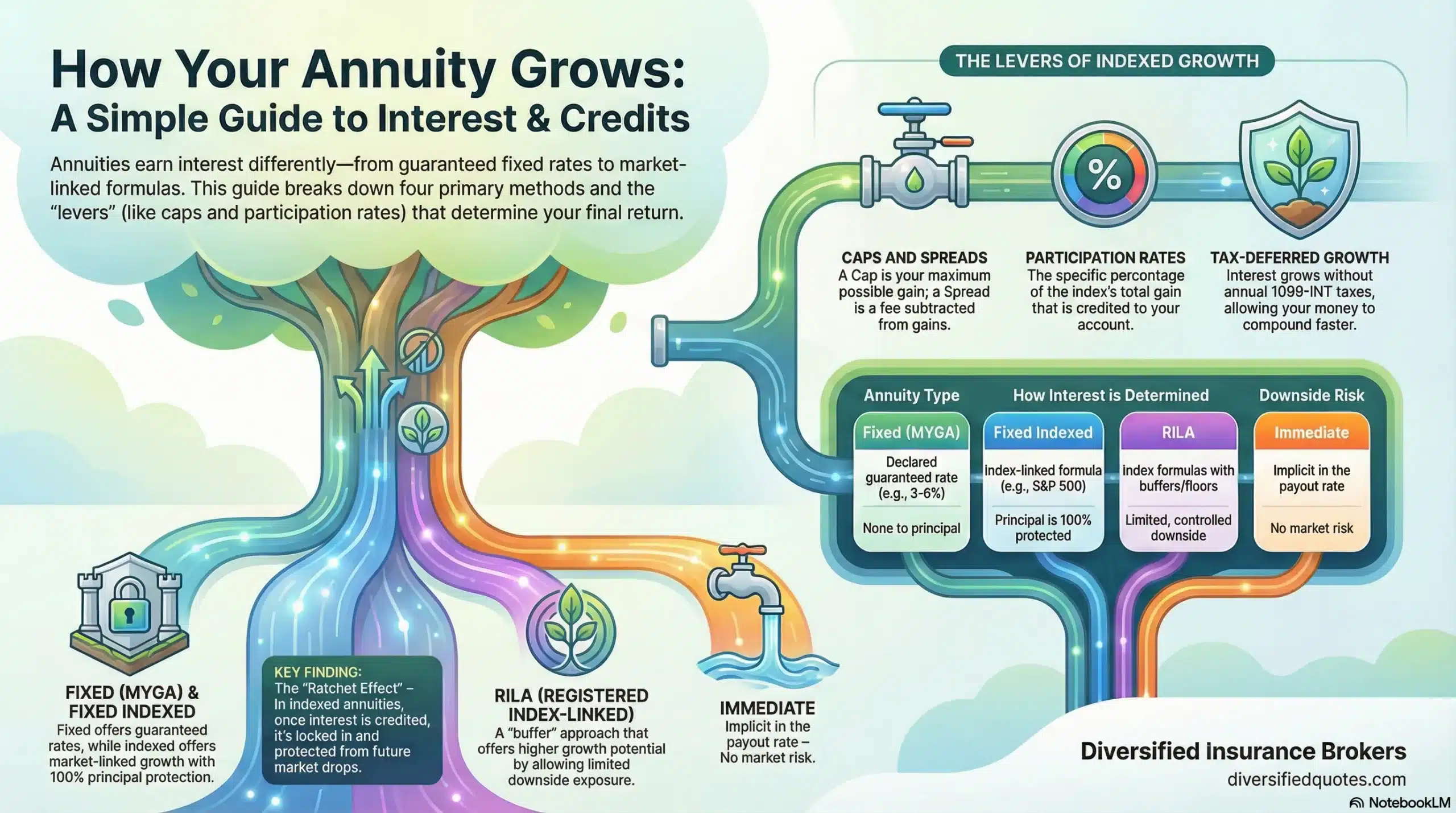
When people say “guaranteed annuity,” they usually mean one of two categories: a fixed annuity (including MYGAs) or a fixed indexed annuity. Both can protect principal. Both avoid direct market losses. But they behave very differently over time, especially when you factor in liquidity, time horizon, and income rider options.
A fixed annuity is straightforward. It credits a declared interest rate for a specific period. Many retirees use these when they want a predictable accumulation period before turning income on later. It’s often used as a bond/CD alternative for retirement assets that need stability.
A fixed indexed annuity uses a market index as the basis for crediting interest, but still protects principal from market declines. The tradeoff is that gains are limited by caps, participation rates, or spreads. When structured properly, this can provide meaningful long-term accumulation potential without taking on direct market downside. Many people use this when they want growth potential and also want an income rider option later.
If you want a clean breakdown of these differences, this comparison is helpful: Fixed Annuities vs Fixed Indexed Annuities
Estimate Your Guaranteed Retirement Income
Before you do paperwork, it helps to see what “income certainty” could actually look like. A rollover isn’t just a transfer — it’s a retirement income decision. The calculator below helps estimate guaranteed lifetime income options, based on your age and the amount you’re rolling over.
Lifetime Income Calculator
Get a real-world estimate of the guaranteed income your 403(b) or 401(k) rollover could generate.
💡 Note: The calculator accepts premiums up to $2,000,000. If you’re investing more, results increase in direct proportion — for example, doubling your premium roughly doubles the guaranteed income at the same age and options.
Step-by-Step: How to Roll Over a 401(k) or 403(b) Into an Annuity Correctly
The best way to roll over a 401(k) or 403(b) into a guaranteed annuity is a direct rollover, sometimes called a trustee-to-trustee transfer. This matters because qualified accounts are tax-deferred. If the transfer is done incorrectly, the IRS may treat it like you took the money out — which can create withholding, penalties, and an unexpected tax bill.
In a proper rollover, the money never becomes “yours” personally during the transfer. The plan sends it directly to the receiving carrier. In most cases, this is done either by electronic transfer or by check payable to the new carrier “for the benefit of” the account owner. That wording is what keeps it qualified.
Once the annuity is issued, it stays inside the qualified retirement structure. The money continues to grow tax-deferred. Later, withdrawals are taxed as ordinary income, just like distributions from a 401(k) or IRA.
Many retirees like this structure because it keeps the tax deferral intact while adding more control over the outcome. It can turn an employer plan into a personal retirement strategy with clearer guardrails.
Important Rollover Rules (That Often Surprise People)
The first surprise is that not every 401(k) or 403(b) allows partial rollovers while you’re still employed. Many plans only allow rollovers after separation from service or retirement, although some offer in-service distributions after a certain age. Before you select any annuity, you want to confirm what your plan allows.
The second surprise is that many employer plans automatically withhold taxes if you request a distribution check made payable to you. That’s why indirect rollovers are risky. Even if you intend to redeposit the funds within 60 days, the withholding can create a gap you must replace out-of-pocket to avoid taxation on the withheld amount.
The third surprise is that many employer plans have unique rules for beneficiary designations and spousal consent. You want to coordinate that transition carefully so your new annuity is titled correctly and aligned with your estate plan. A simple review each year can prevent major downstream problems.
This is a great checklist resource for that piece of the planning: Annual Beneficiary Review Checklist
Should You Roll Over All of Your 401(k) or Only Part of It?
In most real retirement plans, the best answer is “it depends.” Some people want to roll over everything because they’re done with market risk and want contract-defined stability. Others want to keep a portion invested and only transfer the amount needed to build baseline income. Both approaches can be valid — the best decision is based on what the money needs to do.
One of the most practical planning methods is to separate money into “income you must have” and “growth you can tolerate.” Your essential retirement expenses usually include housing, basic bills, food, and healthcare. If those expenses depend entirely on market performance, retirement becomes stressful. But if those expenses are partially covered by guaranteed income, everything else becomes easier to manage.
This concept is especially important for retirees who are worried about taking withdrawals during downturns. That risk has a name, and it’s one of the biggest retirement killers: Sequence of Returns Risk
What About Required Minimum Distributions (RMDs)?
If you’re rolling money from a 401(k) or 403(b) into a qualified annuity, you still need to think about RMDs. The IRS requires minimum distributions after you reach the applicable age, and annuities do not “erase” that requirement. Instead, the strategy must work inside the rules.
Some annuity structures are designed to support retirement distribution planning in a smoother way, especially when the goal is stable income rather than random withdrawals. But the key is that the annuity must be structured with retirement cash flow in mind, not just “highest rate.”
If you’re already in the RMD stage or getting close, this is a strong explainer: Required Minimum Distributions
Fixed Annuity Term Length: Why This Is the Most Overlooked Decision
When people shop annuities, many assume the only thing that matters is “the rate.” But the term length is often just as important. A short-term annuity may offer flexibility, but it can also reprice sooner. A longer-term annuity may lock in guarantees, but it comes with longer surrender schedules.
This matters for retirement plans because your 401(k) rollover is often money you want to protect long-term. If you might need access in a few years, flexibility matters more. If you’re building steady income later, longer guarantees may be a better fit.
A solid approach is to match annuity term length to your actual timeline — not your hopes. That way, you’re not forcing yourself into early withdrawals later.
If you’re looking for a broader view of the rollover decision-making process from a retirement planning lens, this page helps connect the dots: How to Choose the Right Annuity
How Income Riders Actually Work (And Why They Matter for Rollovers)
If your primary goal is guaranteed income, the annuity you pick matters — but so does the income structure. Many fixed indexed annuities offer optional income riders that create a separate “income base” used to calculate lifetime withdrawals. That income base may grow by a roll-up rate, and later it can generate predictable withdrawal amounts based on your age.
This is one of the reasons many retirees roll money into annuities. The income rider creates clarity. It transforms retirement planning from “guesswork” into “contract math.” Not everyone needs a rider, but for people who want reliable lifetime income, it can be one of the most valuable tools available.
If you want a clear explanation of how these guarantees work, this page breaks it down: How Do Annuity Income Riders Work?
403(b) Rollovers for Teachers and Nonprofit Employees
403(b) accounts are common among teachers, school systems, hospitals, and nonprofit organizations. Many of these employees build strong balances over decades, but the investment menus are often limited, and some plans include higher fees than people realize. When retirement gets close, many educators want to simplify and protect their retirement funds, especially if they no longer want market volatility to dictate their retirement lifestyle.
Rolling a 403(b) into a guaranteed annuity can be a strong strategy when the goal is to build stable income. In many cases, educators also want to coordinate this decision with pension income, Social Security timing, and healthcare transition planning.
If you’re in that category, this is a strong companion page: Annuity Rollover Options for Teachers
Common Mistakes to Avoid When Moving a 401(k) Into an Annuity
Most rollover problems come from paperwork mistakes, not product mistakes. A bad rollover is rarely “the annuity’s fault.” It’s usually a process breakdown that creates taxes, delays, or incorrect titling. The most common error is requesting a distribution payable to the owner instead of the receiving carrier. That can trigger withholding and create a 60-day rollover scramble that nobody wants.
Another mistake is choosing an annuity without confirming liquidity rules. A guaranteed annuity is not a checking account. If you might need large access soon, the product and term length must match that. Some annuities provide annual penalty-free withdrawal allowances, while others require longer holding periods for maximum efficiency.
A third mistake is ignoring beneficiary alignment. Retirement accounts and annuities do not always follow the same default beneficiary rules. You want your annuity to match your family plan, not overwrite it accidentally.
Finally, a mistake we see often is focusing only on “highest rate” without clarifying the goal. If the goal is lifetime income, then the income rider, withdrawal factors, and contract terms matter more than an advertised interest crediting story.
Why Diversified Insurance Brokers for Rollover Planning
Rolling over a 401(k) or 403(b) is one of the most important retirement decisions most people will ever make. It should be handled like a retirement planning strategy — not a product transaction. Our advisors help clients compare annuity structures with a focus on income clarity, principal protection, and long-term planning flexibility.
We’re a family-owned fiduciary insurance agency licensed nationwide, and our job is to help you understand your options, avoid rollover mistakes, and pick the structure that actually fits the retirement you want.
Request a Free Annuity Rollover Review
We’ll compare guaranteed annuity rollover options and show what your retirement income could look like — based on your real timeline and goals.
Request a Rollover ReviewRelated Retirement Rollover Pages
Explore related rollover and retirement-income resources that connect directly to 401(k) and 403(b) annuity planning.
Related Annuity Education Pages
These pages help you understand how annuities work, what affects income, and how guarantees are structured.
Talk With an Advisor Today
Choose how you’d like to connect—call or message us, then book a time that works for you.
Schedule here:
calendly.com/jason-dibcompanies/diversified-quotes
Licensed in all 50 states • Fiduciary, family-owned since 1980
FAQs: Rolling Over a 403(b) or 401(k) into a Guaranteed Annuity
Can I roll over my 401(k) or 403(b) without paying taxes?
Yes. A direct rollover allows you to transfer funds from your employer plan to a qualified annuity without triggering current taxes or penalties.
What type of annuity is best for rollover funds?
Fixed and fixed indexed annuities are most common. They preserve principal, grow tax-deferred, and can include lifetime income riders for guaranteed withdrawals.
How long does the rollover process take?
Typically 2–4 weeks depending on your employer plan’s processing time and the receiving insurance company’s funding procedures.
Can I roll over after retiring or changing jobs?
Yes. You can roll over at retirement, job change, or when eligible for in-service distributions if your plan allows it.
What are the benefits of rolling into a guaranteed annuity?
You gain principal protection, predictable income, and continued tax-deferred growth—without the risk of market losses.
Can I include income riders in a rollover annuity?
Yes. Guaranteed Lifetime Withdrawal Benefit (GLWB) riders can turn your rollover funds into guaranteed paychecks for life without annuitization.
Will I lose access to my funds?
Most annuities allow 10% annual penalty-free withdrawals. Some include nursing home or terminal illness waivers for added flexibility.
What if I already started taking 401(k) withdrawals?
You can still roll over the remaining balance, but withdrawals already taken may count as taxable distributions.
How does this affect my Required Minimum Distributions (RMDs)?
RMDs still apply for qualified annuities once you reach age 73. A fiduciary advisor can coordinate the correct annual distribution amounts.
Can educators roll over 403(b) plans into annuities?
Yes. Teachers can roll 403(b) plans directly into annuities, often through simplified custodial transfers with no tax consequences.
About the Author:
Jason Stolz, CLTC, CRPC and Chief Underwriter at Diversified Insurance Brokers (NPN 20471358), is a senior insurance and retirement professional with more than two decades of real-world experience helping individuals, families, and business owners protect their income, assets, and long-term financial stability. As a long-time partner of the nationally licensed independent agency Diversified Insurance Brokers, Jason provides trusted guidance across multiple specialties—including fixed and indexed annuities, long-term care planning, personal and business disability insurance, life insurance solutions, and short-term health coverage. Diversified Insurance Brokers maintains active contracts with over 100 highly rated insurance carriers, ensuring clients have access to a broad and competitive marketplace.
His practical, education-first approach has earned recognition in publications such as VoyageATL, highlighting his commitment to financial clarity and client-focused planning. Drawing on deep product knowledge and years of hands-on field experience, Jason helps clients evaluate carriers, compare strategies, and build retirement and protection plans that are both secure and cost-efficient. Visitors who want to explore current annuity rates and compare options across multiple insurers can also use this annuity quote and comparison tool.
