
Is Disability Insurance Expensive?

Jason Stolz CLTC, CRPC
Is disability insurance expensive? For most people, the honest answer is no—especially when you compare the cost of the premium to the size of the risk it protects. Disability insurance is income insurance. It’s designed to replace a portion of your paycheck if an illness, injury, or medical condition temporarily (or sometimes longer-term) keeps you from working. If you rely on your income to pay for housing, family expenses, debt payments, and long-term goals, disability coverage is one of the most practical protections you can put in place because it defends the thing that funds everything else: consistent cash flow.
What makes disability insurance feel confusing is that it’s not priced like a simple “one size fits all” product. The premium is driven by several design levers—your occupation class, your age, the amount of monthly benefit you want, how long you want benefits to last, how soon you want payments to start, and the contract definition that controls when a claim pays. Once you understand those levers, you can almost always shape the policy so it’s strong enough to matter without being uncomfortable in your budget. At Diversified Insurance Brokers, we help people do exactly that: compare options, understand trade-offs, and choose a design that fits real life.
Another reason people ask “Is disability insurance expensive?” is because they compare it mentally to other insurance types. With life insurance, you’re usually paying for a large benefit that may never be used. With disability insurance, you’re paying for a benefit that could be used while you’re alive, during your working years, when losing income can create immediate stress. That’s why disability coverage often feels more “real” than people expect. It protects you against a scenario that is not dramatic or rare: being unable to work for a period of time because of something medical.
If you’re researching disability insurance cost, it can also help to read our deeper breakdowns on how much disability insurance costs and whether disability insurance is expensive in the real world for different occupations and benefit designs. Many people discover the same thing: the coverage is usually more affordable than expected when it’s designed correctly.
Estimate Your Disability Coverage Cost
Answer a few questions to see realistic pricing based on your age, occupation class, monthly benefit, and elimination period.
Quick, confidential, and designed for real-world budgets.
Why Disability Insurance Often Costs Less Than People Expect
Disability insurance feels expensive only when you look at the premium as “another monthly bill” instead of looking at what it protects. Your paycheck is not just income. It’s the engine behind housing, groceries, healthcare, family stability, and retirement progress. If your income stops for even a short period, many households begin solving the problem with tools that are far more expensive than an insurance premium: credit cards, early withdrawals, loans, or delayed payments that create penalties and stress.
In other words, the “real cost” of a disability is often not just the missed income. It’s the chain reaction. People pause retirement contributions, lose employer matching, liquidate investments at the wrong time, take on debt, and create financial decisions they have to unwind later. Short-term disability coverage can help prevent that chain reaction by replacing a portion of income during the most fragile period: the first few weeks or months when you’re dealing with a medical event and you want normal life to keep running.
Disability coverage is also flexible in a way many people don’t realize. The policy can be designed around your budget. If you want a lower premium, you can often adjust the elimination period (how long you wait before benefits begin), reduce the benefit duration, or select a benefit amount that stabilizes essentials rather than trying to replace every dollar of income. This is one reason people who want control often explore buying coverage digitally, using resources like how to buy disability insurance online and how to buy short-term disability insurance online.
What Determines the Cost of Disability Insurance?
Disability insurance is priced based on risk and benefit design. The insurer is evaluating the likelihood of a claim and the potential cost of paying benefits. That sounds technical, but it becomes very practical once you see the levers. If you’re trying to answer “Is disability insurance expensive?” the best approach is to understand which levers matter most and how each lever changes both premium and protection.
1) Your age at application
Age is one of the most straightforward pricing factors because disability risk generally increases as we get older. Buying coverage earlier often results in a lower premium and better insurability. The other advantage of buying earlier is that you can often lock in future increase options while you’re healthy—meaning your coverage can grow with income without you having to re-qualify medically each time you need more protection.
If you’re in your 20s or 30s, a disability policy can feel like something you “should do later.” But that delay usually means you pay more later, and you risk finding out a minor health issue creates exclusions or limitations you didn’t expect. Buying earlier is often a “rate lock” strategy as much as it is a protection strategy.
2) Health and underwriting profile
Your health profile influences both your eligibility and your rate class. Underwriting commonly evaluates medical history, prescriptions, height and weight, and any conditions that may increase the likelihood of disability. The important thing to understand is that having a medical history does not automatically mean “you can’t get coverage.” It usually means the carrier may price differently, add exclusions related to certain conditions, or request additional records.
This is why comparing carriers matters. Different insurers treat the same medical history differently. An independent brokerage approach can reduce the “guessing game” by matching your profile to carriers that are more favorable for your situation. If you have a more complex history or want to understand how underwriting affects cost, starting with a quote request is often the fastest way to get clarity without assumptions.
3) Occupation class
Occupation is one of the biggest pricing drivers in disability insurance. Carriers classify occupations based on duties, risk exposure, and claim patterns. Some jobs are priced more favorably because the work is less physically demanding and more consistent in duties. Others are priced higher because the work is more physical, hazardous, or difficult to perform with even minor injuries.
But occupation class is not only about physical hazard. It’s also about how a claim would affect your ability to work in your specific role. If your income depends on specialized duties, the contract definition and occupation class become even more important. This is why many professionals prioritize own-occupation disability insurance. That definition is often the difference between a policy that behaves like you expect and a policy that disappoints you when a claim occurs.
For higher earners, the occupation conversation is also about keeping coverage aligned with how compensation actually works—salary, bonus, commissions, partnership income, or business earnings. If that’s your situation, this framing is explored in disability insurance for executives, because executives often discover their employer coverage caps out far below what they need.
4) Monthly benefit amount
The monthly benefit is what the policy can pay during an approved claim. Higher benefits usually mean higher premiums because the insurer is taking on more exposure. Many policies are designed to replace a portion of income, not 100%, and carrier limits often prevent full replacement at higher income levels.
A practical way to choose a benefit amount is to start with your “non-negotiable” monthly expenses—housing, utilities, food, insurance, debt payments, childcare—and then decide whether you want the benefit to protect longer-term momentum like retirement contributions. If you want a more structured sizing framework, review how much disability insurance you need. The right benefit is not “max it out.” It’s “cover what matters most reliably.”
5) Elimination period (waiting period)
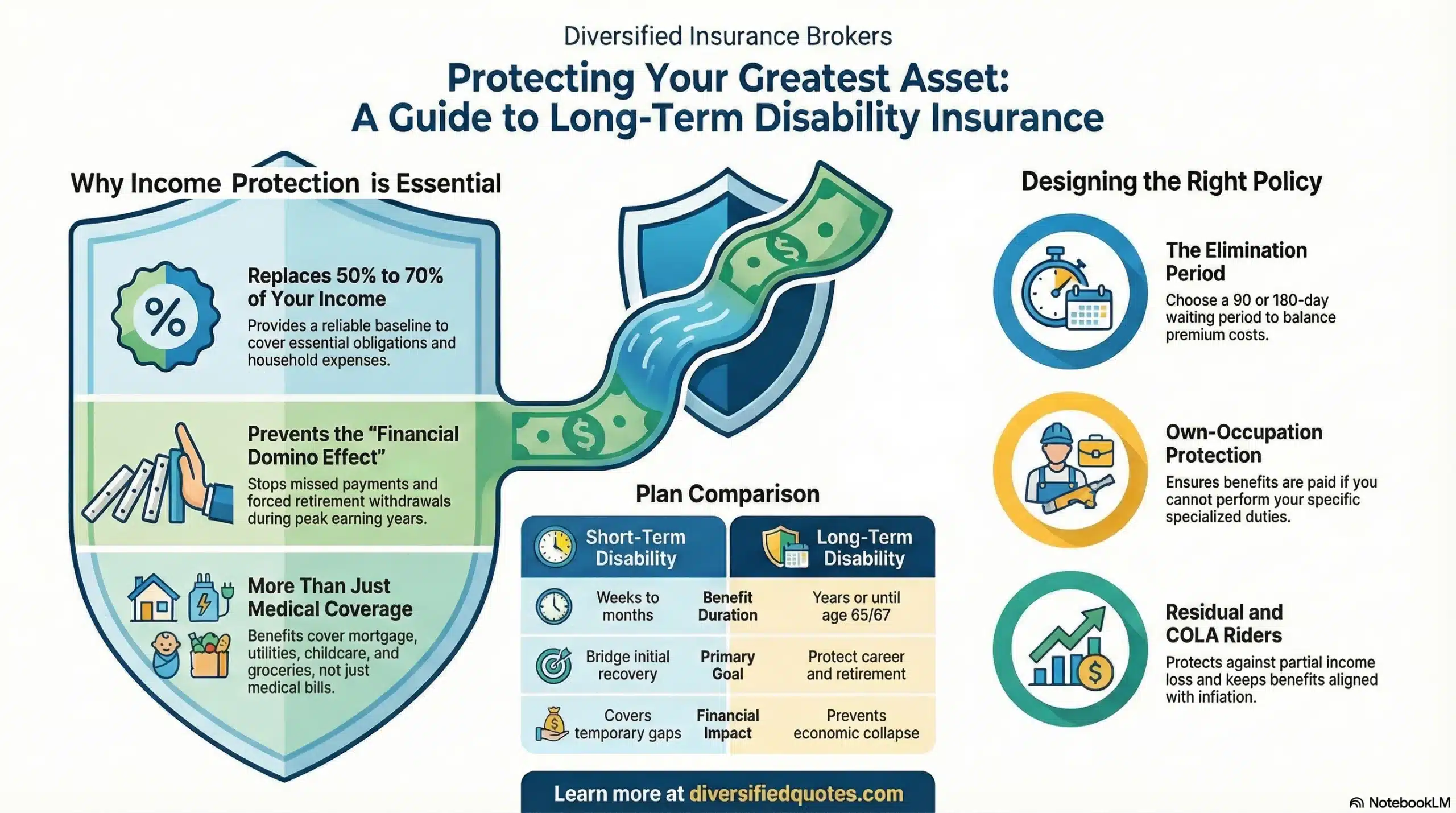
The elimination period is how long you must be disabled before benefits begin. Choosing a longer elimination period often reduces premium because you are self-insuring the early portion of a disability. Many people choose 30, 60, 90, or 180 days. The “right” choice depends on your cash reserves, any sick leave, any employer short-term disability coverage, and how long you could realistically cover your bills without income.
One of the most common ways to reduce cost without weakening the policy is to extend the elimination period—if you have a real emergency fund. This is often the lever that produces savings while still protecting you against the financially devastating scenario: a longer absence from work.
6) Benefit period (how long benefits can pay)
The benefit period determines how long the policy can pay during a claim. Shorter benefit periods are less expensive. Longer benefit periods cost more but protect against long-duration disability that can permanently alter a career. Many people underestimate how long recovery can take for common medical events—especially when work capacity is limited by restrictions, rehabilitation, or chronic conditions.
If you’re trying to keep premium comfortable, benefit period is another lever you can adjust, but it should be done intentionally. The goal is not to buy a policy that expires exactly when you still need it. If you’re comparing short-term and long-term protection, it helps to review short-term disability and long-term disability insurance to understand which risk window you’re protecting.
7) Policy definition and riders
With disability insurance, the “product” is the contract language. Definitions and riders determine when benefits pay and how partial disability is treated. For many professionals, paying for a stronger definition is worth it because it makes the policy behave in a way that matches the reality of professional work.
Common riders that influence cost include residual or partial disability benefits (which help when you can work but earn less), cost-of-living adjustments (which can matter in multi-year claims), and future increase options (which can matter as income grows). The right strategy is not to add everything. The right strategy is to choose riders that solve real problems for your income model.
So… Is Disability Insurance Expensive in Real Numbers?
In many cases, quality disability coverage falls around a range that surprises people—often roughly 1% to 3% of annual income for many common designs, though the exact number depends heavily on the levers above. Some people will be lower, some higher, and certain occupations and benefit designs will change the range. What matters is not the “average.” What matters is designing a plan that protects your life without feeling like a financial burden.
Another way to evaluate cost is to compare it to the value of the asset being protected. If you earn $75,000 per year, you’re protecting a multi-million-dollar income stream over your working life. A premium that feels noticeable monthly can be small compared to the financial damage a disability can create. That’s why disability coverage is often described as a foundational layer of protection rather than an optional add-on.
When Disability Insurance Feels “Expensive” and How to Fix It
Disability insurance usually feels expensive in a few specific scenarios. The good news is that each scenario has a design solution.
Scenario one: benefits start too soon. If you choose a very short elimination period, the premium increases because the insurer is more likely to pay. If you have sick leave or a cash reserve, extending the elimination period can often reduce premium while still protecting the bigger risk—an extended absence.
Scenario two: the benefit period is longer than your real goal. Some people select the longest benefit period without thinking through their risk window. A more targeted benefit period may bring cost down while still protecting the timeline you care about most.
Scenario three: the benefit amount is higher than your actual need. Buying a benefit that covers essential obligations is often more sustainable than buying a maximum benefit that strains the budget. If you want to protect lifestyle, start by protecting essentials, then expand if budget allows.
Scenario four: you waited and your health profile changed. Age and health are real underwriting drivers. If you apply later, the premium can be higher, and exclusions are more likely. If you’re still in good health, taking action sooner is often the simplest way to avoid that problem.
Scenario five: you’re relying on the wrong carrier for your occupation. Different carriers treat the same occupation differently. If you’re paying “too much,” it may not be the concept of disability insurance that’s expensive—it may be that a different carrier or structure would be a better fit.
Group Coverage vs. Individual Coverage: Why the Cost Comparison Can Be Misleading
Many people compare the cost of individual disability insurance to what they pay for employer benefits and assume the individual policy is expensive. But group coverage is priced and structured differently. Employer plans often cap benefits, may include definitions that are less protective, and may not be portable if you change jobs. Some group benefits are also taxable depending on how premiums are paid, which can reduce the net benefit at the exact time you need it most.
Individual disability coverage is priced more like a personalized contract. You can tailor the definition, benefit structure, timing, and duration. It can also follow you even if you change employers, which matters in a world where people change jobs more often than they used to. If you want to understand the portability and why individual coverage can be a cornerstone for many professionals, our overview on disability insurance services provides a broader context.
Short-Term Disability vs. Long-Term Disability: Which One Is “More Worth It”?
Short-term disability and long-term disability solve different problems, and the “worth it” question usually comes down to timing and risk tolerance. Short-term disability stabilizes the early part of a disability—when income disruption is immediate and household stress is highest. Long-term disability protects against the scenario where the disruption lasts much longer and changes career trajectory.
Many households discover their most realistic fear is not “I’m disabled forever.” It’s “I can’t afford to miss a paycheck for months.” That fear is exactly what short-term coverage is designed for. If you want a digital-first path to coverage, our guide on how to buy short-term disability insurance online is designed for that use case.
For business owners, the conversation can be even broader because disability affects both personal income and business operations. In those cases, a layered strategy can matter, including solutions like business overhead expense coverage, which helps cover fixed business costs during disability so the business can survive while you recover.
Ways to Reduce Premium Without Weakening the Coverage
If you’re concerned about cost, the best strategy is to adjust the policy design intelligently rather than “buying less insurance” in a way that defeats the point. In many cases, there are several practical moves that can keep coverage meaningful and reduce premium at the same time.
One of the simplest moves is extending the elimination period if you have a realistic cash reserve. Another is choosing a benefit amount that prioritizes non-negotiable monthly obligations rather than trying to replace every dollar of income. You can also select a benefit period that matches your real risk window. And you can be strategic about riders—starting with the definition and residual benefits, then adding other riders only if they solve a real problem for your situation.
Finally, comparison shopping matters. Two carriers can look very different on price for the same person because they classify occupations differently and have different underwriting appetites. Working through a broker that can compare options is often the difference between “this feels expensive” and “this feels reasonable.”
Why Disability Insurance Is Often Worth Far More Than It Costs
Disability insurance is one of those products that feels easy to postpone because the risk is invisible—until it’s not. Most people don’t plan to become disabled, but the issue isn’t whether you plan it. The issue is whether your finances can handle it. Even a relatively short disruption can force decisions that are financially costly: carrying balances on credit cards, taking loans, pausing retirement contributions, or pulling from accounts that were meant to compound long-term.
When you protect income, you protect your plan. You protect the ability to keep the household stable, avoid forced liquidation of investments, and maintain momentum toward long-term goals. That stability effect is one reason many people link income protection to broader planning strategies like how the wealthy stay wealthy—because protecting cash flow is one of the quiet keys to avoiding catastrophic financial detours.
Get a Real Quote Based on Your Age, Occupation, and Coverage Goals
The fastest way to answer “Is disability insurance expensive?” is to stop guessing and look at real designs based on your profile. The same person can see very different pricing depending on elimination period, benefit duration, definition strength, and carrier fit. A quote request is not just about price. It’s about clarity—so you can see options, compare trade-offs, and choose the policy design that feels both strong and sustainable.
Get a Personalized Disability Quote
See realistic options based on your occupation class, age, benefit amount, and waiting period—so you can choose coverage that fits your budget.
Talk With an Advisor Today
Choose how you’d like to connect—call or message us, then book a time that works for you.
Schedule here:
calendly.com/jason-dibcompanies/diversified-quotes
Licensed in all 50 states • Fiduciary, family-owned since 1980
FAQs: Is Disability Insurance Expensive?
How much does disability insurance typically cost?
Most people pay about 1–3% of their annual income for coverage. For example, someone earning $80,000 may pay $70–$200 monthly for long-term protection.
Is short-term or long-term disability cheaper?
Short-term disability policies are cheaper but offer limited duration—often 3 to 6 months of coverage. Long-term disability costs more but provides ongoing income protection if you can’t work for an extended period.
Does my job affect my disability insurance premium?
Yes. Occupations with higher injury risks or physical demands usually have higher premiums. Office and professional workers generally qualify for lower rates.
Can I get coverage if I’m self-employed?
Absolutely. Disability insurance for self-employed individuals or business owners is widely available, and can include riders for business expenses or income replacement.
Are premiums tax-deductible?
If you pay premiums personally, benefits are typically tax-free. If your business pays the premiums and deducts them, benefits may be taxable when received.
Can I lower my cost without losing protection?
Yes—choosing a longer elimination period, adjusting the benefit duration, and removing unnecessary riders can significantly lower costs while keeping strong protection.
About the Author:
Jason Stolz, CLTC, CRPC and Chief Underwriter at Diversified Insurance Brokers (NPN 20471358), is a senior insurance and retirement professional with more than two decades of real-world experience helping individuals, families, and business owners protect their income, assets, and long-term financial stability. As a long-time partner of the nationally licensed independent agency Diversified Insurance Brokers, Jason provides trusted guidance across multiple specialties—including fixed and indexed annuities, long-term care planning, personal and business disability insurance, life insurance solutions, Group Health, and short-term health coverage. Diversified Insurance Brokers maintains active contracts with over 100 highly rated insurance carriers, ensuring clients have access to a broad and competitive marketplace.
His practical, education-first approach has earned recognition in publications such as VoyageATL, highlighting his commitment to financial clarity and client-focused planning. Drawing on deep product knowledge and years of hands-on field experience, Jason helps clients evaluate carriers, compare strategies, and build retirement and protection plans that are both secure and cost-efficient. Visitors who want to explore current annuity rates and compare options across multiple insurers can also use this annuity quote and comparison tool.
