
Life Insurance for Divorcees

Jason Stolz CLTC, CRPC
Divorce changes more than your personal life—it reshapes your financial responsibilities, future planning, and the people who depend on you. If you’re divorced (or actively going through a divorce), life insurance is often one of the most important “quiet” decisions you’ll make: it can protect children, satisfy legal obligations, preserve the value of support agreements, and reduce the chances of financial disruption later.
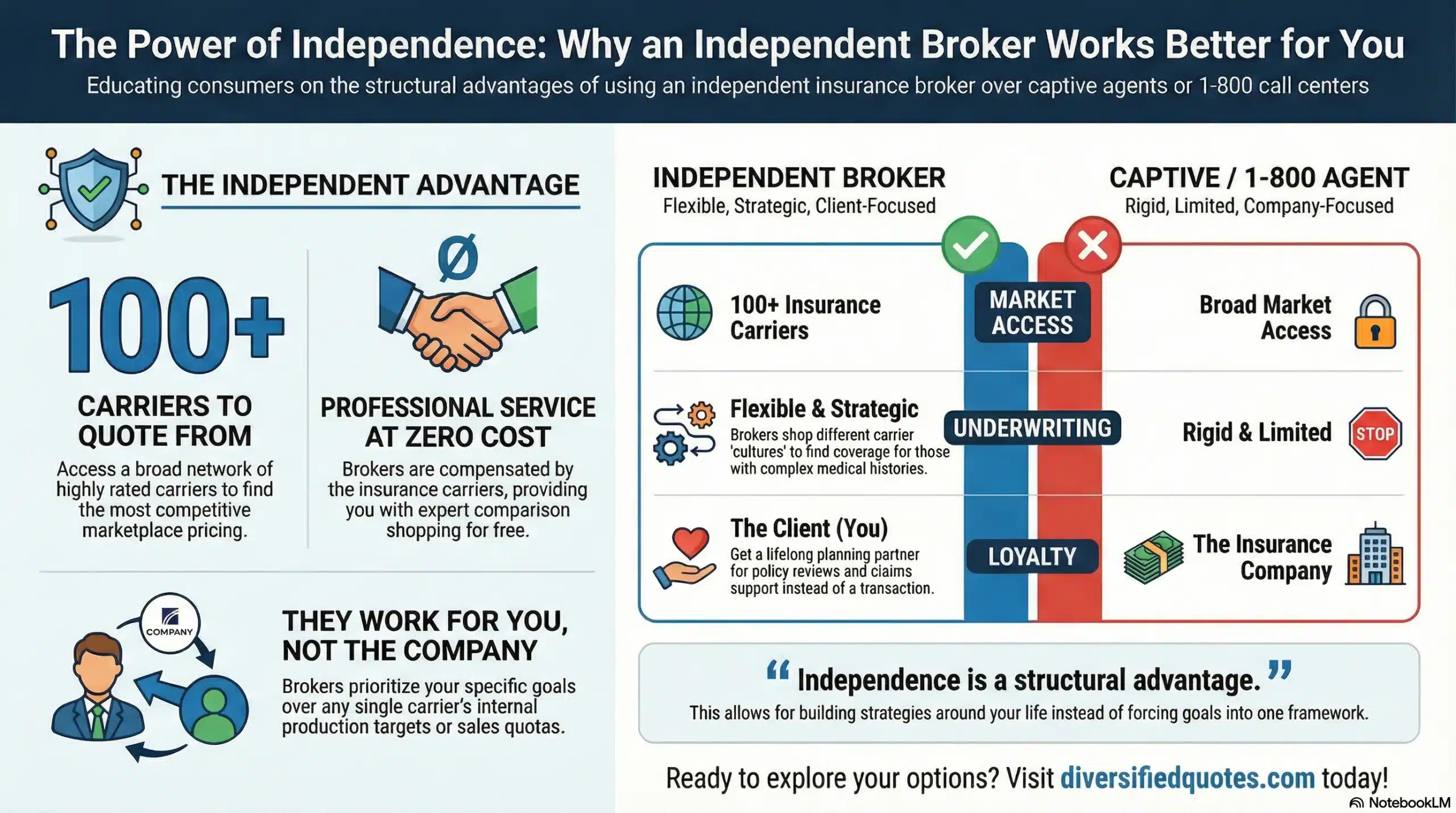
At Diversified Insurance Brokers, we help divorcees secure life insurance coverage that is affordable, properly structured, and aligned with real-world needs—whether you’re buying coverage voluntarily or because it’s required by a court order. As an independent, family-owned, fiduciary insurance agency licensed in all 50 states, we compare options across 100+ top-rated carriers to find the best fit for your budget, timeline, and underwriting profile.
And just as importantly: we help you avoid common mistakes after divorce—like letting a policy lapse, leaving the wrong beneficiary in place, relying entirely on employer coverage that can disappear, or choosing a term length that expires before the obligation ends.
Review Your Life Insurance After Divorce
We’ll help you evaluate coverage needs, court requirements, ownership, and beneficiary designations—then shop carriers for the best fit.
Why Life Insurance Matters After Divorce
After divorce, the financial “picture” often becomes more fragile than people realize—even if everything feels stable today. One income may now support two households, child expenses may be higher than expected, and future responsibilities (like education costs) may still be shared.
Life insurance is a practical tool that helps protect those responsibilities. It can replace support payments, provide stability for children, and reduce the likelihood that surviving family members have to make big decisions under pressure.
For divorcees, we typically see life insurance used for three main purposes:
1) Protecting child support or shared child expenses.
If you have a legal obligation to contribute financially, a life insurance policy can ensure your children remain supported even if you pass away unexpectedly.
2) Securing spousal support (alimony) obligations.
When support payments are expected for a defined number of years, life insurance can secure that agreement so the receiving party isn’t financially stranded.
3) Covering “big fixed costs” that still exist post-divorce.
Mortgages, refinancing, shared debts, co-signed loans, and education plans don’t automatically disappear when a marriage ends. If your income is part of the plan to pay them, coverage may still be important.
Court-Ordered Life Insurance (Child Support & Alimony)
In many divorces, life insurance isn’t optional—it’s written directly into the settlement agreement or ordered by the court. These requirements usually exist for one reason: if the paying spouse dies early, the money that was supposed to support children or a former spouse must still be available.
Court-ordered life insurance usually includes very specific expectations around: coverage amount, duration, beneficiary structure, and sometimes even ownership and proof of coverage. If any part is set up incorrectly, you could end up with coverage that technically exists—but doesn’t actually satisfy the order.
Some divorcees assume their employer coverage solves the problem. But employer life insurance can change with job changes, layoffs, retirement, or benefit adjustments. That’s why many agreements favor an individual policy that stays in force regardless of employment status. If you want the full breakdown, compare group vs. individual life insurance.
If your divorce decree requires coverage, we recommend getting crystal-clear answers to these questions:
• How long must the coverage stay active?
Ideally the term length matches the obligation (or extends beyond it with buffer).
• Who must be the beneficiary?
Sometimes it’s an ex-spouse directly. Sometimes it’s a trust, guardian, or another structure. Minor children often require a more careful setup.
• Who must own the policy?
Ownership matters because it controls whether the policy can be changed, canceled, or reassigned later. Even if the court does not explicitly state ownership, ownership often becomes the difference between “compliant on paper” and “secure in reality.”
• Do you need proof of coverage?
Many agreements require documentation or periodic verification. We can help make sure the paperwork is easy to produce.
Beneficiaries, Ownership, and Common Post-Divorce Mistakes
This is where most divorce-related life insurance issues happen—not because someone didn’t buy a policy, but because the policy details weren’t handled correctly.
Here are some of the most common mistakes we help divorcees avoid:
Mistake #1: The policy expires before the obligation ends.
A 10-year term policy doesn’t work for a 12-year support timeline. This is simple, but it’s extremely common.
Mistake #2: Wrong beneficiary setup.
Naming a minor child directly as a beneficiary can create delays and legal complications. Many families do not realize this until it becomes an emergency.
Mistake #3: Relying on employer-provided coverage alone.
Even if it’s “enough today,” it may not remain in place tomorrow. Individual coverage protects continuity.
Mistake #4: Forgetting to update beneficiaries after divorce.
If your divorce is finalized and you intended to remove a former spouse, that must be done intentionally. In other cases, your court order may require the opposite. Either way, it should be controlled—never accidental.
Mistake #5: Trying to solve a legal requirement with the wrong policy type.
For many divorcees, a properly structured term policy is the best fit. For others, permanent coverage may be necessary depending on the obligation. The point is that the structure has to match the goal.
How Much Life Insurance Coverage Do Divorcees Typically Need?
The “right” amount depends on what the coverage is meant to replace. Some divorcees need coverage to secure support payments. Others need coverage to protect children and long-term plans. In many cases, it’s both.
Common coverage approaches include:
Support replacement approach:
Coverage amount is structured to reflect remaining child support and/or alimony obligations. This often aligns closely with the court requirement.
Income replacement approach:
Coverage is built around what your children would need if your income disappears—often designed around the years until adulthood, college, or independent living.
Debt and stability approach:
Some divorcees choose coverage to pay off major debts (mortgage, loans) so children can stay in their home and the surviving parent isn’t forced to sell assets quickly.
A calculator can help estimate a starting point, but a fast review with an advisor helps ensure the final structure matches the real obligation and the real timeline.
Instant Life Insurance Quotes
Compare term options and pricing ranges instantly, then we’ll help confirm the coverage fits your post-divorce obligations.
Term vs. Permanent Life Insurance After Divorce
Most divorce-related life insurance needs are tied to a defined timeline. That’s why term life insurance is often the most efficient solution: it provides high coverage for a set period at a lower cost.
Term life insurance is commonly used to cover obligations such as: child support, alimony, mortgage protection, and income replacement during the “high responsibility” years.
Permanent life insurance can make sense when: your obligation is ongoing, you want lifetime coverage, you are planning for legacy needs, or you want a long-term policy that doesn’t expire as you age.
Some divorcees choose a blended approach: a larger term policy for the obligation period, paired with a smaller permanent policy for long-term planning.
If you already have a term policy and want to keep coverage without re-qualifying medically, you may want to explore convert term to permanent life insurance.
Employer Life Insurance vs. Individual Coverage After Divorce
Employer life insurance can be a great benefit, but it’s not always a reliable long-term solution—especially after divorce. Coverage amounts can be limited, portability can be restricted, and benefits can change with a career transition.
Individual life insurance is designed to follow you regardless of your job. That matters when your policy is securing obligations that a court expects you to maintain. A common strategy is to keep employer coverage if it’s free or inexpensive, then add an individual policy to reach the full amount needed.
If you want to compare these options quickly, start here: Group vs. Individual Life Insurance.
How Life Insurance Underwriting Works for Divorcees
Divorce itself does not “hurt” your underwriting class. Life insurance companies focus on your age, build, health history, medications, family history, and lifestyle factors.
Where divorce can indirectly affect the process is through timing: stress, life changes, inconsistent medical follow-ups, or rushed applications can create delays. Our goal is to keep the process clean, accurate, and fast—especially when deadlines exist.
If you have underlying health conditions, approvals may still be very possible. The key is matching your profile to the right carriers and documenting stability. If that applies, you may also want to review life insurance with pre-existing conditions.
How Fast Can You Get Life Insurance After Divorce?
Timing depends on your health profile and the policy type. Some cases can be approved quickly with simplified underwriting. Other cases take longer due to medical records or lab requirements.
If you have a legal deadline, we can help prioritize a strategy that balances speed and structure without sacrificing compliance.
In urgent cases—especially when coverage is required for court compliance—our team focuses on: selecting the right carrier first, avoiding preventable delays, and submitting a clean application that underwriters can review efficiently.
How Diversified Insurance Brokers Helps Divorcees
Divorce-related coverage isn’t just about buying a policy—it’s about setting it up correctly and keeping it reliable. We help divorcees by handling the details that most people don’t realize matter until it’s too late.
When you work with our team, we help you:
• Choose a term length that actually matches the obligation timeline
(and avoids coverage gaps later)
• Structure beneficiary designations intentionally
so the death benefit goes where it’s meant to go
• Avoid overbuying or underbuying coverage
by aligning the policy to what it needs to protect
• Compare multiple carriers instead of guessing
so you don’t get stuck with one underwriting viewpoint
• Keep the process confidential, professional, and neutral
We focus on compliance and financial clarity—nothing else.
If you’re ready to review or set up coverage, start here: Request a Quote.
Get Help Structuring Divorce-Related Life Insurance
We’ll confirm coverage amount, term length, and structure—then compare carriers for the best approval and pricing.
Request a QuotePrefer to call? 800-533-5969
Talk With an Advisor Today
Choose how you’d like to connect—call or message us, then book a time that works for you.
Schedule here:
calendly.com/jason-dibcompanies/diversified-quotes
Licensed in all 50 states • Fiduciary, family-owned since 1980
Can I buy life insurance after a divorce?
Yes. Divorce does not prevent you from buying life insurance. Eligibility and pricing depend on health, age, and underwriting factors—not marital status.
Is life insurance required after divorce?
Sometimes. Courts often require life insurance to secure child support or alimony obligations. Requirements depend on the divorce agreement.
Who should be the beneficiary after divorce?
This depends on legal obligations and family needs. In some cases, a former spouse or trust must remain beneficiary for a set period.
Should I keep my old policy?
Not always. Many policies need beneficiary updates or replacement to better match post-divorce responsibilities.
Is term or permanent life insurance better after divorce?
Term is often used for time-limited obligations, while permanent coverage may suit long-term planning goals.
Does divorce affect life insurance premiums?
No. Premiums are based on health and risk factors, not marital status.
Can employer life insurance satisfy a court order?
Sometimes, but employer coverage may end if employment changes, so individual policies are often preferred.
About the Author:
Jason Stolz, CLTC, CRPC and Chief Underwriter at Diversified Insurance Brokers, is a senior insurance and retirement professional with more than two decades of real-world experience helping individuals, families, and business owners protect their income, assets, and long-term financial stability. As a long-time partner of the nationally licensed independent agency Diversified Insurance Brokers, Jason provides trusted guidance across multiple specialties—including fixed and indexed annuities, long-term care planning, personal and business disability insurance, life insurance solutions, and short-term health coverage. Diversified Insurance Brokers maintains active contracts with over 100 highly rated insurance carriers, ensuring clients have access to a broad and competitive marketplace.
His practical, education-first approach has earned recognition in publications such as VoyageATL, highlighting his commitment to financial clarity and client-focused planning. Drawing on deep product knowledge and years of hands-on field experience, Jason helps clients evaluate carriers, compare strategies, and build retirement and protection plans that are both secure and cost-efficient.
