
Life Insurance for Maritime Workers

Jason Stolz CLTC, CRPC
Life insurance for maritime workers is one of the most practical financial moves a seafarer, offshore worker, or port professional can make—because your job combines two things life insurance underwriters pay attention to: higher-than-average occupational risk and periods of time away from routine medical access. Whether you work on cargo ships, tugboats, fishing vessels, offshore platforms, or in port operations, the goal is the same: secure coverage that stays in force regardless of contracts, employers, deployment schedules, or travel routes. At Diversified Insurance Brokers, we help maritime professionals compare carrier rules, document job duties accurately, and pursue coverage designed for life on (and around) the water.
Many maritime workers already have some employer-provided group coverage, but that benefit is often limited in amount, tied to your current contract, and not always portable if you change jobs, switch unions, go independent, or transition into a different role. An individual policy follows you, giving your family a stable financial backstop even when your work schedule and location are anything but stable. If you’re also navigating medical underwriting concerns, start here for context: Life Insurance with Pre-Existing Conditions.
Request a Life Insurance Quote for Maritime Workers
Compare life insurance options built for seafarers, offshore professionals, and port-based marine careers.
Get My Quote Call 800-533-5969
Tip: Accurate duty description (offshore vs. nearshore, vessel type, travel zones) can materially change underwriting class.
Why Life Insurance Is Critical for Maritime Professionals
Maritime careers are essential to the global economy, but they come with risk profiles that look different from “typical” office-based occupations. Underwriters think in probabilities: remote work sites, heavy equipment, unpredictable weather, fall hazards, vessel operations, and long rotations can all increase exposure compared to standard industries. The result is that life insurance for maritime workers often hinges on two variables at once—your personal health profile and your occupational profile. When both are positioned correctly, many maritime workers qualify for competitive coverage.
Life insurance becomes even more valuable when your household relies on your income and schedule. A death benefit can replace income, stabilize a mortgage payment, pay off debts, protect a spouse who may not have the same earning power, and create a dependable education fund for children. For maritime workers who own businesses—like independent captains, contractors, or specialized equipment operators—life insurance can also be used to protect business continuity and financial obligations that don’t pause when work stops.
Many maritime workers also deal with job transitions: moving from one vessel to another, switching companies, joining a new contract, or going from offshore to port-based roles. Employer group plans don’t always follow you through those transitions, and the amounts may be far lower than what a family actually needs. Individual coverage keeps the protection stable even when your role changes.
Who Qualifies for Maritime Life Insurance?
Maritime life insurance is available across a wide range of roles, but underwriting results can vary depending on the level of offshore exposure, travel zones, job duties, and safety controls. The most important thing is describing what you actually do. “Maritime worker” can mean very different things on paper, and the carrier will price what they believe your day-to-day exposure looks like.
We routinely help clients in roles such as commercial seafarers on cargo, container, or passenger vessels; tugboat and harbor crew members; marine engineers and deck officers; offshore oil and gas professionals; commercial fishermen; and longshoremen and dockworkers who handle cargo operations and port logistics. Even within the same job title, a nearshore schedule and modern safety protocols may underwrite differently than deep-sea routes and high-risk tasks.
How Underwriting Works for Maritime Workers
Underwriting is rarely “maritime job = automatic decline.” Instead, carriers typically classify the occupation based on where you work (onshore/port vs. offshore), how often you travel, what type of vessel or platform you’re on, and whether your duties involve higher-risk activities. A deck officer on a commercial container ship may be viewed differently than a diver working subsea, and a dockworker may underwrite differently than a long-haul ocean route.
Carriers also evaluate your experience level, certifications, and safety record. Years in the industry and documented safety training can matter. If you have a clean record, consistent work history, and clearly defined duties that don’t include specialized high-hazard activities, it can help keep your occupational class more favorable. In contrast, if an application leaves the job description vague, the carrier may default to a more conservative classification, which can increase premiums.
Most fully underwritten policies will still consider build, blood pressure, cholesterol, family history, tobacco use, and general medical history, just like any other applicant. If you’re unsure what to expect from the medical side of the process, this guide can help: What Is a Life Insurance Exam?.
Special Considerations for Seafarers, Offshore Workers, and Port Crews
Maritime underwriting often comes down to context. Underwriters may ask about time offshore, time at sea per year, international vs. domestic waters, and whether you routinely operate in areas the carrier considers higher risk. They may also ask about emergency access and how quickly medical care is available in the event of injury or illness, especially for offshore roles. These questions aren’t designed to disqualify you—they’re designed to classify risk accurately.
Schedule and contract structure can also matter. Some maritime careers involve rotating weeks on and off, while others involve long deployments. Underwriters may want to understand whether your work is seasonal, contract-based, or continuous. The goal is to ensure the insurer is comfortable issuing coverage that will remain enforceable even if you’re out of the country or offshore when something happens.
For many maritime workers, the best results happen when we proactively clarify duties and travel rather than forcing the carrier to guess. That’s one of the advantages of working with an independent agency that regularly handles occupational underwriting cases: we know what details to include and what questions carriers tend to ask.
Types of Life Insurance Available to Maritime Workers
Term life insurance is the most common solution for maritime workers who want the largest death benefit for the lowest cost. Term coverage is often used to protect income replacement, a mortgage payoff, and family expenses during the years when responsibilities are highest. Many maritime workers use term insurance as the primary layer of protection because it is straightforward and cost-efficient.
Whole life insurance can be a strong fit when you want permanent protection with predictable premiums and long-term cash value growth. This can be useful for people who want lifetime coverage that doesn’t expire at the end of a term, especially when family obligations or estate needs don’t fit neatly into a 20-year window.
Universal life insurance is a flexible category that can adapt as income changes, contracts change, or long-term goals evolve. In some cases, a maritime worker’s income can be strong but variable, and flexible premium structures can be useful when managed properly.
Final expense insurance is typically used for smaller policies designed to cover funeral and last expenses. It can be a practical fallback for older applicants, those who want minimal underwriting, or those who want a baseline policy in place while working toward larger coverage later.
How Much Life Insurance Do Maritime Workers Need?
Most families underestimate how much coverage is actually needed because they focus only on final expenses. A more realistic approach is to think in terms of income replacement and household stability. A common framework is 7–10 times annual income, adjusted for debts, mortgage balance, and the number of dependents you support. If you already have employer coverage, you can treat it as a baseline and then add individual coverage to reach the total protection level your family would need.
Many maritime workers also choose a layered approach: a large term policy for the high-responsibility years, paired with a smaller permanent policy for long-term lifetime protection. That blend can provide both affordability and permanence without overpaying for coverage you may not need at maximum levels forever.
When we work with maritime clients, we also discuss practical “what if” scenarios. What happens if you are injured and can’t return to work? What happens if you’re between contracts? What happens if your spouse must reduce work hours to manage the household? These scenarios help clarify what the death benefit should realistically be.
Real-World Example
A 42-year-old commercial tugboat captain with a family of four wanted to add meaningful personal coverage beyond his employer’s limited group policy. His health profile was strong, but he was concerned his occupation would automatically trigger high premiums. We clarified his job duties, travel zones, and safety protocols, then targeted carriers that evaluate maritime roles more precisely. The result was a $1,000,000 20-year term life policy approved at a standard rate, providing stable protection regardless of contract changes or future job transitions.
Riders and Policy Enhancements Maritime Workers Should Consider
Some maritime professionals choose to enhance coverage with riders that better match the realities of their work. The right rider depends on your goals, but a few are commonly discussed for higher-risk or travel-heavy occupations.
Accidental death benefit can provide an additional payout if death results from a qualifying accident. This is sometimes used to add extra protection for on-the-job exposure, though it should be viewed as a supplement rather than a replacement for the core death benefit.
Waiver of premium can help keep a policy in force if you become totally disabled and can’t work. For maritime workers whose income depends on being physically able to perform duties, this rider can be an important safeguard.
If income protection is part of your planning, disability coverage may also be worth evaluating alongside life insurance, especially for workers who rely heavily on physical capability. When you’re comparing protection strategies, it helps to work with advisors who understand how underwriting interacts across products and carriers.
Why Work With Diversified Insurance Brokers?
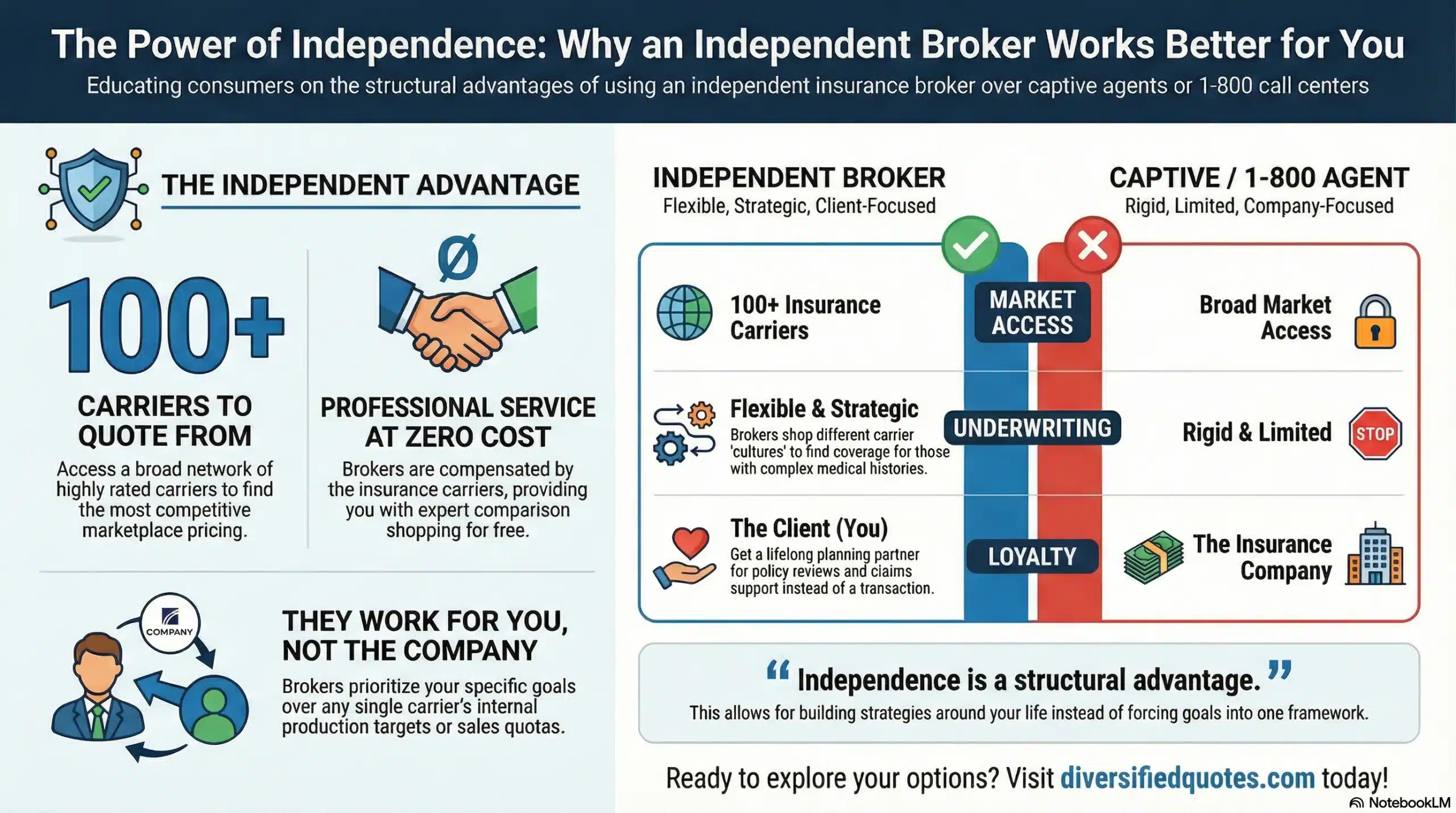
Maritime underwriting is not just about finding the “cheapest quote.” It’s about finding a carrier that understands your role and will classify your duties fairly. At Diversified Insurance Brokers, we’ve helped high-risk professionals secure coverage since 1980. We operate nationwide and compare options across many top-rated carriers so maritime professionals can find coverage that fits their budget, duties, and travel realities.
Our advisors know which carriers are more comfortable with offshore exposure, which ones are more precise about job classifications, and which ones tend to default to conservative assumptions when a job description is vague. That knowledge can make a real difference in outcomes. If you’re also planning ahead for long-term flexibility, this guide can be helpful: Convert Term to Permanent Life Insurance. If you’re comparing independent help options, this page explains what matters most: Best Independent Insurance Agent.
Compare Life Insurance Rates for Maritime Workers
See Real-Time Quotes
Explore coverage amounts and term lengths. Final approval depends on underwriting and accurate occupational classification.
Protecting Families Beyond the Shoreline
Life at sea and offshore work can create a strong career and a strong income, but it also creates exposure most families don’t want to think about until it’s too late. A well-structured life insurance plan ensures your work continues to protect your household even if something happens during a deployment or on the job. The right strategy is to match a policy to your duty profile, document your role accurately, and work with carriers that evaluate maritime occupations with nuance instead of blanket assumptions.
When you’re ready, our advisors will help you compare options, explain trade-offs in plain English, and build a coverage plan designed for the realities of maritime life—on deck, in the engine room, offshore, or in the port.
Request Your Personalized Life Insurance Quote for Maritime Work
We’ll match your duties and travel profile to carriers that underwrite maritime occupations fairly.
Talk With an Advisor Today
Choose how you’d like to connect—call or message us, then book a time that works for you.
Schedule here:
calendly.com/jason-dibcompanies/diversified-quotes
Licensed in all 50 states • Fiduciary, family-owned since 1980
FAQs: Life Insurance for Maritime Workers
Can maritime workers qualify for life insurance?
Yes. Most maritime and offshore professionals can qualify, including seafarers, engineers, and port workers.
Does offshore or overseas work affect eligibility?
It may influence underwriting, but many carriers accept offshore applicants with proper documentation.
Do I need a medical exam to apply?
Some policies require a quick health exam, while others offer no-exam or simplified-issue options.
Will time at sea increase my premium?
Possibly, depending on your role and travel regions. Working with a broker experienced in maritime coverage helps minimize costs.
Can I keep my policy if I switch employers or ships?
Yes. Individual life insurance is fully portable and follows you anywhere your career goes.
Are foreign-flagged vessel employees eligible?
Yes. Many insurers cover U.S. citizens working on international vessels as long as residency is established in the U.S.
What if I was declined before?
We work with specialized carriers for maritime and offshore occupations, helping many clients secure approval after a prior decline.
About the Author:
Jason Stolz, CLTC, CRPC and Chief Underwriter at Diversified Insurance Brokers, is a senior insurance and retirement professional with more than two decades of real-world experience helping individuals, families, and business owners protect their income, assets, and long-term financial stability. As a long-time partner of the nationally licensed independent agency Diversified Insurance Brokers, Jason provides trusted guidance across multiple specialties—including fixed and indexed annuities, long-term care planning, personal and business disability insurance, life insurance solutions, and short-term health coverage. Diversified Insurance Brokers maintains active contracts with over 100 highly rated insurance carriers, ensuring clients have access to a broad and competitive marketplace.
His practical, education-first approach has earned recognition in publications such as VoyageATL, highlighting his commitment to financial clarity and client-focused planning. Drawing on deep product knowledge and years of hands-on field experience, Jason helps clients evaluate carriers, compare strategies, and build retirement and protection plans that are both secure and cost-efficient.
