
Life Insurance with No Medical Questions Asked

Jason Stolz CLTC, CRPC
If you’ve been declined before, have multiple health conditions, take several medications, or simply want a straightforward application that avoids medical records, labs, and exams, life insurance with no medical questions asked can be a practical way to get coverage in place quickly. In most cases, “no medical questions” refers to guaranteed issue whole life insurance—coverage where approval is typically based on age and state eligibility, not medical history. These policies are usually designed to help with funeral and final expenses, small debts, and immediate family needs, especially when certainty matters more than maximum face amount.
At Diversified Insurance Brokers, we help clients nationwide compare true “no questions” guaranteed issue options alongside simplified issue policies (few questions, usually no exam) and fully underwritten coverage (best pricing when health allows). The goal is simple: help you get the most coverage for the lowest cost you can realistically qualify for, without wasted time or surprise declines. Many people assume “no questions” is the only path. Sometimes it is. But in other situations, a short simplified application may still be available and can sometimes provide immediate full benefits with better pricing.
Explore No-Medical-Questions Options
Use the quote tool below to view pricing. If you want the best value, compare guaranteed issue vs. simplified issue in the same session.
Instant Quotes for Life Insurance With No Medical Questions
This tool is a great starting point for real-world budgeting because it lets you test different benefit amounts and see how pricing changes. Many families begin with a modest benefit (often in the $10,000–$25,000 range) to cover a basic service and related costs, then adjust the amount to match a comfortable monthly premium.
If you’re unsure where to begin, focus on what you’re trying to protect. Some people want coverage strictly for funeral and burial or cremation costs. Others want a small cushion for final medical bills, household expenses, or outstanding balances. The “right” amount is usually the amount you can maintain long-term without strain.
What “No Medical Questions” Life Insurance Really Means
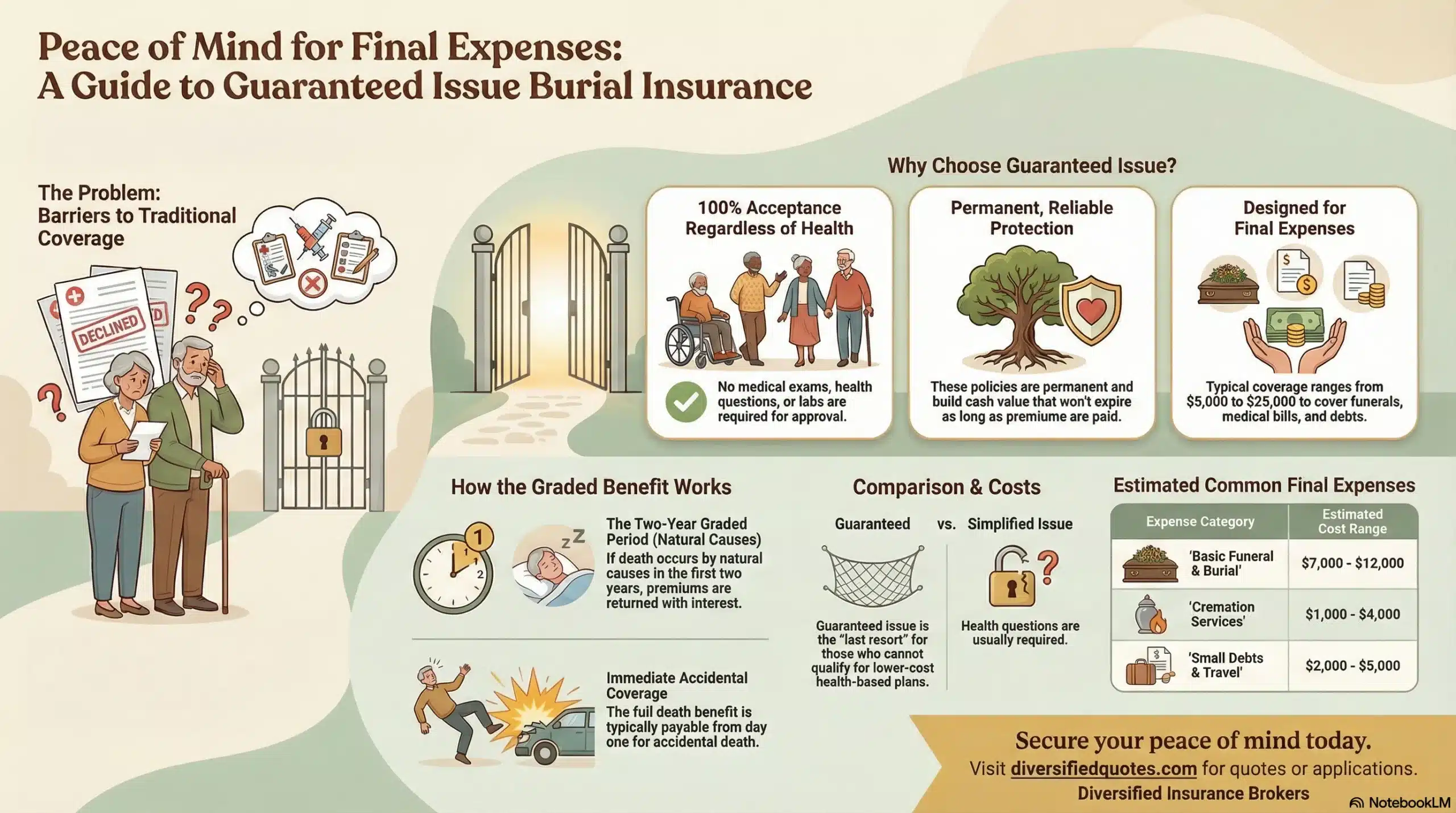
“No medical questions asked” is most commonly shorthand for guaranteed issue whole life insurance. With true guaranteed issue, the application generally does not ask health questions, does not require a medical exam, and does not involve pulling medical records. If you meet the carrier’s age range (often somewhere around 50–80, depending on the company and state) and you live in an eligible state, you’re typically approved.
These policies are usually structured as final expense coverage. That means smaller face amounts, permanent coverage that doesn’t expire, and premiums that are typically level for life. The purpose is not to replace decades of income. The purpose is to create a dependable, quick-access cash benefit so your beneficiary can handle funeral costs, cremation expenses, unpaid bills, and other immediate needs without scrambling.
It also helps to understand what “no medical questions” does not mean. It does not automatically mean “best deal,” and it does not automatically mean “full coverage from day one.” Because the insurer is not screening health, guaranteed issue policies commonly include a graded benefit period during the early years. That graded structure is not a reason to avoid guaranteed issue—it’s simply the tradeoff that makes guaranteed acceptance possible.
Who This Type of Coverage Is Built For
Guaranteed issue coverage is designed for people who want certainty and speed more than “best possible pricing.” It’s often a fit when someone has been declined for traditional life insurance, has multiple health conditions that make underwriting unpredictable, or wants to avoid time-consuming medical steps.
This is especially common when a person has a long prescription list, has had recent procedures, or is managing conditions that tend to trigger declines or postponements in traditional underwriting. If you want to see why underwriting outcomes vary so widely by carrier and product type, our overview of life insurance with pre-existing conditions is a helpful place to start. It explains why a “decline once” doesn’t always mean “declined everywhere,” but also why guaranteed issue can be the cleanest option when health history is likely to keep causing problems.
We also see “no questions” coverage chosen by people who are simply tired of uncertainty. They want to avoid “wait and see,” avoid follow-up calls, and avoid turning their medical history into an approval hurdle. In that scenario, guaranteed issue can do exactly what it’s supposed to do: remove friction and put a guaranteed benefit in place.
Waiting Periods, Graded Benefits, and What Gets Paid
Because guaranteed issue policies do not screen for health, most include a graded benefit period (sometimes called a waiting period), commonly around two years. This is the most important “fine print” item to understand before buying. During this period, the policy may not pay the full death benefit for death due to natural causes.
Instead, many plans pay a return of premium (sometimes with an additional amount described as interest) or a reduced benefit if death occurs from natural causes during the waiting period. Accidental death is commonly covered at the full face amount from day one, although definitions and limitations vary by carrier. After the waiting period ends, the full death benefit generally becomes payable for any covered cause of death, as long as premiums stay current.
The practical takeaway is simple: if your top priority is immediate full day-one coverage and you can qualify for simplified issue, it may be worth pursuing that first. If your top priority is guaranteed acceptance and a policy that stays in force for life, guaranteed issue remains a strong solution—especially when the benefit amount is sized realistically for final expenses.
Exact benefit rules vary by carrier and state. Always rely on the contract and your personalized illustration for details.
Guaranteed Issue vs. Simplified Issue vs. Fully Underwritten
These three underwriting paths exist for a reason, and picking the right one can dramatically change your cost and coverage. Guaranteed issue is the most predictable approval, but it’s typically the most expensive per $1,000 of coverage. Simplified issue sits in the middle—often faster than full underwriting, usually no exam, but with limited medical questions. Fully underwritten coverage is often the best value when health allows, but it takes more time and may require medical records, labs, and/or an exam.
| Feature | Guaranteed Issue (No Questions) | Simplified Issue (Few Questions) | Fully Underwritten |
|---|---|---|---|
| Health Questions / Exam | None / None | Yes (short form) / Usually no exam | Yes / Exam may be required |
| Typical Coverage | $5k–$25k | $5k–$50k+ | $100k–$1M+ |
| Cost per $1,000 | Highest | Moderate | Lowest (if healthy) |
| Waiting Period | Common (graded period) | Often none | None |
| Best For | Serious health issues / prior declines | Average health, wants speed | Good health, larger amounts |
When in doubt, price simplified issue alongside guaranteed issue—you may be surprised at what you qualify for.
One of the most common “misses” we see is someone buying guaranteed issue without first checking simplified issue. Many simplified issue policies ask a short list of questions and still avoid exams. If you can answer “no” to a few key items, you may qualify for a level benefit policy that pays the full face amount immediately and costs less over time. When you’re shopping “no exam,” it’s worth remembering that “no exam” and “no questions” are not the same thing.
How Much Coverage You Can Typically Buy
Most no-medical-questions policies are built to cover final expenses, so benefit amounts are usually modest. Common ranges are $5,000 to $25,000, although some states or carriers may allow higher limits. If your goal is larger coverage for income replacement, guaranteed issue is usually not the right tool. At that point, exploring traditional life insurance options (simplified issue or fully underwritten) is typically the better path.
Many people choose a benefit amount by starting with expected funeral costs, then adding a small buffer for final medical bills and immediate household needs. If you’re in your 50s, you may also find that burial coverage is often more efficient earlier rather than later. For example, this guide on burial insurance for seniors over 50 explains why pricing and plan availability can be meaningfully better when you act sooner.
If you’re helping a parent or a loved one choose a benefit amount, keep it practical. The best plan is the one the family can keep in force without strain. In many households, a smaller, affordable policy that stays active is far better than a larger face amount that becomes difficult to maintain.
Why Pricing Looks Different (and How to Keep It Efficient)
Guaranteed issue is priced differently because the insurer is accepting applicants without medical screening. That means the cost per $1,000 of coverage is usually higher than simplified issue or fully underwritten insurance. This is normal. The tradeoff is predictable approval and a simplified application process.
The smartest way to keep this efficient is to focus on three practical decisions. First, choose a benefit amount that matches your actual goal (funeral costs, final bills, a small cushion). Second, compare guaranteed issue to simplified issue when possible, because simplified issue can sometimes provide immediate full benefits at a lower cost. Third, avoid buying more guaranteed issue coverage than you truly need, because “more” can create unnecessary premium strain over time.
Certain risk factors can make simplified issue harder to qualify for, even when someone feels stable day-to-day. Weight and blood pressure history are common examples. If that’s your situation, these guides can help you understand how carriers typically think about those profiles: burial insurance for overweight people and burial insurance for people with high blood pressure. Even when simplified issue isn’t available, guaranteed issue can still put a meaningful plan in place.
How to Shop It the Smart Way
The best way to shop no-questions coverage is to treat it as a spectrum, not a single product. Start by testing pricing for the benefit amount you want. Then compare guaranteed issue against simplified issue policies that may still avoid an exam but offer better pricing and immediate full benefits. If health is stable enough, it can also be worth pricing a modest traditional policy because even a small fully underwritten policy can sometimes cost less than guaranteed issue coverage for the same face amount.
If you’re already researching end-of-life planning, our guides on burial insurance for seniors and life insurance with pre-existing conditions can help you set realistic expectations about approvals, plan types, and what carriers focus on most.
Also consider the “why” behind the policy. If your goal is strictly funeral and immediate costs, final expense coverage is usually the right frame. If your goal is broader family protection, you may need a different structure. Sometimes families use a small permanent policy as a baseline and pair it with term coverage for a set window—especially if income protection is still important. If you’re in that stage of life, the term life insurance calculator can help model what larger protection might look like when health allows.
Not sure if you need guaranteed issue?
Compare simplified issue vs. guaranteed issue side-by-side. If you qualify for simplified issue, you may get more coverage for less—and often with no graded period.
Common Mistakes to Avoid
The biggest mistake is buying based on a headline instead of the benefit rules. “No questions” sounds perfect until you realize the plan has a graded period and you expected day-one full coverage. Guaranteed issue can still be the right decision—you just want to make that decision with the graded rules clearly understood.
Another common mistake is overspending on a face amount that doesn’t match the goal. Final expense coverage works best when premiums are sustainable. If budget is tight, it’s usually better to choose a smaller amount and keep the policy in force than to stretch for a larger number and risk lapse later.
Finally, many families don’t update beneficiary details. Beneficiary designations are not “set it and forget it.” Life changes happen. Keep beneficiaries current, keep personal information accurate, and make sure the beneficiary knows the policy exists. If you’re unsure how the payout works in common situations, it can also help to review whether life insurance death benefits are taxable and what documentation is typically needed for claims.
Talk With an Advisor Today
Choose how you’d like to connect—call or message us, then book a time that works for you.
Schedule here:
calendly.com/jason-dibcompanies/diversified-quotes
Licensed in all 50 states • Fiduciary, family-owned since 1980
FAQs: Life Insurance with No Medical Questions Asked
What does “no medical questions asked” life insurance actually mean?
In most cases, it refers to guaranteed issue whole life insurance—coverage that does not ask health questions, does not require an exam, and is approved primarily based on age and state eligibility.
Can I be declined even if the policy asks no health questions?
Usually, no. Approval is generally based on eligibility factors such as age range, residency, and sometimes administrative requirements. If you fit the carrier’s rules for your state, you’re typically approved.
How much coverage can I typically buy with guaranteed issue?
Most carriers offer smaller amounts intended for final expenses—often around $5,000 to $25,000, depending on the carrier and state.
Do guaranteed issue policies have a waiting period?
Most do. Many have a graded benefit period (commonly about two years) where natural-cause claims may pay a return of premium (sometimes with interest) or a reduced benefit. Accidental death is commonly covered at full benefit from day one, depending on the contract.
Will my premium increase over time?
In most cases, guaranteed issue whole life premiums are level for life, as long as premiums are paid on time. Policies also typically build modest cash value over time.
Is there a cheaper alternative if my health is decent?
Often, yes. Simplified issue coverage may avoid an exam but can offer better pricing and immediate full benefits if you qualify. Fully underwritten coverage is typically the best value when health allows.
What’s the best way to shop these policies?
Start by comparing prices at the benefit amount you actually want, then review guaranteed issue vs. simplified issue side-by-side. The “best” policy is the one that matches your approval likelihood, budget, and whether you need immediate full benefits.
About the Author:
Jason Stolz, CLTC, CRPC and Chief Underwriter at Diversified Insurance Brokers (NPN 20471358), is a senior insurance and retirement professional with more than two decades of real-world experience helping individuals, families, and business owners protect their income, assets, and long-term financial stability. As a long-time partner of the nationally licensed independent agency Diversified Insurance Brokers, Jason provides trusted guidance across multiple specialties—including fixed and indexed annuities, long-term care planning, personal and business disability insurance, life insurance solutions, Group Health, and short-term health coverage. Diversified Insurance Brokers maintains active contracts with over 100 highly rated insurance carriers, ensuring clients have access to a broad and competitive marketplace.
His practical, education-first approach has earned recognition in publications such as VoyageATL, highlighting his commitment to financial clarity and client-focused planning. Drawing on deep product knowledge and years of hands-on field experience, Jason helps clients evaluate carriers, compare strategies, and build retirement and protection plans that are both secure and cost-efficient. Visitors who want to explore current annuity rates and compare options across multiple insurers can also use this annuity quote and comparison tool.
