
What are the Pros and Cons of Self Funded Group Health

Jason Stolz CLTC, CRPC
Self-funded group health insurance has become one of the fastest-growing strategies for employers trying to regain control over healthcare costs. Instead of paying a fixed premium to an insurance carrier each month, self-funded plans allow businesses to pay employee medical claims directly. In most cases, employers pair this strategy with stop-loss insurance to protect against catastrophic or unexpectedly high claims. The result is a model that can potentially lower long-term healthcare spending, improve transparency into claims trends, and give employers more flexibility in how benefits are structured.
For many organizations, especially those frustrated with annual premium increases, self-funding represents a shift from “renting” insurance to actively managing healthcare risk. However, this approach is not universally right for every company. Self-funded plans introduce new responsibilities, new administrative requirements, and new financial exposure that must be understood before transitioning away from a fully insured structure. The goal of this page is to help business owners, HR leaders, and CFOs clearly understand both sides of the equation so they can make a confident decision based on data, not just industry trends.
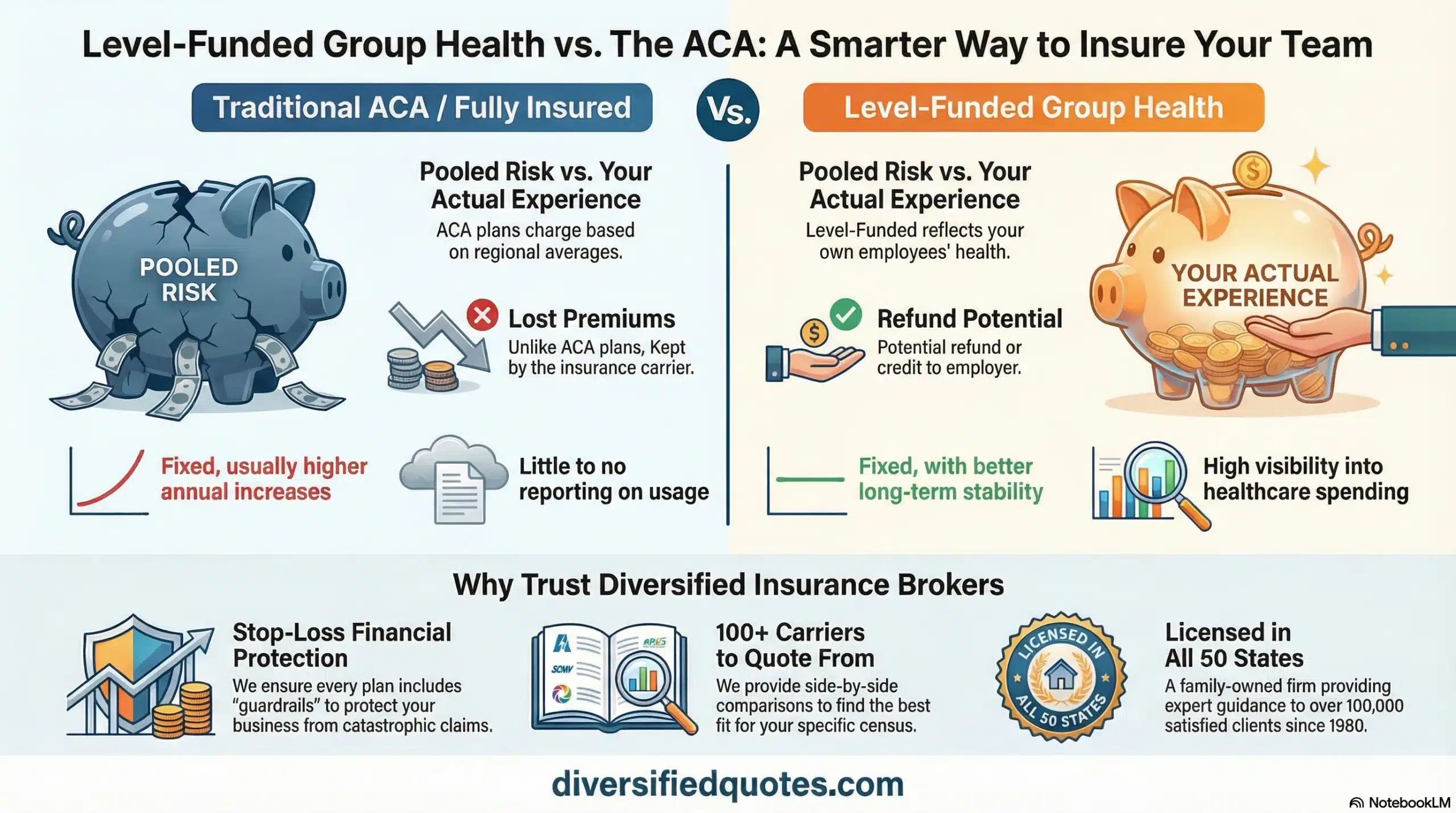
Employers exploring this strategy often start by comparing self-funded models against traditional fully insured group health plans and newer hybrid options like level-funded health insurance. Each structure has advantages depending on workforce size, claims stability, cash flow predictability, and long-term benefit strategy. Understanding where self-funding fits in that spectrum is critical before making any structural changes to employee healthcare programs.
Compare Self-Funded vs Fully Insured Group Health Options
See side-by-side cost structures, stop-loss strategies, and real employer funding scenarios before choosing your plan structure.
Request a Group Health Strategy ReviewThe Advantages of Self-Funded Group Health Insurance
The biggest reason employers consider self-funded health insurance is cost control. In a fully insured plan, employers pay premiums that include carrier risk margins, administrative overhead, and profit layers. With self-funding, employers pay actual claims plus administrative costs and stop-loss premiums. When claims are lower than expected, the savings stay with the employer instead of the insurance carrier. Over multi-year periods, this can create significant cost advantages for organizations with relatively healthy employee populations.
Another major advantage is cash flow flexibility. Instead of pre-paying fixed premiums regardless of utilization, self-funded employers retain control of their healthcare dollars until claims are incurred. This can improve working capital efficiency, particularly for companies with strong financial reserves and predictable revenue cycles. For finance teams focused on optimizing capital deployment, this feature alone can justify evaluating self-funded strategies.
Transparency is also dramatically improved under self-funded arrangements. Employers gain access to detailed claims data that allows them to identify cost drivers such as chronic condition trends, specialty drug utilization, or emergency room misuse. This level of insight enables proactive wellness strategies, targeted disease management programs, and smarter network or pharmacy contract decisions. Fully insured plans rarely provide this depth of actionable data.
Customization is another core strength of self-funded health plans. Employers can tailor plan designs to align with workforce demographics, geographic footprint, and company culture. Some companies emphasize preventive care incentives, while others design cost-sharing structures to encourage smarter healthcare utilization. This flexibility can help organizations design benefit programs that truly support both employee health outcomes and company financial goals.
Self-funded plans also provide regulatory consistency through ERISA preemption. Instead of navigating different state insurance mandates across multiple locations, self-funded employers typically operate under federal ERISA guidelines. For multi-state employers, this can simplify compliance and create more uniform plan administration across locations.
Over time, companies that actively manage self-funded plans often build institutional knowledge about healthcare cost management. This can create a competitive advantage when compared to employers who rely entirely on carrier pricing cycles. Employers who adopt long-term self-funded strategies often develop stronger vendor negotiation leverage and more predictable healthcare budgeting capabilities.
The Risks and Challenges of Self-Funded Group Health Insurance
While the potential upside of self-funded health insurance is significant, the financial risk is real. Employers are directly responsible for claims payments, which means unexpected large claims can disrupt cash flow if stop-loss coverage is not structured correctly. Although stop-loss insurance protects against catastrophic claims, employers must still manage claims up to attachment points and manage reimbursement timing.
Cash flow volatility is one of the biggest concerns for employers considering self-funding. Healthcare claims do not occur evenly month to month. Some months may be very low, while others may spike dramatically due to surgeries, specialty medications, or high-cost diagnoses. Companies must be financially prepared to absorb these fluctuations while maintaining operational stability.
Administrative complexity increases under self-funded arrangements. Employers typically work with third-party administrators (TPAs), pharmacy benefit managers, stop-loss carriers, and compliance vendors. While experienced advisors and vendors can streamline this process, leadership teams must still maintain oversight of multiple moving parts compared to the relative simplicity of fully insured plans.
Compliance responsibilities also expand. Self-funded plans must meet ERISA, HIPAA, ACA reporting, and other federal regulatory standards. While most TPAs help manage compliance reporting, ultimate responsibility remains with the employer. Organizations without strong HR or compliance infrastructure may find this transition more challenging.
Self-funding may not be appropriate for very small groups with unpredictable claims experience. Smaller employee populations can produce less predictable risk pooling, which may increase financial volatility compared to larger workforce populations. In these situations, level-funded or partially self-funded hybrid models may provide a better entry point.
Not Sure If Self-Funding Is Too Risky?
We can model best-case, expected, and worst-case claim scenarios so you can evaluate self-funded risk before making changes.
Run a Self-Funded Risk AnalysisSelf-Funded vs Fully Insured vs Level-Funded: Strategic Differences
Fully insured plans provide maximum predictability but often come with higher long-term cost trends because carriers price in risk buffers. Self-funded plans provide maximum cost control and transparency but require stronger financial discipline and planning. Level-funded plans attempt to blend both approaches by creating predictable monthly costs with potential year-end savings if claims are lower than expected.
Many employers transition gradually, starting with level-funded programs before moving fully self-funded once they gain comfort with claims volatility and data reporting. This phased approach allows companies to build financial models and administrative infrastructure before taking on full claims responsibility.
From a long-term financial perspective, organizations with stable workforce populations often see the strongest self-funded performance. However, industries with high turnover or volatile workforce health trends may see less predictable results. Each company must evaluate self-funding within the context of its own workforce profile and financial objectives.
Which Employers Typically Benefit Most From Self-Funded Plans
Self-funded health insurance often works best for mid-size and large employers with stable cash reserves and predictable revenue cycles. Companies that already invest in wellness programs, preventive care initiatives, and employee engagement programs often see the strongest results because they can actively influence claims outcomes over time.
Organizations with strong financial leadership often adapt quickly to self-funded models because they are already accustomed to managing variable expenses and forecasting risk scenarios. CFO involvement is often a strong predictor of successful self-funded plan transitions.
Companies with geographically diverse workforces often appreciate the regulatory consistency of ERISA self-funded plans. This can simplify benefit administration across multiple state regulatory environments and create more standardized employee benefit experiences across locations.
Employers focused on long-term workforce retention and culture building often find self-funded models align well with strategic HR goals. When employers can see claims trends clearly, they can build targeted health improvement programs that improve both workforce wellbeing and financial outcomes.
Build a Long-Term Group Health Cost Strategy
Compare 3-year and 5-year projections across fully insured, level-funded, and self-funded models.
Start My Group Health Cost ProjectionRelated Group Health Strategy Pages
Explore additional employer health plan strategy guides, cost comparisons, and plan structure breakdowns.
Talk With an Advisor Today
Choose how you’d like to connect—call or message us, then book a time that works for you.
Schedule here:
calendly.com/jason-dibcompanies/diversified-quotes
Licensed in all 50 states • Fiduciary, family-owned since 1980
FAQs: Self-Funded Group Health Insurance
How does a self-funded health plan work?
The employer pays employee medical claims directly instead of paying premiums to an insurance carrier, using stop-loss coverage for protection against large claims.
What is stop-loss insurance?
Stop-loss insurance limits financial exposure by reimbursing the employer for claims that exceed a set dollar threshold.
Can small employers self-fund?
Yes, but smaller businesses typically use level-funded plans, which blend self-funding flexibility with fixed monthly costs.
What are the main advantages of self-funding?
Greater flexibility, potential savings, transparency in claims data, and customizable benefits design.
What are the downsides of self-funding?
Higher financial risk, administrative complexity, and claim volatility, especially for small groups without sufficient reserves.
About the Author:
Jason Stolz, CLTC, CRPC and Chief Underwriter at Diversified Insurance Brokers, is a senior insurance and retirement professional with more than two decades of real-world experience helping individuals, families, and business owners protect their income, assets, and long-term financial stability. As a long-time partner of the nationally licensed independent agency Diversified Insurance Brokers, Jason provides trusted guidance across multiple specialties—including fixed and indexed annuities, long-term care planning, personal and business disability insurance, life insurance solutions, and short-term health coverage. Diversified Insurance Brokers maintains active contracts with over 100 highly rated insurance carriers, ensuring clients have access to a broad and competitive marketplace.
His practical, education-first approach has earned recognition in publications such as VoyageATL, highlighting his commitment to financial clarity and client-focused planning. Drawing on deep product knowledge and years of hands-on field experience, Jason helps clients evaluate carriers, compare strategies, and build retirement and protection plans that are both secure and cost-efficient.
