
What are Today’s Best Annuity Rates

Jason Stolz CLTC, CRPC
What are today’s best annuity rates? For most people searching that phrase, what they really want is a clean, apples-to-apples benchmark they can trust before they commit money to a multi-year term. That’s exactly what this page is built to do: provide a simple snapshot of competitive MYGA (Multi-Year Guaranteed Annuity) yields from 1 to 10 years, plus a clear way to think about rate locks, liquidity, and laddering. Rates move. Carriers update pricing based on interest-rate markets, demand, and state availability. Use this table as your baseline, then request a live quote for your state and deposit size so you can confirm the exact offer you qualify for.
It also helps to define what “best” means in the real world. The highest rate on a chart isn’t always the best fit if the contract’s liquidity provisions don’t match your plan, if the term is longer than you want, or if you prefer a different structure (like a bonus annuity) for a specific retirement income goal. A strong annuity decision is usually less about chasing a single headline number and more about aligning term length, access rules, and insurer strength with the way you intend to use the money. That’s why we treat the table as step one and the plan design as step two.
🖊️ Check Today’s Live Annuity Rates
We’ll verify current yields, state approvals, and any rate-lock windows available to you.
Why “Today’s Best Annuity Rates” Matter (Beyond the Number)
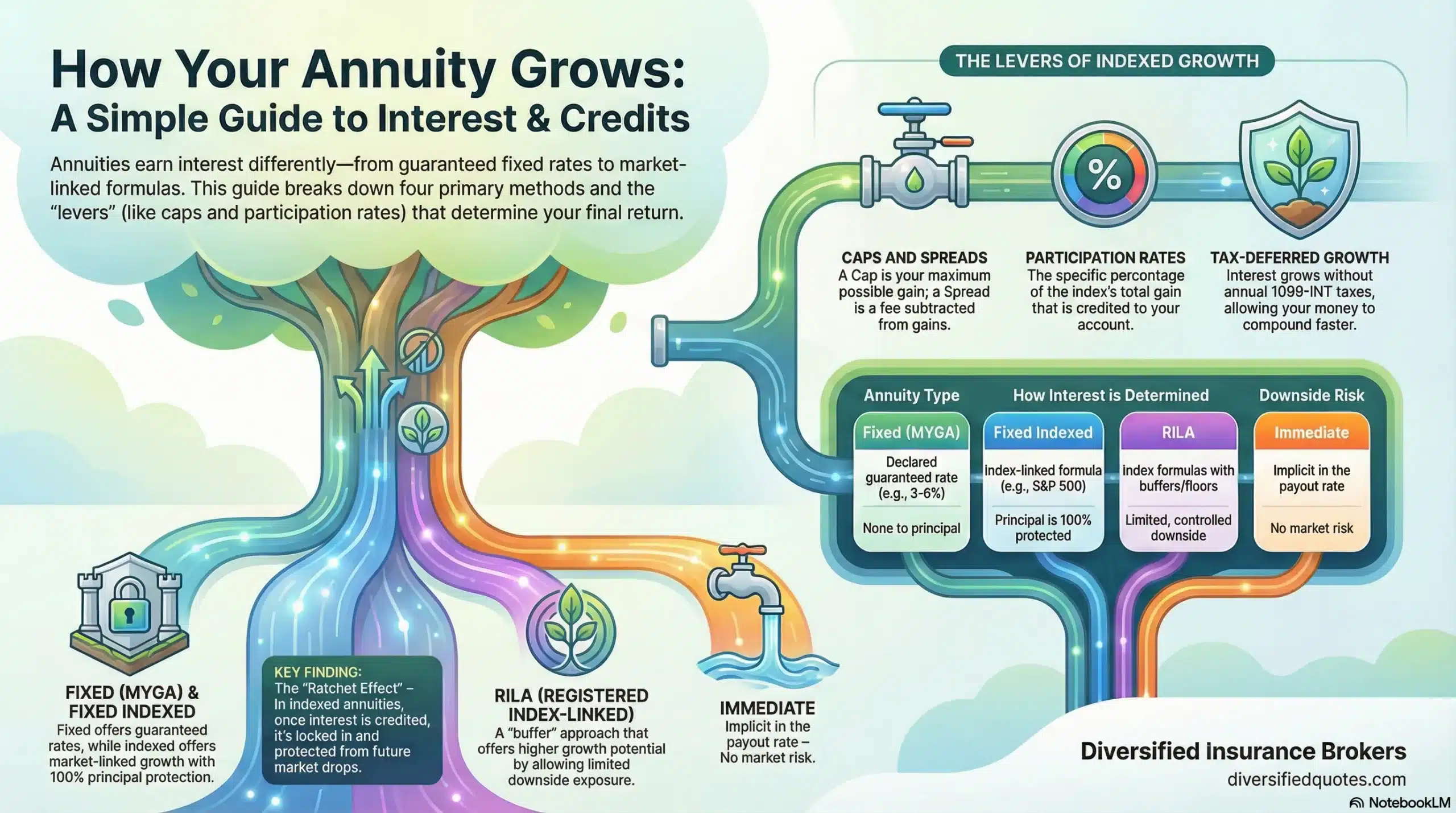
A MYGA is essentially the annuity version of a fixed-rate term: you place a premium with an insurer and they guarantee a stated interest rate for a specific period. The appeal is simple. You get a defined outcome, principal protection, and tax-deferred growth (outside of qualified accounts). Unlike market-based strategies, your account isn’t exposed to stock market declines. That’s a big reason MYGAs are often used as a retirement “stability sleeve,” especially for people who want predictable accumulation and don’t want to rely on market timing.
That said, the “best” rate is only truly best if it fits your timeline and access needs. MYGAs are designed for money you can set aside for the chosen term. Most contracts include some form of annual penalty-free withdrawal amount, and many have provisions for IRA required minimum distributions (RMDs) if the annuity is inside a qualified account. But the details vary by carrier and by product. When you request a live quote, you’re not just confirming the yield—you’re confirming the parts of the contract that determine how flexible the annuity will be if life changes.
If you’re comparing fixed annuities against other annuity structures, it may help to start from the annuity “hub” and work outward. Our annuities overview explains the major types and where they fit. If you’re curious about income-focused planning, the annuity payout calculator and lifetime income planning pages provide additional context. And if you want to explore products that include upfront credits, our current bonus annuity rates page is a useful comparison point.
Today’s Benchmark MYGA Rates (1–10 Year Terms) as of April 2026.
The table below is intentionally simple. It’s meant to show a term-by-term snapshot of competitive MYGA rates so you can quickly spot where yields are strongest and which term lengths may be worth exploring. Click any Rate to request a personalized quote. Carrier availability and yields vary by state, age, premium band, and effective date. In many cases, the rate you see publicly is a “benchmark,” and the exact offer can differ slightly depending on premium tier or timing. This is why confirming live quotes matters.
Some of the highest annuity rates are sometimes offered by carriers with B or B+ ratings. However, we also work with many insurance companies rated A-, A, A+, and A++ by AM Best. In many cases the difference in rates between carriers is small, and the most important factor is choosing a company you feel comfortable with. We have access to dozens of carriers and can help you shop the market to find the option that best fits your goals.
| Term | Rate | Provider | Product | AM Best |
|---|---|---|---|---|
| 1 Year | 4.15% | GCU Life | 1+4 Choice | A- |
| 2 Years | 5.25% | Mountain Life | Secure Summit | B |
| 3 Years | 6.00% | Mountain Life | Secure Summit | B |
| 4 Years | 6.05% | Mountain Life | Secure Summit | B |
| 5 Years | 6.30% | American Gulf | Anchor MYGA | B++ |
| 6 Years | 6.30% | American Gulf | Anchor MYGA | B++ |
| 7 Years | 6.30% | American Gulf | Anchor MYGA | B++ |
| 8 Years | 6.00% | Mountain Life | Secure Summit | B |
| 9 Years | 5.50% | Liberty Bankers | Heritage Elite | A- |
| 10 Years | 6.25% | Sentinel Security | Personal Choice | B |
Illustrative benchmarks. Your actual offer may differ based on state, age, premium band, options (e.g., MVA), and effective date.
Annuity Interest Rate Examples by Deposit Size
See how annuity interest and income potential can vary depending on the size of your investment.
How MYGA Rates Are Set (And Why Two People Can See Two Different Offers)
MYGA pricing is influenced by several factors, and understanding them helps you avoid “rate shopping” mistakes. The most obvious driver is interest rates in the broader market. When bond yields rise, insurers can often offer more attractive fixed annuity rates. When yields fall, annuity rates tend to adjust downward as well. But carriers also change rates based on internal demand, target premium levels, and product capacity. Some carriers prefer to attract more premium in certain months; others tighten rates to manage volume.
State approval is another factor people underestimate. An annuity is an insurance product filed and approved at the state level. That means the same product can have different availability, riders, or pricing in different states. Age and premium band can also influence your effective offer. In some cases, higher premium tiers can qualify for stronger yields, which is why confirming a live quote matters even if you already have the benchmark table.
If you’re weighing MYGAs against other annuity structures, it can be useful to compare what fixed-rate certainty looks like versus bonus-style incentives. That’s why many readers also review current bonus annuity rates after they understand the MYGA landscape. The decision often comes down to what you value more: a clean guaranteed rate for a set term, or an upfront credit that may come with more moving parts.
Liquidity Rules: The “Best Rate” Only Helps If You Can Live With the Access Terms
One of the biggest mistakes we see is choosing a term based purely on the rate and then discovering later that the access rules don’t match real life. MYGAs are designed to be held to term. If you withdraw more than the penalty-free amount during the surrender period, surrender charges may apply. Some contracts also include a market value adjustment (MVA), which can increase or decrease the amount you receive on an early surrender depending on how interest rates moved after the contract was issued. That doesn’t mean MYGAs are “bad”—it simply means they are tools designed for specific use-cases.
Most people who use MYGAs effectively do two things: they align the term with the money’s job, and they plan liquidity intentionally. If you expect you’ll need access to a portion of the funds over the next few years, it’s often cleaner to keep that portion in a separate liquid bucket and reserve the MYGA for assets you intend to leave untouched. If you’re inside an IRA and are subject to RMDs, many contracts include an RMD-friendly feature that allows withdrawals for required distributions without surrender charges. But it must be confirmed at the product level.
If your longer-term goal is retirement income rather than accumulation, it can be useful to explore how guaranteed income options might look, even when you’re starting from a MYGA comparison. That’s why we include the calculator below—so you can see how income illustrations work, then decide whether your plan is best served by a fixed-rate term, an indexed strategy, or an income-focused design.
Laddering Strategy: A Practical Way to Reduce Reinvestment Risk
When people ask “what are today’s best annuity rates,” they often assume there’s one perfect term. In practice, many retirees get better results by building a simple ladder. Laddering means splitting your deposit across multiple terms so that not all of your money renews at once. That reduces reinvestment risk (the risk that rates are lower when your term ends), and it can also improve liquidity because you have scheduled “decision points” as each segment matures.
A common ladder might include a mix of 3-, 5-, and 7-year terms, or a 2/4/6/8 structure depending on how you want money to free up. The best ladder is the one that matches your retirement timeline. If you want to keep the plan flexible, shorter terms can create more frequent decision points. If you want to lock attractive yields longer, longer terms can stabilize the plan. There’s no single right answer, but there is a right structure for your goal.
It’s also worth noting that laddering can pair nicely with diversification across carriers. Not because any one insurer is “unsafe,” but because diversification can reduce concentration and give you multiple renewal opportunities over time. If you want more context on the broader annuity landscape while you’re considering a ladder, our annuities hub is a good reference point.
How to Capture a Top Rate (Without Overcomplicating It)
The most efficient way to capture a top MYGA rate is to confirm eligibility and timing first, then focus on contract features that matter for your plan. Start by verifying state availability and the effective date. Rates are often tied to the day the carrier receives the premium or the day the contract is issued. Many carriers have a “rate lock” window once an application is submitted, but the exact rules vary. This is why a live quote is more useful than a screenshot of a table.
Next, confirm the access rules that matter to you: the annual penalty-free withdrawal amount, any RMD provisions if the annuity is in an IRA, and whether the contract includes an MVA. MVAs aren’t automatically “bad.” They are simply a lever used by insurers to manage interest-rate risk on early surrenders. The key is knowing whether it’s present and how it works so there are no surprises.
Finally, choose the term (or ladder) that fits your timeline. If you’re unsure, it often helps to decide on the first decision point you want. In other words: when do you want the option to move money again without surrender charges? That answer often determines whether a 3-, 5-, or 7-year segment is the best fit.
Next Steps
If you like today’s yields, the next step is simply confirming what is actually available for your state and premium band and identifying which term (or ladder) best fits your timeline. If you also want to compare fixed-rate MYGA certainty against an upfront-credit strategy, you can review our current bonus annuity rates to see how bonus designs differ in structure.
For many retirees, the best outcome comes from combining clarity and structure: choose the money’s job, choose the term that matches that job, and confirm the access rules before funding. When you do those three things, “best annuity rates” becomes less about hunting for the highest number and more about building a plan that stays stable no matter what markets do.
Get Today’s Best Rate for Your State
We’ll confirm availability, rate-lock timing, and the highest yield you qualify for.
Financial Protection Essentials
Compare annuity types, review current rate benchmarks, evaluate payout strategies, and plan for reliable retirement income.
Retirement Account & Income Transition Planning
Compare post-retirement rollover, distribution, and income strategy decisions across major retirement account types.
Advanced Planning, Insurance, and Income Strategy Topics
Explore deeper strategy topics including diversification, Medicare timing, income design, and insurance planning fundamentals.
Talk With an Advisor Today
Choose how you’d like to connect—call or message us, then book a time that works for you.
Schedule here:
calendly.com/jason-dibcompanies/diversified-quotes
Licensed in all 50 states • Fiduciary, family-owned since 1980
FAQs: What Are Today’s Best Annuity Rates
Why are some rates higher than others today?
Higher rates often come from longer terms, less liquid products, or carriers with lower ratings. Balancing yield and strength is key.
How long does a “today’s” rate last?
Rates can change quickly based on market conditions and deposit flows. Once funded and issued, the rate is locked for the term.
Can I lock today’s rate while paperwork is pending?
Many carriers offer a rate-lock window, often 30-60 days, after your application or funds are submitted. Ask your agent for the exact lock policy.
What if I need the money earlier?
Review free-withdrawal allowances and surrender-charge schedules. If you may need access, shorter term or laddering may be smarter.
About the Author:
Jason Stolz, CLTC, CRPC and Chief Underwriter at Diversified Insurance Brokers (NPN 20471358), is a senior insurance and retirement professional with more than two decades of real-world experience helping individuals, families, and business owners protect their income, assets, and long-term financial stability. As a long-time partner of the nationally licensed independent agency Diversified Insurance Brokers, Jason provides trusted guidance across multiple specialties—including fixed and indexed annuities, long-term care planning, personal and business disability insurance, life insurance solutions, Group Health, and short-term health coverage. Diversified Insurance Brokers maintains active contracts with over 100 highly rated insurance carriers, ensuring clients have access to a broad and competitive marketplace.
His practical, education-first approach has earned recognition in publications such as VoyageATL, highlighting his commitment to financial clarity and client-focused planning. Drawing on deep product knowledge and years of hands-on field experience, Jason helps clients evaluate carriers, compare strategies, and build retirement and protection plans that are both secure and cost-efficient. Visitors who want to explore current annuity rates and compare options across multiple insurers can also use this annuity quote and comparison tool.
