
What is a GLWB

Jason Stolz CLTC, CRPC
What is a GLWB? A Guaranteed Lifetime Withdrawal Benefit (GLWB) is an optional annuity feature—often called an income rider—that can create contract-defined retirement income you cannot outlive. A GLWB is designed to solve one problem: how to turn part of your retirement savings into a predictable “paycheck” that can last for life without forcing you to fully annuitize or permanently give up control of your contract. In many designs, you keep beneficiary choices and you choose when to start income, while the GLWB provides a lifetime withdrawal framework backed by the insurance company.
At Diversified Insurance Brokers, our advisors help clients nationwide compare GLWB riders across fixed and fixed indexed annuities from a large carrier lineup. Comparisons matter because GLWB riders can look similar on a brochure, but the rider language defines the real outcome. The contract determines how the benefit base grows, how payout percentages work at each age, how withdrawals can reduce future income, and how spousal continuation is handled. This page explains how a GLWB works in plain English, what details change the income result, and how to evaluate a GLWB rider so it actually fits your retirement plan.
If you only remember one takeaway, make it this: a GLWB is not “free money” and it is not a promise that you can withdraw a big “income base” as cash. A GLWB is a rules-based lifetime income guarantee. When your plan matches those rules, a GLWB can be one of the cleanest ways to build a stable income floor in retirement.
Ensure you are receiving the absolute top rates
Lifetime Income Calculator
💡 Note: The calculator accepts premiums up to $2,000,000. If you’re investing more, results increase in direct proportion — for example, doubling your premium roughly doubles the guaranteed income at the same age and options.
What a GLWB Guarantees (and What It Does Not)
A GLWB is a lifetime withdrawal guarantee attached to an eligible annuity. If you follow the GLWB rules, the insurance company agrees to pay a specified amount each year for as long as you live (or for as long as either spouse is alive on a joint option). The guaranteed amount is determined by the GLWB rider language—typically your age when income begins, whether the GLWB is single or joint, and the value the carrier uses for income calculations.
What a GLWB does not guarantee is that you can take a large “income base” number as a lump sum. Many contracts track a separate value called a benefit base (also called an income base). The benefit base is used to calculate GLWB lifetime income, but it is usually not the same thing as your cash value. When retirees get disappointed with a GLWB, it’s usually because the two values were not explained clearly up front.
A GLWB also does not remove the need to plan liquidity. You still have access to your account value, but the GLWB guarantee is based on taking withdrawals within the GLWB limits. If you take more than the GLWB allows, the contract may reduce future guaranteed income. In other words, a GLWB is best viewed as an “income lane,” not a permission slip to withdraw anything at any time without consequences.
If you keep those boundaries clear, a GLWB becomes easy to understand: it is a structured way to create lifelong income while generally keeping ownership of the annuity and maintaining beneficiary control on any remaining account value.
Account Value vs. Benefit Base: The Two Numbers You Must Separate
Most GLWB designs track two different numbers. Your account value is the real cash value of the annuity. It is typically used for withdrawals, surrender value, and many death-benefit calculations. Your benefit base is a calculation value used only to determine GLWB lifetime income under the rider. The benefit base can increase because of GLWB rider rules—such as roll-up growth, bonuses, or performance-based step-ups—even if the account value grows differently.
This “two-number” structure is what allows a GLWB to provide a lifetime income guarantee without promising that your account value will always stay high. In many cases, the account value may remain healthy for years, and beneficiaries may receive remaining value if death occurs before the account is depleted. In other cases—especially if GLWB income is taken for a long time—the account value can gradually decline. The GLWB’s job is to keep the income going even if the account value eventually reaches zero.
From a planning standpoint, the separation is helpful. The account value supports flexibility and potential legacy. The benefit base supports the income guarantee math. A strong GLWB recommendation usually starts by deciding which goal matters more in your situation: maximum lifetime paycheck, maximum flexibility, or a balanced middle.
If you’re comparing annuities, always ask the same question: “Which value drives my income—the account value or the benefit base—and how does this GLWB rider increase that value over time?” That one question prevents most misunderstandings.
How GLWB Income Is Calculated
Although contract language varies, the GLWB income math is usually built around a simple concept: Benefit Base × Payout Percentage = Annual Guaranteed Income. The payout percentage is typically tied to your age when you start GLWB withdrawals. Many carriers adjust the payout percentage based on whether you choose single-life GLWB income or joint-life GLWB income for a spouse.
Because the payout percentage is age-based, two people with the same premium can have different GLWB income if they start at different ages. This is one reason the GLWB is popular for retirees who want timing flexibility. If your plan changes, you can often adjust the start date. You are not forced to turn on income immediately unless the contract requires it, and many retirees use this flexibility to coordinate a GLWB start date with Social Security, pension timing, or part-time work.
In real life, most retirees want monthly “paycheck style” distributions. Many GLWB riders define the annual amount first, then allow monthly payments based on that annual figure. When you compare a GLWB across carriers, check the details around monthly distributions and partial-year start rules. These are small details, but they affect usability and how pension-like your GLWB income feels.
Also note the difference between starting GLWB income and taking a random withdrawal. With a GLWB, you usually “activate” the income phase by electing lifetime withdrawals, and the rider then defines what you can take each year without reducing the guarantee. That framework is what makes the GLWB predictable.
Deferring Income: Why Waiting Can Increase Your GLWB Lifetime Payout
Many GLWB designs are built to reward people who delay income. If you defer, the GLWB rider may increase the benefit base using a roll-up rate, a bonus schedule, or step-ups that lock in higher values. At the same time, GLWB payout percentages usually rise with age. Those two effects can combine to create meaningfully higher guaranteed lifetime income if you start later.
Deferral is especially common for retirees who want a “later-life income floor.” Some households use portfolio withdrawals early in retirement, then switch on the GLWB at a planned age to ensure income is strong in the 70s and 80s. This can be a practical way to hedge longevity risk without forcing every retirement asset into one product.
The tradeoff is that deferring a GLWB requires a plan for the years before income starts. If your bridge assets are market-exposed, you still carry sequence risk. Many retirees address that by treating the GLWB as the stable foundation while keeping other assets diversified for flexibility and discretionary spending. The right approach is the one that lets you stay consistent through good markets and bad markets.
If you want to understand the deferral mechanics that often drive the benefit base, it helps to learn what a roll-up is and how carriers apply it. See what an annuity roll-up rate is to make the “benefit base growth” side of a GLWB more intuitive.
How the Annuity Type Impacts the GLWB Experience
A GLWB rider sits on top of an annuity chassis. The annuity’s crediting method affects how the account value behaves while you are deferring and while you are taking GLWB income. Fixed annuities typically focus on guaranteed interest. Fixed indexed annuities focus on principal protection with interest credits linked to an index, subject to caps, spreads, or participation rates. The GLWB is separate from the crediting method, but the two interact over time because the account value funds withdrawals and fees.
For many retirees, the practical question is whether they want the plan to lean more heavily on the GLWB guarantee or on the account value experience. Some people are comfortable treating the account value as secondary because their priority is the highest dependable lifetime income. Others care deeply about account value because they want flexibility for irregular expenses or they want a stronger chance of leaving value to beneficiaries if death occurs earlier. This is why “best GLWB” is not one-size-fits-all. The best GLWB is the one that fits the role the annuity is supposed to play in your plan.
If you want a clearer picture of how the account value side behaves in a fixed indexed chassis, review how a fixed indexed annuity works. When you understand the account value mechanics, it becomes much easier to understand how the GLWB can be used responsibly.
Withdrawal Rules: What Can Reduce Future GLWB Income
GLWB riders are built around a simple promise: take the rider-defined amount, and the carrier guarantees it for life. Most GLWB problems happen when withdrawals fall outside that framework. If you withdraw more than the GLWB amount in a given year, the rider often treats that as an “excess withdrawal” and reduces the benefit base proportionally. That can permanently reduce future income, because future GLWB income is calculated from the adjusted base.
This is why many retirees treat GLWB income as the “baseline paycheck” portion of the plan. If you want maximum flexibility for irregular, large withdrawals, the cleaner design is to keep a separate liquidity bucket. A common approach is to use the GLWB for predictable monthly income and keep other assets for one-time spending needs like large home repairs, family support, vehicle purchases, or discretionary travel.
Withdrawal planning also needs to respect surrender schedules. Many annuities include surrender charges for withdrawals above the free-withdrawal amount during the surrender period. A GLWB does not erase surrender charges. It defines how lifetime income is calculated and what withdrawals are “within the lane.” If you want to understand the withdrawal mechanics in plain English, see annuity free withdrawal rules.
One more nuance that matters: riders sometimes differentiate between a “lifetime withdrawal amount” and other features like nursing home confinement provisions or terminal illness access provisions. These are contract-specific. If you think those features matter to you, the smartest move is to compare the rider language side by side so you don’t assume a feature exists when it does not.
GLWB Fees: What You’re Paying For
Most GLWB riders charge an annual fee. The number matters, but the fee base matters just as much. Some GLWB riders charge a percentage of the account value. Others assess the fee based on the benefit base. Two GLWB riders with the same percentage can have very different real-dollar costs if the fee base is different—especially after years of roll-up growth.
It helps to frame the GLWB fee as a tradeoff rather than as a “good” or “bad” number. You are paying to transfer longevity risk to the carrier and to replace uncertainty with a contract-defined income floor. That is why a GLWB is not primarily a performance product. It is a risk-management product that can produce a stable, pension-like income stream.
The fee is most often worth considering when you truly intend to use the GLWB for lifetime income. If you add a GLWB rider but never plan to activate it, you may be paying for a guarantee you do not need. That’s why our advisors often compare the same annuity with and without the GLWB rider so you can see what you gain and what you give up.
If you want to explore the cost question in a more direct way, see do income riders have fees. The best comparison is always: fee cost versus the value of the guarantee in your plan.
How GLWB Riders Grow the Benefit Base
When you evaluate a GLWB, you are really evaluating how the rider grows the benefit base before income begins. Riders typically do this in one (or a combination) of three ways: roll-up credits, performance step-ups, and income bonuses. A roll-up credit is a rider-defined growth rate applied to the benefit base during the deferral period. A step-up typically locks the benefit base to a higher value when performance or account value reaches certain conditions. An income bonus may increase the benefit base at the moment you activate lifetime withdrawals, or it may increase the payout factors depending on the design.
These mechanics are why a GLWB can produce a larger guaranteed income number than the account value alone might suggest. But they are also why clarity matters. A benefit base can grow on paper while the account value grows differently, because they serve different purposes. The benefit base is the calculation engine for the GLWB. The account value is your actual cash value.
Bonuses create additional confusion for shoppers because the word “bonus” sounds like immediate spendable value. In many designs, an income bonus is applied only to the benefit base used for GLWB calculations. It may not increase walk-away cash value in the same way. If you want to understand that distinction, see what an annuity income bonus is. That concept shows up constantly in GLWB comparisons.
For retirees, the practical question is simple: “Do I want the GLWB to maximize my future paycheck, or do I want the annuity to maximize my cash value flexibility?” You can often improve one, but it may come with tradeoffs on the other. The best choice is the one that matches how you plan to use the annuity.
How GLWB Income Is Taxed
GLWB income is taxed based on how the annuity is owned. If the annuity is inside an IRA or another qualified retirement account, distributions generally follow the qualified account rules. In that case, the GLWB is essentially a structured distribution approach backed by an insurance guarantee. If the annuity is funded with after-tax dollars outside a retirement account, taxation generally follows the rules for non-qualified annuity distributions. The GLWB changes the income structure, not the tax law.
From a planning perspective, the bigger issue is often timing rather than tax definitions. Some retirees start GLWB income earlier to reduce stress on market-exposed accounts. Others defer GLWB income so they can coordinate with Social Security or create a stronger later-life income floor. The best start date is usually the one that fits the household’s income plan and liquidity needs, not simply the date that produces the largest brochure illustration.
Spousal Continuation: Designing GLWB Income for Two Lives
For couples, the biggest planning question is whether income continues after the first spouse passes away. Many GLWB riders offer joint options designed to cover two lives. In many designs, joint GLWB payouts are lower than single-life payouts because the guarantee could last longer. For many households, that tradeoff is worth it because it protects the surviving spouse’s budget and reduces the risk of an income drop later in retirement.
Joint coverage can be structured in different ways, including full continuation or reduced continuation depending on contract language. The “right” structure depends on the couple’s other income sources and how much guaranteed income floor they want to preserve for the surviving spouse. When we help compare a GLWB for couples, we are usually trying to answer one question: “What happens to the household income plan if one spouse is gone?” The best GLWB choice is often the one that keeps the surviving spouse’s plan stable.
If you want to explore the spousal continuation concept more deeply, see what a spousal continuation annuity is.
GLWB and Beneficiaries: How Legacy Often Fits In
Many retirees prefer GLWB riders because they generally do not require annuitization. That often means you keep beneficiary control on the contract. If you pass away while there is still account value, beneficiaries may receive the remaining value based on the annuity’s death benefit terms. Over time, withdrawals and GLWB fees can reduce account value, and if income continues for many years, account value can approach zero. The GLWB is designed to keep income going even if that happens.
The planning takeaway is simple: a GLWB is primarily an income tool. Legacy can be a secondary benefit if account value remains, but it is not the main guarantee. If leaving a specific legacy is your top priority, you may want to compare other structures and decide whether the GLWB is the right “core” tool or a smaller supporting tool within the plan.
If you want to understand how annuity beneficiary outcomes typically work, see annuity beneficiary death benefits. That page helps frame what beneficiaries can reasonably expect when an annuity is used for lifetime income planning.
GLWB vs. Other “Guaranteed Income” Approaches
GLWB riders sit in the middle of the spectrum between “pure income” annuitization and “pure flexibility” portfolio withdrawals. With a traditional immediate annuity, you exchange a lump sum for a fixed payment stream. That can be very efficient for income, but it often comes with less flexibility once it is annuitized. With a GLWB, you are buying a lifetime income guarantee while generally keeping ownership of the contract, beneficiary control, and the ability to choose your GLWB income start date.
That is why many retirees use GLWB income as a baseline income floor while keeping other assets invested for flexibility and discretionary spending. The annuity supports predictable baseline income. The portfolio supports lifestyle, inflation flexibility, and one-time expenses. For retirees who want to reduce stress during down markets, this combination can be more emotionally sustainable than relying on portfolio withdrawals alone.
It’s also worth noting that “guaranteed income” can be created in more than one way. Some people prefer a simple annuitization approach. Others prefer the GLWB because it feels more flexible and allows them to retain account ownership. The best fit depends on the household’s priorities: maximum paycheck, maximum flexibility, or a balanced approach.
If you’re still sorting out what’s real versus what’s hype in indexed annuity marketing, you may find it helpful to read fixed indexed annuity myths debunked. GLWB decisions get easier when the underlying annuity expectations are realistic.
How to Compare GLWB Riders the Right Way
If you want to compare a GLWB like an advisor does, focus on five questions.
First, how does the benefit base grow before income starts, and what rider rules control that growth? A GLWB that looks strong at year one may not look strong at year ten if the roll-up rules or step-up rules are weaker than alternatives.
Second, what payout percentages apply at your intended GLWB start age, and how do they change for joint income? The difference between starting at 62, 65, or 70 can be meaningful, and joint payout factors can change the result in ways that are not obvious in quick summaries.
Third, is the GLWB fee based on account value or benefit base, and how does that affect long-term outcomes? This is one of the most overlooked details, and it can change the long-term “cost of guarantee” dramatically.
Fourth, what happens if you need extra money—how do excess withdrawals reduce future GLWB income? A GLWB is most powerful when your withdrawal behavior is consistent. If you expect irregular large withdrawals, you should size the annuity accordingly or choose a design that better matches your liquidity plan.
Fifth, what happens at death—both before and after GLWB income begins? This is where beneficiary and legacy expectations should be aligned with reality. A GLWB is primarily designed to protect lifetime income, not to maximize inheritance.
These five questions cut through marketing language and get to the contract mechanics. When you answer them, you can treat the GLWB as what it truly is: a retirement planning tool that creates a contract-defined income floor. That makes it easier to size the allocation appropriately and to choose a start date that supports your income plan.
Common Ways Retirees Use a GLWB in a Real Retirement Plan
A GLWB can be used in several practical ways, and understanding these use cases helps you decide whether a GLWB fits your retirement planning mindset.
One common use case is building a baseline income floor. A retiree might decide that certain expenses must be covered no matter what: housing, utilities, insurance, and groceries. Social Security may cover part of that. The GLWB can be designed to cover another part. The goal is not to “maximize returns.” The goal is to remove pressure from the rest of the portfolio so discretionary spending and growth goals are not forced to carry essential bills.
Another use case is the “later-life paycheck” strategy. Some households prefer to rely on liquid assets early in retirement, then activate the GLWB later. This can create a larger guaranteed income amount in later years, which can be reassuring when people start thinking about longevity, rising healthcare costs, and the possibility that markets may not cooperate forever.
A third use case is spousal protection. Couples often worry about the budget after a spouse passes away. A joint GLWB can be designed to keep a predictable income stream alive as long as either spouse is living. The household may accept a slightly lower payout factor in exchange for higher certainty of survivor income stability.
Finally, some retirees use the GLWB as a behavioral tool. If market volatility makes it hard to stay invested, a GLWB can create a calmer baseline so the rest of the plan can be invested more patiently. When the “must-have” income is contract-defined, it is often easier to avoid emotional decisions during bad markets.
None of these approaches is perfect for everyone. The right choice depends on how you want retirement to feel: more flexible, more guaranteed, or balanced.
Compare GLWB Annuity Payouts
Share your age, premium range, and ideal income start date. We’ll compare multiple GLWB riders and illustrate the guaranteed income side by side.
Request Personalized Quotes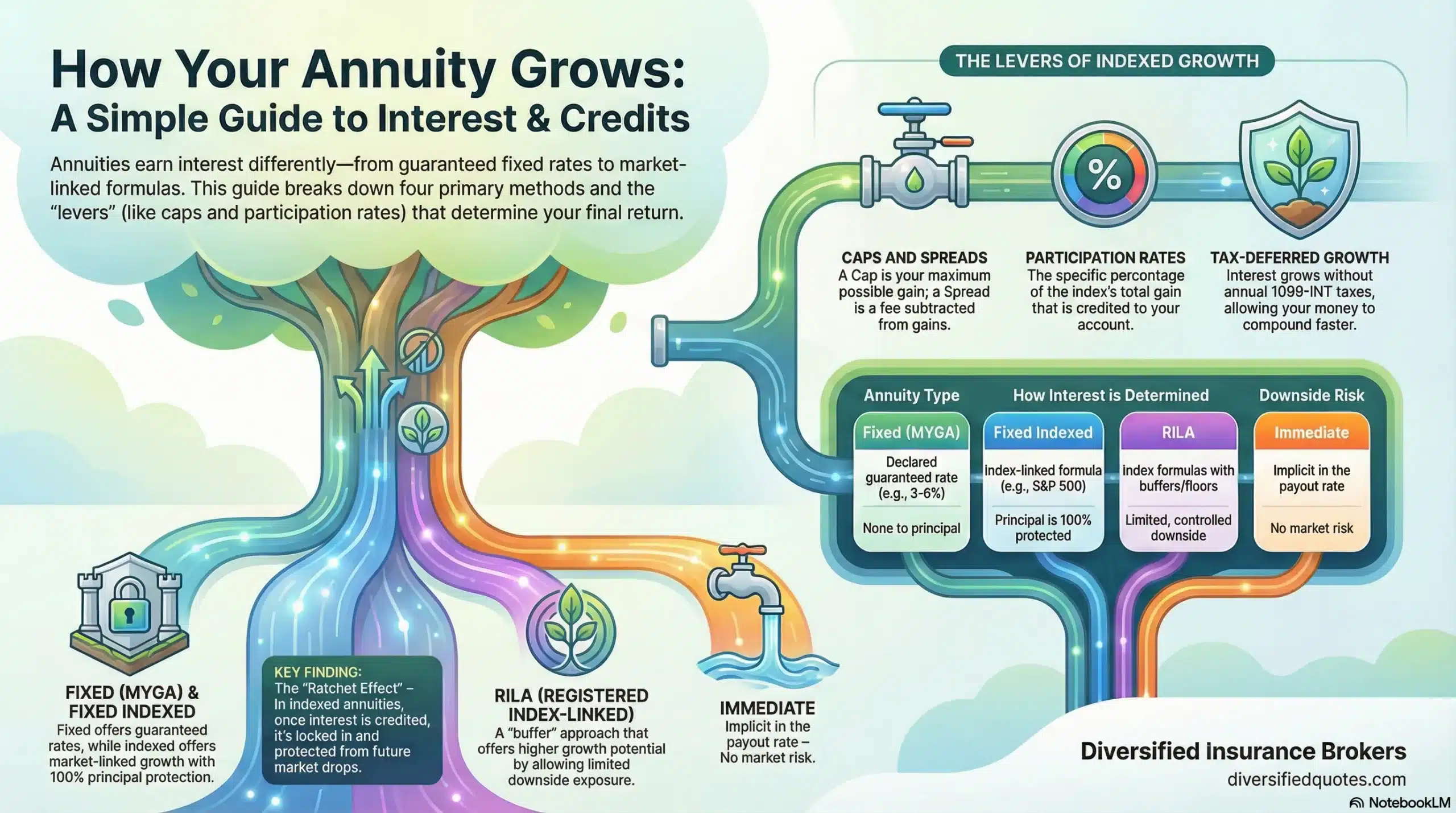
Talk With an Advisor Today
Choose how you’d like to connect—call or message us, then book a time that works for you.
Schedule here:
calendly.com/jason-dibcompanies/diversified-quotes
Licensed in all 50 states • Fiduciary, family-owned since 1980
FAQs: Guaranteed Lifetime Withdrawal Benefit (GLWB)
Is a GLWB the same as an income rider?
Yes. A GLWB is the technical term for most income riders used on fixed and fixed indexed annuities.
Does a GLWB reduce my account value?
Only withdrawals and rider fees affect the account value. Your income base grows separately and determines the guaranteed lifetime payout.
What happens if my account value hits zero?
The insurance company continues paying your income for life. That’s the core guarantee of a GLWB rider.
Can I take out extra money if I need it?
You can withdraw above your guaranteed amount, but it may reduce future income guarantees. We’ll show side-by-side illustrations for clarity.
Are GLWB payments taxable?
Payments from qualified funds (IRA, 401(k)) are taxed as ordinary income. Non-qualified contracts use the exclusion ratio until gains are fully recovered.
About the Author:
Jason Stolz, CLTC, CRPC and Chief Underwriter at Diversified Insurance Brokers, is a senior insurance and retirement professional with more than two decades of real-world experience helping individuals, families, and business owners protect their income, assets, and long-term financial stability. As a long-time partner of the nationally licensed independent agency Diversified Insurance Brokers, Jason provides trusted guidance across multiple specialties—including fixed and indexed annuities, long-term care planning, personal and business disability insurance, life insurance solutions, and short-term health coverage. Diversified Insurance Brokers maintains active contracts with over 100 highly rated insurance carriers, ensuring clients have access to a broad and competitive marketplace.
His practical, education-first approach has earned recognition in publications such as VoyageATL, highlighting his commitment to financial clarity and client-focused planning. Drawing on deep product knowledge and years of hands-on field experience, Jason helps clients evaluate carriers, compare strategies, and build retirement and protection plans that are both secure and cost-efficient.
