
Whole Life Burial Insurance

Jason Stolz CLTC, CRPC
Whole life burial insurance—often called final expense whole life insurance—is designed to provide permanent, affordable coverage that helps your family pay for funeral and end-of-life costs without financial stress. Unlike temporary policies that expire, whole life burial insurance stays in force for your entire lifetime and pays a guaranteed death benefit when it’s needed most.
At Diversified Insurance Brokers, we help seniors and families across the country secure burial insurance that is simple, dependable, and tailored to real-world needs. Whether your goal is to cover funeral expenses, protect loved ones from unexpected bills, or leave a small legacy, whole life burial insurance offers clarity and peace of mind.
This guide breaks down how these policies work, what insurers look for, how to choose between immediate and graded benefits, and how to pick a coverage amount that fits your budget without overbuying. If you’re exploring broader protection beyond final expenses, you can also compare life insurance options alongside final expense coverage to see which direction best matches your goals.
Compare Whole Life Burial Insurance Plans
View affordable burial insurance options with fixed premiums and lifetime protection.
What Is Whole Life Burial Insurance?
Whole life burial insurance is a form of permanent life insurance structured specifically to cover final expenses such as funeral services, burial or cremation, medical bills, and small outstanding debts. As long as premiums are paid, the policy stays in force for life and the death benefit is guaranteed.
Most burial insurance policies are intentionally built to be simpler than larger traditional life insurance. Benefit amounts are usually modest (often $5,000 to $40,000), the application is shorter, and many plans are available without a medical exam. That simplified approach is a major reason burial insurance remains accessible for older applicants and for people with common health conditions.
Some people use burial insurance as “standalone” protection for final expenses. Others treat it as a foundation—then add other coverage only if it’s needed and affordable. The key is that burial insurance is designed for clarity: you buy it for a specific purpose, you pay a fixed premium, and it pays a guaranteed benefit.
Why Families Choose Whole Life Burial Insurance
Funeral and end-of-life costs have become one of the most common financial shocks for families. Even when household budgets are managed carefully, end-of-life expenses can arrive quickly and create immediate pressure on children, spouses, or other loved ones.
A funeral alone can easily cost thousands of dollars, and families often face additional expenses at the same time—medical copays, hospice bills, travel for relatives, outstanding household expenses, and the paperwork burden that comes with settling an estate. Whole life burial insurance creates a simple plan that converts a manageable monthly premium into a guaranteed pool of money that can be used when it matters most.
Because the policy is permanent, it also provides certainty. There is no “renewal decision” every few years, no risk that coverage expires before it’s needed, and no surprise premium increases caused by aging. Many families choose burial insurance specifically because it reduces uncertainty when budgets and timelines are tight.
If you’re comparing burial coverage with other types of protection, it can also help to review specialized options such as life insurance for pre-existing conditions, especially when medical history is part of the decision.
How Whole Life Burial Insurance Works
Whole life burial insurance is straightforward by design. You select a death benefit amount, complete an application, and pay a fixed premium. If approved, the policy stays in force for life as long as premiums are paid, and it pays the death benefit to your beneficiaries when you pass away.
Most policies are structured around three guarantees:
Lifetime coverage: The policy does not expire based on age. As long as premiums are paid, coverage remains in force for your entire lifetime.
Level premiums: Your premium is designed to stay the same. It will not increase simply because you get older or because your health changes after the policy is issued.
Guaranteed death benefit: Once the policy is active, the insurer pays a defined amount to your beneficiaries, subject to the policy’s benefit type (immediate vs. graded) and any applicable waiting period rules.
Most burial insurance benefit amounts are chosen to match realistic final expenses rather than long-term income replacement. That’s not a limitation—it’s the point. These policies are designed to solve a specific problem with a predictable budget.
How Underwriting Typically Works for Burial Insurance
Burial insurance underwriting is usually simpler than traditional life insurance, but it still varies by carrier and by product design. In most cases, insurers are trying to answer one basic question: How stable is the applicant’s health today?
Many burial insurance applications use simplified underwriting, which usually means a short set of health questions and database checks (often including prescription history). The application is designed to be fast and practical, which is why many plans are marketed as “no exam.”
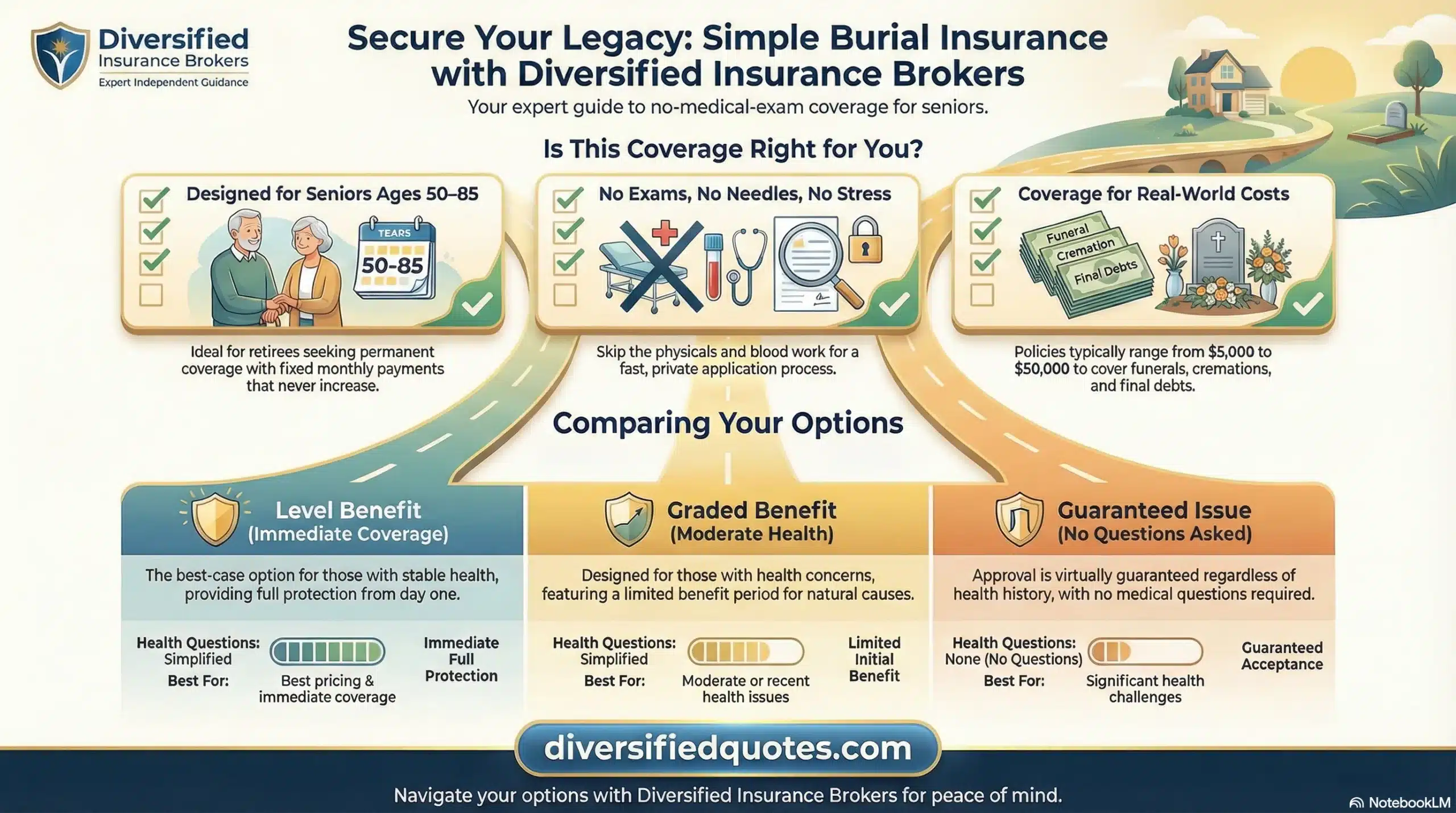
In real-world shopping, burial insurance commonly falls into one of three broad categories:
1) Simplified issue (health questions, no exam). This is the most common path. You answer health questions, the insurer checks prescription and other sources, and if approved you may qualify for level premiums and (often) immediate benefits.
2) Graded/modified benefit (partial early period for natural causes). If health history is more complex, some carriers still approve coverage but limit natural-cause benefits during an initial period. This keeps policies accessible when underwriting is tighter.
3) Guaranteed issue (no health questions). These plans accept applicants within age limits without health questions. The trade-off is typically higher cost per dollar of benefit and a graded benefit period.
The best strategy is usually to start by targeting simplified options first whenever possible, then use graded or guaranteed issue options only when needed. Choosing the right carrier is often the difference between immediate coverage and a waiting period.
Immediate Benefit vs. Graded Benefit Policies
One of the most important decisions in whole life burial insurance is understanding whether the policy provides immediate coverage or uses a graded structure. Both types are common, and neither is automatically “right” or “wrong.” The key is matching the structure to your health profile and your priorities.
Immediate benefit policies pay the full death benefit from day one once the policy is active and the first premium is paid (subject to the contract terms). These policies are often available when the applicant’s health history is relatively stable under the carrier’s guidelines.
Graded benefit policies include a waiting period, commonly two to three years, for natural-cause death. If the insured passes during that period from natural causes, the policy typically returns premiums paid plus interest (or a defined percentage). Accidental death is commonly covered immediately. After the graded period ends, the policy pays the full death benefit for all causes.
Graded policies exist for a reason: they keep coverage available when health makes immediate approval difficult. For many families, graded burial insurance is better than staying uninsured, and it can be re-shopped later if health stabilizes or enough time has passed since certain medical events.
If you’re comparing this concept across similar pages, you may also find it helpful to compare burial insurance strategies for specific profiles such as burial insurance for smokers or burial insurance for overweight people, since benefit type and pricing often vary by underwriting group.
What Carriers Look At When You Apply
Even with simplified underwriting, burial insurance carriers evaluate risk. The difference is that they do it with fewer steps and faster tools. Knowing what they look for helps you understand why the same person can get different outcomes with different companies.
Age and state of residence are foundational because pricing and availability can vary by state, and premiums generally increase with age.
Health history is evaluated with broad categories rather than deep medical records. Carriers often focus on recent hospitalizations, current diagnoses, mobility limitations, oxygen use, uncontrolled chronic conditions, or a history of certain severe illnesses.
Medication history is frequently a major underwriting signal. Prescription history can indicate stability, complexity, or progression of conditions even when medical records are not requested.
Build and tobacco status can affect premiums and eligibility. Some carriers are stricter than others, which is another reason comparing multiple carriers matters.
Because each carrier uses its own “knockout rules,” an independent comparison often produces a better result than applying randomly. The goal is not to submit multiple applications—it’s to submit the right one, with the right company, based on your situation.
Who Is Whole Life Burial Insurance Best For?
Whole life burial insurance is best for people who want permanent protection designed specifically for final expenses. It’s often chosen when the main goal is not income replacement, but rather ensuring family members aren’t forced to use savings or credit cards for funeral costs and immediate end-of-life bills.
It can be a strong fit for seniors who prefer a simple application process, especially when a full medical exam is not appealing. It can also be a practical solution for people who have health conditions that make traditional fully underwritten life insurance difficult.
Many families choose burial insurance because the cost can be predictable. A fixed monthly premium is easier to plan around than uncertain future expenses, and the death benefit is designed to arrive at the exact moment families need liquidity.
Some applicants also compare burial insurance to other planning solutions such as a term-to-permanent conversion if they already have term coverage and want to keep a permanent policy in place later in life.
Cash Value and Policy Benefits
Whole life burial insurance typically builds cash value over time. While the primary purpose of the policy is the death benefit, cash value is a secondary feature that can provide added flexibility later in life. In most whole life designs, cash value growth is modest in the early years and becomes more meaningful over time.
Some policies allow access to cash value through policy loans. That can be helpful in an emergency, but it should be used carefully because loans can reduce the death benefit and may create interest costs if they remain outstanding. For most families, the death benefit remains the main reason to buy the policy, and cash value is best treated as a backup option rather than a primary financial plan.
Another benefit families appreciate is that burial insurance claims can often be paid relatively quickly once the claim is filed and documentation is submitted. This helps families access funds during a time when immediate costs are common.
How Much Whole Life Burial Insurance Do You Need?
The right coverage amount depends on your local funeral costs and your personal goals. The most common mistake is choosing an amount based purely on “what sounds right” rather than looking at real expenses and practical budgeting.
Most families plan around a few common cost categories. Funeral and burial or cremation services are the obvious starting point, but end-of-life expenses can include other items as well, such as medical bills, hospice copays, remaining household expenses, small outstanding debts, and travel costs for family members.
Many policies fall in the $10,000 to $25,000 range because that’s where final expenses commonly land for many families. However, your needs may be higher or lower depending on your location, whether you want burial or cremation, whether you want a memorial service, and whether you want to leave a small cash gift behind.
If affordability is your primary concern, choosing a realistic coverage amount that fits your budget long-term is usually better than stretching for a larger policy that becomes difficult to maintain.
Burial Insurance Calculator
Use the calculator below to compare burial insurance pricing and estimate monthly premiums based on your age and coverage needs.
How to Compare Whole Life Burial Insurance Plans
Comparing burial insurance plans is less about finding a “best company” and more about finding the best match for your health profile, your coverage goal, and your budget. Carriers differ in pricing, underwriting flexibility, age limits, and benefit type availability.
A practical comparison approach starts with your priorities. If you want day-one benefits, you should target carriers and plans that commonly approve immediate coverage for your health category. If health issues make immediate coverage unlikely, a graded policy may be the right solution today, with a plan to re-shop later.
It also helps to compare policies with the same basic structure: level premiums, permanent coverage, and a benefit amount that aligns with your goal. When you compare wildly different benefit amounts or different benefit types, the premiums can be misleading.
If your health history is more complex, you may also find value in reviewing broader guidance such as life insurance for pre-existing conditions, since that topic overlaps heavily with burial insurance underwriting categories.
Why Work With Diversified Insurance Brokers?
Burial insurance is often marketed as “simple,” but the truth is that results can vary significantly from one company to the next. The same applicant can see different benefit types, different pricing, or even different approval outcomes depending on which carrier receives the application.
Since 1980, Diversified Insurance Brokers has helped families make life insurance decisions with clarity and confidence. As an independent, family-owned agency licensed in all 50 states, we compare burial insurance policies across multiple carriers to find the best fit for your health profile, budget, and goals.
Our approach is education-first. We focus on explaining the difference between immediate and graded policies, helping you choose a realistic benefit amount, and making sure you understand what the policy is designed to do before you move forward.
If you’re ready to compare options, you can use the quote request button below to start the process.
Protect Your Family From Final Expenses
Compare whole life burial insurance plans with fixed premiums and lifetime coverage.
Talk With an Advisor Today
Choose how you’d like to connect—call or message us, then book a time that works for you.
Schedule here:
calendly.com/jason-dibcompanies/diversified-quotes
Licensed in all 50 states • Fiduciary, family-owned since 1980
FAQs: Whole Life Burial Insurance
What is whole life burial insurance?
Whole life burial insurance is a permanent life insurance policy designed to cover funeral, burial, or cremation expenses, with fixed premiums and a guaranteed death benefit.
How is whole life burial insurance different from term life?
Term life covers you for a set number of years, while whole life burial insurance lasts your entire lifetime and never expires as long as premiums are paid.
Does whole life burial insurance require a medical exam?
Most whole life burial insurance policies do not require a medical exam. Approval is typically based on a short health questionnaire.
What expenses can burial insurance be used for?
The death benefit can be used for funeral home services, burial or cremation costs, medical bills, outstanding debts, or any other final expenses.
How much whole life burial insurance do people usually buy?
Most policies range from $5,000 to $40,000, depending on local funeral costs and whether additional funds are desired for other final expenses.
Are premiums guaranteed to stay the same?
Yes. Whole life burial insurance premiums are level and will not increase due to age or health changes after the policy is issued.
Is there a waiting period before the policy pays out?
Some policies offer immediate full benefits, while others are graded, meaning the full death benefit becomes available after a set period depending on health.
Can seniors with health issues qualify?
Yes. Many carriers offer options for applicants with common health conditions, and guaranteed issue policies may be available if other plans are declined.
About the Author:
Jason Stolz, CLTC, CRPC and Chief Underwriter at Diversified Insurance Brokers (NPN 20471358), is a senior insurance and retirement professional with more than two decades of real-world experience helping individuals, families, and business owners protect their income, assets, and long-term financial stability. As a long-time partner of the nationally licensed independent agency Diversified Insurance Brokers, Jason provides trusted guidance across multiple specialties—including fixed and indexed annuities, long-term care planning, personal and business disability insurance, life insurance solutions, Group Health, and short-term health coverage. Diversified Insurance Brokers maintains active contracts with over 100 highly rated insurance carriers, ensuring clients have access to a broad and competitive marketplace.
His practical, education-first approach has earned recognition in publications such as VoyageATL, highlighting his commitment to financial clarity and client-focused planning. Drawing on deep product knowledge and years of hands-on field experience, Jason helps clients evaluate carriers, compare strategies, and build retirement and protection plans that are both secure and cost-efficient. Visitors who want to explore current annuity rates and compare options across multiple insurers can also use this annuity quote and comparison tool.
