
Workers Comp Settlement Loan – Fast Cash for Injured Workers

Jason Stolz CLTC, CRPC
Waiting on a workers’ comp settlement can feel like a financial squeeze with no end date. Even when your claim is legitimate and moving in the right direction, the timeline is rarely fast. Medical appointments, physical therapy, prescription costs, rent, utilities, and everyday living expenses don’t pause while your case is pending. A workers comp settlement loan (also called a workers’ comp settlement advance) is designed to bridge that gap by giving you access to cash now based on the strength and expected value of your pending claim.
At Diversified Insurance Brokers, we help people understand how settlement advances work, what to watch out for, and how to apply safely. While we’re primarily an insurance brokerage, many clients ask about short-term cash-flow options during an injury claim—especially when the recovery process disrupts income. This page explains what a workers’ comp settlement loan is, how the approval process works, what it costs, how repayment is handled, and when it may (or may not) be a smart move.
Apply for a Workers’ Comp Settlement Advance
Fast review, simple application, and no repayment unless your case results in a settlement or award.
What Is a Workers Comp Settlement Loan?
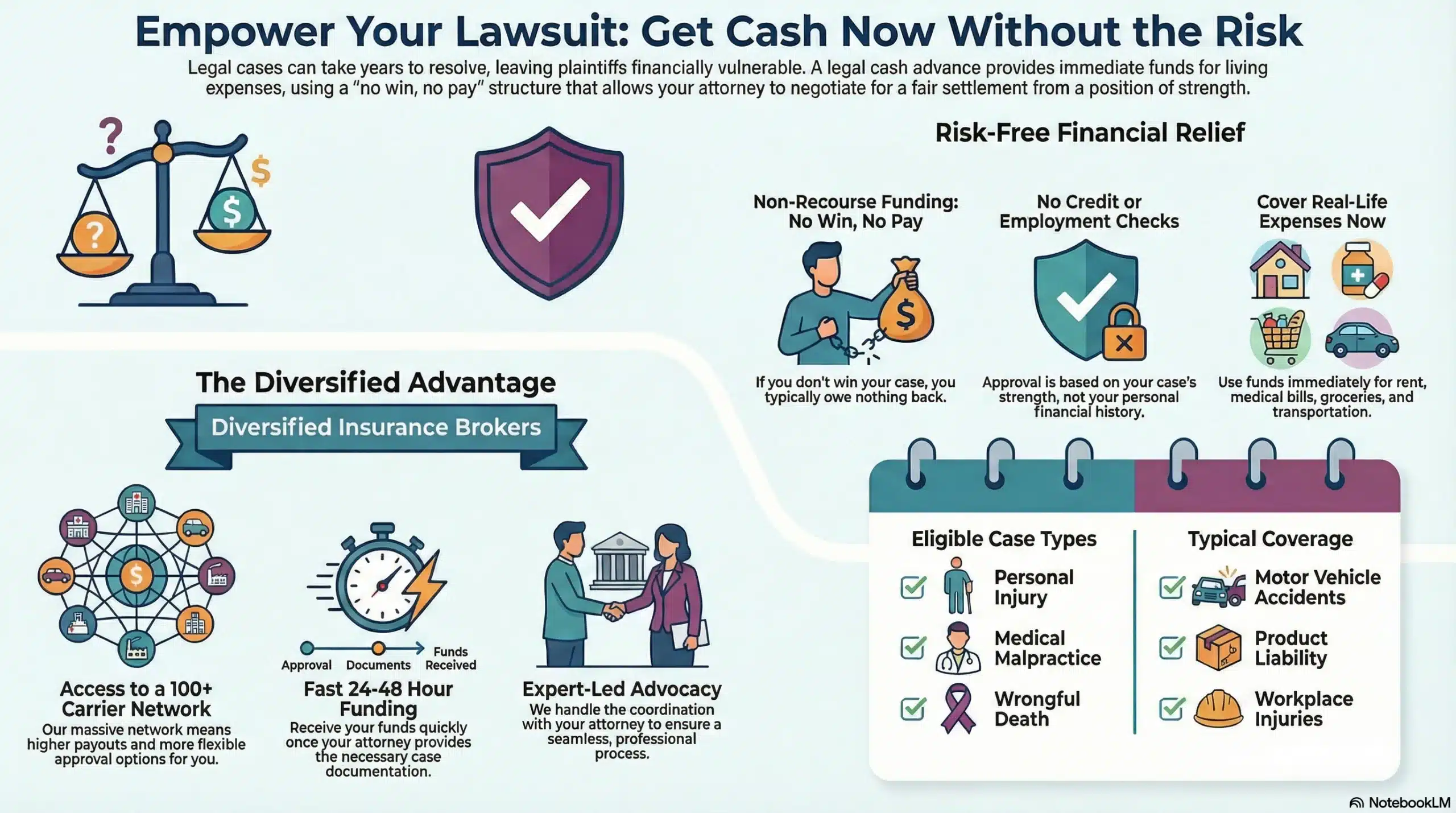
A workers’ comp settlement loan is typically non-recourse funding provided to an injured worker who has an active workers’ compensation claim. “Non-recourse” is the key difference between a settlement advance and a traditional personal loan. With a traditional loan, you repay on a monthly schedule regardless of what happens. With non-recourse funding, repayment generally occurs only if your case results in a settlement or award. If the claim does not result in a recovery (or if legal or technical issues prevent payment), the funding provider may not be able to collect repayment from you personally, depending on the agreement.
Many people call it a “loan” because it feels like borrowing money, but in most cases it is structured as an advance against proceeds rather than a bank-style loan. You’re not being evaluated based on credit score, income, or employment status. Instead, you’re being evaluated based on the strength of the claim, the status of the case, and the likelihood and expected size of a future payout.
Workers’ comp is different from standard personal injury because the claim involves a workplace injury and a separate legal/administrative framework. That affects timing, documentation, and the way settlement funds are disbursed. A funding provider will usually require attorney confirmation (if you have counsel), a case summary, and clarity on whether the claim is in litigation, negotiation, or nearing resolution. If you’re also researching other settlement funding types, you may find it helpful to read our overview of how lawsuit loans work to understand the broader concept of non-recourse legal funding.
Why People Use Workers’ Comp Settlement Funding
Most workers don’t plan for an injury that disrupts earning capacity. Even when workers’ comp benefits cover certain medical costs, injured workers can still face out-of-pocket expenses, delayed wage replacement, benefit disputes, or gaps caused by waiting on approvals. Add in the reality that some cases take months to resolve, and cash-flow pressure becomes the biggest stressor—sometimes bigger than the injury itself.
Workers’ comp settlement funding is commonly used to cover essentials: rent or mortgage, utilities, groceries, transportation, and medical co-pays. Some people use funding to avoid high-interest credit card debt or to prevent falling behind on bills. Others use it to stabilize finances so they can focus on recovery and avoid accepting a low settlement simply because they’re desperate for cash. In that sense, a settlement advance can function as leverage: it can give you breathing room while your attorney negotiates from a stronger position.
That said, funding is not “free money.” It comes with cost, and the cost can be meaningful. The best way to think about it is as a tool: sometimes the tool is worth it because it prevents worse outcomes (eviction, repossession, spiraling debt), and other times the tool is too expensive relative to the size or uncertainty of the case.
How a Workers’ Comp Settlement Loan Works
Although providers have different workflows, most workers’ comp funding follows a similar sequence. First, you submit basic case information, including your injury date, the employer/insurer (if known), the jurisdiction/state, whether you have an attorney, and your estimate of where the case stands. Second, the funding company evaluates the case—often by contacting your attorney to confirm details and request documentation. Third, if approved, you receive an offer that states the advance amount and the repayment terms. Finally, if you accept, funds are issued (often quickly) and repayment is handled from the eventual settlement proceeds.
In many cases, the provider will require your attorney to sign an acknowledgment agreeing to repay the advance from settlement funds before disbursing the remainder to you. This is one reason funding is typically easier when you are represented by counsel: it creates a clear repayment pathway. Some providers may fund unrepresented claimants, but it can be more restrictive and may require additional safeguards.
Workers’ comp settlements often require formal approval depending on your state and the structure of the settlement (for example, a compromise and release). A funding provider will factor in those procedural steps, because they affect the timeline for repayment. The more clearly documented the case posture is, the easier it is to underwrite the advance responsibly.
What You Can Qualify For (And What Impacts Approval)
Approval is usually based on claim viability and expected recovery rather than your personal finances. Key underwriting factors often include: the nature of the injury, the extent of medical documentation, whether the claim is accepted or disputed, whether there are pending hearings or appeals, and whether you have an attorney with an established track record. Providers may also look at the stage of negotiation and whether there is a realistic settlement range being discussed.
The amount you qualify for is typically a fraction of the expected net recovery (what you receive after fees, liens, and costs). Workers’ comp claims can include medical liens and other offsets, so the “headline settlement number” is not always what you actually receive. A responsible funding evaluation focuses on the likely net proceeds because that is what repayment will come from. If you’re also dealing with serious financial strain due to injury and inability to work, it may be worth reviewing protection options that can reduce future vulnerability, such as bridging health coverage gaps or exploring disability coverage strategies (if applicable to your work situation).
Costs, Fees, and What “Non-Recourse” Really Means
Settlement advances are priced differently than bank loans. You may see costs described as a funding fee, use fee, flat fee, or monthly charge that accrues over time. Because repayment depends on the case outcome and timeline, funding providers price for risk and duration. Generally, the longer the case takes to resolve, the higher the payoff amount becomes. That’s why it’s critical to understand the repayment schedule in plain language before accepting any offer.
“Non-recourse” generally means you don’t make monthly payments and repayment is tied to settlement proceeds. However, you should still read the contract carefully. Ask specifically: What happens if the case takes longer than expected? Are there compounding fees? Are there administrative fees? Can the funding be paid off early, and does early payoff reduce cost? Are there multiple tranches (more than one advance), and how are they priced?
A practical rule: if you can cover your needs through less expensive means, do that first. But if the alternative is high-interest revolving debt, missed housing payments, or accepting an unfair settlement, then funding can be rational. The decision should be made with a clear view of trade-offs, not just urgency.
Do I Need an Attorney?
You don’t always need an attorney to apply, but having one often improves clarity and speed. Funding providers commonly require attorney cooperation because your attorney is typically the settlement disbursement point and can confirm case status. If you already have counsel, the funding provider will usually ask for permission to communicate directly with the firm. If you do not have counsel, the provider may request documents directly from you, but the review may be slower and the offer may be smaller.
It’s also worth stating plainly: funding companies generally do not “control” your case, and they should not influence settlement decisions. Your legal strategy should remain between you and your attorney. Funding should be a financial bridge—not a steering wheel.
When a Workers’ Comp Settlement Advance Is Most Helpful
Funding is usually most helpful when your case is reasonably strong, the timeline is uncertain, and the financial pressure is immediate. For example, if you have medical documentation supporting the injury, the claim is progressing, and settlement discussions are underway—but you’re facing rent due dates, utility shutoff risk, or medical travel costs—an advance can reduce the short-term stress.
It can also help when delayed resolution would otherwise force a poor decision. Financial desperation can push people into accepting a low settlement simply to stop the bleeding. If a modest advance prevents that outcome and the case has meaningful upside, the overall financial result may be better even after the funding cost.
On the other hand, if the claim is highly disputed, documentation is thin, or the likely settlement is small, funding may not be worth the cost. In those situations, it’s often better to focus on budgeting, negotiating hardship arrangements, or exploring alternative support options until the case is clearer.
What to Watch Out For (Protecting Yourself)
The most common problem with settlement advances is misunderstanding the cost curve. The advertised advance amount can look attractive, but the repayment number can grow quickly if the case drags on. Before you accept, you should be able to answer these questions: How much do I receive today? How much do I repay if the case resolves in 3 months, 6 months, 12 months, or longer? Is the fee simple or compounding? What happens if I want to pay it off early? Are there penalties?
Also, avoid stacking multiple advances unless it is absolutely necessary. Multiple tranches can create a heavy payoff burden and reduce the portion of settlement proceeds you ultimately receive. If you think you may need more than one advance, it’s often better to request an amount that realistically covers your needs for a defined period—so you don’t repeatedly pay new fees.
Finally, keep your attorney in the loop. Even if you’re applying independently, it’s usually wise to let counsel review the funding agreement so you understand how it interacts with liens, fees, and settlement disbursement order.
How to Apply
The application process is typically straightforward. You provide basic personal details, case information, and attorney contact information (if represented). The funding provider then requests confirmation and documentation. If approved, you receive an offer. If you accept, funding is issued and the provider places a lien/assignment against settlement proceeds consistent with your agreement. Repayment occurs at settlement.
If you’re ready to start, use the secure form below to request a review. Submitting the form does not obligate you to accept an offer. It simply begins the underwriting review so you can see what options are available.
Start Your Workers’ Comp Settlement Funding Request
Submit your case details to see if you qualify for a settlement advance.
Related Pages
How Lawsuit Loans Work (Fast Cash Advances Explained) — a clear overview of how non-recourse legal funding is typically structured and what approval depends on.
Wrongful Death Settlement Loan — another example of settlement funding mechanics if you’re comparing funding types across case categories.
Disability Insurance if You’re Self-Employed — how income protection can reduce financial pressure if an injury disrupts work.
How Short-Term Health Insurance Can Bridge the Gap — an option some people explore when coverage changes during a transition period.
Marketplace Apply — a starting point for health coverage exploration when circumstances change.
Talk With an Advisor Today
Choose how you’d like to connect—call or message us, then book a time that works for you.
Schedule here:
calendly.com/jason-dibcompanies/diversified-quotes
Licensed in all 50 states • Fiduciary, family-owned since 1980
FAQs: Workers Comp Settlement Loan
Is a workers’ comp settlement loan a real “loan”?
Most workers’ comp “settlement loans” are structured as a non-recourse cash advance against expected settlement proceeds rather than a traditional personal loan. Approval is usually based on the claim’s strength and expected recovery—not credit score or employment.
Do I have to make monthly payments?
Typically, no. With non-recourse funding, repayment usually occurs from settlement proceeds when the case resolves. The agreement will outline how fees accrue over time and what the payoff would be at different timelines.
What happens if I don’t win or don’t receive a settlement?
In many non-recourse arrangements, if there is no recovery, the provider may not be able to collect repayment from you personally. However, terms vary, so it’s important to read the contract and confirm what “non-recourse” means in your specific agreement.
How much can I get for a workers’ comp settlement advance?
The advance amount is usually a portion of the expected net settlement value (after attorney fees, liens, and costs). The more documented and advanced the case is, the easier it is to estimate net proceeds and underwrite responsibly.
Do I need an attorney to qualify?
Not always, but many providers prefer attorney-represented cases because counsel can confirm case status and facilitate repayment from settlement funds. Unrepresented cases may still be reviewed but can be more restrictive.
How fast can I receive funds?
Timing varies, but funding can often be issued quickly after the case review and attorney verification are complete. Delays usually occur when documentation is missing or the case posture is unclear.
How much does it cost?
Costs vary by provider and case risk. Many agreements use fees that increase over time until the case resolves. Before accepting, ask for payoff examples at 3, 6, 12, and 18 months so you understand the cost curve.
Can I pay it off early?
Some agreements allow early payoff, and some reduce costs with early resolution. Others may have minimum fees or set payoffs. Always confirm early-payoff terms in writing before you accept an offer.
Will getting an advance affect my settlement negotiations?
It shouldn’t change the legal merits of your case, but it can affect how much of your eventual proceeds you take home. The best use of funding is to relieve immediate pressure without over-borrowing, so you maintain flexibility at settlement.
What information do I need to apply?
Most applications ask for basic personal information, the state/jurisdiction, injury date, employer/insurer (if known), claim status, and attorney contact (if represented). Providers then request records to verify the claim and expected recovery.
About the Author:
Jason Stolz, CLTC, CRPC and Chief Underwriter at Diversified Insurance Brokers, is a senior insurance and retirement professional with more than two decades of real-world experience helping individuals, families, and business owners protect their income, assets, and long-term financial stability. As a long-time partner of the nationally licensed independent agency Diversified Insurance Brokers, Jason provides trusted guidance across multiple specialties—including fixed and indexed annuities, long-term care planning, personal and business disability insurance, life insurance solutions, and short-term health coverage. Diversified Insurance Brokers maintains active contracts with over 100 highly rated insurance carriers, ensuring clients have access to a broad and competitive marketplace.
His practical, education-first approach has earned recognition in publications such as VoyageATL, highlighting his commitment to financial clarity and client-focused planning. Drawing on deep product knowledge and years of hands-on field experience, Jason helps clients evaluate carriers, compare strategies, and build retirement and protection plans that are both secure and cost-efficient.
