
Affordable Life Insurance for Seniors with Health Issues

Jason Stolz CLTC, CRPC
Finding affordable life insurance for seniors with health issues can feel overwhelming. Many carriers tighten guidelines once chronic conditions are disclosed, while others approve coverage but at much higher premiums. The good news is that there are policies designed specifically for seniors with health concerns—including final expense and guaranteed issue life insurance—that can provide real peace of mind without a drawn-out underwriting process.
At Diversified Insurance Brokers, we help seniors nationwide compare options across many top-rated carriers and underwriting paths. The goal is simple: help you get the most coverage for the lowest cost you can realistically qualify for—without wasted time, surprise declines, or being pushed into a policy that doesn’t match your situation. When health issues are part of the picture, “cheapest” usually isn’t a single company—it’s the carrier and policy type that best fits your exact condition history, medications, and timeline.
Get a Quote for Senior Life Insurance
Even with health issues, you may still qualify for affordable coverage. Compare your options today.
Types of Coverage Available
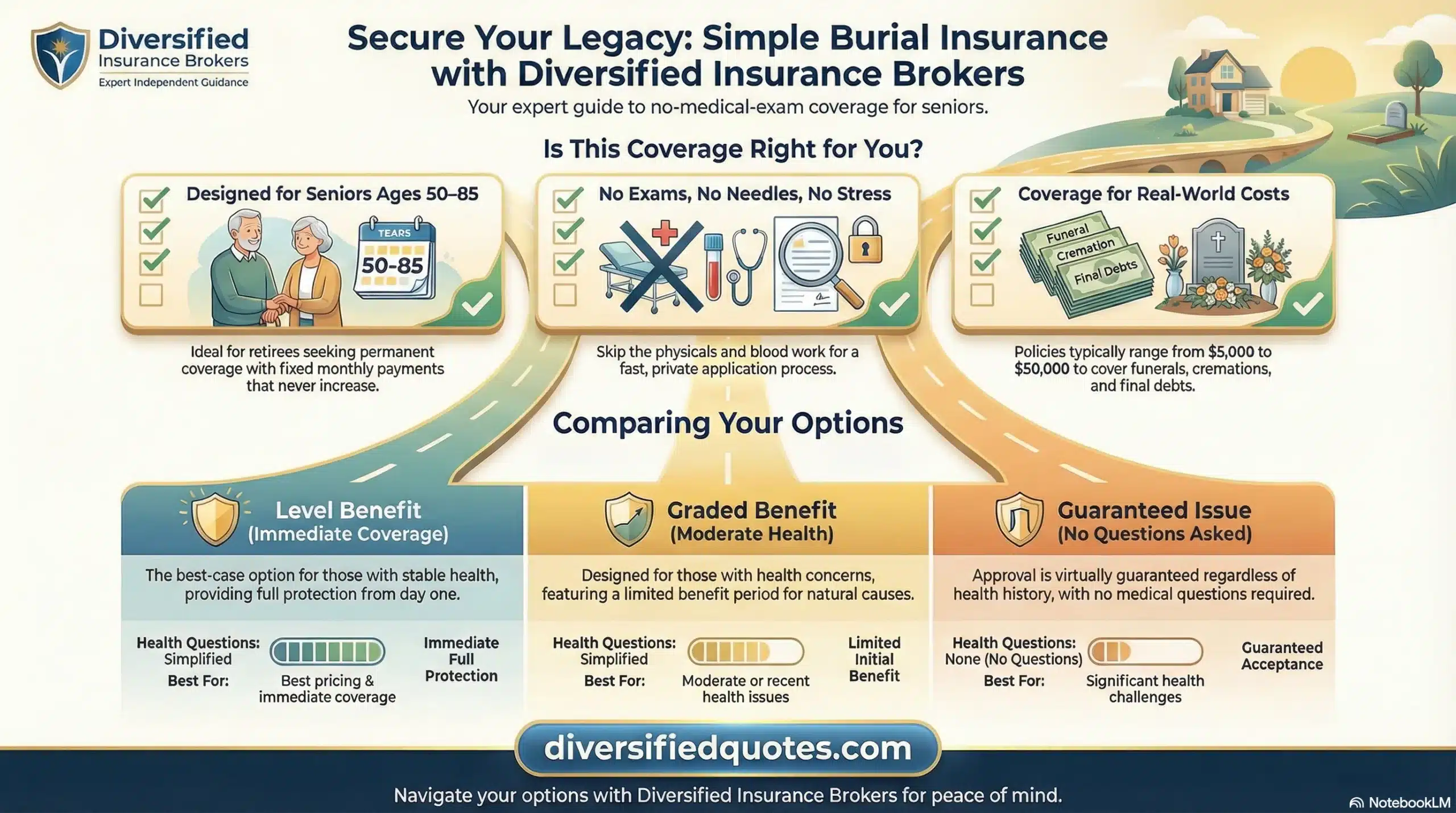
Seniors with health issues usually have three practical “lanes” to shop in: final expense (burial insurance), guaranteed issue, and simplified issue coverage. The best lane depends on your age, conditions, medications, and whether you’re trying to cover final expenses or protect a spouse with a larger death benefit. If you’re comparing the big picture between burial coverage and term insurance, this guide can help frame the tradeoffs: Final Expense Life Insurance vs. Term Life Insurance.
Final expense (burial insurance) is often the most budget-friendly fit for seniors who primarily want to cover funeral costs and immediate bills. These policies are commonly issued in smaller amounts (often $5,000–$50,000), designed to stay in force for life, and built around simplified underwriting so approvals can be much easier than traditional policies.
Guaranteed issue life insurance is the “certainty-first” option. It typically involves no health questions and no medical exam, which means approval can be far more predictable for seniors with complex medical histories. The tradeoff is that the cost per $1,000 of coverage is often higher, and many policies include a graded benefit period for natural-cause death early in the policy.
Simplified issue coverage sits in the middle. It usually avoids a medical exam but does ask a short set of health questions. If you can qualify, simplified issue can sometimes provide better pricing than guaranteed issue and may offer immediate full coverage, depending on the plan. When seniors are focused on affordability, this is often the lane that saves the most money—if health answers allow it.
Finally, it’s important to understand the benefit structure you’re buying. Some plans offer level benefits (full death benefit available right away), while others use a graded benefit structure (often a waiting period for natural causes before full benefits apply). That single detail can change how a policy performs in the early years, so it needs to be crystal clear before you apply.
How Underwriting Works for Seniors with Health Issues
Carriers evaluate risk differently. Some are more flexible with controlled diabetes, stable blood pressure, or past cancer in remission, while others focus more heavily on cardiac, respiratory, or neurological history. The result is that the “same senior” can look very different from one carrier to the next—especially when medication history and recent treatment timelines are involved.
With simplified issue applications, carriers usually ask a short list of health questions and then verify information using database checks such as prescription history. The questions are often designed to identify recent major events (hospitalizations, active treatment, oxygen use, certain diagnoses, mobility limitations, or cognitive impairment) rather than everyday conditions. If you can fit inside that simplified lane, it can be a strong way to keep premiums reasonable.
Guaranteed issue policies bypass health questions entirely, which can reduce stress and uncertainty for seniors who have had declines or who know their history will likely fail simplified screens. Because the carrier is accepting applicants without screening, many guaranteed issue policies protect themselves with a graded benefit period early in the policy. The key is not avoiding graded coverage—it’s understanding it and sizing the benefit realistically so the policy stays affordable long-term.
Our job is to match your profile to the underwriting lane that actually fits your situation, then shop carriers inside that lane to find the best combination of premium, approval odds, and benefit structure.
What Health Issues Do Carriers Consider?
Not all health issues affect eligibility the same way. Seniors are often surprised by what matters most. In many cases, carriers focus less on the name of a condition and more on stability, treatment, complications, and recent timing.
The conditions that most commonly shape pricing and approval include heart histories (past heart attack, stents, bypass), diabetes (oral meds vs. insulin, control history), high blood pressure and cholesterol, past cancer with remission timelines, stroke or other neurological events, and respiratory issues such as COPD or oxygen use.
Beyond diagnoses, carriers also pay close attention to build (height/weight), tobacco use, recent hospitalizations, mobility aids, cognitive concerns, pending tests, and whether there are signs a condition is progressing. Clear disclosure helps prevent mismatches, avoids preventable declines, and keeps the process efficient from the start.
Estimate Burial Insurance Premiums
Use this calculator to compare affordable policies designed for seniors with health concerns.
Comparison: Healthy Seniors vs. Seniors with Health Issues
Seniors in good health often qualify for a wider range of products and the best pricing tiers. Seniors with health issues can still get coverage, but the most affordable path is usually found by selecting the right underwriting lane first (simplified issue vs. guaranteed issue) and then choosing a realistic face amount that keeps premiums sustainable for life.
| Factor | Healthy Seniors | Seniors with Health Issues |
|---|---|---|
| Policy Options | Term, Whole, Universal, Burial | Burial, Guaranteed Issue, Simplified Issue |
| Premiums | Lowest available | Higher, but often manageable with the right carrier and amount |
| Approval Odds | Very high | Moderate to high depending on condition and stability |
| Underwriting | Full medical review | Few health questions or guaranteed approval |
Cost Drivers You Can Influence
When a senior is dealing with health issues, affordability is usually created by choosing the right mix of policy type and coverage amount. A smaller face amount—often something like $10,000 to $25,000—can keep premiums lower while still covering the most common final expenses. Policy type matters too: guaranteed issue is typically the easiest to qualify for, but simplified issue can be less expensive if health answers fit the guidelines.
Payment mode can also affect pricing. Monthly EFT is common, while annual pay can sometimes reduce the effective cost. Tobacco use remains a major driver, and carriers often separate pricing into tobacco vs. non-tobacco tiers. Riders can add value in specific scenarios, but they can also increase premiums, so it’s usually best to add riders only when they solve a real need rather than “just in case.”
Case Example
A 72-year-old woman with insulin-dependent diabetes applied for $15,000 in burial insurance. One carrier’s simplified lane only offered graded coverage with a waiting period for natural causes. We approached the case differently by selecting a carrier whose diabetes guidelines were more favorable based on stability and treatment history, and the result was an immediate level benefit option at a competitive premium. The outcome wasn’t “magic”—it was simply the right underwriting match.
Application Tips for Faster Approvals
The fastest approvals usually come from clean, consistent information. Be upfront about medical history. If something is missing or inconsistent, it often slows the process down because the carrier has to verify and clarify. It also helps to have a current medication list ready, including what each medication is for and who prescribes it.
When health history is more complicated, the best strategy is usually to focus on carriers with guidelines that fit your profile rather than testing random applications. If simplified issue screens are likely to fail, it may be better to price guaranteed issue options immediately and size the benefit for long-term affordability.
Beneficiaries, Payout Speed, and Final Expenses
Most final expense policies pay benefits directly to your beneficiaries, who can use proceeds for funeral costs, medical bills, travel, and other immediate needs. Many carriers streamline claims for smaller policies when documentation is complete. Choosing primary and contingent beneficiaries carefully, keeping beneficiary information current, and making sure a trusted family member knows the policy exists can make a real difference when the time comes.
Why Work With Diversified Insurance Brokers?
Since 1980, Diversified Insurance Brokers has helped seniors— even those with complex health or occupation histories—secure affordable life insurance. We know which companies tend to be more flexible for specific conditions and how to select the underwriting lane that fits the situation without wasting time. You can also learn more about our burial insurance services and how they can protect your family from final expenses.
Compare Senior Coverage Options
If you have health issues, we’ll help you identify the best underwriting lane and keep premiums aligned with your budget.
Talk With an Advisor Today
Choose how you’d like to connect—call or message us, then book a time that works for you.
Schedule here:
calendly.com/jason-dibcompanies/diversified-quotes
Licensed in all 50 states • Fiduciary, family-owned since 1980
Frequently Asked Questions
Can seniors with health issues still qualify for life insurance?
Yes. Many seniors qualify for coverage even with medical conditions. The best fit depends on your age, current stability, medications, and whether you’re applying for simplified issue, guaranteed issue, or a traditional underwritten policy.
What is the difference between simplified issue and guaranteed issue life insurance?
Simplified issue policies usually ask a short set of health questions but often have faster approvals and immediate full benefits if you qualify. Guaranteed issue policies have no medical questions and no exam, but commonly include a waiting period for natural causes during the first 1–2 years.
Will my policy pay the full death benefit right away?
It depends on the policy type. Many simplified issue plans offer immediate level benefits. Many guaranteed issue plans include a graded benefit period, where natural-cause claims early in the policy may pay a reduced amount (often premiums paid plus interest) until the waiting period ends.
How much life insurance do seniors usually buy for final expenses?
Most seniors choose amounts designed to cover funeral and end-of-life costs—often in the range of $10,000 to $25,000. The best amount is the one that fits your goals and stays affordable long term.
If I was declined before, can I still get coverage now?
Yes. A prior decline does not mean you’re out of options. Depending on why you were declined, you may still qualify through a different carrier, a different underwriting path, or a guaranteed issue policy that does not require medical approval.
Does taking multiple medications automatically increase my price?
Not automatically. Underwriting usually focuses on what the medications are treating, how stable the condition is, and whether there have been recent complications. For guaranteed issue plans, medications typically do not affect eligibility.
How fast can senior life insurance coverage start?
Many simplified issue and guaranteed issue policies can start quickly once the application is completed and the first premium is processed. Timing varies by carrier and payment setup.
About the Author:
Jason Stolz, CLTC, CRPC and Chief Underwriter at Diversified Insurance Brokers, is a senior insurance and retirement professional with more than two decades of real-world experience helping individuals, families, and business owners protect their income, assets, and long-term financial stability. As a long-time partner of the nationally licensed independent agency Diversified Insurance Brokers, Jason provides trusted guidance across multiple specialties—including fixed and indexed annuities, long-term care planning, personal and business disability insurance, life insurance solutions, and short-term health coverage. Diversified Insurance Brokers maintains active contracts with over 100 highly rated insurance carriers, ensuring clients have access to a broad and competitive marketplace.
His practical, education-first approach has earned recognition in publications such as VoyageATL, highlighting his commitment to financial clarity and client-focused planning. Drawing on deep product knowledge and years of hands-on field experience, Jason helps clients evaluate carriers, compare strategies, and build retirement and protection plans that are both secure and cost-efficient.
