
Are Annuities Worth it

Jason Stolz CLTC, CRPC
Are annuities worth it? For many retirees and pre-retirees, the answer is yes—but only when the annuity is solving a real retirement problem. The value of an annuity depends on your goals, timeline, liquidity needs, tax picture, and your comfort with market risk. Annuities are not one-size-fits-all products. When the fit is right, they can deliver outcomes that are hard to reproduce with traditional investments alone: guaranteed lifetime income, protection from market losses, more predictable interest crediting, and the ability to build a “pension-like” income layer you can budget around.
At Diversified Insurance Brokers, we help clients evaluate annuities with a simple lens: what problem are you trying to solve? Some people are trying to protect principal after working hard for decades and don’t want to risk a major drawdown right as retirement starts. Others want to create a baseline “retirement paycheck” that can’t be outlived. Others want to reduce sequence-of-returns risk so they aren’t forced to sell investments in a down market. Still others want tax-deferred growth in a place that feels more stable than a fully market-based account. In each case, the product only becomes “worth it” if it improves the plan, not if it just looks good on paper.
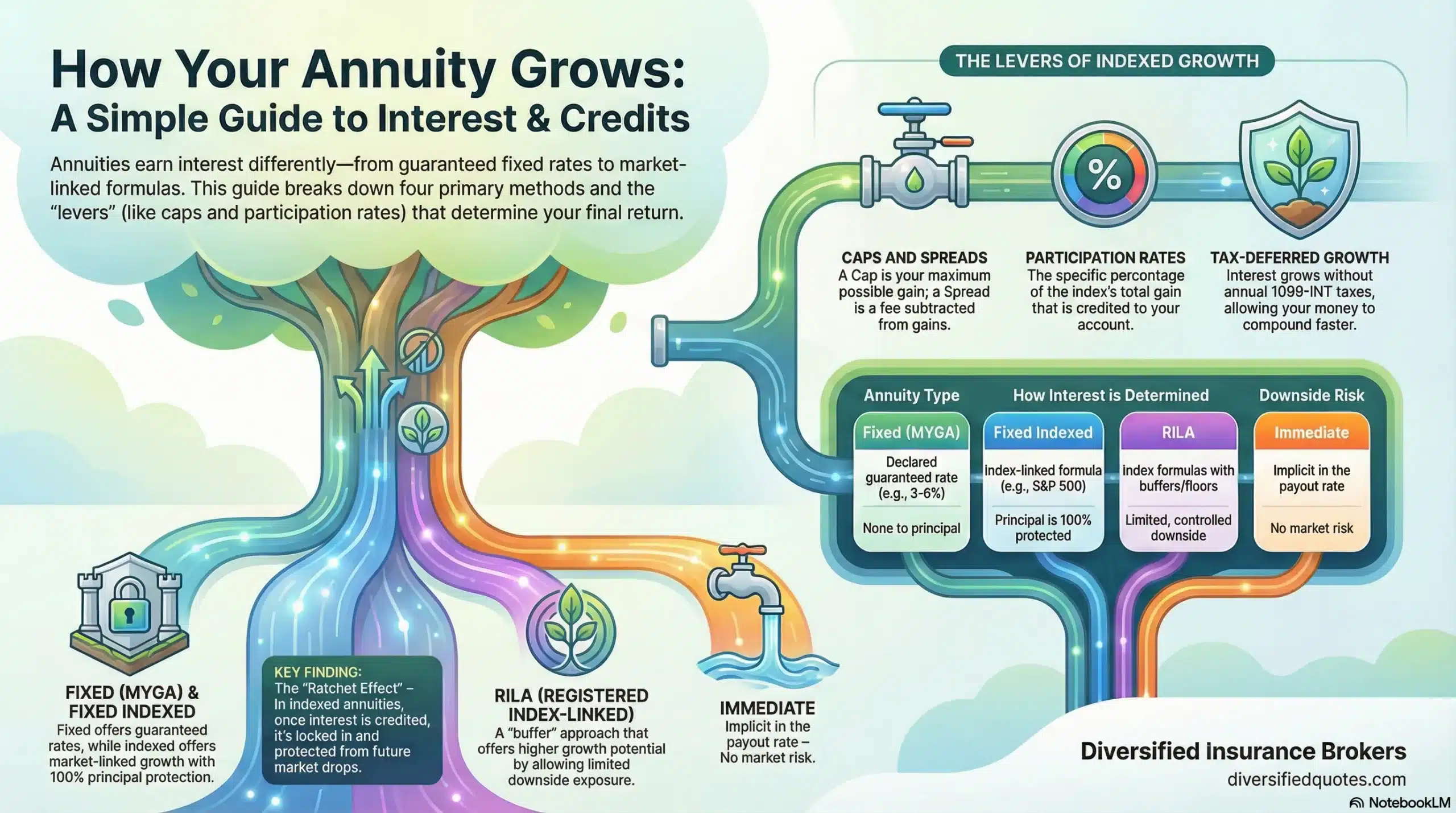
Before you decide, it helps to understand the core categories. Fixed annuities are built for principal protection and predictable interest, while fixed indexed annuities are designed to offer upside potential linked to an index—with a floor that protects against market loss. And if income is the goal, learning how lifetime income works is essential because it changes the decision from “what return can I earn?” to “what income can I lock in, and what risks am I removing?” Those differences are the foundation for deciding whether an annuity is worth it for your situation.
Find Out If an Annuity Improves Your Retirement Plan
We’ll compare fixed, indexed, and income options and show the tradeoffs in plain English—using your timeline and goals.
Why Many People Consider Annuities “Worth It”
Annuities are “worth it” when they solve retirement challenges that investment accounts alone cannot guarantee against. Investment accounts can grow, but they do not guarantee the timing of returns, they do not guarantee a stable paycheck, and they do not guarantee you won’t be forced to sell during a market drawdown. Annuities, on the other hand, are designed around contractual promises—either a guaranteed rate of interest, a guaranteed floor against loss, or a guaranteed income stream for a specified period or for life.
For a retiree, the biggest shift is often psychological: retirement stops being about “total return” and becomes about “reliable cash flow.” If a household has enough income to cover essentials, retirement feels manageable even during volatile years. If the household is depending on a portfolio withdrawal strategy for essentials, volatility can create anxiety and force poor decisions. This is where annuities can add real value—by anchoring part of the plan in certainty.
Longevity risk (outliving savings) is another major reason annuities can be worth it. People regularly underestimate how long retirement can last. A 65-year-old couple has a meaningful chance that one spouse lives into their 90s. A plan that looks “fine” over 20 years can become fragile over 30 years—especially if markets are choppy and withdrawals are steady. When an annuity is structured for lifetime income, the insurer takes on the risk of the retiree living longer than expected. That risk transfer can be extremely valuable, especially for people who want to simplify decision-making.
There is also a practical planning reason: sequence-of-returns risk. Even if markets average strong long-term returns, the order of returns matters. Retiring into a down market while taking withdrawals can permanently damage a portfolio. Annuities are often used to reduce the amount that must be withdrawn from investments during down years, giving the portfolio time to recover.
What “Worth It” Actually Means in Annuity Decisions
“Worth it” is not just a rate or a hypothetical projection. An annuity is worth it when it improves your retirement plan under real-world conditions. That means it should help you do at least one of the following: increase the reliability of income, reduce downside risk, provide a clearer budgeting framework, create a better survivor plan for a spouse, improve tax-deferred growth (when appropriate), or reduce the chance that you run out of money over a long retirement.
In other words, the annuity should improve outcomes you care about, not simply provide a product feature that sounds good. The best annuity decisions often come from seeing the annuity next to an alternative plan. When you compare “annuity + portfolio” to “portfolio only” using conservative assumptions, you can often see where the annuity is adding real planning value—especially around income reliability and market stress years.
Types of Annuities and What They’re Worth For
The value you get from an annuity depends heavily on choosing the right category. People sometimes dismiss annuities because they are thinking of the wrong type. Others buy a type that doesn’t match their real goal. The main categories can be summarized as: fixed annuities for predictable growth, fixed indexed annuities for protected growth potential, and income annuities or riders for guaranteed paychecks.
Fixed Annuities: Worth It for Predictability and Principal Protection
Fixed annuities are often compared to CDs because they can offer a guaranteed interest rate for a set period. The difference is how they fit in retirement planning. Many fixed annuities are built for longer-term allocation decisions and can offer competitive yields relative to other conservative options, especially when you consider tax deferral for non-qualified funds. They are often worth it for people who want predictable interest, no market exposure, and a clear “safe bucket” inside a broader plan.
Fixed annuities can also help reduce pressure on a bond portfolio. Some retirees use them to stabilize a portion of assets that would otherwise be in fixed income, especially if they are concerned about interest-rate sensitivity and market volatility in bonds. The annuity is not a replacement for a full diversified plan, but it can be an effective tool when the goal is stability and predictable accumulation.
Fixed Indexed Annuities: Worth It When You Want Protected Upside Potential
Fixed indexed annuities (FIAs) credit interest based on the performance of a market index, subject to contract limits such as caps, spreads, or participation rates. The core feature is that you typically have a floor that protects against negative market years. That makes FIAs attractive to people who want a bridge between “fully fixed” and “fully market-based.” They can be worth it for people who want principal protection but still want a chance to capture some market-linked growth over time.
FIAs can also be worth it when paired with lifetime income riders for retirement income planning. In that structure, the annuity is not just an accumulation tool—it becomes part of the income plan. The value then comes from the combination: protected accumulation plus the option to turn on guaranteed lifetime withdrawals later, which can help a retiree create predictable baseline income without fully giving up account value access (subject to contract rules).
Income Annuities and Lifetime Income Riders: Worth It for Paycheck Replacement
Income annuities—such as SPIAs, DIAs, and annuities with lifetime income riders—are designed to solve one problem: creating reliable income. For retirees without a pension, that can be an enormous benefit. For couples, joint lifetime income can protect the surviving spouse and reduce the chance of an income cliff after the first death. If your primary retirement fear is “running out of money,” income annuities are often the most directly valuable type because they are built to remove longevity risk.
Some people evaluate income annuities by comparing them to a traditional portfolio withdrawal strategy. That comparison can be helpful if it is done honestly. The portfolio strategy assumes certain returns and assumes discipline during down markets. The annuity strategy replaces that uncertainty with a contract. The question becomes: how much certainty do you want, and what portion of assets should be used to buy that certainty?
When Annuities Are Worth It—and When They Aren’t
Annuities are often worth it when they match a clear objective. If you want principal protection, fixed and indexed annuities can be valuable because they protect against market losses. If you want predictable lifetime income, income annuities and riders can provide a paycheck that markets cannot guarantee. If you want tax-deferred growth, non-qualified annuities can provide deferral that may improve long-term compounding for certain situations. If you want to shift longevity risk, annuities can transfer that risk to the insurer. If you want stability and less stress, annuities can create a foundation you can budget around.
But annuities may not be worth it if your primary need is short-term liquidity, if you expect to need large withdrawals in the near term, or if you are trying to use an annuity for a job it wasn’t designed to do. Products with surrender schedules can be a poor fit for someone who wants maximum flexibility. Likewise, a person who is comfortable with market volatility and has ample assets and income coverage might not need to allocate much to annuities at all.
It’s also important to coordinate annuities with retirement account rules. If part of your assets are in an IRA, you should understand how RMDs interact with annuities and how your plan will handle required distributions. In many cases, the right solution is about placement and timing, not just product selection.
Are Indexed Annuities Worth It?
Indexed annuities can be worth it for people who want a more balanced approach between growth and safety. Their value tends to be highest when you plan to hold them long enough for the protected-growth structure to matter and when you want to reduce portfolio volatility. They can also be valuable when the role of the annuity is to reduce downside exposure while the rest of the portfolio remains invested for long-term growth.
Indexed annuities can also be worth it for diversification. Many retirees are surprised how stressful it is to see a portfolio swing after they stop working. Reducing volatility can improve decision-making, prevent panic selling, and allow a retiree to stick with a long-term plan. FIAs can be one way to create that stability while still having a mechanism for growth.
The key is to understand that index-linked crediting is not the same as owning the market. There are contract limits. The value proposition is not “I get all the market upside.” The value proposition is “I can participate in some upside while protecting against downside,” which can be an excellent fit for conservative-to-moderate investors in or near retirement.
Are Fixed Annuities Worth It?
Fixed annuities are often worth it for people who want the simplest, most predictable form of annuity growth. They can provide a guaranteed rate for a set period, and for many retirees, that certainty is the point. If your goal is to park a portion of assets in a stable, interest-bearing vehicle with principal protection, a fixed annuity can be a strong option to compare against CDs and other conservative holdings.
When evaluating fixed annuities, it helps to compare current yields and renewal options. You can review competitive options using our current fixed annuity rates page. If you are also evaluating incentive-based designs, you can explore bonus annuity opportunities where available and appropriate. The right choice depends on how you plan to use the annuity—pure accumulation, future income planning, or a blend strategy.
The Cost of an Annuity vs. Its Worth
To decide whether an annuity is worth it, you need to understand how costs and tradeoffs show up in different annuity types. Many fixed and indexed annuities do not charge an explicit annual “management fee” the way an investment account might. Instead, the pricing is often embedded in the way interest is credited or in internal yield spreads. Income riders can add explicit costs, typically stated as a percentage tied to account value or a benefit base, depending on contract design.
Understanding how annuity costs work helps put the decision in context. The better question is rarely “does this annuity have a fee?” The better question is “what guarantee am I receiving, and what would it cost to reproduce that guarantee in other ways?” For most retirees, replicating a true lifetime income guarantee with investments requires assumptions and risk that may not be acceptable when the goal is stability.
Another way to evaluate “worth it” is to compare outcomes under stress. What happens if markets are down early in retirement? What happens if inflation stays elevated? What happens if one spouse lives much longer than expected? When you run comparisons through those scenarios, the value of guarantees often becomes clearer.
Calculator: See Whether an Annuity Is Worth It for You
Use the income calculator below to model potential outcomes at different ages and premium levels. The goal isn’t to find a “perfect” number on the first try. The goal is to get a feel for how guaranteed income changes with timing and structure, so you can decide whether adding a guaranteed income layer improves your plan.
💡 Note: The calculator accepts premiums up to $2,000,000. If you’re investing more, results increase in direct proportion — for example, doubling your premium roughly doubles the guaranteed income at the same age and options.
Ensure you are receiving the absolute top rates
Compare today’s strongest fixed rates and bonus opportunities, and request personalized annuity quotes.
Are Annuities Worth It for Income Planning?
For income planning, annuities can be extremely valuable because they convert uncertainty into a number you can budget around. A lifetime income annuity or an income rider can create a monthly payment that continues even if you live far longer than expected. That can be especially valuable for households without pensions, for couples who want survivor protection, and for retirees who want to reduce the stress of managing withdrawals in volatile markets.
Many retirees find that guaranteed income simplifies planning. Instead of repeatedly asking “how much can I safely withdraw this year?”, they can build a plan around known income amounts. That does not mean the retiree no longer needs investments. It means the investments can play a more targeted role—funding discretionary spending, handling inflation over time, and providing liquidity—while the annuity covers a defined set of baseline needs.
Guaranteed income strategies can also work as a “retirement stabilizer” when paired with Social Security. For some households, the right planning move is to cover more baseline expenses with guaranteed sources, which can reduce the chance of lifestyle cuts during downturns. For other households, the right move is to use an annuity later in retirement as a backstop, reducing the risk of running out of money at advanced ages. The worth is highly personal, but the underlying benefit is the same: longevity and market timing risks become more manageable.
Are Annuities Worth It for Growth Planning?
Some people buy annuities primarily for growth. In that case, “worth it” depends on what kind of growth you want. A fixed annuity is worth it if your goal is predictable interest without market exposure. A fixed indexed annuity is worth it if your goal is upside potential with downside protection. Neither is designed to compete with equities over short time windows. Instead, they are designed to provide an alternative to fully market-based exposure for the portion of assets that you want to protect.
In many retirement plans, the growth question is really a volatility question. If an annuity allows a retiree to keep part of the portfolio stable, the retiree may be able to keep the rest invested without panic selling. That behavioral advantage can be worth more than a small difference in projected returns.
Are Annuities Worth It for Inheritance Planning?
Annuities are not always the primary tool for legacy planning, but they can still add value in certain cases. Some annuity structures include death benefit options or refund features. For income annuities, period-certain and cash-refund designs can help protect beneficiaries if death occurs early. For accumulation annuities, beneficiaries may receive remaining account value (subject to contract rules). The key is that adding guarantees can reduce income strength, so the design has to match the household’s priorities.
Many retirees also pair annuity income planning with other legacy tools. In some plans, guaranteed income reduces the need to pull from other accounts, which can indirectly preserve assets for heirs. In other plans, annuity decisions are coordinated with life insurance decisions. The annuity’s role in legacy planning often shows up indirectly through better income stability and reduced portfolio stress.
Common Reasons People Regret Annuities (and How to Avoid Those Mistakes)
When people regret annuities, it’s usually not because annuities are “bad.” It’s because the annuity was mismatched to their needs. A common regret is buying an annuity with a surrender schedule and then needing large liquidity. Another is buying a contract for growth when the real goal was income, or buying for income when the household didn’t actually need more income. Another is comparing illustrations that use different assumptions and then being surprised by outcomes.
These mistakes are avoidable with a simple process: define the annuity’s job, size the allocation appropriately, confirm liquidity needs, compare multiple carriers with consistent inputs, and select a structure that matches income timing and survivor goals. When that process is followed, annuities tend to be used as intended: as retirement infrastructure, not as a speculative bet.
Get a Personalized “Worth It” Answer
We’ll show you side-by-side outcomes: annuity vs. no annuity, income now vs. income later, single vs. joint options.
Key Questions to Ask Before You Decide
If you want a clear decision, focus on questions that reveal fit. How much liquidity do you need over the next five to ten years? Are you trying to create income, protect principal, or both? Do you need income for one life or two? How much of your monthly budget do you want covered by guaranteed sources? How will the annuity interact with Social Security timing and retirement accounts? What level of market volatility can you truly tolerate once you stop earning a paycheck? Those answers will tell you more about “worth it” than any sales pitch.
For some people, an annuity is a cornerstone of retirement income planning. For others, it’s a smaller stabilizing allocation. For others, it may not be needed at all. The value lies in alignment. When an annuity matches the job it is being asked to do, it can be one of the most useful retirement tools available.
Final Thoughts: Are Annuities Worth It?
Annuities are worth it when they solve a meaningful retirement problem: protecting principal, creating predictable income, reducing sequence-of-returns risk, improving retirement confidence, and shifting longevity risk to an insurer. They are not designed for short-term liquidity, and they are not a substitute for a complete plan. They are a tool—often a powerful one—when used deliberately and sized appropriately.
At Diversified Insurance Brokers, we look at your age, goals, timeline, tax picture, liquidity needs, and risk tolerance to determine whether an annuity adds meaningful value—and if it does, which type and structure delivers the strongest fit. If you want the clearest answer, the fastest path is a side-by-side comparison that shows real tradeoffs with consistent assumptions.
Financial Protection Essentials
Core strategies to protect retirement income, prepare for healthcare costs, and build long-term financial stability.
Talk With an Advisor Today
Choose how you’d like to connect—call or message us, then book a time that works for you.
Schedule here:
calendly.com/jason-dibcompanies/diversified-quotes
Licensed in all 50 states • Fiduciary, family-owned since 1980
About the Author:
Jason Stolz, CLTC, CRPC and Chief Underwriter at Diversified Insurance Brokers (NPN 20471358), is a senior insurance and retirement professional with more than two decades of real-world experience helping individuals, families, and business owners protect their income, assets, and long-term financial stability. As a long-time partner of the nationally licensed independent agency Diversified Insurance Brokers, Jason provides trusted guidance across multiple specialties—including fixed and indexed annuities, long-term care planning, personal and business disability insurance, life insurance solutions, and short-term health coverage. Diversified Insurance Brokers maintains active contracts with over 100 highly rated insurance carriers, ensuring clients have access to a broad and competitive marketplace.
His practical, education-first approach has earned recognition in publications such as VoyageATL, highlighting his commitment to financial clarity and client-focused planning. Drawing on deep product knowledge and years of hands-on field experience, Jason helps clients evaluate carriers, compare strategies, and build retirement and protection plans that are both secure and cost-efficient. Visitors who want to explore current annuity rates and compare options across multiple insurers can also use this annuity quote and comparison tool.
