
Premium Financing Pros and Cons
Premium Financing Pros and Cons

Jason Stolz CLTC, CRPC, DIA, CAA
Premium financing life insurance is one of the most sophisticated strategies in high-net-worth estate planning — and one of the most consequential decisions a client can make incorrectly. When designed conservatively, implemented with coordinated legal, tax, and lending professionals, and managed through disciplined annual review, premium financing can allow clients to secure large permanent death benefit coverage without deploying the substantial liquidity that out-of-pocket premium payment would require. When built on aggressive policy performance assumptions, inadequately stress-tested against rising interest rate environments, or implemented without a defined exit strategy, the same structure can introduce collateral pressure, unexpected costs, and complexity that undermines the original estate planning objective. The difference between these two outcomes is not primarily the structure itself — it is the planning discipline, modeling conservatism, and professional coordination that surrounds it.
At Diversified Insurance Brokers, Jason Stolz, CLTC, CRPC, DIA, CAA evaluates premium financing arrangements through comprehensive modeling rather than assumption-driven optimism. This means reviewing the complete client balance sheet, stress-testing loan structures against materially higher interest rate scenarios, using conservative non-guaranteed policy performance projections rather than illustrated maximums, and comparing the financed structure against traditional out-of-pocket funding and alternative advanced strategies — including split dollar arrangements and other structures covered in our resource on what is split dollar life insurance — before presenting a recommendation. Our comprehensive resource on what is premium financing life insurance covers the structural mechanics, and our resource on is premium financing life insurance safe covers the specific risk factors that determine whether a given structure is appropriate for a specific client profile. This page addresses the complete pros and cons landscape that every serious evaluation must cover.
See Real-Term Rates Side by Side
Life Insurance Quoter
Request a Premium Financing Strategy Review
Side-by-side projections comparing financed structures, traditional funding, and alternative advanced estate strategies — stress-tested for interest rate risk and conservative policy performance.
Schedule Your Strategy Review Call 800-533-5969Premium Financing vs. Out-of-Pocket Funding — Key Planning Dimensions
Every premium financing evaluation ultimately reduces to a single core comparison: does the financed structure produce a better net outcome than simply paying premiums out of pocket, after accounting for all the costs, risks, and complexity the financing introduces? The table below maps that comparison across the dimensions that matter most for high-net-worth estate planning decisions.
| Planning Dimension | Premium Financing | Out-of-Pocket Premium Payment |
|---|---|---|
| Upfront capital required | Low — annual interest servicing costs only; principal remains outstanding until a defined exit event; liquidity is preserved for alternative deployment | High — full premium amount required each year; significant annual cash flow commitment for large permanent policies |
| Liquidity impact on estate | Minimal — capital remains available for business operations, investment deployment, or alternative planning; opportunity cost of premium payment is avoided | Significant — premium payments permanently reduce deployable capital; large policies require substantial annual cash flow redirection |
| Interest rate exposure | Material — most financing arrangements use floating rates tied to SOFR or similar benchmarks; rising rates increase annual servicing costs and can compress or eliminate assumed arbitrage | None — no third-party debt; policy performance is the only variable; interest rate environment is irrelevant to premium funding cost |
| Collateral requirements | Yes — policy cash value serves as primary collateral; additional outside assets may be required in early policy years or when values underperform; margin calls possible if collateral is insufficient | None — no lender relationship; no collateral pledging; no external asset encumbrance of any kind |
| Policy performance sensitivity | High — leverage magnifies the impact of underperformance; if credited rates or dividends fall below projections, the assumed positive spread narrows or reverses; exit timelines lengthen | Moderate — underperformance relative to illustration affects accumulation but does not create additional cost or collateral obligations; policy remains in force as funded |
| Structural complexity | High — requires coordination among insurance advisor, estate planning attorney, CPA, and lender; ILIT or other trust structure typically required; ongoing monitoring essential; loan agreements, collateral assignments, and trust administration all ongoing | Low to moderate — standard trust structures apply; no third-party lender relationship to manage; annual review is advisable but not necessitated by loan mechanics |
| Exit strategy flexibility | Multiple paths but must be pre-designed — policy cash value repayment, outside asset repayment, refinancing, or estate settlement; exit must be planned from inception; premature exit can be costly | Unlimited — no exit required; policy continues as long as premiums are paid; coverage can be maintained, reduced, or surrendered based entirely on client objectives at any time |
| Estate tax planning effectiveness | Very high when structured correctly — enables large death benefit outside taxable estate without depleting liquid assets; gift tax efficiency through interest servicing rather than full premium gifting | Very high — full death benefit outside estate; lower complexity; no leverage risk; Crummey gift to ILIT covers premium effectively for many estate sizes |
| Best suited for | Ultra-high-net-worth clients with strong liquidity, long time horizons, a clear need for large permanent coverage, and comfort with leverage managed through conservative modeling and ongoing professional coordination | Most high-net-worth estate planning scenarios; provides equivalent estate tax protection without leverage risk; appropriate when simplicity, certainty, and elimination of external debt are priorities |
The table’s most important revelation is that out-of-pocket premium payment is not simply a “less sophisticated” alternative to premium financing — it is a structurally simpler, lower-risk path to the same estate planning objective that deserves genuine comparison rather than dismissal. Premium financing makes economic sense when the client’s alternative use of the preserved liquidity produces returns that exceed the financing cost, when the interest arbitrage assumption is conservatively modeled and stress-tested, and when the client is genuinely positioned to manage the ongoing collateral and servicing obligations the structure requires. When any of those conditions is missing, out-of-pocket funding often produces a better net outcome with dramatically less complexity and risk. Our resource on life insurance strategies the wealthy use covers the full spectrum of advanced life insurance planning approaches, positioning premium financing within the broader menu of tools that high-net-worth estate plans can employ.
What Premium Financing Actually Is — The Structural Framework
Premium financing is a leverage strategy in which a third-party lender — typically a bank or specialty financing institution — provides a loan to fund the premium payments on a large permanent life insurance policy. The borrower (most commonly an Irrevocable Life Insurance Trust established for the benefit of the insured’s heirs) services the interest on the loan annually while the principal remains outstanding, with repayment deferred to a future exit event: the use of policy cash value, the receipt of an outside liquidity event such as a business sale, estate settlement proceeds at the insured’s death, or refinancing. The life insurance policy serves as primary collateral for the loan, with additional outside assets often required as supplemental collateral in early policy years before sufficient cash value has accumulated.
The strategy is most commonly paired with high-cash-value universal life or whole life contracts — permanent policies that accumulate tax-deferred cash value over time and provide a death benefit outside the taxable estate when owned by an irrevocable trust. The appeal for high-net-worth clients is that these policies can require annual premiums in the hundreds of thousands or millions of dollars for the death benefit levels needed to address significant estate tax exposure or succession planning obligations. Financing allows those premiums to be funded without the annual cash flow impact — preserving the client’s capital for continued business operation, investment deployment, or other planning priorities. Our resource on how premium financing works for estate planning covers the trust structure, gift tax mechanics, and collateral assignment framework that make the arrangement legally functional within the estate plan. For clients evaluating the premium financing concept in the context of broader high-net-worth wealth strategies, our resource on institutional investing secrets the ultra-wealthy use covers the broader wealth architecture that premium-financed life insurance typically sits within, and our concierge wealth services covers how Diversified Insurance Brokers coordinates these advanced planning strategies for qualified clients.
The Core Advantage — Liquidity Preservation and Opportunity Cost
The central economic argument for premium financing rests on a single premise: the return the client earns on capital that is preserved through financing exceeds the after-tax cost of the financing itself. If a client has $2 million of liquid capital that could either pay life insurance premiums over several years or remain invested in a business, investment portfolio, or real estate position, the question is which deployment produces the better long-term net worth outcome. For clients whose alternative investment opportunities genuinely produce returns that exceed borrowing costs — a realistic scenario for successful business owners, private equity investors, and real estate operators in many market environments — premium financing can produce a genuine economic advantage that justifies the structure’s added complexity and risk.
The preserved liquidity also has option value that is difficult to quantify in an illustration but is real in practice. Business owners who keep capital available for investment opportunities, for addressing unexpected business needs, or for taking advantage of market dislocations in their core investment domain consistently generate better long-term outcomes than those who lock up capital in annual premium payments that cannot be redeployed. Premium financing makes that optionality available in the life insurance planning context — allowing the estate plan’s coverage objective to be achieved without foreclosing other uses of the capital that might generate superior returns. Our resource on life insurance for business owners covers the complete spectrum of business-owner life insurance planning, including key man policies and other business-protection coverage that often accompanies premium-financed estate planning for business-owning clients.
The Estate Tax Liquidity Problem Premium Financing Is Designed to Solve
Many premium financing arrangements exist primarily to solve one specific problem: creating tax-efficient liquidity to pay estate taxes without forcing the sale of illiquid assets. Taxable estates — those that exceed applicable federal and state estate tax exemptions — face a liquidity problem at the first death: the estate tax is due within nine months, but the assets causing the taxable estate may be a closely held business, real estate, investment partnerships, or other illiquid holdings that cannot be efficiently sold on that timeline without significant discount. Life insurance owned outside the taxable estate provides a tax-free death benefit that heirs can use to pay the estate tax without being forced to liquidate the productive assets that may be the family’s primary wealth source.
For clients with taxable estates that significantly exceed current exemption levels, the death benefit amounts needed to adequately fund this estate tax liquidity need can be very large — generating annual premium requirements that exceed what annual gifting to an ILIT can comfortably accommodate without gift tax implications or significant cash flow disruption. Premium financing addresses this by allowing the trust to borrow the premiums from a third-party lender, with only the annual interest cost — rather than the full premium — requiring current gift funding. This can substantially reduce the annual gift tax exposure of the estate planning strategy while still placing the full death benefit coverage in force. The risk is that the interest rates on those borrowed premiums may change materially over the holding period, creating servicing cost variability that out-of-pocket premium strategies do not carry. Our resource on is life insurance death benefit taxable covers the conditions under which life insurance proceeds remain income-tax-free for beneficiaries — the foundational tax treatment that makes the estate planning strategy work. The site’s insight page on the death trap covers the estate tax liquidity problem that premium financing is specifically designed to address.
The Primary Risks — Why Conservative Modeling Is Non-Negotiable
Interest rate exposure is the most significant and most commonly underappreciated risk in premium financing arrangements. Most premium financing structures use variable interest rates tied to short-term benchmark rates — SOFR (the Secured Overnight Financing Rate that replaced LIBOR), or other benchmark-based structures. When the lending environment was characterized by historically low interest rates for an extended period, premium financing illustrations that showed modest interest costs against optimistic policy crediting projections produced apparent arbitrage spreads that made the strategy appear highly efficient. When benchmark rates rose materially — as they did beginning in 2022 — those spreads compressed or reversed, creating significantly higher servicing costs than illustrations assumed. Clients whose structures were not stress-tested against higher rate environments faced collateral pressure and servicing cost escalation that the original planning had not adequately anticipated.
Collateral requirements represent the second major risk category. Lenders typically require the policy’s cash value as primary collateral for the loan and may require additional outside liquid assets as supplemental security, particularly in the early policy years before the cash value has accumulated to a level that adequately covers the outstanding loan balance. If policy performance falls below projections — either because credited rates are lower than illustrated or because the policy’s cost of insurance increases faster than anticipated — the primary collateral coverage ratio can decline, triggering requests for additional outside collateral. Clients who have pledged illiquid assets or whose liquidity is concentrated in a business must manage this collateral sensitivity carefully. For clients exploring premium financing alongside the Be Your Own Banker strategy or other cash value strategies, the interaction between existing policy values, policy loan balances, and third-party financing collateral requirements requires careful coordination to avoid creating competing claims on the same asset base.
Policy performance risk is the third major category — and the one most commonly obscured by optimistic illustration assumptions. Many permanent policy illustrations project non-guaranteed crediting rates, dividend scales, or indexed performance assumptions that may not materialize over a multi-decade holding period. Leverage magnifies the impact of this underperformance: a client who pays premiums out of pocket and experiences a lower-than-illustrated dividend may simply accumulate less cash value than projected, without any additional structural consequence. A client who financed those same premiums against an optimistic arbitrage assumption may find that the positive spread disappears, the loan balance grows relative to cash value, and the exit timeline extends significantly. Conservative non-guaranteed illustrations — tested against lower crediting scenarios — are essential for any premium financing evaluation. Our resource on whole life insurance with cash value covers the policy performance mechanics that determine how cash value accumulates over time in the product types most commonly used for premium financing.
Exit Strategy — The Most Neglected Planning Component
The exit strategy from a premium financing arrangement is as important as the entry design — and it is consistently the most neglected component in premium financing plans that later create difficulty. An exit strategy defines how and when the outstanding loan balance will be repaid without requiring the sale of assets the client intends to preserve. Well-designed exit strategies typically include multiple paths rather than a single scenario: using accumulated policy cash value to repay the loan at a defined future date, using proceeds from an anticipated business sale or liquidity event to clear the debt, refinancing the outstanding balance at loan maturity if the original term expires before cash value is sufficient, or relying on the income-tax-free death benefit to extinguish the loan when the insured passes. Each path needs to be modeled under conservative assumptions, stress-tested under adverse scenarios, and confirmed as feasible given the client’s actual asset profile before the arrangement is implemented.
Clients who enter premium financing without a clear exit strategy defined from day one often discover the problem at the worst possible time: at loan maturity when the lender demands repayment, when interest rate increases have compressed the policy’s ability to service the loan through internal values, or when a planned liquidity event — a business sale or asset realization — does not occur on the expected timeline. The exit strategy must be reviewed and updated annually as the client’s circumstances, the policy’s performance, and the lending environment evolve. This is why premium financing requires ongoing professional coordination — among the insurance advisor, estate planning attorney, CPA, and lender — rather than the one-time implementation and infrequent review that simpler strategies can tolerate. Our resource on is premium financing life insurance safe covers the specific planning disciplines that determine whether a given structure remains safe throughout the holding period.
When Premium Financing Makes Genuine Strategic Sense
Premium financing makes the most strategic sense when a specific combination of client characteristics aligns: net worth that significantly exceeds projected estate tax exposure thresholds, strong and predictable liquidity from business cash flow or investment income that can service interest costs without strain, a long time horizon of fifteen or more years that allows the policy’s cash value to accumulate meaningfully and the exit strategy to develop, a conservative modeling approach that shows the structure remaining viable under higher interest rate and lower policy performance scenarios simultaneously, and a genuine use for the preserved capital that generates returns exceeding the financing cost with reasonable confidence.
Business succession scenarios where a defined future liquidity event — a business sale, recapitalization, or private equity exit — is reasonably anticipated on a specific timeline represent one of the most appropriate premium financing contexts. In these situations, the financing serves as a bridge strategy: coverage is placed in force now using financing to preserve capital during the business’s growth phase, with the anticipated liquidity event providing the repayment mechanism at a defined future date. The correlation between the financing structure’s exit timeline and the anticipated liquidity event creates a natural alignment that reduces exit risk materially. Our resource on what is an accredited investor covers the sophisticated investor designation that typically accompanies premium financing eligibility, as the strategy’s complexity and risk profile are appropriate only for clients who meet the financial sophistication and net worth thresholds that sophisticated financial planning requires.
When to Choose Traditional Funding Instead
The discipline of premium financing planning requires honest evaluation of when the traditional out-of-pocket approach is genuinely superior — and that is more often than premium financing advocates typically acknowledge. Clients with income streams that can comfortably absorb annual premium payments without meaningful opportunity cost are often better served by the simplicity, predictability, and zero-leverage-risk of traditional funding. Clients whose estate planning needs are modest enough that annual gifting to an ILIT can adequately fund the premiums through the annual exclusion and lifetime exemption are likely best served by that simpler path. Clients who value certainty over efficiency and who are uncomfortable with the variable interest costs, collateral requirements, and complexity that financing introduces are well-advised to avoid the structure regardless of the theoretical economic advantage it might produce.
The appropriate alternative evaluation depends on the client’s specific situation. For many high-net-worth clients whose primary need is large permanent coverage with maximum simplicity, traditionally funded whole life or universal life through a properly structured ILIT accomplishes the estate planning objective without the complications that financing introduces. For clients in the early stages of exploring permanent life insurance rather than sophisticated estate leverage strategies, our resource on how to buy term life insurance online provides the foundational coverage comparison, and our resource on is life insurance a good investment covers the value evaluation framework for permanent life insurance broadly. For clients who want access to life insurance cash value as a financial planning tool without third-party lending exposure, our resource on the Be Your Own Banker strategy covers the policy loan approach that provides liquidity and planning flexibility without introducing external lender relationships. And for clients who want no-underwriting life insurance access for simpler protection needs, our resource on no-exam life insurance covers the simplified access options that serve fundamentally different planning objectives than estate-scale premium financing.
How Diversified Insurance Brokers Evaluates Premium Financing
Our premium financing evaluation process starts from a position of skepticism — not toward the strategy itself, but toward unexamined assumptions. We begin by reviewing the complete client balance sheet, income statement, and estate plan to confirm that the client genuinely meets the financial profile for which premium financing is designed. We then model the financed structure under conservative assumptions: base case projections using modest non-guaranteed performance, plus stress scenarios that apply materially higher interest rates and lower policy crediting simultaneously. If the structure remains viable under those stress conditions, it warrants serious consideration. If it requires favorable outcomes across multiple assumptions simultaneously to work, it may not be the right tool for this client. Our resource on best independent life insurance broker covers how independent market access across 100+ carriers improves both the product selection and the comparative evaluation quality in sophisticated strategies like premium financing.
We also insist on comparing the financed structure against its most relevant alternatives — not just against doing nothing. That comparison includes traditionally funded permanent coverage through an ILIT, split dollar arrangements, and other advanced strategies outlined in our resource on life insurance strategies the wealthy use. The right structure is the one that produces the best risk-adjusted outcome for the specific client’s estate size, liquidity profile, time horizon, and tolerance for complexity — not the one with the most impressive headline leverage ratio in an optimistic illustration.
Compare Financing vs. Traditional Funding With Real Projections
We model both paths with conservative assumptions, stress-test for interest rate risk, and present the comparison honestly — so the decision reflects your actual situation rather than an optimistic illustration.
Request Your Premium Financing ConsultationRelated Advanced Planning Guides
Deeper education on premium financing mechanics, estate planning integration, and alternative advanced structures.
Financial Protection Essentials
Business protection, cash value strategies, and advanced wealth planning resources for high-net-worth clients.
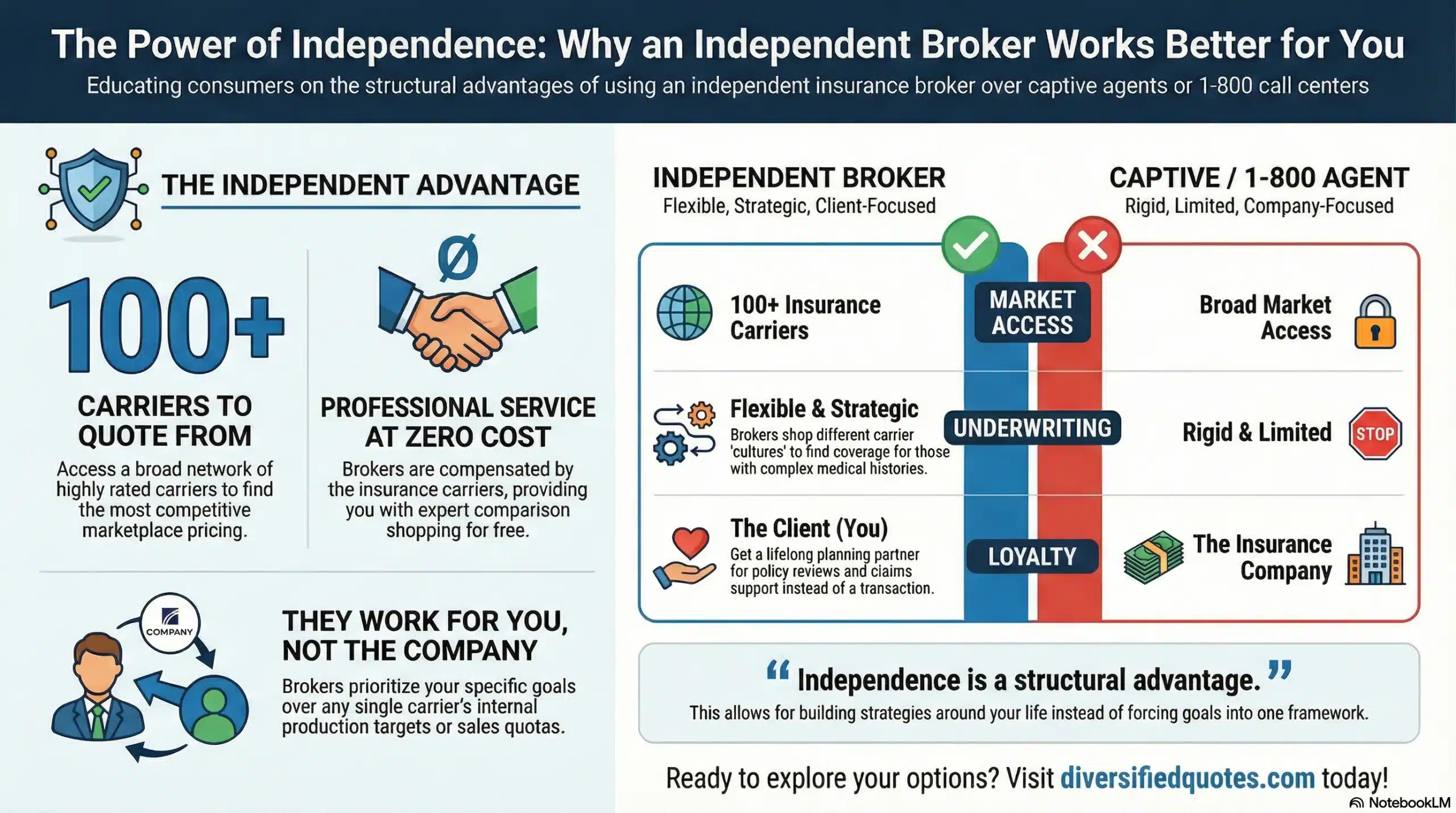
Talk With an Advisor Today
Choose how you’d like to connect—call or message us, then book a time that works for you.
Schedule here:
calendly.com/jason-dibcompanies/diversified-quotes
Licensed in all 50 states • Fiduciary, family-owned since 1980
FAQs: Premium Financing Pros and Cons
What are the main benefits of premium financing life insurance?
The primary benefits of premium financing life insurance are liquidity preservation, leverage-enhanced death benefit access, and estate tax planning efficiency. Liquidity preservation is often the most compelling: instead of directing several hundred thousand dollars or more of annual cash flow toward life insurance premiums, the client retains that capital for continued business operation, investment deployment, or other planning priorities while a third-party lender funds the premiums. This preserved liquidity has both quantifiable value — if invested at returns exceeding the financing cost — and option value, since capital that remains available can address opportunities and needs that premium-paid capital cannot. Leverage-enhanced death benefit access allows clients to secure larger death benefit amounts than might be comfortable purely from a cash flow standpoint, which matters when taxable estates require substantial liquidity for estate taxes without forcing the sale of family businesses or real estate. Estate tax planning efficiency is achieved by reducing the annual gift to the ILIT to interest servicing costs rather than full premiums — potentially allowing the strategy to be implemented with less gift tax exposure than traditional ILIT premium gifting would require. Our resource on how premium financing works for estate planning covers the estate tax mechanics in detail.
What are the primary risks of premium financing?
Premium financing introduces three primary risk categories that do not exist in traditional out-of-pocket premium payment. Interest rate exposure is the most significant: most financing arrangements use floating rates tied to benchmark lending rates, which means rising rate environments increase annual servicing costs and can compress or eliminate the assumed arbitrage that makes the strategy economically attractive. Collateral requirements represent a second category: lenders require the policy’s cash value as primary collateral and may require additional outside liquid assets as supplemental security, particularly in early policy years; if policy performance underperforms projections, the collateral coverage ratio can decline and trigger requests for additional contributions or a modified loan structure. Policy performance risk is the third: leverage magnifies the impact of non-guaranteed element underperformance — if credited rates, dividends, or indexed returns are lower than projected, the positive spread that justifies the strategy may narrow or reverse, extending the exit timeline and increasing the complexity of managing the arrangement. Our resource on is premium financing life insurance safe covers how conservative modeling and stress-testing reduce (but cannot eliminate) these risks.
Who is a good candidate for premium financing?
Premium financing is appropriate for a specific and relatively narrow client profile: ultra-high-net-worth individuals and families with net worth significantly exceeding projected estate tax exposure, strong and reliable liquidity from business cash flow or investment income that can service loan interest without financial strain, a long time horizon of fifteen or more years, and genuine comfort with leverage and the ongoing monitoring obligations it requires. Business owners with anticipated liquidity events — a business sale, private equity recapitalization, or partnership buyout — on a reasonable timeline are among the strongest candidates, because the anticipated exit provides a natural repayment mechanism that reduces the open-ended nature of the leverage risk. Clients who have exhausted simpler estate planning mechanisms, who need death benefit amounts that would require extremely large annual premiums to fund without financing, and who work with sophisticated tax and legal counsel capable of managing the structural complexity are the appropriate audience. For clients who fall below this profile, traditional permanent coverage funded out of pocket almost always produces a better risk-adjusted outcome with dramatically less complexity. Our resource on what is an accredited investor covers the financial sophistication designation that generally characterizes premium financing candidates.
How does premium financing compare to paying premiums out of pocket?
The comparison between premium financing and out-of-pocket premium payment is the most important evaluation in any premium financing decision — and it is more often resolved in favor of out-of-pocket funding than financing advocates typically acknowledge. Out-of-pocket funding eliminates all interest rate exposure, requires no collateral pledging, introduces no third-party lender relationship to manage, and produces a simpler structure that is easier to monitor and adjust over time. Its disadvantage is that it requires significant annual cash flow and produces an opportunity cost if that capital would generate superior returns when deployed elsewhere. Financing eliminates the opportunity cost and cash flow pressure while introducing interest rate sensitivity, collateral requirements, and structural complexity that create ongoing management obligations. The right choice depends on the specific client’s alternative return on preserved capital, liquidity profile, comfort with complexity, and time horizon. When the comparison is modeled conservatively — with realistic alternative investment return assumptions and stress-tested interest rate scenarios — out-of-pocket funding frequently produces competitive or superior risk-adjusted outcomes for clients whose income can accommodate premium payments without material strain. Our resource on is life insurance a good investment covers the value framework for evaluating permanent life insurance independently of the financing question.
Can I exit a premium financing arrangement early?
Yes — and a well-designed premium financing arrangement must define multiple viable exit paths from inception rather than treating exit as a future problem to be solved. The most common exit mechanisms are: using accumulated policy cash value to repay the outstanding loan balance when the cash value reaches a sufficient level, using proceeds from an anticipated outside liquidity event (business sale, asset realization, inheritance) to retire the debt, refinancing the outstanding loan balance with a new lender at maturity if the original loan term expires before the preferred exit is available, and relying on the income-tax-free death benefit at the insured’s death to extinguish the loan and deliver the remaining benefit to the trust. Each of these paths should be stress-tested under adverse assumptions before the structure is implemented — not because adverse outcomes are expected, but because exit feasibility under stress scenarios determines whether the arrangement can be managed safely through the full holding period. Premature exit — surrendering the policy, paying off the loan with unplanned asset liquidation, or walking away from the structure — can result in surrender charges, policy gains that create taxable events, or the loss of coverage that the estate plan was relying on. A clearly defined exit strategy is not optional — it is a prerequisite for implementing any premium financing arrangement responsibly.
Is premium financing right for most high-net-worth families?
No — premium financing is appropriate for a relatively narrow subset of high-net-worth families and is specifically inappropriate for most. For the majority of high-net-worth estate planning clients, traditional permanently funded life insurance owned in an irrevocable trust accomplishes the same estate tax liquidity objective with dramatically less complexity, no interest rate exposure, no collateral requirements, and no ongoing lender relationship to manage. The cases where premium financing genuinely adds value — where the preserved liquidity produces returns that materially exceed financing costs, where the death benefit need is very large, and where the client’s financial profile makes the leverage manageable — are real but represent a minority of high-net-worth estate planning situations. Most families with estate planning needs are best served by clearly structured traditional funding, potentially supplemented with strategies like split dollar arrangements or grantor trust techniques that accomplish similar goals without the leverage and complexity that premium financing introduces. The fundamental question — does financing genuinely improve the client’s net long-term outcome after full accounting for all costs and risks — requires an honest, conservative analysis rather than an assumption-driven illustration to answer correctly.
What role does the trust structure play in premium financing?
The Irrevocable Life Insurance Trust (ILIT) is typically the core legal entity in a premium financing arrangement because estate tax planning requires the life insurance to be owned outside the taxable estate. If the insured owns the policy directly or retains any incidents of ownership, the death benefit is included in the taxable estate and fails to accomplish the estate tax liquidity objective. The ILIT owns the policy, is the named beneficiary, and receives the income-tax-free death benefit outside the taxable estate. In a premium financing structure, the ILIT is also the borrower — it enters into the loan agreement with the lender, pledges the policy as collateral, and receives the loan proceeds to pay the premiums to the insurance company. The trust requires careful design to ensure compliance with estate tax rules, gift tax reporting on any grantor contributions to fund interest, and coordination with the insured’s overall estate plan. The lender relationship, collateral assignment, and gift tax strategy for funding annual interest must all be coordinated through the trust’s administration. This legal and administrative complexity is one of the primary reasons premium financing requires a team of coordinated professionals — insurance advisor, estate planning attorney, and CPA — rather than being implementable by any single advisor working alone. Our resource on life insurance for business owners covers the business ownership and trust structure considerations that frequently accompany premium financing for business-owning clients.
About the Author:
Jason Stolz, CLTC, CRPC, DIA, CAA and Chief Underwriter at Diversified Insurance Brokers (NPN 20471358), is a senior insurance and retirement professional with more than 25 years of real-world experience helping individuals, families, and business owners protect their income, assets, and long-term financial stability. As a long-time partner of the nationally licensed independent agency Diversified Insurance Brokers, Jason provides trusted guidance across multiple specialties—including fixed and indexed annuities, long-term care planning, personal and business disability insurance, life insurance solutions, Group Health, Travel Medical and Evacuation Insurance, and short-term health coverage. Diversified Insurance Brokers maintains active contracts with over 100 highly rated insurance carriers, ensuring clients have access to a broad and competitive marketplace.
His practical, education-first approach has earned recognition in publications such as VoyageATL, and contributions from his agency featured in Kiplinger and GoBankingRates— highlighting his commitment to financial clarity and client-focused planning. Drawing on deep product knowledge and years of hands-on field experience, Jason helps clients evaluate carriers, compare strategies, and build retirement and protection plans that are both secure and cost-efficient. Visitors who want to explore current annuity rates and compare options across multiple insurers can also use this annuity quote and comparison tool.
Explore More Life Insurance Options: Browse our complete guide to Business Life Insurance — covering buy-sell agreements, key person, contract indemnity & group life from 100+ carriers.
Last Reviewed: June 17, 2026 |
Reviewed by: Jason Stolz, CLTC, CRPC, DIA, CAA
Chief Underwriter, Diversified Insurance Brokers, Inc. | NPN: 20471358 | Diversified Insurance Brokers, Inc. — Licensed in all 50 states
Fact Checked by: Tonia Pettitt, CMIP©
Medicare Specialist, Diversified Insurance Brokers, Inc. | NPN: 14374308 | Diversified Insurance Brokers, Inc. — Licensed in all 50 states
Did you find this content helpful? Leave us a Google review — it helps others find trustworthy guidance too.
Editorial Standards: Diversified Insurance Brokers maintains rigorous editorial standards to ensure accuracy, clarity, and independence in all content. Learn more about our editorial standards and commitment to transparency.
