
Burial Insurance: Simple, Affordable Protection for Final Expenses
When a loved one passes away, families are forced to navigate grief, logistics, paperwork, and financial decisions all at once. The last thing anyone should have to worry about in that moment is how to pay for a funeral, burial, medical bills, or outstanding personal expenses. That is why burial insurance—often referred to as Final Expense insurance—continues to be one of the most practical and compassionate planning tools available today. Unlike large traditional life insurance policies designed primarily for income replacement, burial insurance focuses specifically on covering end-of-life costs so your family does not have to scramble financially during an already overwhelming time. It is typically structured as a smaller whole life insurance policy, which means coverage lasts your entire lifetime as long as premiums are paid, and the benefit does not expire at a certain age. For many seniors and individuals with health conditions, it offers a realistic, accessible way to leave behind immediate liquidity for final expenses without complicated underwriting or invasive medical exams.

Funeral costs alone can range anywhere from $7,000 to $15,000 or more depending on location, services selected, and cemetery expenses. When you factor in medical bills, credit card balances, small personal loans, or outstanding household costs, that number can rise quickly. Families who are unprepared often rely on savings accounts, retirement funds, or even high-interest credit cards to cover these expenses. Burial insurance changes that dynamic by creating a designated pool of funds specifically for final expenses. Instead of your spouse or children worrying about how to cover your final expenses, they receive a tax-free death benefit they can use immediately. That flexibility is important. The benefit is not restricted to funeral homes; it can be used for burial services, cremation, memorials, transportation, probate fees, or simply to give your family financial breathing room. Because it is permanent whole life coverage, the policy also builds modest cash value over time, adding another layer of stability.
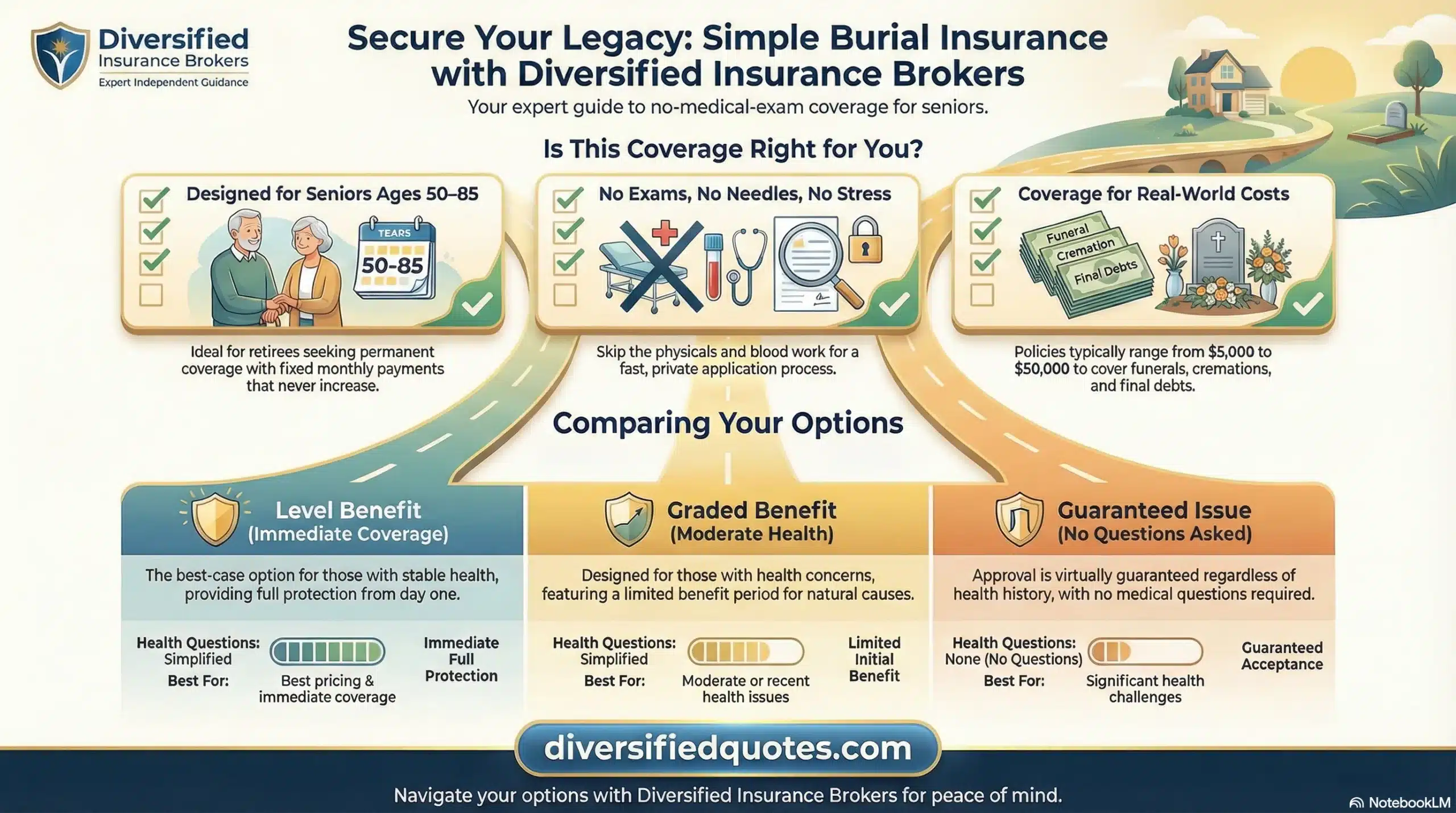
For many individuals, especially those later in life, traditional fully underwritten life insurance may not be realistic. Health conditions such as diabetes, heart disease, past surgeries, or prescription medication histories can make larger policies difficult or expensive to secure. Burial insurance is specifically designed to address that gap. Many policies use simplified underwriting, meaning there is no medical exam—just a brief series of health questions. Some carriers even offer guaranteed issue options for individuals who may not qualify elsewhere. If you have previously been declined for coverage, it does not mean you are out of options. In fact, you may benefit from reviewing what happens if you’re denied life insurance and understanding how specialized carriers approach higher-risk applicants. Our role at Diversified Insurance Brokers is to compare more than 75 top-rated carriers to find the most competitive approval path for your situation.
Another reason burial insurance remains popular is simplicity. Policies are typically issued in face amounts ranging from $5,000 to $50,000, depending on age and health. Premiums are level, meaning they do not increase as you age. The benefit does not decrease. There are no investment components, market risk exposure, or complicated riders required to make the policy effective. For families who want straightforward protection without complexity, burial insurance provides exactly that. And because it is a form of permanent coverage, it complements other planning strategies such as term life, retirement income planning, and even asset protection tools. If you are unsure how different types of coverage compare, it may help to revisit how life insurance works overall so you can see where final expense coverage fits into the broader picture.
At Diversified Insurance Brokers, we view burial insurance not as a standalone product but as part of a comprehensive financial protection strategy. Many families we work with are simultaneously reviewing retirement income options, Social Security timing, Medicare planning, and long-term care considerations. Others are evaluating annuity strategies for guaranteed lifetime income. If you are currently researching income protection or asset stability tools, you may also want to explore what is the safest type of annuity to understand how guaranteed income products differ from life insurance. While annuities focus on income during your lifetime, burial insurance ensures liquidity immediately at death. Together, they create a well-rounded plan.
Use our Burial Insurance Calculator below to see how easy it is to get started.
Planning ahead is not about expecting the worst; it is about protecting the people you love from unnecessary financial strain. Many clients tell us they feel relief simply knowing their family will not have to pass a collection plate, dip into emergency savings, or make rushed financial decisions during an emotional time. That peace of mind is often the most valuable part of burial insurance. And if you are currently balancing other long-term goals—such as supporting children or grandchildren—you can coordinate your planning efforts across multiple areas. For example, families who are actively saving for education costs sometimes explore protection strategies alongside Diversified College Planning to reduce tuition burdens while maintaining financial stability at home. Coordinating these conversations ensures one goal does not unintentionally compromise another.
Burial insurance is also commonly layered with existing coverage. Some individuals maintain a term policy for income replacement but recognize that the term will eventually expire. Others have group life insurance through an employer and are unsure what happens at retirement. If you are comparing employer coverage versus private options, reviewing group vs. individual life insurance can clarify portability concerns. A burial policy can serve as a permanent foundation beneath temporary coverage, ensuring at least a base level of protection is always in place. And if you already own a life insurance policy, we are happy to evaluate whether it still fits your needs through our policy review service. Coverage that made sense 15 years ago may not align with your current stage of life.
One of the most misunderstood aspects of burial insurance is cost. Because face amounts are smaller and underwriting is streamlined, premiums are often more affordable than people expect—especially when compared to the potential financial strain of paying final expenses out of pocket. Age, health, tobacco use, and coverage amount all influence pricing, but the structure remains predictable. Unlike certain policies that fluctuate based on risk classes or table ratings, many burial policies simplify risk categories. If you are curious how health classifications affect traditional policies, you can learn more about life insurance table ratings explained. Burial coverage is often more forgiving.
Another key advantage is speed. Because underwriting is simplified, approvals can often occur quickly. In some cases, coverage is issued within days rather than weeks. That efficiency matters for individuals who have delayed planning or recently experienced health changes. The sooner a policy is active, the sooner your family has guaranteed financial protection in place. And unlike savings accounts that can be depleted by unexpected expenses, a burial insurance policy maintains its death benefit regardless of how markets perform or how other assets fluctuate.
Have questions about eligibility, pricing, or layering coverage with your existing plan?
Our advisors are here to help you compare options and secure protection with confidence.
🔗 Request Personalized Burial Insurance Guidance Here
At Diversified Insurance Brokers, our approach is educational first. We explain how policies work, clarify waiting periods (if applicable), review beneficiary designations, and ensure your coverage aligns with your broader retirement and estate planning goals. We do not believe in one-size-fits-all recommendations. Instead, we analyze your health history, financial objectives, and family dynamics to match you with the most appropriate carrier and structure. Whether you are securing coverage for yourself, helping a parent navigate options, or coordinating planning with a spouse, we simplify the process so you can move forward with clarity.
Ultimately, burial insurance is about dignity, preparation, and responsibility. It ensures that your final wishes can be honored without creating a financial burden for those you leave behind. It protects savings, preserves retirement income strategies, and eliminates uncertainty during a time when clarity matters most. By combining accessible underwriting, permanent coverage, and predictable premiums, it remains one of the most practical financial planning tools available for seniors and individuals with health considerations. If you are ready to take the next step, use the calculator above to explore options, and connect with our team through the link provided. A short conversation today can prevent significant stress for your family tomorrow.
Related Pages
Financial Protection Essentials
Explore life insurance strategies for seniors, global travel medical protection resources, and financial planning tools that help manage risk and long-term coverage needs.
Talk With an Advisor Today
Choose how you’d like to connect—call or message us, then book a time that works for you.
Schedule here:
calendly.com/jason-dibcompanies/diversified-quotes
Licensed in all 50 states • Fiduciary, family-owned since 1980
FAQs: Is Burial Insurance Necessary?
What does burial insurance actually cover?
Burial insurance covers funeral costs, cremation expenses, medical bills, and other end-of-life charges that families often face unexpectedly. The benefit is paid directly to your chosen beneficiary.
Is burial insurance necessary if I already have life insurance?
It depends. Some people keep life insurance for income replacement, debt payoff, or legacy planning and prefer a separate, smaller policy dedicated to final expenses. This avoids draining the main policy’s benefit.
Can I self-fund final expenses instead of buying insurance?
Yes—if you have sufficient savings earmarked for this purpose. Burial insurance is most useful when savings are limited or unpredictable.
Why do some people choose burial insurance even if they can afford their funeral?
Many choose it to guarantee immediate liquidity for their family. Funeral homes require prompt payment, and insurance ensures funds are available instantly without delays or probate.
Is burial insurance necessary for someone with health issues?
It can be very helpful, as burial insurance offers simplified underwriting and guaranteed-issue options for those who may be declined for traditional life insurance.
Is burial insurance worth it for younger or middle-aged adults?
In some cases, yes. Premiums are lower at younger ages, and buying early can protect against future health decline or higher policy costs later in life.
Can burial insurance replace a full life insurance policy?
No. Burial insurance is designed only to cover final expenses. Individuals who need income replacement or broader financial protection will still need traditional life insurance.
What happens if I die shortly after buying a policy?
If you pass from accidental causes, most burial policies pay the full benefit immediately. For natural causes, graded-benefit plans may delay the full payout if death occurs within the first 2–3 years.
Is burial insurance a good option for people without family?
Yes. Individuals with no close relatives often use burial insurance to ensure their affairs and funeral costs are covered without burdening distant relatives or the state.
How do I know whether burial insurance is necessary for me?
Consider your savings, health status, age, family situation, and whether loved ones could comfortably handle funeral costs. Burial insurance provides certainty when these factors are uncertain.
About the Author:
Jason Stolz, CLTC, CRPC and Chief Underwriter at Diversified Insurance Brokers (NPN 20471358), is a senior insurance and retirement professional with more than two decades of real-world experience helping individuals, families, and business owners protect their income, assets, and long-term financial stability. As a long-time partner of the nationally licensed independent agency Diversified Insurance Brokers, Jason provides trusted guidance across multiple specialties—including fixed and indexed annuities, long-term care planning, personal and business disability insurance, life insurance solutions, Group Health, and short-term health coverage. Diversified Insurance Brokers maintains active contracts with over 100 highly rated insurance carriers, ensuring clients have access to a broad and competitive marketplace.
His practical, education-first approach has earned recognition in publications such as VoyageATL, highlighting his commitment to financial clarity and client-focused planning. Drawing on deep product knowledge and years of hands-on field experience, Jason helps clients evaluate carriers, compare strategies, and build retirement and protection plans that are both secure and cost-efficient. Visitors who want to explore current annuity rates and compare options across multiple insurers can also use this annuity quote and comparison tool.
