
Disability Insurance for High Earners and Business Owners

Jason Stolz CLTC, CRPC
Disability insurance for high earners and business owners is fundamentally different from standard income protection. At Diversified Insurance Brokers, we specialize in advanced disability planning for professionals whose income, equity, and long-term financial security depend on their ability to work. When earnings rise into the six- or seven-figure range, the financial consequences of a disability grow exponentially—and most off-the-shelf policies simply are not designed to handle that level of exposure.
Executives, physicians, partners, entrepreneurs, and closely held business owners often discover too late that traditional group disability plans replace only a fraction of their real income. Monthly caps, narrow definitions of disability, and exclusions around bonuses, distributions, or ownership income can leave a dangerous gap between what you earn and what you would actually receive during a claim. Properly structured individual disability insurance is designed to fill that gap and protect not only income, but lifestyle, business continuity, and long-term wealth accumulation.
At Diversified Insurance Brokers, our role is not to sell a policy—it is to design a disability insurance strategy. That strategy accounts for earned income structure, business ownership, tax treatment, retirement planning, and how coverage layers with existing benefits. This level of planning requires carrier access, underwriting expertise, and real-world claims knowledge, which is why high earners consistently seek out independent specialists rather than captive or employer-based solutions.
Request a High-Income Disability Insurance Review
If your income exceeds standard limits—or includes bonuses, distributions, or business ownership—we’ll design a strategy built for how you actually earn.
Independent comparison • Nationwide • No obligation
Why Disability Risk Is Greater for High Earners
High earners face a unique paradox. While income is higher, the margin for error is often smaller. Expenses scale upward alongside earnings—mortgages, education costs, lifestyle commitments, and ongoing business obligations do not pause because of illness or injury. At the same time, income sources are often less predictable, relying on performance bonuses, profit distributions, productivity-based compensation, or revenue tied to billable hours and client demand.
A disabling event does not need to be catastrophic to cause financial disruption. Many claims among high earners are partial disabilities—situations where an individual can still work, but at a reduced capacity that results in a substantial drop in income. For a surgeon, that might mean losing the ability to perform procedures while still seeing some patients. For an executive, it could be an extended cognitive recovery that reduces output and triggers compensation changes. For an entrepreneur, it may mean stepping away from business development, sales, or leadership while fixed obligations continue.
This is where many plans fail. If your policy only pays for total disability, you could face a meaningful income loss while receiving little or no benefit. Properly structured coverage focuses on real-world claim patterns: reduced capacity, reduced income, and a gradual return-to-work period that can last months or longer.
Group disability plans rarely address this reality. They are designed for broad employee populations, not high-income professionals. Individual disability insurance allows benefits to be customized to the way income is actually earned and lost, and it can be written with stronger definitions that protect specialized careers.
The Business Owner Disability Problem
Business owners face layered risk that extends far beyond personal income. When an owner becomes disabled, the business may still require rent, payroll, loan servicing, insurance premiums, equipment leases, vendor payments, and software subscriptions. Even short-term disabilities can threaten cash flow and long-term viability, especially when the owner is also the primary producer or relationship manager.
This is why disability planning for business owners often involves coordinated coverage. Personal disability insurance is designed to replace lost income. Business Overhead Expense (BOE) coverage is designed to reimburse qualifying business expenses during disability so the operation can survive while the owner recovers. In certain cases, key person disability coverage may help address the financial impact of losing a critical rainmaker or executive. And for partners, disability buy-sell planning can create a cleaner ownership transition if a disability becomes permanent.
Diversified Insurance Brokers evaluates the business structure—ownership percentages, compensation methods, cash flow stability, and succession planning—before recommending coverage. The goal is to prevent the most common failure points: forced liquidation, expensive debt, loss of staff, or a rushed sale on unfavorable terms during a vulnerable period.
How Insurers Underwrite High Income
One of the most misunderstood aspects of disability insurance for high earners is how income is defined and documented. Carriers do not insure lifestyle; they insure verifiable earned income. For business owners and executives, that can include salary and W-2 income, and it may include certain K-1 income, partnership income, or net business income depending on the carrier and how the income is sourced and documented.
Bonuses, deferred compensation, and profit distributions are often treated differently than base income. Some carriers average variable compensation over time. Others limit what counts, or require specific documentation to include it. Without proper planning, high earners can end up underinsured because underwriting does not reflect true earning power at the time of application.
That gap is avoidable—but only if the case is structured correctly from the beginning. The carrier you choose matters, the documentation package matters, and the wording around occupation and duties matters. High earners do not have the luxury of “good enough” policy design because the gap between income and standard coverage caps can be enormous.
We work directly with carrier underwriting teams to present income accurately and favorably. That includes strategic documentation, income averaging where appropriate, and carrier selection based on how each company evaluates complex income structures. The right approach can often mean the difference between being modestly covered and meaningfully protected.
Benefit Amounts and High-Limit Coverage
Standard disability insurance policies have monthly benefit limits that may be insufficient for high earners. High-limit disability insurance programs exist specifically to address this issue, allowing significantly larger monthly benefits when income supports it.
In many cases, high-limit planning requires layered coverage—base policies combined with excess or supplemental layers—to reach appropriate replacement levels. This approach can be highly effective, but it must be designed carefully. Coordination across layers matters because you want benefits that integrate cleanly, definitions that align, and a claim process that works the way you expect.
For example, if one layer has a strong own-occupation definition but another layer is more restrictive, the overall strategy can break down in a real claim. Likewise, if residual benefits differ across layers, you may experience mismatched payouts during partial disability scenarios. High earners do not benefit from patchwork coverage; they benefit from coordinated coverage that behaves like one integrated plan.
That is why carrier selection and policy architecture are not a “shop for the lowest quote” exercise at the high-income level. The policy has to perform—not just illustrate well. Claim behavior follows contract language, and contract language is where sophisticated planning wins or loses.
Policy Features That Matter Most for High Earners
For high-income professionals, contract language matters more than price. Certain policy features dramatically affect how benefits are paid during real-world claims, especially in scenarios where income declines before work stops completely.
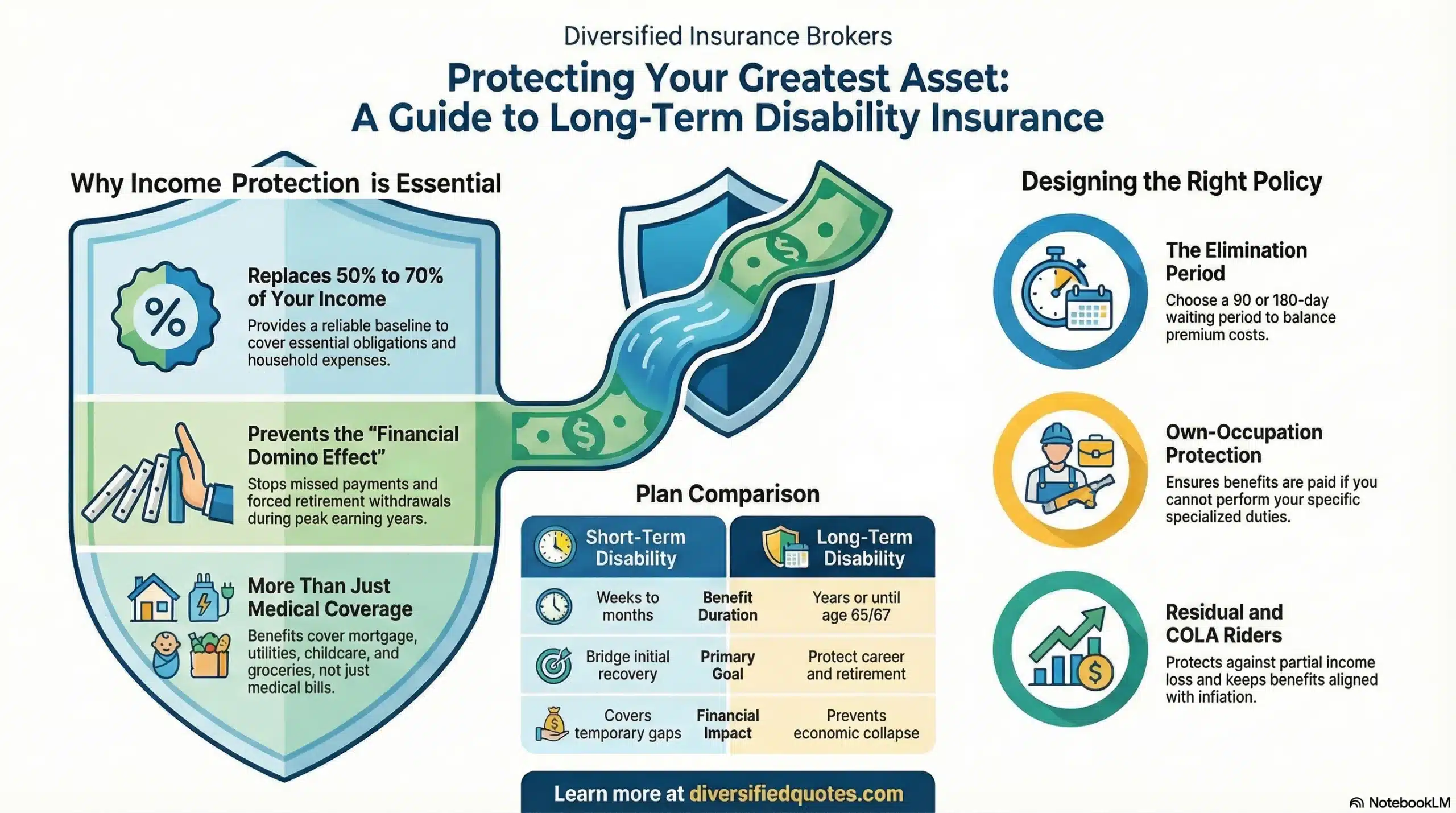
True own-occupation coverage is designed to ensure benefits are payable if you cannot perform the material and substantial duties of your specific occupation, even if you are capable of working in another role. This matters most for specialized professionals—physicians, dentists, attorneys, executives, and business owners whose income is tied to specific skill sets and responsibilities.
Residual and partial disability benefits protect against income loss when you are not totally disabled but experience a measurable reduction in earnings. For many high earners, this is the core risk. The most damaging financial events are often not “cannot work at all” situations—they are “cannot work at full capacity” situations that persist for months or longer.
Benefit duration should align with long-term financial goals. Many high earners choose benefits payable to age 65 or 67. Others align benefit length with business transition timelines, early retirement plans, or the age at which they expect investments and guaranteed income strategies to cover living expenses without employment income.
Future increase riders allow benefits to grow as income increases, often without additional medical underwriting. This can be critical for younger professionals and business owners in growth phases. A strong plan anticipates income growth because the cost of being underinsured grows with success.
Cost-of-living adjustment (COLA) riders can help protect purchasing power during long-term claims, particularly for those with decades of potential benefit exposure. Inflation erodes fixed benefits over time, and high earners often have long-term obligations that do not decline during disability.
The practical approach is to choose features that address real-world risks: specialized duties, partial income loss, long working horizons, and income growth. That is why “feature selection” should be part of a broader plan rather than a checklist.
Not Sure Your Current Coverage Matches Your Real Income?
We’ll review benefit caps, definitions, and how bonuses or ownership income are treated—so you can see the real gap before a claim happens.
Tax Planning Considerations
How disability insurance premiums are paid influences how benefits are taxed. Many high earners prefer to pay premiums personally with after-tax dollars so that benefits are received tax-free. This approach often creates the cleanest outcome: a predictable benefit that can replace spending power without additional tax friction.
Business-paid premiums may sometimes be deductible, but taxable benefits can reduce net income during a claim—especially if you are receiving a large monthly benefit and remain in a relatively high tax bracket. For high earners, the difference between tax-free and taxable benefits can be substantial, which is why the premium-pay structure should be intentional rather than accidental.
For business owners, the decision also intersects with entity structure and compensation methods. The “best” choice depends on how income is earned, how benefits would be used during disability, and what financial outcome you are trying to preserve. The point is not to chase deductions; it is to preserve reliable, spendable income during a claim.
Disability Insurance as Asset Protection
For high earners, disability insurance is not just income replacement—it is asset protection. Without income, retirement contributions stop, investment strategies unravel, and long-term plans can be permanently altered. A prolonged disability can force withdrawals from retirement accounts, taxable investment sales, or business asset liquidation at the worst possible time.
Well-designed disability coverage protects capital by creating a financial bridge: it provides cash flow so you can keep long-term assets intact while you recover or while you adapt to a new capacity. For a business owner, this may also mean preserving the value of the business rather than draining working capital or losing staff during a recovery period.
This is why disability insurance is often described as the foundation of a high-income financial plan. Without it, even strong portfolios can be vulnerable because the portfolio may be forced to support day-to-day life long before it was meant to. Disability shifts the timeline of financial independence, and good coverage helps prevent that shift.
How Disability Coverage Layers with Business Continuity Planning
High earners and business owners often benefit from thinking in layers. One layer protects personal income. Another layer protects business operations. Another layer may address key person exposure or partner transitions. The right design depends on your actual risk points.
For example, if you are a practice owner whose revenue is tied to personal production, personal disability insurance is essential, but BOE coverage can be what prevents the practice from collapsing during recovery. If you are a founder with an operations team, personal income protection may be the priority, while key person coverage may be more relevant for a revenue-driving executive or partner. If you have partners, disability buy-sell planning can reduce the risk of conflict, stalled decision-making, or a messy ownership outcome if one partner becomes permanently disabled.
The reason specialists exist in this space is simple: the right solution is rarely one policy. It is usually a coordinated plan that matches how money is earned, how the business functions, and what happens when the primary producer cannot perform.
Why High Earners Work With Diversified Insurance Brokers
Diversified Insurance Brokers is a family-owned, fiduciary-minded insurance agency licensed nationwide. We specialize in advanced disability insurance planning for high-income professionals and business owners who cannot afford “generic” coverage. When income is complex and the stakes are high, experience matters.
With access to over 75 top-rated carriers, we design coverage strategies that go beyond basic policies. Our advisors understand underwriting nuance, contract language, and how benefits behave in real claim scenarios. We focus on preventing surprises—because the worst time to discover your plan’s limitations is after your income has already stopped.
Clients rely on us not because we sell policies, but because we solve problems before they happen. If your goal is to protect income, preserve business value, and keep your long-term financial plan intact through unexpected health events, disability insurance should be structured intentionally—and that is exactly what we do.
Related Disability Pages
Continue exploring high-limit planning, underwriting pathways, and how coverage designs fit different situations.
Related Business Owner Pages
For owners and partners, these pages cover continuity planning concepts that frequently pair with personal DI.
Financial Protection Essentials
Burial insurance comparisons, travel protection planning, carrier reviews, and post-heart attack life insurance guidance.
Talk With an Advisor Today
Choose how you’d like to connect—call or message us, then book a time that works for you.
Schedule here:
calendly.com/jason-dibcompanies/diversified-quotes
Licensed in all 50 states • Fiduciary, family-owned since 1980
Frequently Asked Questions – Disability Insurance for High Earners
How much disability insurance can a high earner qualify for?
Benefit limits depend on income, occupation, and existing coverage. High earners often combine base policies with supplemental coverage to close income gaps.
Is group disability insurance enough for business owners?
In most cases, no. Group plans often have low caps and limited definitions. Individual coverage provides higher limits and better contract terms.
Can disability insurance cover bonuses or distributions?
Sometimes. Carriers evaluate how income is reported. Proper structuring and documentation are critical.
What happens if my income increases after I buy a policy?
Policies with future increase options allow you to raise benefits without new medical underwriting.
About the Author:
Jason Stolz, CLTC, CRPC and Chief Underwriter at Diversified Insurance Brokers (NPN 20471358), is a senior insurance and retirement professional with more than two decades of real-world experience helping individuals, families, and business owners protect their income, assets, and long-term financial stability. As a long-time partner of the nationally licensed independent agency Diversified Insurance Brokers, Jason provides trusted guidance across multiple specialties—including fixed and indexed annuities, long-term care planning, personal and business disability insurance, life insurance solutions, Group Health, and short-term health coverage. Diversified Insurance Brokers maintains active contracts with over 100 highly rated insurance carriers, ensuring clients have access to a broad and competitive marketplace.
His practical, education-first approach has earned recognition in publications such as VoyageATL, highlighting his commitment to financial clarity and client-focused planning. Drawing on deep product knowledge and years of hands-on field experience, Jason helps clients evaluate carriers, compare strategies, and build retirement and protection plans that are both secure and cost-efficient. Visitors who want to explore current annuity rates and compare options across multiple insurers can also use this annuity quote and comparison tool.
