
Disability Insurance for Pilots

Jason Stolz CLTC, CRPC
Pilots face a unique income risk that most professionals never encounter. Your ability to earn a living is not just tied to your skills or experience—it is directly dependent on maintaining strict medical certification standards. A single medical event, injury, or diagnosis can ground a pilot permanently, even if that same condition would allow someone in another profession to continue working. That is why disability insurance for pilots is not optional planning—it is essential income protection.
At Diversified Insurance Brokers, we specialize in disability insurance strategies for high-risk and specialized professions, including airline pilots, corporate pilots, charter pilots, military pilots, flight instructors, and commercial aviation professionals. With access to top-rated carriers and deep experience in aviation-aware underwriting, we help pilots secure coverage that aligns with FAA medical realities—not generic assumptions.
Pilots often assume they are “covered” through employer or union plans, but many discover too late that those policies fall short when it matters most. Individual disability insurance is the foundation of protecting a pilot’s career, lifestyle, and long-term financial security—because it stays with you when airlines, schedules, and roles change.
Request a Pilot Disability Insurance Quote
Compare coverage designed for FAA medical risk, specialty occupations, and variable schedules—built for how pilots actually earn income.
Independent comparison • Pilot-focused underwriting • No obligation
Why Disability Insurance Is Different for Pilots
For most professionals, disability is defined by whether they can work in any reasonable occupation. For pilots, the definition is far more rigid. FAA medical certification governs whether you can fly, and losing that certification—temporarily or permanently—often means losing your income overnight.
Conditions such as vision changes, cardiovascular events, neurological symptoms, sleep disorders, orthopedic injuries, or even certain medications can disqualify a pilot from flying. In many cases, you may still be physically capable of working in another field, but that does not replace the income of a professional aviation career.
This is why pilots must focus on occupation-specific disability coverage. A policy must be structured to pay benefits when you can no longer perform the duties of a pilot—even if you are capable of working elsewhere.
Airline Pilots vs. Other Aviation Professionals
Not all pilots are underwritten the same way. Disability insurance carriers differentiate between aviation roles based on income stability, duty structure, flight hours, and risk exposure. The goal is not to label one pilot “better” than another—it’s to make sure your policy is priced and structured to match your real-world risk.
Airline pilots often benefit from more favorable underwriting due to structured schedules and documented income. However, strict FAA medical standards can make occupation definition and benefit design especially important.
Corporate and charter pilots can face more underwriting variability due to irregular schedules, diverse aircraft types, and variable compensation. These cases often require careful income documentation and a benefit structure that reflects how earnings fluctuate.
Military pilots transitioning to civilian roles frequently need individual coverage to supplement or replace disability programs that may not align with future civilian income levels, and may not protect a specialized aviation career path.
Flight instructors and contract pilots who earn income through instruction, contract flying, or aviation-related businesses may need underwriting that recognizes multiple income streams and how loss of flying privileges impacts total earnings.
The Importance of Own-Occupation Coverage for Pilots
One of the most critical features of disability insurance for pilots is the policy’s definition of disability. A true or properly structured own-occupation definition helps ensure benefits are payable if you cannot perform the duties of a pilot—even if you are capable of working in another capacity.
Without strong occupation language, a policy could deny benefits if you are medically disqualified from flying but still able to teach, consult, or work in a non-aviation role. That scenario creates a massive income gap because the alternative work may pay a fraction of pilot compensation.
If you want to zoom out and see the broader category first, our Disability Insurance Overview page explains how individual DI works, then you can use this pilot page to apply those concepts to FAA-specific risk.
How Much Disability Insurance Do Pilots Need?
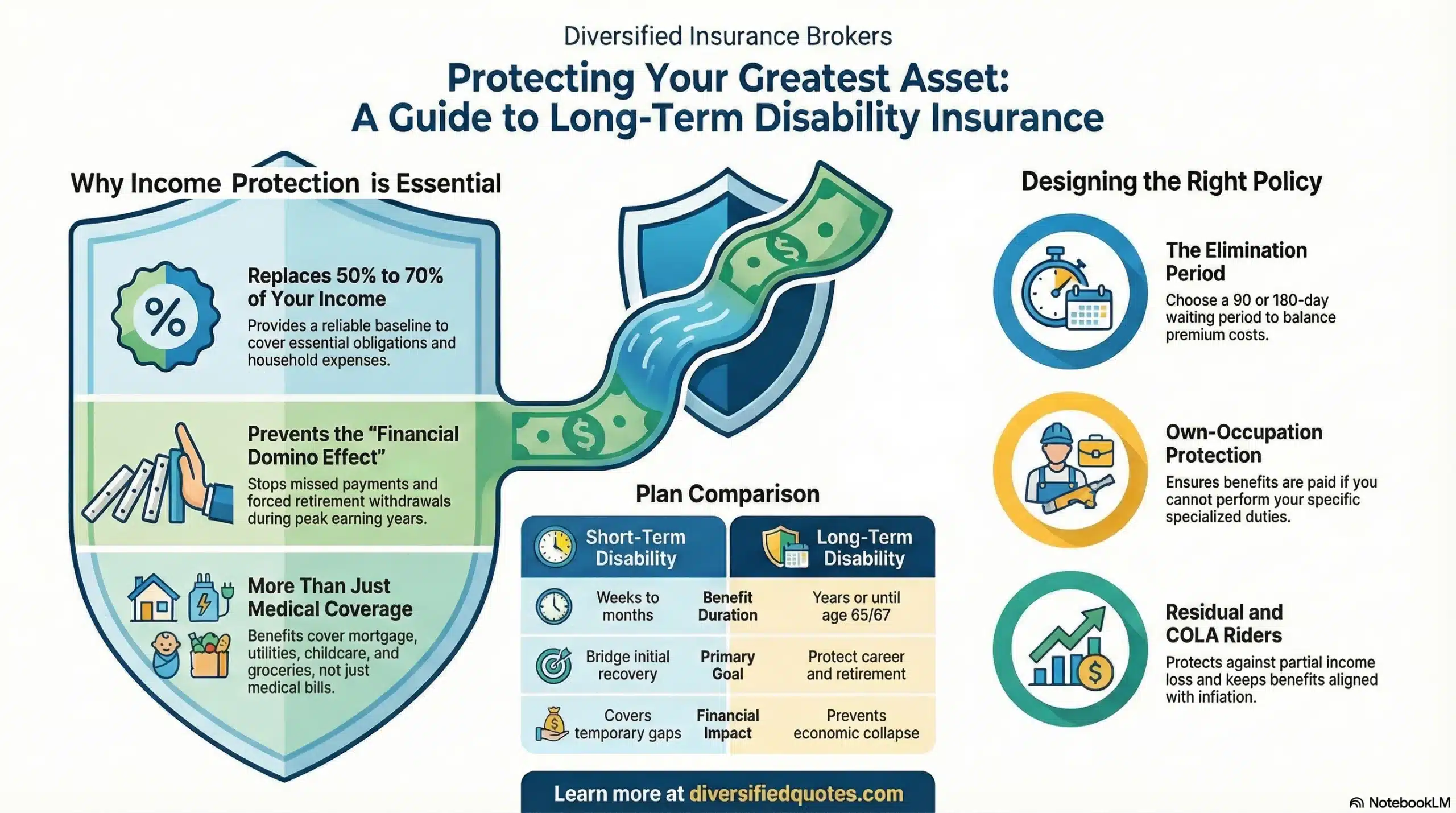
Most individual disability insurance policies are designed to replace approximately 50% to 70% of earned income. For pilots, determining the right benefit amount requires more detail than a simple salary number. Base pay, flight hours, bonuses, per diem treatment, and long-term earning trajectory all matter because they shape your real household cash flow.
Many pilots also underestimate how much income they truly need protected once fixed obligations are considered—mortgage, insurance premiums, family expenses, and the need to keep retirement savings on track. The right strategy is not “max benefit at any cost.” It’s a benefit level that realistically stabilizes your household and prevents forced withdrawals from savings or retirement assets.
If you want a structured way to think about benefit targets and gaps, our guide on How Much Disability Insurance Do I Need? can help frame the decision.
FAA Medical Risk and Disability Underwriting
Disability insurance is medically underwritten, and pilot applicants are often evaluated with extra attention because FAA certification is sensitive to medical history and medication use. Even conditions that seem minor can create follow-up questions if they could threaten medical clearance.
Common underwriting focus areas include cardiovascular history, vision and hearing stability, sleep apnea screening or treatment, orthopedic injuries, neurological symptoms, mental health treatment, and prescription history. The key is not “having no history.” The key is stable documentation and clarity. A clean, consistent medical narrative often underwrites far better than gaps, vague records, or unresolved evaluations.
Group Disability Coverage vs. Individual Policies
Many pilots have access to employer-sponsored or union disability plans. Those plans can be helpful as a base layer, but they often include limitations that reduce real-world protection—benefit caps, taxable payouts, offsets, weaker definitions, and lack of portability. They may also replace only base salary while excluding meaningful income components.
An individually owned disability policy is designed to supplement group coverage and remain in force regardless of employer, airline, or union changes. It also allows you to lock in underwriting based on your current health, which can be invaluable if medical conditions arise later.
Residual and Partial Disability for Pilots
Not all disabilities are total. Many pilots experience partial loss of capacity that reduces flight hours, restricts aircraft type, limits duties, or forces a shift into lower-compensation roles. A residual or partial disability rider is designed for that reality. It can pay benefits when income drops due to medical limitations—even if you are still working in some capacity.
For pilots whose pay is tied to schedules, hours, or duty assignments, partial disability protection can be one of the most important pieces of the plan—because the financial pain often starts before flying stops completely.
Get a Policy Built Around FAA Reality
We’ll help you compare occupation wording, residual protection, and benefit design so your coverage responds the way pilots actually need it to.
Elimination Periods and Benefit Durations
Choosing the right elimination period is a balance between premium cost and financial readiness. Common elimination periods for pilots range from 90 to 180 days, depending on emergency savings, sick time, and any employer benefits available during a short-term medical interruption.
Benefit durations often extend to age 65 or 67, aligning with retirement timelines. Some pilots choose shorter benefit periods to manage cost and then coordinate that decision with other long-term income resources. The key is making sure the benefit period matches the “how long could this impact my ability to earn” risk—not just the cheapest quote.
Tax Treatment of Disability Benefits
When premiums are paid personally with after-tax dollars, disability benefits are generally received tax-free. This is one reason individual disability insurance can be an extremely efficient income replacement tool. If a plan is employer-paid or funded pre-tax, benefits may be taxable, reducing net replacement income during a claim.
Because pilots often have multiple layers (employer plans, union plans, and individual coverage), understanding how each layer is funded is critical so you’re not surprised at claim time.
Why Pilots Work With Diversified Insurance Brokers
Disability insurance for pilots is not a standard transaction. It requires specialized carrier access, aviation-aware underwriting experience, and benefit design that reflects FAA medical risk and the way pilot income is actually earned and lost.
At Diversified Insurance Brokers, we help pilots compare pilot-friendly carriers, structure occupation definitions correctly, coordinate individual coverage with group or union plans, and avoid common underwriting pitfalls that can delay approval or weaken benefits.
Our goal is simple: protect your aviation income if your medical certificate—or career—changes unexpectedly.
Related Pages
More disability pages that help you compare definitions, rider choices, and coverage structure.
Financial Protection Essentials
Burial insurance comparisons, travel protection planning, carrier reviews, and post-heart attack life insurance guidance.
Talk With an Advisor Today
Choose how you’d like to connect—call or message us, then book a time that works for you.
Schedule here:
calendly.com/jason-dibcompanies/diversified-quotes
Licensed in all 50 states • Fiduciary, family-owned since 1980
FAQs: Disability Insurance for Pilots
Can pilots qualify for individual disability insurance?
Yes. Many pilots can qualify for individual disability income coverage, but underwriting often depends on license type, flight duties, hours, aircraft type, medical certification history, and whether you fly commercially, privately, or as a CFI. The key is placing the application with carriers that understand aviation risk and structuring the policy correctly.
What does “own-occupation” mean for a pilot?
Own-occupation disability insurance is designed to pay benefits if you can’t perform the material and substantial duties of your occupation. For pilots, the definition matters because loss of medical certification or inability to fly can impact your income even if you could work in a different role (training, dispatch, admin, etc.). The policy language determines how strongly your benefits are protected if you pivot to other work.
Does disability insurance cover loss of medical certification?
Sometimes—but it depends on the carrier and the exact policy language. Some policies may treat loss of medical as evidence of disability if it’s tied to a sickness or injury that prevents you from safely performing duties, while others may be more restrictive. This is one of the most important items to clarify before applying.
Are aviation activities excluded on disability policies?
They can be. Some carriers may add aviation exclusions (for example, excluding claims arising from flying activities) depending on your duties and risk profile. In other cases, pilots can obtain coverage with no aviation exclusion, especially when the application is positioned properly and the risk class fits underwriting guidelines.
How much monthly benefit can a pilot typically qualify for?
Benefit amounts are based on earned income and financial underwriting. Many policies are designed to replace a portion of income (often targeting a majority of base pay), but limits vary by carrier and occupation class. Additional riders or supplemental coverage may be considered depending on compensation structure and existing group benefits.
What riders matter most for pilots?
Commonly valuable options include a residual/partial disability rider (to protect income if you can work but earn less), a future increase option (to grow benefits as pay increases), and a cost-of-living adjustment rider (to help benefits keep pace with inflation while on claim). The best set of riders depends on how your income is structured and how stable your career path is.
How does group (employer) LTD compare to an individual policy?
Group LTD can be helpful but may have caps, offsets, taxable benefit issues (depending on how premiums are paid), and less favorable disability definitions. An individual policy can add portability, stronger contract language, and more control over riders—especially important for specialized occupations like pilots.
What health and history items do insurers focus on for pilots?
Underwriting often focuses on your medical history, medications, any prior restrictions or concerns tied to medical certification, and conditions that can affect cognitive or physical performance. They may also review lifestyle and avocations, driving history, and other risk indicators depending on the carrier.
How long does underwriting usually take?
Timelines vary based on benefit amount, medical history, and whether medical records or an exam are required. Cleaner cases can move faster; more complex histories can take longer due to attending physician statements and additional documentation.
What can improve approval odds or reduce exclusions?
Clear and consistent documentation, stable medical history, accurate details about flight duties, and selecting carriers that are more receptive to aviation occupations can materially improve outcomes. Structuring the benefit amount and riders appropriately can also help underwriting go smoother.
About the Author:
Jason Stolz, CLTC, CRPC and Chief Underwriter at Diversified Insurance Brokers (NPN 20471358), is a senior insurance and retirement professional with more than two decades of real-world experience helping individuals, families, and business owners protect their income, assets, and long-term financial stability. As a long-time partner of the nationally licensed independent agency Diversified Insurance Brokers, Jason provides trusted guidance across multiple specialties—including fixed and indexed annuities, long-term care planning, personal and business disability insurance, life insurance solutions, Group Health, and short-term health coverage. Diversified Insurance Brokers maintains active contracts with over 100 highly rated insurance carriers, ensuring clients have access to a broad and competitive marketplace.
His practical, education-first approach has earned recognition in publications such as VoyageATL, highlighting his commitment to financial clarity and client-focused planning. Drawing on deep product knowledge and years of hands-on field experience, Jason helps clients evaluate carriers, compare strategies, and build retirement and protection plans that are both secure and cost-efficient. Visitors who want to explore current annuity rates and compare options across multiple insurers can also use this annuity quote and comparison tool.
