
Hospital Indemnity for Medicare Advantage Members

Jason Stolz CLTC, CRPC
Get Hospital Indemnity Quotes
Pair your Medicare Advantage plan with cash benefits that can help offset inpatient copays, observation stays, ER visits, ambulance rides, and more.
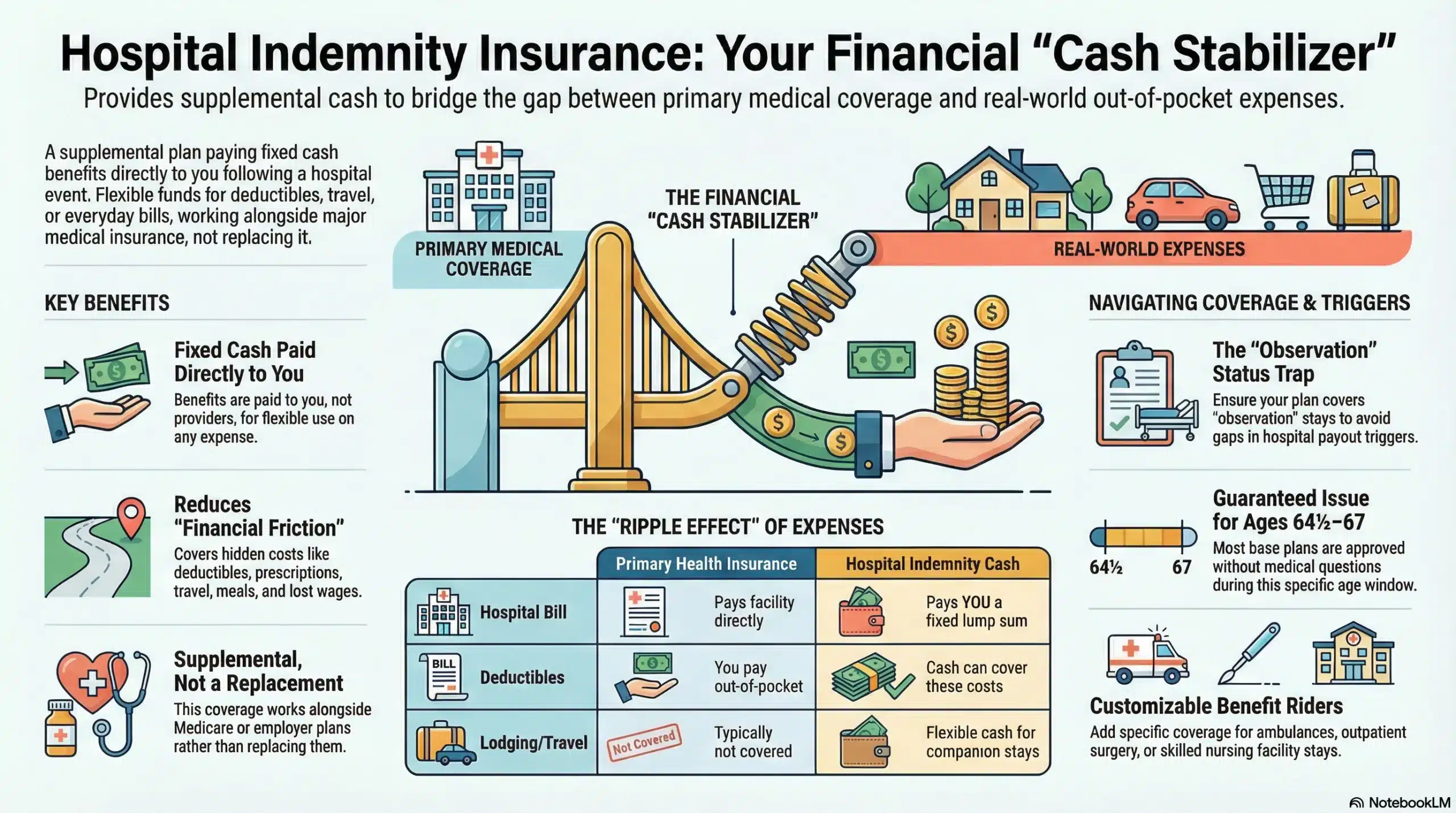
Hospital indemnity insurance for Medicare Advantage members is a supplemental policy that pays you cash during covered hospital-related events. It is not a replacement for Medicare Advantage and it does not work like traditional medical insurance that pays providers directly. Instead, it is designed to send a fixed cash benefit to your household when a hospital episode creates copays, coinsurance, and disruption—so you have flexible money to apply wherever the pressure shows up.
This coverage is especially useful for Medicare Advantage (MA) members because many MA plans rely on cost-sharing rules that can look predictable on paper but become expensive in real life. A few inpatient days, an ER visit that turns into monitoring, an ambulance ride, or a string of outpatient services can create a chain of copays that adds up quickly. A well-designed hospital indemnity insurance for Medicare Advantage members strategy helps “bring cash to the problem,” so you can protect your savings and keep your household budget steadier when care happens.
At Diversified Insurance Brokers, we design hospital indemnity the same way we design any supplemental coverage: we start with the cost-sharing you actually face inside your MA plan, then we match fixed benefits and riders to the scenarios that are most likely to occur. The goal is simple—when the hospital label, length of stay, or care setting changes, your coverage should still feel useful rather than leaving you surprised by definitions you did not know to ask about.
Why Medicare Advantage Members Add Hospital Indemnity
Medicare Advantage can be a strong value because it often bundles coverage and may include additional benefits beyond Original Medicare. The tradeoff is that your out-of-pocket spending is frequently structured through copays that apply by setting and by service. Inpatient stays can have a daily copay for a set number of days. Emergency room care may have its own copay. Ambulance transport can be a separate charge. Observation stays and outpatient hospital services can come with their own cost-sharing rules. Even when each number seems manageable, the combined total can become meaningful when care happens in clusters.
Hospital indemnity insurance for Medicare Advantage members helps because it pays cash benefits directly to you when a covered event happens. Many people use that cash to offset MA copays, but the cash is not limited to medical bills. You can apply it to travel for follow-up appointments, meals for a caregiver, lodging for a spouse, home help, or everyday bills while you recover. That flexibility is a major reason Medicare Advantage members choose to add hospital indemnity as a “budget stabilizer” during hospital events.
It also supports better decision-making when health events occur. During a hospital episode, people should be focused on recovery—not on whether the next bill will force a withdrawal from retirement accounts or a credit card balance. A properly designed plan does not eliminate all costs, but it can reduce the financial friction that makes medical events harder on the household.
How Hospital Indemnity Pays (Daily vs. Lump Sum)
Most hospital indemnity policies pay benefits in one or both of these ways: a daily confinement benefit and a lump-sum admission benefit. Some designs use just one structure, while others combine both to cover a wider range of real-world scenarios. The “best” structure depends on how your Medicare Advantage plan charges you during a hospital episode and what you want the cash to accomplish.
A daily benefit is designed for multi-day stays because it pays a set amount per covered day, often up to a selected number of days per confinement. This structure can be a strong fit for Medicare Advantage members whose plans charge a per-day inpatient copay for the first several days of a stay. A lump-sum benefit is designed to deliver cash quickly when a hospital episode begins, which can help with early expenses like copays, prescriptions, transportation, meals, lodging for a spouse, or arranging temporary help at home.
Depending on your state and the plan design, you may also be able to add benefits for ambulance transportation, ER-to-admission scenarios, outpatient surgery, skilled nursing facility stays, and limited rehab or therapy services. The key is to avoid picking benefits that sound impressive but do not match your MA plan’s cost-sharing triggers. We focus on coverage that aligns to the events that actually create out-of-pocket exposure for Medicare Advantage members.
Match Benefits to Your MA Copays
We’ll compare daily vs. lump-sum designs and show the rider combinations that make the most sense for Medicare Advantage cost-sharing.
Observation vs. Inpatient: Why the Label Matters
One of the biggest sources of confusion for Medicare beneficiaries is the difference between observation and inpatient admission. You can spend the night in a hospital, receive tests and monitoring, and still be classified as observation. That label can affect your Medicare Advantage cost-sharing, and it can also influence how a supplemental policy counts a stay for benefit purposes. From a patient perspective, the experience can feel like “being admitted.” From a billing and benefit-trigger perspective, the label can change how benefits are calculated.
Because this distinction matters, hospital indemnity insurance for Medicare Advantage members should be designed with observation in mind. Some policies pay a partial benefit for shorter observation stays and a full benefit for longer inpatient stays. Other designs define observation separately, with distinct thresholds and documentation requirements. The goal is not to memorize every rule. The goal is to select a design that recognizes the most common short-stay patterns so your coverage still pays even when the hospital labels the stay differently than you expected.
If you want a deeper dive into how observation classification impacts cash benefit triggers, start here: Hospital Indemnity for Observation Stays: Avoid Surprise Bills, and then review: Observation vs. Inpatient: How Cash Benefits Pay. These guides explain why the label matters and what to look for so you can avoid gaps in benefit design.
How to Design Benefits That Fit Your Medicare Advantage Copays
The best hospital indemnity plan is not the one with the highest numbers. The best plan is the one that fits the way your Medicare Advantage plan actually charges you. Medicare Advantage cost-sharing often follows a predictable rhythm: an ER copay, potentially observation classification, daily inpatient copays for a set number of days, and additional copays for services that surround the hospital stay. When your hospital indemnity benefits are calibrated to that pattern, the policy becomes far more useful because it pays where the cost-sharing actually happens.
A practical design approach for many Medicare Advantage members is to combine a daily confinement benefit with a modest lump-sum admission benefit. The daily benefit can help match daily inpatient copays when a stay lasts more than a day. The lump sum can provide immediate cash at the start of the event—often the moment when transportation, prescriptions, meals, and household logistics become stressful. This combination can make coverage feel “complete” across both the first day and the days that follow.
Ambulance benefits are also commonly important for Medicare Advantage members, especially for those who have meaningful transport copays or who want protection from an unexpected ride to a facility that is not nearby. If post-acute recovery is part of your concern, a skilled nursing facility rider may also matter because Medicare Advantage plans can still leave you exposed to daily cost-sharing in certain post-acute settings. If that’s relevant, review Skilled Nursing Facility Rider Explained and we can show how SNF benefits are commonly designed and limited.
Benefit design should also be realistic. Most plans include day limits, annual caps, and definitions that matter. The goal is not to buy every rider. The goal is to choose riders that map to your most likely exposures under Medicare Advantage so the policy pays in the situations that matter most.
What It Costs and Common Discounts
Hospital indemnity premiums for Medicare Advantage members are typically influenced by your age, your state, and the benefit amounts you select. Optional riders increase premium, but they can also increase usefulness when they address the specific triggers that create cost-sharing inside Medicare Advantage. This is why pricing only the “base” benefit often understates what you’ll actually want if your goal is broad protection around a hospital episode.
Many carriers offer a household or spousal discount when you live with another adult, and some policies include a small policy fee at issue. The best way to evaluate cost is to compare complete designs side by side—benefit amounts, day limits, admission rules, waiting periods, and pre-existing condition limitations—rather than focusing on premium alone. When we quote options through Diversified Insurance Brokers, we compare multiple carriers, apply eligible discounts, and then narrow down to the design that fits your budget and complements your MA plan’s cost-sharing structure.
When to Enroll and What to Watch For
If you are new to Medicare Advantage, the easiest approach is to evaluate hospital indemnity as part of your broader enrollment planning so benefits are in place for the plan year and you have time to design coverage thoughtfully. If you switch Medicare Advantage plans during AEP or OEP, it is also smart to review your hospital indemnity design at the same time. The policy is separate from Medicare Advantage, but your MA copays can change, and your indemnity benefits should stay aligned for the policy to remain effective.
It is also important to understand that many hospital indemnity plans include waiting periods and pre-existing condition limitations. Those rules vary by carrier and state. If your goal is to protect against the next hospital episode, reviewing options before you “need” them is usually the smarter move because it gives you time to account for timing rules and choose a design without pressure.
Helpful resources
If you’re coordinating hospital indemnity with Medicare planning, these related topics can help you compare options and understand how benefits fit together.
See Designs That Pay in Real MA Scenarios
We’ll tailor benefits to your most likely exposures—hospital stays, observation classification, ER-to-admission events, and ambulance transport.
Match Cash Benefits to Your Medicare Advantage Plan
We’ll review your MA copays and build a hospital indemnity design that pays in the situations that matter most—hospital stays, observation, ER-to-admission events, and more.
Talk With an Advisor Today
Choose how you’d like to connect—call or message us, then book a time that works for you.
Schedule here:
calendly.com/jason-dibcompanies/diversified-quotes
Licensed in all 50 states • Fiduciary, family-owned since 1980
Hospital Indemnity & Medicare Advantage FAQs
Does hospital indemnity replace Medicare Advantage?
No. Hospital indemnity is a supplemental cash-benefit policy that works alongside your Medicare Advantage plan. Your MA plan remains your primary coverage, while hospital indemnity can help offset copays and related costs when covered events occur.
How does hospital indemnity actually pay benefits?
Most plans pay either a daily cash benefit during a covered hospital confinement, a lump-sum benefit tied to an admission/event, or a combination of both. Some plans also include optional benefits for ambulance, ER-to-admission, skilled nursing facility care, or outpatient procedures, depending on your state.
Will it pay if I’m in observation status instead of admitted as an inpatient?
Sometimes—this depends on the carrier and the plan design. Many policies pay differently for observation stays than for inpatient admissions, and some use hour thresholds or separate benefit definitions. We design coverage with both observation and inpatient scenarios in mind.
Can hospital indemnity help with ER, ambulance, or outpatient surgery copays?
Often yes, if those benefits (or riders) are included in the plan you select. Availability, payout amounts, limits, and frequencies vary by state and carrier, so the quote should be reviewed for exact details.
Is there a waiting period or pre-existing condition limitation?
Most policies include a waiting period and a pre-existing condition limitation, but the specific timeframes vary by carrier and state. Your quote and policy outline the exact rules that apply to you.
Will my hospital indemnity premium change if I switch Medicare Advantage plans?
Hospital indemnity is separate from your Medicare Advantage plan, so switching MA plans does not automatically change the hospital indemnity policy. However, we recommend reviewing your benefits after an MA change to ensure the cash payouts still match your new copay structure.
How do I choose the right daily benefit amount and number of days?
A practical approach is to map your Medicare Advantage inpatient copays (often per-day for a limited number of days) and choose a daily amount and day count that closely offsets that exposure. Adding a lump-sum admission benefit can also help with upfront costs and non-medical expenses during recovery.
Does hospital indemnity pay me or the hospital?
It typically pays you (the policyholder). That’s what makes it flexible—you can use the cash for copays, travel, lodging, household help, or any other needs that come up during a hospital event.
Can I get hospital indemnity with guaranteed issue?
Some carriers offer guaranteed-issue windows around certain Medicare enrollment ages for the base benefit, but riders and higher benefit designs may still require underwriting. Availability varies by state.
Is hospital indemnity the same as a Medicare Supplement (Medigap) plan?
No. Medigap plans are standardized medical coverage that pays certain Medicare-approved cost-sharing. Hospital indemnity is a separate cash-benefit policy that can be used alongside Medicare Advantage and pays based on covered events, not Medicare-approved charges.
About the Author:
Jason Stolz, CLTC, CRPC and Chief Underwriter at Diversified Insurance Brokers (NPN 20471358), is a senior insurance and retirement professional with more than two decades of real-world experience helping individuals, families, and business owners protect their income, assets, and long-term financial stability. As a long-time partner of the nationally licensed independent agency Diversified Insurance Brokers, Jason provides trusted guidance across multiple specialties—including fixed and indexed annuities, long-term care planning, personal and business disability insurance, life insurance solutions, Group Health, and short-term health coverage. Diversified Insurance Brokers maintains active contracts with over 100 highly rated insurance carriers, ensuring clients have access to a broad and competitive marketplace.
His practical, education-first approach has earned recognition in publications such as VoyageATL, highlighting his commitment to financial clarity and client-focused planning. Drawing on deep product knowledge and years of hands-on field experience, Jason helps clients evaluate carriers, compare strategies, and build retirement and protection plans that are both secure and cost-efficient. Visitors who want to explore current annuity rates and compare options across multiple insurers can also use this annuity quote and comparison tool.
