
How to Buy Short Term Disability Insurance Online

Jason Stolz CLTC, CRPC

How to Buy Short-Term Disability Insurance Online is a question that has become far more common, because the way people buy protection has changed. Most households don’t want paper forms, appointments, and back-and-forth phone calls just to protect their paycheck. They want something fast, private, and practical—something that can be put in force without a long process, and without being pushed into a sales conversation. Short-term disability coverage exists for one purpose: to keep cash flow stable when illness, injury, surgery, or a medical restriction temporarily keeps you from working. When income stops abruptly, that timing is what catches people off guard. The mortgage doesn’t pause. Utilities still draft. Childcare still costs money. Groceries still happen. A short-term disability policy can be the difference between “we’re stressed but okay” and “we’re scrambling.”
At Diversified Insurance Brokers, we help clients nationwide secure income protection in the way people actually prefer to buy coverage today. Some want one-on-one guidance and a full review. Others want a fully digital, self-service experience with no agent involvement unless they ask for it. If you prefer speed, privacy, and control, the online application option below is the most efficient way to get a policy in force. And if you want guidance later—after you’ve seen the choices—you can still ask for help without restarting your work.
Buy Short-Term Disability Insurance Online
Apply securely online—no appointments, no pressure, and no agent interaction unless you choose.
Many applicants receive instant decisions or same-day approval.
Why More People Are Buying Short-Term Disability Insurance Online
Short-term disability insurance has always been important, but the way people discover the risk has changed. Today, income is more fragile than people realize. Many workers have limited sick leave. Contractors and self-employed professionals may have no paid time off at all. Even W-2 employees often discover their employer benefits don’t fully cover the first few weeks of an illness or injury, which is when bills still hit on schedule. That’s why online buying is growing: it removes the friction that used to stop people from taking action.
In many households, the emergency fund is not designed to replace income. It may cover a few bills, but not the entire lifestyle. The moment a paycheck pauses, the household starts making decisions: which payments can be delayed, what expenses can be cut, whether to use credit cards, whether to pull money from savings or investments, and how long that can realistically continue. This is exactly why short-term disability coverage matters. It’s not about creating “extra money.” It’s about preventing a temporary medical problem from turning into a long-term financial problem.
Online disability insurance also appeals to people who want privacy. Health events are personal. Some people simply don’t want to talk through the details unless they absolutely have to. A digital application process lets you move at your own pace, review the structure, and submit information securely. You can be self-directed, and you can still ask for guidance later if you decide it would help to validate your choices.
Finally, buying online is just practical. The online process lets you choose benefit levels, benefit timing, and durations without waiting. That transparency helps you understand what you’re buying. It also helps you avoid buying a policy you don’t understand, which is one of the most common reasons people lose confidence in coverage over time.
What Short-Term Disability Insurance Covers (and What It’s Designed to Do)
Short-term disability insurance is designed to protect your paycheck—not your medical expenses. This is an important distinction. Health insurance pays doctors and hospitals. Short-term disability insurance replaces income. If you’re medically unable to work for a period of time, the policy can pay a monthly benefit after the waiting period you select. That benefit can be used however you need—mortgage, rent, utilities, groceries, childcare, transportation, or any other normal household obligations.
In general, short-term disability insurance can help when a non-work-related medical condition prevents you from performing your job duties. Covered situations vary by carrier and policy design, but commonly include illnesses, injuries, recovery periods after surgery, and other temporary conditions where a physician restricts you from working or confirms you cannot perform the material duties of your occupation. The key is that the policy is meant to create predictable cash flow during the time window when you are recovering and unable to produce normal income.
Short-term disability coverage is often most relevant for “normal life” events: you get sick and the recovery takes longer than expected, you have a medical procedure and you’re restricted from working for a period of time, you’re injured and your physician limits your activity, or a condition flares up and temporarily reduces your capacity. These are not rare events. They are part of the real-world risk of relying on a paycheck.
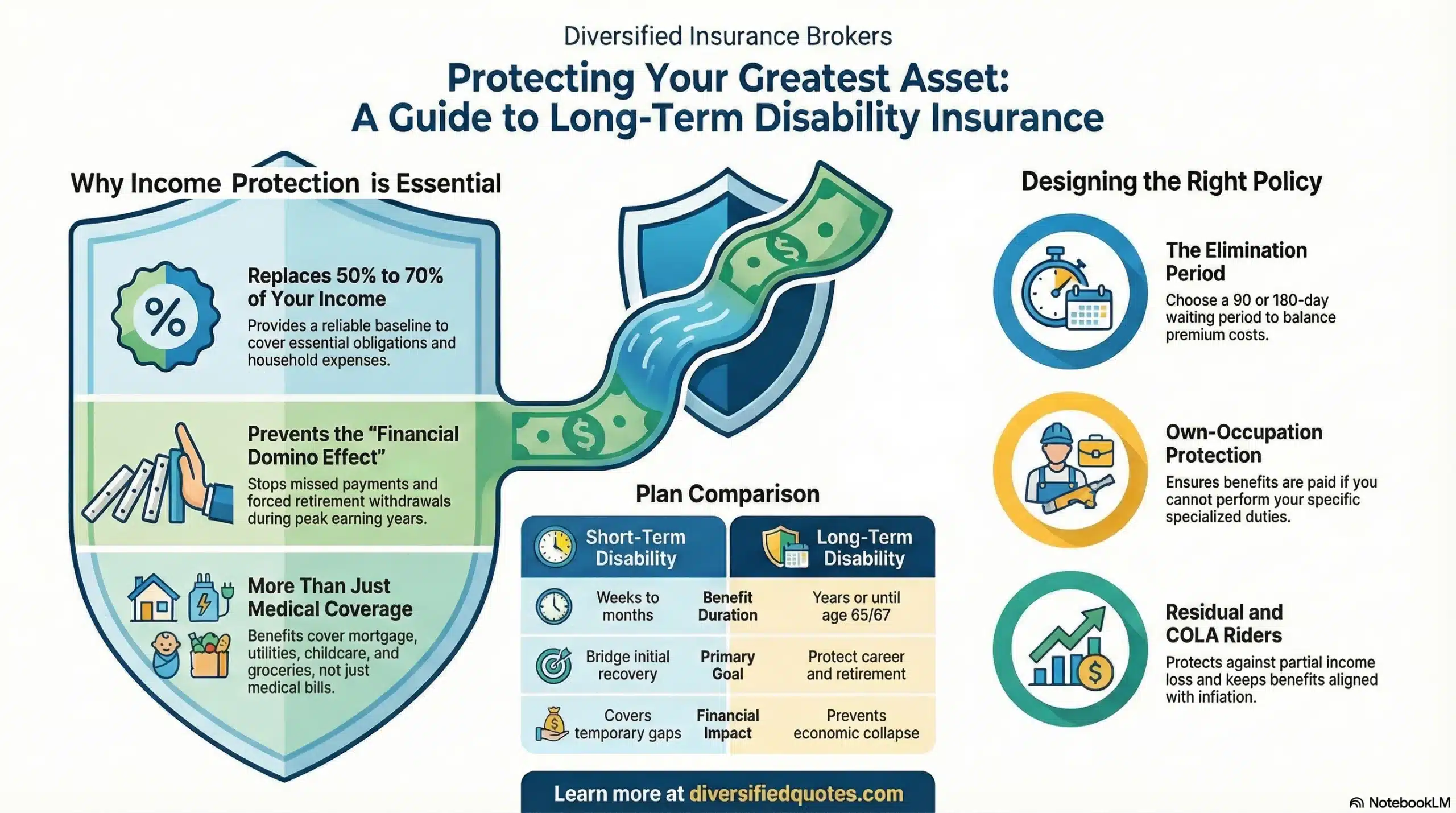
It’s also worth understanding what short-term disability coverage is not. It is not intended to replace your income for decades. That’s the role of long-term disability coverage. Short-term disability is a bridge. It helps stabilize the early part of the disability timeline—the first weeks or months—when household stress is highest because income disruption is immediate but the situation is still evolving.
How Short-Term Disability Works: The Three Choices That Drive Everything
When people buy short-term disability online, they often expect “one policy, one price.” In reality, short-term disability insurance is a structure. You’re choosing the timing and the benefit design that match your situation. The application flow generally makes the trade-offs clear, and once you understand them, the rest becomes much easier.
First: the waiting period. This is how long you must be disabled before benefits can begin. Many people choose a waiting period that matches their realistic cash reserve or any sick leave they can rely on. If you have minimal savings and limited paid time off, you typically want benefits to start sooner. If you have a strong cash reserve and you’re simply protecting against a longer absence, you can often choose a longer waiting period and lower the premium.
Second: the benefit amount. This is the monthly income replacement. The best benefit amount is the one that stabilizes the household without over-insuring. Most people focus on essential obligations first—housing, utilities, food, insurance, and debt payments. Then they decide whether they want the benefit to also protect longer-term momentum like retirement contributions or savings consistency. If you want a practical framework for sizing coverage, review how much disability insurance do I need. Even though that page discusses disability sizing broadly, the core logic applies to short-term planning as well: protect the bills that don’t stop just because your paycheck does.
Third: the benefit duration. This is how long benefits can be paid for a qualifying claim. Short-term disability policies are designed for a limited benefit window. The right duration depends on what you’re trying to protect against. Many people are most concerned about “a few months,” because that’s when savings often run out and financial stress starts escalating. Choosing a benefit duration that realistically matches your risk tolerance is one of the most important online decisions you’ll make.
How to Buy Short-Term Disability Insurance Online (Step-by-Step)
The online application process is designed to be straightforward and can often be completed quickly. You stay in control from start to finish, and you can typically stop and resume the application if you need to gather information or compare options.
Step 1: Start the online application. Begin through the secure portal. Starting does not obligate you to finish, and you can move at your own pace. This is ideal if you want to see options before you decide what level of protection makes sense.
Step 2: Answer basic eligibility questions. Applications typically focus on your occupation, employment status, and basic health history. Because short-term disability policies are designed for speed and accessibility, the process is often streamlined compared to heavily underwritten long-term policies. That said, accuracy matters. Give complete, truthful answers so underwriting decisions align with your actual profile.
Step 3: Customize your coverage choices. This is where you choose the benefit amount, waiting period, and benefit duration. These choices shape both your protection and your premium. If you want to keep cost reasonable, start by adjusting the waiting period and benefit duration before you weaken the benefit amount too far. The goal is to protect the household’s stability—not just buy a policy that feels inexpensive.
Step 4: Review pricing and submit. Many applicants receive fast eligibility decisions. Others may be approved shortly afterward if the carrier needs to confirm details. Either way, no phone calls or agent interaction are required unless you request help.
Step 5: Put the policy in force. Once approved and accepted, you set up payment, confirm your details, and the policy goes into effect according to its start date and contract terms. At that point, you have income protection in place for the short-term risk window you designed.
How Much Does Short-Term Disability Insurance Cost?
Pricing depends on factors like your age, occupation class, benefit amount, waiting period, and benefit duration. People are often surprised that short-term disability premiums can feel reasonable, especially compared to the impact of even one missed paycheck. The most important point isn’t the exact number—it’s the purpose: to create predictable cash flow during the weeks or months when you’re medically unable to work and your household bills still have to be paid.
Cost also depends on how quickly you want benefits to start. If you want benefits to begin very soon, the premium tends to be higher. If you can handle a longer waiting period, the premium often becomes more comfortable. The online buying process is helpful because it lets you see those trade-offs immediately, and it lets you build a policy that fits the reality of your budget.
If you want a deeper explanation of what drives disability pricing and how to reduce premium without weakening the policy in the wrong places, our guide on how much does disability insurance cost is a useful companion. Even though it covers disability insurance broadly, the same pricing levers show up in short-term coverage: timing, benefit size, and the structure you select.
Who Should Buy Short-Term Disability Insurance Online?
Buying short-term disability insurance online is typically a strong fit for people who want fast coverage with a self-service experience. It’s especially relevant if you don’t have employer-provided disability benefits, if your sick leave is limited, or if your household relies on your income to stay stable. Many self-employed professionals and independent contractors also choose online options because they don’t have traditional employer benefits, and they need protection that matches their real-world income risk.
This approach is also a fit if you prefer a digital process and want the ability to compare options privately. You can handle everything online, and if you decide you want guidance at any point, you can still bring an advisor into the conversation without restarting the process.
Short-term disability coverage can also be a smart layer for people who already have some protection through work but recognize the gap in timing. Many employer plans focus on long-term benefits, while the short-term window is where the household is most exposed. If your biggest fear is “I can’t afford to miss a paycheck,” then short-term disability is the coverage designed to answer that fear.
What If You Already Have Coverage Through Work?
Employer benefits can be helpful, but many workers don’t know what they actually have until they need it. Some employers offer sick pay but only for a limited time. Some offer short-term disability, but the benefit amount may be lower than expected or the waiting period may be longer than you assumed. Others offer only long-term disability coverage, which may not help in the first weeks of a disability when household stress is highest.
Buying your own short-term disability policy online can be a clean way to create control. You choose the timing. You choose the benefit structure. You know what the policy is designed to do because you built it intentionally. Even if you have employer coverage, your own policy may help cover timing gaps or cash-flow needs that employer benefits don’t fully address.
Common Mistakes to Avoid When Buying Short-Term Disability Online
Online buying is convenient, but convenience can sometimes lead to rushed decisions. The most common mistake is choosing coverage based purely on premium. A low premium can be appealing, but if the benefit is too small or the waiting period is too long, the policy may not solve the problem you’re buying it to solve. The purpose of short-term disability coverage is immediate stability. If the design can’t stabilize the household when income pauses, it’s not the right design.
Another mistake is choosing a benefit duration that’s too short for your risk tolerance. Many people focus on “getting through a few weeks,” but the real financial stress often starts when the absence extends into months. A stronger duration can make a meaningful difference. The goal is to reduce stress and preserve normal life while you recover, not create a new deadline that becomes another source of anxiety.
A final mistake is ignoring how your income actually works. If you’re self-employed, commission-based, or variable-income, you want coverage that fits your reality. If you’re a business owner, you may also want to consider how disability affects the business beyond your own paycheck. In those situations, it can help to explore key person disability insurance to understand the bigger picture of business continuity during disability.
Why Buy Through Diversified Insurance Brokers?
Many “online” disability platforms only show a single carrier’s product, which can limit your choices. Diversified Insurance Brokers helps preserve choice while still giving you a fast, digital experience. You can complete everything online and stay self-directed, or you can ask one of our advisors to review your options—especially if you’re unsure how to balance benefit amount, waiting period, and benefit duration. Either way, the goal is the same: secure coverage that protects your income in the time window when missed paychecks create immediate financial stress.
We also understand that people buy disability coverage in different ways. Some want to click through privately and be done. Others want to see options first, then ask one intelligent question and move forward. Our job is to support whichever path you prefer, without pressure and without turning a practical decision into a drawn-out process.
Protect Your Income Before You Need It
Apply online in minutes and secure short-term income protection today.
Financial Protection Essentials
Retirement account mechanics, disability impact planning, carrier evaluations, and specialized insurance education.
Talk With an Advisor Today
Choose how you’d like to connect—call or message us, then book a time that works for you.
Schedule here:
calendly.com/jason-dibcompanies/diversified-quotes
Licensed in all 50 states • Fiduciary, family-owned since 1980
FAQs: How to Buy Short-Term Disability Insurance Online
Can I buy short-term disability insurance entirely online?
Do I need a medical exam?
How long does short-term disability insurance pay?
How much coverage can I buy?
How soon does coverage begin?
Is pregnancy covered?
What occupations cannot buy online?
Is buying online safe?
About the Author:
Jason Stolz, CLTC, CRPC and Chief Underwriter at Diversified Insurance Brokers (NPN 20471358), is a senior insurance and retirement professional with more than two decades of real-world experience helping individuals, families, and business owners protect their income, assets, and long-term financial stability. As a long-time partner of the nationally licensed independent agency Diversified Insurance Brokers, Jason provides trusted guidance across multiple specialties—including fixed and indexed annuities, long-term care planning, personal and business disability insurance, life insurance solutions, Group Health, and short-term health coverage. Diversified Insurance Brokers maintains active contracts with over 100 highly rated insurance carriers, ensuring clients have access to a broad and competitive marketplace.
His practical, education-first approach has earned recognition in publications such as VoyageATL, highlighting his commitment to financial clarity and client-focused planning. Drawing on deep product knowledge and years of hands-on field experience, Jason helps clients evaluate carriers, compare strategies, and build retirement and protection plans that are both secure and cost-efficient. Visitors who want to explore current annuity rates and compare options across multiple insurers can also use this annuity quote and comparison tool.
