
How to Qualify for Long-Term Care Insurance

Jason Stolz CLTC, CRPC
How to qualify for long-term care (LTC) insurance comes down to one simple idea: carriers are trying to predict whether you’re likely to need care soon, and whether you’re healthy and independent enough today to be a good long-term risk. Approval is rarely based on one single diagnosis. Instead, underwriting looks at patterns—age, stability of chronic conditions, medication history, mobility and balance, independence with daily activities, cognitive status, and whether your overall profile suggests a higher chance of near-term claim.
This guide breaks down what carriers look for, what actually happens during underwriting, and how to improve your approval odds for traditional LTC insurance, hybrid life/LTC policies, and annuities with LTC benefits. The goal is not to “game” underwriting. The goal is to understand the rules so you can apply at the right time, with the right product type, and with the right expectations—without wasting weeks on a process that wasn’t likely to work from the start.
At Diversified Insurance Brokers, we take a carrier-neutral approach. Underwriting appetites vary widely, and one decline does not automatically mean you are uninsurable for long-term care planning. In many cases, the difference between a “no” and a “yes” is simply matching your profile to the correct carrier and the correct plan design. When traditional LTC is not a fit, we often map out alternatives—hybrid or annuity-based—so you can still build meaningful protection.
Check Your Eligibility and Options
We’ll compare carriers and outline your best path: traditional LTC, hybrid life/LTC, or annuity with LTC benefits.
What LTC Carriers Look For
Most people expect underwriting to focus only on diagnoses. In reality, long-term care underwriting is more functional than many other types of insurance underwriting. A stable diagnosis can be acceptable if your daily function, mobility, and cognition are strong. Conversely, a short list of diagnoses can still lead to a decline if the carrier sees evidence of instability, frequent falls, difficulty with daily activities, or cognitive concerns.
Carriers typically evaluate six big categories: age, medical history, medication history, function and mobility, cognition, and financial suitability. Within each category, they’re looking for signals that suggest either long-term stability (better outcome) or near-term claim risk (higher concern). When you understand those signals, you can apply with fewer surprises.
Age Matters, But Timing Matters More
Age affects both approval odds and pricing. The younger you are (within reason), the more years the carrier expects to collect premiums before a claim, and the more likely you are to be approved. That’s why many people see their best window for traditional LTC approval and pricing in their 50s to early 60s. That does not mean you can’t qualify later, but it does mean underwriting becomes more sensitive to small mobility issues, medication complexity, or early cognitive changes.
Timing also matters because underwriting is heavily influenced by what happened “recently.” If you had a surgery, a hospitalization, a medication change, a fall, or a new diagnosis in the last 6–12 months, carriers often want to see stability before they approve. Many declines are not “forever declines.” They are “not yet” decisions that improve once follow-up visits are completed and the record shows you are stable.
Health History: What Helps and What Hurts
Traditional LTC insurance underwriting tends to be strict around conditions that correlate with future functional decline. Neurological conditions (especially progressive ones), significant fall history, uncontrolled diabetes with complications, recent strokes with deficits, and moderate to severe cognitive impairment are among the most common barriers to traditional approval.
On the other hand, many common conditions can still qualify when they are well controlled and stable. Controlled hypertension and cholesterol issues are typically not a problem by themselves. Mild arthritis is often acceptable when it does not impair walking or daily function. Many past cancers can be acceptable depending on type, stage, treatment completion, and ongoing follow-up. Sleep apnea can be acceptable when documented as treated and compliant. The underwriting theme is consistency: if the carrier sees regular follow-up, stable meds, and good function, many “everyday” conditions are manageable.
If you are also exploring broader retirement risk planning alongside long-term care, it can be helpful to coordinate these decisions with other retirement protection tools. Some families evaluate how long-term care planning fits alongside guaranteed income planning and asset protection concepts, which is why we often cross-reference how protection strategies integrate with retirement income approaches found on pages like Current Annuity Rates for those considering annuity-based LTC designs.
Medications: The Underwriting Shortcut Carriers Rely On
Medication history is one of the fastest ways for carriers to understand your health profile. It’s common for underwriting to run prescription database checks early in the process. The carrier is not only looking at what you take—they’re looking at what your medications suggest about severity, stability, and complexity. Multiple medications for the same condition can indicate a harder-to-control issue. Frequent changes can suggest instability. Certain pain management medications can raise questions about mobility, chronic pain, and risk of falls.
This is why preparation matters. Before you apply, you should know your current medication list, your dosages, and why you take each medication. If there were recent changes, be ready to explain the reason and show follow-up documentation that the condition is now stable. Underwriting tends to go smoother when the record is consistent and the medication list “makes sense” relative to your stated health history.
Function and Mobility: The Quiet Deal-Breakers
Long-term care underwriting is deeply focused on function. Carriers are insuring the risk that you will need assistance with daily living and supervision. So they pay close attention to whether you’re currently independent, whether you walk safely without frequent falls, and whether you handle everyday tasks without support.
Even if your medical conditions are mild, fall history can trigger heightened scrutiny. Falls suggest balance issues, frailty risk, medication side effects, or neurological decline. Similarly, the use of certain assistive devices is evaluated carefully—not because using support is “bad,” but because it may signal reduced independence. Some applicants can still qualify with an assistive device if their condition is stable and they demonstrate safe function, but it becomes more case-specific.
If mobility is a concern, carriers may look for physical therapy notes, physician statements, or follow-up records showing improvement. When someone is recovering from surgery or addressing balance issues, it is often smarter to wait until the record clearly shows recovery and stability rather than applying too early and triggering a preventable decline.
Cognition: Why Carriers Use Cognitive Screens
Cognitive screening is one of the biggest reasons applicants get surprised during the LTC process. Many carriers include a phone interview that contains a brief cognitive assessment. These screens are not meant to be humiliating. They exist because cognition is one of the strongest predictors of long-term care claims, especially claims involving memory care and supervision needs.
Cognitive impairment that is documented in the medical record is often disqualifying for traditional LTC insurance. Even when there is no formal diagnosis, carriers may decline if the interview suggests significant memory impairment. This is why applicants should take the interview seriously and schedule it for a time when they are rested and focused. It is also why transparency matters: if there is already a cognitive diagnosis or a pattern of cognitive concerns in the record, traditional LTC may not be the best path, and an alternative strategy may be more realistic.
Build and Frailty Factors
Height and weight can influence underwriting, but build is often less important than what the build suggests about frailty, stability, or complicating conditions. Extremes can create underwriting concerns, particularly when paired with mobility limitations or conditions like uncontrolled diabetes, advanced cardiac disease, or chronic respiratory issues. Many carriers have build charts, but approvals vary by carrier, and build alone is not always a deal-breaker.
When build is part of the underwriting story, the carrier often wants to see that the applicant is stable, functional, and not in a trajectory of decline. If your weight changed significantly in the last year, the carrier may want an explanation and follow-up.
Financial Suitability: The Part People Ignore Until It Matters
Long-term care insurance is a long-duration product. Carriers and regulators care whether premiums are sustainable. If a premium looks likely to strain your budget, it can create suitability concerns. This does not mean you need to be wealthy. It means your long-term care plan should be designed at a level that fits with your income and assets.
Sometimes people apply for “too much” coverage and run into suitability issues. A smarter approach is often to blend insurance with personal savings. Instead of trying to cover every dollar of future care, some households insure the catastrophic risk—creating a meaningful monthly benefit that protects retirement income—while expecting to contribute some out-of-pocket funds if needed.
Traditional LTC vs Hybrid vs Annuity-Based: Different Underwriting Paths
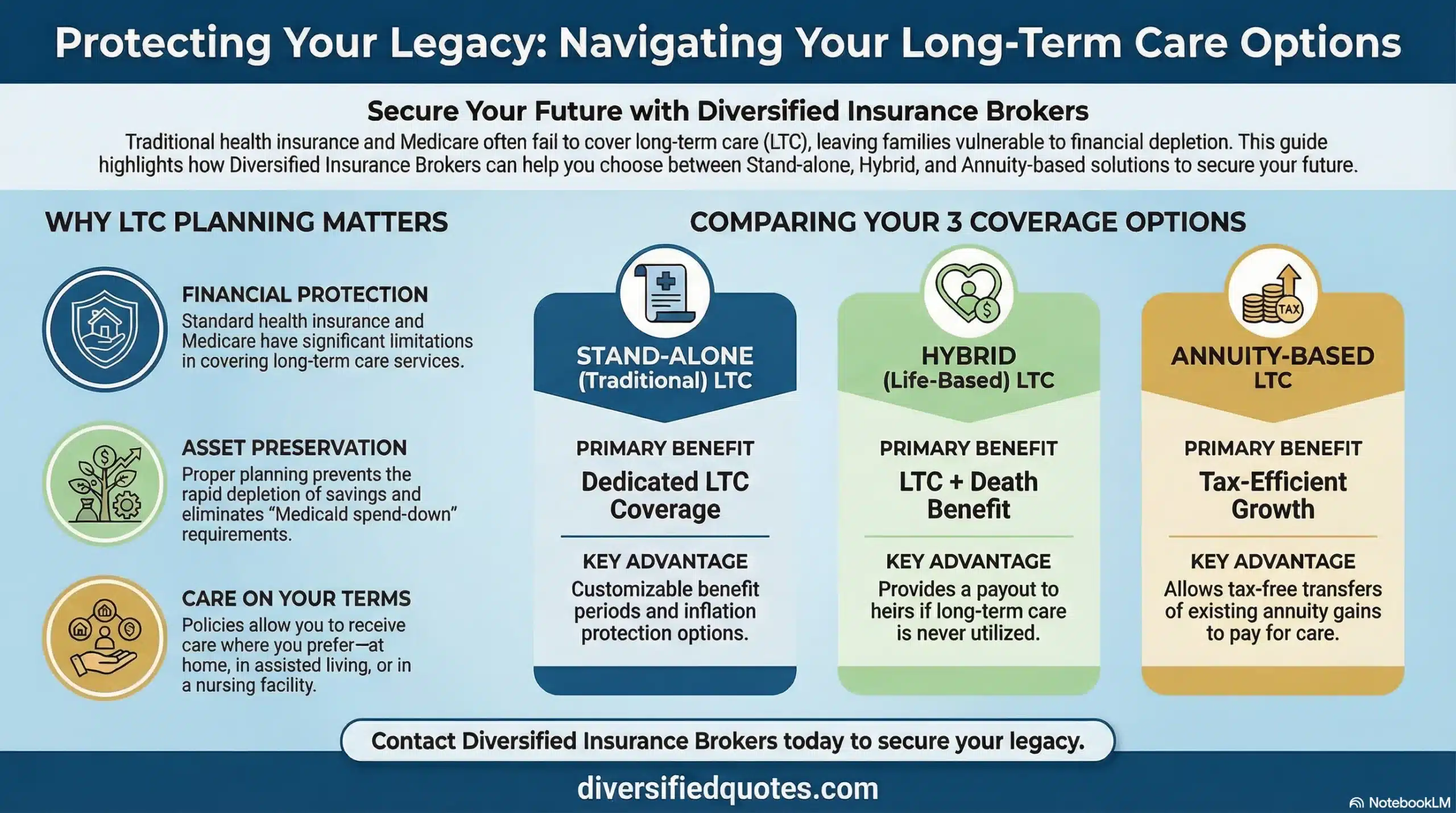
One of the most important insights in LTC planning is that not all long-term care solutions are underwritten the same way. This matters because an applicant who struggles to qualify for traditional LTC may still qualify for a hybrid life/LTC policy or an annuity-based LTC strategy depending on the specific carrier and design.
Traditional LTC insurance is designed purely for long-term care benefits. Underwriting is often strict because the carrier is taking on care claim risk directly, with no offsetting death benefit structure. Traditional LTC can be highly customizable—monthly benefit, benefit period, inflation protection, elimination period, and couples designs like shared pools. But that flexibility often comes with strict underwriting guardrails.
Hybrid life/LTC policies are generally life insurance chassis with long-term care benefits attached by rider or linked structure. Underwriting often follows life insurance logic. That can be more forgiving in certain scenarios, especially when the applicant is stable and functional but has a medical history that makes traditional LTC harder. Hybrid designs can also provide a death benefit if care is never used, which changes the value proposition for many families.
Annuities with LTC benefits are often designed for asset repositioning. Underwriting can be different, and the planning focus is frequently on leveraging existing assets to create a larger LTC benefit pool. For households that also care about retirement income planning, it can be helpful to understand how income-focused annuity structures work alongside LTC benefits, which is why some families review pages like Best Fixed Indexed Annuities with Lifetime Income Riders while evaluating whether an annuity-based LTC strategy fits their broader plan.
What the Underwriting Process Actually Looks Like
Most LTC applicants experience underwriting as a sequence of steps. The steps vary by carrier, but the workflow is usually predictable. When you know what’s coming, the process is less stressful and you can prepare properly.
Step 1: Application and health questionnaire. The application collects detailed health history, prior surgeries, hospitalizations, and your current medications. It also asks about functional independence—whether you need help with bathing, dressing, cooking, shopping, managing finances, or transportation. Many people underestimate how important the functional questions are. Answering accurately and consistently matters.
Step 2: Phone interview and cognitive screen. Many carriers schedule an interview that can range from 15 to 30 minutes. This is where lifestyle, functional independence, and cognition are evaluated. The interview may include simple recall tasks, attention tasks, or questions designed to confirm orientation and memory.
Step 3: Prescription database checks and information checks. Carriers commonly confirm prescription patterns. The goal is consistency: medications should align with your disclosed conditions and should not show patterns that suggest instability.
Step 4: Medical records (APS) if needed. If you have a complex history, recent specialist care, or a hospitalization, the carrier may request physician records. This step can add time, but it can also be the step that turns a borderline case into an approval when records show stability.
Step 5: Decision. Outcomes typically include approve as applied, approve with rating, approve with modified benefits, postpone, or decline. A postpone is often an invitation to reapply later with a better stability window.
Health Conditions: How Underwriters Tend to Think
Underwriters do not only ask “what do you have?” They ask “how stable is it?” and “what does it mean for function over time?” That’s why two people with the same diagnosis can have different outcomes. One may be stable, active, and independent. Another may have frequent complications, falls, or cognitive concerns.
Commonly favorable when well controlled: controlled blood pressure and cholesterol, stable thyroid issues, mild orthopedic history that doesn’t impair walking, and many well-managed chronic conditions with consistent follow-up.
Case-by-case conditions: histories involving cardiac events with good recovery and stable follow-up, diabetes that is controlled without complications, mental health conditions that are stable on consistent medications, and sleep apnea when treated and compliant. These cases often come down to documentation and stability windows.
Higher concern conditions: progressive neurological diseases, significant recent stroke with deficits, repeated falls, significant chronic pain issues that impact mobility, uncontrolled diabetes with complications, and cognitive impairment. These profiles may still have options, but the product type path matters. If traditional LTC is not likely, we often map out hybrid or annuity-based alternatives.
If you are exploring last-resort options or limited-underwriting designs, some households review alternatives such as Guaranteed Issue Long Term Care to understand what exists when full underwriting is not realistic.
Couples Planning: Improving Value and Reducing Household Risk
Couples long-term care planning is different than individual planning because the household risk is interconnected. If one spouse needs care, the other spouse may become the caregiver, may reduce work, or may have to manage household finances alone. That’s why couples often look at shared benefit designs or strategies that create flexibility across two lives.
Shared pools can be powerful because the couple can draw from the same pool if one spouse needs extended care. It can also improve efficiency because it aligns the benefit with real household risk rather than forcing each spouse to buy a fully independent benefit stack. If you want a deep dive into shared pool logic, see Long-Term Care Insurance with Shared Benefits.
Couples can also improve approval outcomes by approaching underwriting strategically. If one spouse has a more complex history, it can help to map out which solutions are realistic for each spouse rather than forcing both into the same product type. A blended plan is often better than a perfect plan that never gets implemented.
Design Choices That Affect Eligibility and Price
Long-term care insurance is not just about qualifying. It is also about building a benefit that is sustainable. Some design choices can make approval easier and premiums more manageable, especially for applicants who are older or have more complex health profiles.
Monthly benefit and benefit period. Higher benefits and longer benefit periods increase premium and may increase underwriting scrutiny. Many households choose a benefit that coordinates with their expected savings contribution rather than trying to insure the full cost.
Inflation protection. Inflation can be crucial for younger buyers. For older buyers, inflation may still matter, but the cost tradeoff is different. The right answer is often to compare multiple structures and decide what fits.
Elimination period. A longer elimination period generally lowers premium and can improve suitability because it implies you are willing to self-fund the first phase of care. It can also align better with how care often starts—short periods of support before a longer-term pattern is established.
Couples shared benefits. Shared pools can create efficiency and flexibility, and they may change how the household thinks about coverage adequacy.
Find the Most Approveable Design for Your Profile
We can model multiple benefit levels, elimination periods, and product types to improve approval odds without overpaying.
Practical Steps to Improve Approval Odds
Apply earlier, if possible. If you are in your mid-50s to early-60s and you know long-term care is a concern, that can be a strong time to apply for traditional coverage. Waiting until later can reduce options and increase cost.
Stabilize your health first. If you recently changed medications, had a procedure, or had a new diagnosis, it may be smarter to wait until follow-up is complete and the record shows stability. The strongest applications show controlled conditions, consistent follow-up, and no recent “red flags” that suggest near-term decline.
Be consistent with your medication story. Underwriters will see your prescription history. Make sure your application answers match what the record shows. If something looks unusual, prepare a clear explanation.
Take the phone interview seriously. Schedule it when you are rested and focused. Use a quiet room. Avoid distractions. If hearing is a challenge, use a device that allows you to hear clearly so you don’t miss questions or appear confused.
Address fall risk proactively. If there’s a history of falls, physical therapy progress and documentation of improved balance can matter. Underwriting is heavily influenced by fall patterns because falls correlate with future claim risk.
Shop multiple carriers. The same profile can get very different responses across carriers. The “best carrier” is not a universal answer. It is the carrier whose underwriting appetite aligns with your profile today.
If You Don’t Qualify for Traditional LTC
If traditional LTC underwriting is not likely to work, that does not mean you have no options. It means the product type needs to change. This is where hybrid life/LTC and annuity-based LTC strategies can be valuable. They are not “better” than traditional LTC. They are different tools with different underwriting logic and different value mechanics.
Hybrid life/LTC. For some people, life-based underwriting can be a better fit. Hybrid policies can also address a common objection to traditional LTC: the desire for value even if you never use care benefits. If you want to understand the life underwriting side of the house, reviewing what the life insurance process looks like can help, such as the steps explained on What Is a Life Insurance Exam?.
Annuity with LTC benefits. For households with non-qualified savings, annuity-based LTC strategies can create a structured benefit pool for care while keeping an asset-based backbone. Some families evaluate these strategies alongside retirement income planning, which is why they may cross-reference broader income rider concepts such as fixed indexed annuities with lifetime income riders.
Partial coverage + self-funding. Sometimes the best strategy is not “all or nothing.” A smaller LTC benefit can still reduce risk significantly. A plan that covers the catastrophic portion of care can protect retirement income even if it does not cover every dollar of cost.
How to Think About “Approval” the Right Way
Approval is not the only goal. The real goal is a plan that is both obtainable and sustainable. Many people can qualify for an LTC policy design that is too expensive to keep. That is not a win. It is better to build a plan that fits your household budget, aligns with your care philosophy, and remains maintainable even if expenses rise later in retirement.
That’s why we focus on matching the underwriting path to the product type and then building a benefit design that fits within a long-term plan. For some households, that means traditional LTC with shared benefits. For others, it means a hybrid solution that provides value either way. For others, it means repositioning assets into an annuity-based LTC benefit pool. The best fit is the one you can keep.
Get a Carrier-Neutral Eligibility Review
We’ll shop multiple carriers and outline your best qualifying path—traditional LTC, hybrid life/LTC, or annuity-based coverage.
Related Long-Term Care Pages
Explore long-term care underwriting, benefit design strategies, and couple-focused options.
Related Planning Topics
These pages help you understand underwriting, retirement protection, and alternative LTC structures.
Talk With an Advisor Today to learn how to Qualify for Long-Term Care Insurance
Choose how you’d like to connect—call or message us, then book a time that works for you.
Schedule here:
calendly.com/jason-dibcompanies/diversified-quotes
Licensed in all 50 states • Fiduciary, family-owned since 1980
FAQs: Qualifying for Long-Term Care Insurance
What age is best to apply for LTC insurance?
Most people see the best combination of approval odds and price in their 50s to early 60s. You can apply later, but underwriting gets stricter and premiums increase.
Will my medications affect eligibility?
Carriers review your prescription history. Well-controlled conditions are often fine, but certain meds (advanced pain, cognitive, some insulin regimens) can trigger ratings or declines.
Do I have to take a cognitive test?
Many carriers include a short memory/attention screening during the phone interview. Results help assess current cognition and risk for impairment.
What if I have a history of cancer or heart issues?
Stable, well-followed cases with favorable follow-up can be acceptable. Details like diagnosis stage, time since treatment, and ongoing control matter.
Can couples improve coverage with shared benefits?
Yes. A shared pool lets either spouse use the total benefits, adding flexibility if one partner needs extended care. It’s often cost-efficient for couples.
What if I’m declined for traditional LTC?
Consider hybrid life/LTC or an annuity with LTC benefits, which use different underwriting. Partial coverage or layered strategies can also work.
How long does underwriting take?
Phone interview results are quick; full decisions can take 2–6 weeks depending on medical records. We keep the process moving and shop alternatives if needed.
Do premiums ever increase?
Traditional LTC premiums can be subject to rate adjustments by class in some states. Hybrid life/LTC and many annuity-based designs use guaranteed premiums or deposits with specified benefits.
About the Author:
Jason Stolz, CLTC, CRPC and Chief Underwriter at Diversified Insurance Brokers (NPN 20471358), is a senior insurance and retirement professional with more than two decades of real-world experience helping individuals, families, and business owners protect their income, assets, and long-term financial stability. As a long-time partner of the nationally licensed independent agency Diversified Insurance Brokers, Jason provides trusted guidance across multiple specialties—including fixed and indexed annuities, long-term care planning, personal and business disability insurance, life insurance solutions, Group Health, and short-term health coverage. Diversified Insurance Brokers maintains active contracts with over 100 highly rated insurance carriers, ensuring clients have access to a broad and competitive marketplace.
His practical, education-first approach has earned recognition in publications such as VoyageATL, highlighting his commitment to financial clarity and client-focused planning. Drawing on deep product knowledge and years of hands-on field experience, Jason helps clients evaluate carriers, compare strategies, and build retirement and protection plans that are both secure and cost-efficient. Visitors who want to explore current annuity rates and compare options across multiple insurers can also use this annuity quote and comparison tool.
