
Hybrid Long Term Care

Jason Stolz CLTC, CRPC
Compare Hybrid Long Term Care Insurance Options
See asset-based long-term care solutions that combine protection, flexibility, and legacy value—without “use-it-or-lose-it” premiums.
Hybrid long term care insurance (often called asset-based or linked-benefit) is designed for people who like the idea of long-term care protection, but dislike the feeling of paying premiums for years and getting “nothing” if care is never needed. A hybrid plan solves that objection by pairing long-term care benefits with another form of value—typically a life insurance death benefit or an annuity value. If you need care, the contract pays benefits for covered services. If you don’t, the value can still go to you or your beneficiaries.
At Diversified Insurance Brokers, we help families compare hybrid designs across multiple carriers and structures so the plan matches real life: aging at home first, then possibly transitioning into assisted living or skilled nursing later. We also coordinate hybrid LTC decisions with lifetime income planning, conservative accumulation strategies tied to current annuity rates, and legacy goals when leaving money behind matters.
How Hybrid Long Term Care Insurance Works
Most hybrid LTC plans follow a simple idea: the contract creates a pool of benefits that can be used for qualified long-term care, and if that pool is never used (or not fully used), there is still a remaining value that can be paid to you or your beneficiaries. Instead of “renting” coverage, you’re repositioning dollars into a policy that has multiple outcomes—care protection, legacy value, or a combination of the two.
To access long-term care benefits, you generally must meet a benefit trigger. In many designs, that trigger is the inability to perform at least two Activities of Daily Living (ADLs)—like bathing or dressing—or a qualifying cognitive impairment. Once you qualify, benefits can typically be used for covered services across common care settings. If staying at home as long as possible is important, the way the contract treats home care benefits matters a lot—and it’s one of the details we focus on when building a comparison.
Hybrid plans usually define benefits in two ways: a total pool and a monthly maximum. The total pool is the maximum amount available for long-term care benefits over time. The monthly maximum is the most the contract can pay per month. Matching the monthly maximum to realistic care costs is one of the easiest ways to avoid buying a plan that looks strong on paper but feels thin in a real claim.
Some designs also include a waiting period (often called an elimination period). Traditional LTC tends to emphasize elimination periods more directly. In hybrid designs, the structure may look different depending on the carrier, but the theme is the same: the plan needs to align with how you’d actually pay for care in the first phase of a claim.
Premium structure is another key difference between hybrids and traditional plans. Many hybrid designs are funded with a single premium or a limited-pay period, which can feel more predictable for retirees. Others can be structured with ongoing payments. The best structure is the one that protects liquidity and avoids creating a premium that strains the budget later.
If you want to see how some families approach “single deposit” planning for care, start with single-pay long-term care insurance and then compare it to hybrid options side-by-side.
See Hybrid LTC Options Side-by-Side
We’ll compare pool size, monthly benefit, inflation options, and premium structure—so you can see trade-offs clearly.
Why Choose Asset-Based Long-Term Care
Hybrid LTC has become popular because it addresses the most common emotional and financial objections to traditional long-term care insurance. Many people want protection, but they want to know that their dollars still have value if care never happens. A hybrid policy gives you that “either way” outcome—use the policy for care, or preserve a meaningful value for beneficiaries.
Another reason hybrids are chosen is predictability. While plan details differ by carrier, many hybrid designs are built around guaranteed premium structures or funding styles that aim to reduce future uncertainty. For retirees, that predictability can matter just as much as the total benefit pool because the plan has to be sustainable across decades, not just affordable today.
Hybrid LTC also creates planning flexibility. Some households want the maximum care leverage. Others want to prioritize legacy value if care is never needed. Hybrid designs can often be tuned in either direction. That tuning is where good comparisons matter, because two plans can both be “hybrid LTC” but behave very differently in a claim or in a no-claim scenario.
Finally, hybrids often integrate cleanly with broader retirement planning. Many clients want to protect retirement income while also avoiding a scenario where one spouse’s care costs derail the entire household plan. When a hybrid LTC policy is paired thoughtfully with a predictable income strategy, it can stabilize the plan and reduce the need to sell investments at the wrong time. If you want to see the retirement-income side of that equation, visit our overview of lifetime income strategies.
Life-Based vs. Annuity-Based Hybrids
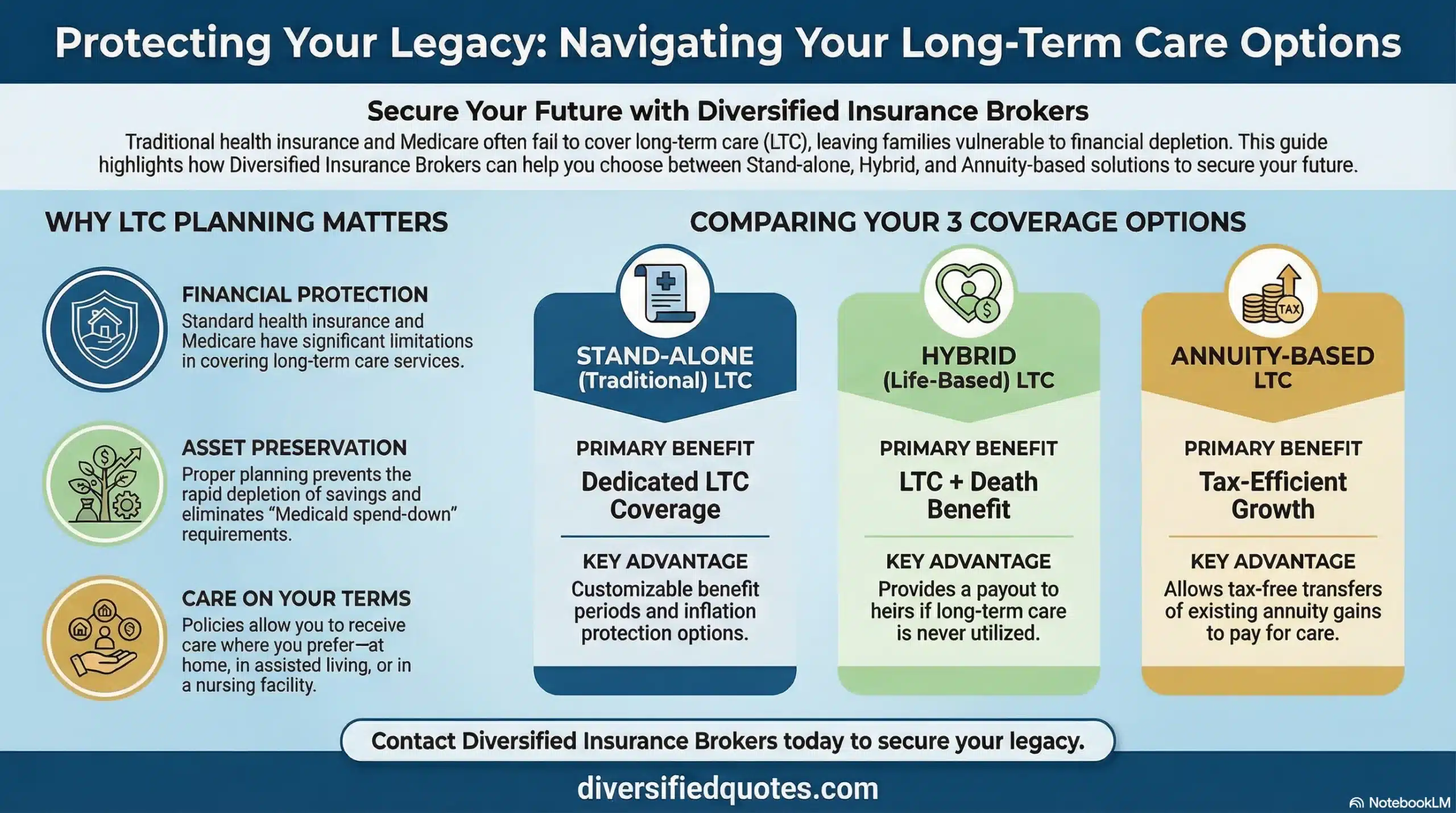
Hybrid long term care insurance generally shows up in two major “chassis” types: life-based hybrids and annuity-based hybrids. Both are built to provide a pool of long-term care benefits, but they create value differently when care is never needed. This is one of the most important distinctions in the entire category.
Life-based hybrids combine permanent life insurance with long-term care acceleration. If care is needed, the contract accelerates benefits (often reducing the death benefit as benefits are paid). If care is never needed, a death benefit is available for beneficiaries. Many families like life-based hybrids because they feel intuitive: “If I never need care, my family still receives something meaningful.” Life-based hybrids are often attractive when legacy value is a primary priority or when someone prefers a premium structure that is designed to be stable and predictable.
Annuity-based hybrids use an annuity structure that can expand into a larger pool for care (often through a multiplier concept when qualified care is needed). Annuity-based hybrids can be compelling when someone wants to reposition cash-like assets or conservative savings into a strategy that creates a defined care pool without losing the concept of contract value. In some scenarios, an annuity-based hybrid comparison is most meaningful when looked at alongside current annuity rate environments and the broader retirement plan’s need for safety and predictability.
Neither chassis is universally “better.” The right answer depends on goals: do you want the strongest possible legacy value, the strongest possible leverage for care, or a balanced middle ground? That’s why comparisons need to be built from your priorities first—not from product labels.
Design Choices That Move the Needle
Hybrid LTC is not a single product type. The real decision is how the plan is designed. A small change in design can meaningfully change the premium, the monthly benefit, the total pool, and the value that remains for beneficiaries. When we build comparisons, we focus on the design levers that change outcomes in real claims—not just marketing features.
Inflation protection is one of the biggest decision points. Care costs tend to rise over time, and inflation features can help a plan stay relevant if care happens many years from now. Inflation can also increase cost, so the plan has to match your time horizon and budget. If affordability is the first priority, there are ways to structure benefits so you don’t overpay for inflation features you may not need.
Monthly maximum vs. pool size is another lever. Some plans look large because the total pool is big, but if the monthly maximum is too low, the plan may not match the cost of care when the time comes. A strong design pairs a realistic monthly maximum with a pool that lasts long enough to cover the most likely care scenarios.
Shared pools for couples can also matter. Some households prefer designs that allow one spouse to use more of a combined pool if their claim lasts longer. This can be an effective way to protect the household plan while keeping total cost more efficient than buying two entirely separate “maximum” policies.
Return-of-premium and liquidity options can be useful if circumstances change. Some families like having an “escape valve” if the plan no longer fits years down the road. The details vary by carrier, so we model the trade-offs clearly instead of assuming all return-of-premium features behave the same way.
Because design is so important, our process is comparison-first: we show how each lever affects both the care scenario and the no-care scenario so you can choose intentionally.
Hybrid vs. Traditional LTC vs. Self-Funding
Most families choose between three broad approaches: hybrid LTC, traditional long-term care insurance, or self-funding. Each approach can work, but each has trade-offs. The key is choosing the approach that matches your assets, your risk tolerance, and how important it is to preserve money for a spouse or heirs.
Hybrid LTC is often chosen when someone wants value “either way.” You’re repositioning dollars so they can serve as a care pool if needed, but still preserve value if care never occurs. Many people also like the predictability of funding styles that feel clearer in retirement planning.
Traditional LTC is often chosen when someone wants maximum long-term care leverage for the premium paid. It can be a strong planning tool, but many people dislike the “use it or lose it” feeling if care never happens. Traditional plans can also be sensitive to how pricing is managed over time, which is why structure and carrier selection matter.
Self-funding can work when assets are large enough that paying for care would not threaten the household plan. The trade-off is uncertainty: care costs can be large and unpredictable, and it can be difficult to know how much to set aside without over-allocating money that could have been used elsewhere.
In many real-world plans, the best answer is not “only one” approach. Some families use a hybrid plan for a defined pool and then keep a separate reserve for flexibility. The goal is not perfection—it’s reducing the worst-case scenarios while keeping the plan livable and predictable.
Who’s a Good Fit for Hybrid LTC?
Hybrid LTC is usually a strong fit for people who have meaningful assets to protect but don’t want to earmark a massive portion of their portfolio as a “care fund.” It can also be a fit for households that prioritize clarity: they want to know what their plan does if care happens, and they want to know what it does if care never happens.
It may also be a good fit for people who are conservative with cash and CDs and want those dollars to do more than simply sit at low yields. In that scenario, an annuity-based hybrid comparison can be especially relevant when paired with a broader look at annuity rate options and how safety-oriented money is allocated within the plan.
Couples often explore hybrid designs because long-term care risk is not evenly distributed. One spouse may need years of care while the other remains healthy. Hybrid planning can be structured to protect the healthy spouse and preserve the household plan while still providing meaningful care dollars if the risk becomes real.
Funding & Tax Considerations
Hybrid LTC can be funded in different ways, and the best choice depends on liquidity needs and how you prefer to plan. Some households use a single premium or a limited-pay structure so the funding is “done” and the plan is easier to manage in retirement. Other households prefer spreading cost over time so they keep more liquidity today.
Hybrid funding is also frequently coordinated with broader conservative-planning decisions. For example, if someone is comparing safety-oriented strategies, the hybrid conversation often overlaps with what their safe-money alternatives look like and whether they are already considering conservative allocations tied to fixed annuity rate opportunities or other guaranteed strategies.
Tax treatment depends on the contract design and how benefits are accessed. Many qualified long-term care benefits are generally income-tax-free when used for qualified care. The exact details can vary by design and personal situation, so the smartest approach is to build the plan first, then coordinate the tax angle with your tax professional once the structure is selected.
If you’re also comparing cost dynamics, you may find it helpful to review an LTC cost discussion like Is long term care insurance expensive? to frame what drives pricing and which levers are most controllable.
Helpful resources
If you’re building a broader plan, these pages can help you compare related strategies:
Next Steps & How We Help
Most people don’t need a “perfect” policy—they need a plan that clearly reduces the biggest risks without creating a new financial burden. That’s exactly how we build hybrid LTC comparisons. We start with your priorities (care leverage, monthly benefit strength, legacy value, and funding comfort), then model a small set of designs that show meaningful differences. Instead of drowning you in options, we focus on the few that actually match your goals.
When you request a quote, we can structure the comparison so it answers practical questions: What does this plan pay if care starts at home? What does it pay if care later moves to assisted living or skilled nursing? How long does the pool last at realistic costs? And if care never happens, what value remains for beneficiaries?
The result is a clearer decision: not “hybrid vs. traditional” as a debate, but “which design fits our household” as a plan.
Request Your Hybrid LTC Comparison
Get a clear, side-by-side look at hybrid long-term care designs that fit your budget and legacy goals.
Talk With an Advisor Today
Choose how you’d like to connect—call or message us, then book a time that works for you.
Schedule here:
calendly.com/jason-dibcompanies/diversified-quotes
Licensed in all 50 states • Fiduciary, family-owned since 1980
FAQs: Hybrid Long Term Care Insurance
What is hybrid long term care insurance?
A policy that combines long-term care benefits with either a life insurance death benefit or an annuity value. If you need care, it pays covered expenses; if not, remaining value passes to beneficiaries or stays in the contract.
How are premiums structured?
Common options include single-pay, 5–10-pay, or ongoing premiums. Many designs lock premiums and benefits, supporting predictable costs in retirement.
Can we add inflation protection?
Yes. 3% or 5% compound inflation is widely available to help benefits keep pace with rising care costs.
What if I never need long-term care?
Life-based hybrids pay a death benefit; annuity-based hybrids keep contract value subject to the policy. Some designs also offer return-of-premium features.
How do couples use shared benefits?
Some carriers allow a shared pool or linked policies so spouses can access combined benefits if one needs more care than expected.
About the Author:
Jason Stolz, CLTC, CRPC and Chief Underwriter at Diversified Insurance Brokers (NPN 20471358), is a senior insurance and retirement professional with more than two decades of real-world experience helping individuals, families, and business owners protect their income, assets, and long-term financial stability. As a long-time partner of the nationally licensed independent agency Diversified Insurance Brokers, Jason provides trusted guidance across multiple specialties—including fixed and indexed annuities, long-term care planning, personal and business disability insurance, life insurance solutions, Group Health, and short-term health coverage. Diversified Insurance Brokers maintains active contracts with over 100 highly rated insurance carriers, ensuring clients have access to a broad and competitive marketplace.
His practical, education-first approach has earned recognition in publications such as VoyageATL, highlighting his commitment to financial clarity and client-focused planning. Drawing on deep product knowledge and years of hands-on field experience, Jason helps clients evaluate carriers, compare strategies, and build retirement and protection plans that are both secure and cost-efficient. Visitors who want to explore current annuity rates and compare options across multiple insurers can also use this annuity quote and comparison tool.
