
Income Protection Insurance

Jason Stolz CLTC, CRPC
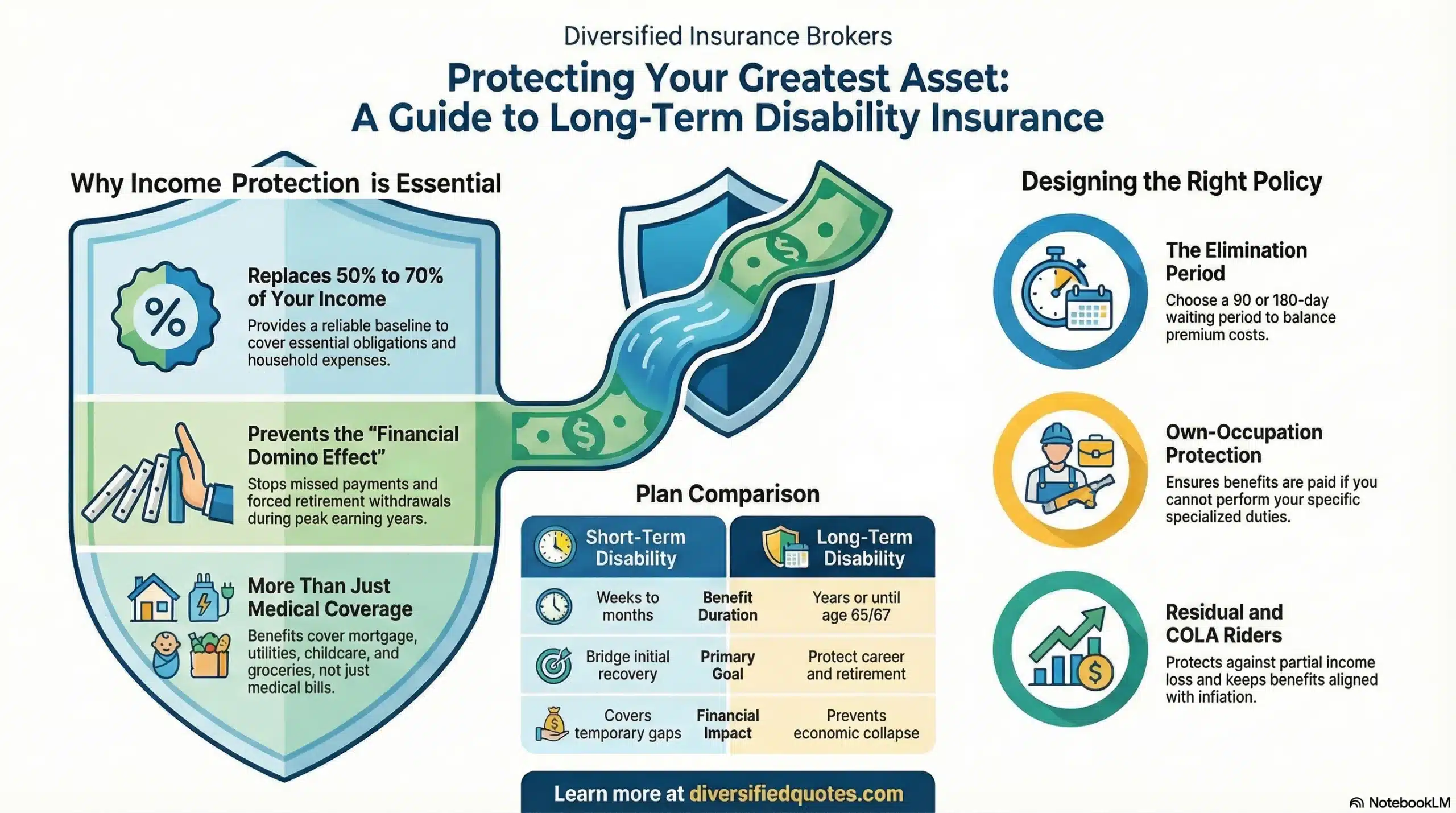
Income protection insurance, more commonly known as disability income insurance, is designed to replace a portion of your income if a medical condition prevents you from working. For most households, income is the engine that powers everything else—mortgage payments, rent, groceries, savings, retirement contributions, insurance premiums, and daily living expenses. Yet while families routinely insure their homes, vehicles, and even smartphones, the very asset that funds all of it—the paycheck—is often left exposed. Income protection insurance exists to close that gap. At Diversified Insurance Brokers, we help individuals, families, business owners, and high-income professionals build disability strategies that are customized to how they actually earn money. Whether you are W-2, 1099, self-employed, a partner in a firm, or a business owner whose income fluctuates year to year, your coverage must reflect real-world income patterns, tax treatment, and occupational risk—not just a generic template.
Unlike health insurance, which pays doctors and hospitals, disability income insurance pays you. If an illness, injury, surgery, pregnancy complication, or mental health condition prevents you from performing the duties of your occupation, the policy pays a monthly benefit designed to help cover housing, utilities, transportation, groceries, debt obligations, and ongoing financial commitments. It does not require you to justify how the money is spent. The purpose is simple: keep your financial life stable while your health recovers. For business owners, this stability is even more critical because personal and business finances are often intertwined. When revenue slows or stops, fixed obligations continue. Income protection insurance can be the difference between a temporary health setback and long-term financial disruption.
Request Your Income Protection Quote
Tell us your occupation and income structure, and we’ll compare disability income options that fit your goals.
Get My Income Protection QuotePrefer to speak first? Call 800-533-5969
One of the biggest misconceptions about disability income insurance is that it is only necessary for high-risk occupations. In reality, statistically speaking, long-term disabilities are more likely to result from illness than catastrophic injury. Cancer, cardiovascular events, autoimmune disorders, back conditions, neurological disorders, and mental health conditions account for a significant portion of long-term claims. Even relatively routine surgeries can require months of recovery depending on complications and job duties. For professionals whose income depends on fine motor skills, cognitive clarity, or physical endurance, the inability to perform specific occupational tasks—even temporarily—can trigger significant income loss. This is why policy definition matters far more than many people realize.
When evaluating income protection coverage, one of the most important distinctions is between “own-occupation” and “any-occupation” definitions. A strong own-occupation policy can pay benefits if you cannot perform the substantial duties of your specific occupation—even if you are capable of working in another capacity. This is particularly important for physicians, dentists, attorneys, engineers, executives, first responders, and skilled tradespeople whose income is tied to specialized abilities. By contrast, an any-occupation definition is far stricter, requiring that you be unable to work in any occupation for which you are reasonably suited by education or experience. The difference in claim outcome between these definitions can be dramatic, which is why policy language must be evaluated carefully before focusing on premium alone.
Benefit structure is equally important. Most disability income policies replace a percentage of earned income rather than the full amount. Carriers set maximum replacement ratios based on verified income and occupational class. For W-2 earners, this typically involves reviewing pay stubs and tax documentation. For self-employed individuals and business owners, underwriting may require multiple years of tax returns, K-1 statements, or business financials. Because income can fluctuate, especially for entrepreneurs and commission-based earners, designing the correct benefit amount involves both underwriting realities and forward-looking planning. Too little coverage leaves gaps. Too much requested coverage can result in underwriting reductions or delays.
The elimination period—commonly 30, 60, 90, or 180 days—is another key lever in structuring affordability and practicality. A shorter elimination period results in faster benefit payments but higher premiums. A longer elimination period lowers cost but requires sufficient emergency savings to bridge the waiting period. Many financially disciplined households choose a 90-day elimination period as a balance between affordability and risk management, though the appropriate selection depends on liquidity, debt levels, and overall financial structure. Benefit duration is equally critical. A two-year benefit period may address short-term disabilities, but longer benefit periods—to age 65 or 67—provide protection against long-term, career-ending conditions.
Riders often determine whether a policy remains effective over decades. A cost-of-living adjustment (COLA) rider increases benefits during long-term claims to offset inflation. A future increase option allows you to purchase additional coverage as income grows without new medical underwriting. Residual or partial disability riders provide benefits if you can work in a reduced capacity but suffer income loss. Catastrophic disability riders may enhance benefits for severe impairments. These features can dramatically improve claim outcomes, especially for younger professionals whose income trajectory is still rising.
Income protection insurance is particularly important for households where one income supports multiple dependents. Mortgage obligations, student loans, childcare expenses, and retirement contributions rarely pause during medical recovery. Without income replacement, families may deplete emergency funds, accumulate debt, liquidate retirement accounts prematurely, or delay long-term goals. For business owners, income protection also prevents personal financial strain from spilling into business operations. If your personal income drops to zero, business decisions can become reactive rather than strategic. Stability preserves options.
We frequently design coverage for professionals in higher-risk public service occupations. For example, firefighters and law enforcement officers often face underwriting nuances tied to occupational hazards. If you serve in these roles, you may benefit from reviewing options such as disability income insurance for firefighters or disability income insurance for law enforcement. Business leaders and executives may also consider specialized solutions like disability insurance for key person employees, which can protect organizational continuity alongside personal income security.
Some individuals begin their research online, particularly for shorter-term needs. While simplified applications can be useful starting points, long-term planning often requires more robust policy design. If you are exploring digital-first options, you may also review guidance on how to buy short-term disability insurance online, then coordinate that strategy with a longer-duration individual policy for comprehensive protection.
Get a Personalized Disability Income Review
We’ll evaluate your occupation class, benefit structure, elimination period, and riders—then shop carriers for the strongest fit.
Request My ReviewUnderwriting for disability income insurance is typically more detailed than life insurance underwriting because carriers are insuring your ability to work, not simply mortality risk. Medical records, prescription histories, occupational duties, income documentation, and lifestyle factors are reviewed carefully. Certain hobbies or avocations may influence classification. Transparent disclosure during the application process is essential to prevent claim complications later. While underwriting can feel thorough, it ultimately protects policyholders by ensuring policy terms are clearly defined and enforceable.
Income protection planning often works best when integrated with broader financial strategy. For example, if you are also reviewing personal risk management in other areas, you may explore disability insurance services in coordination with life coverage, particularly if your household depends heavily on one primary earner. Individuals managing medical histories may also want to review options such as life insurance with pre-existing conditions to ensure coordinated underwriting strategies across policies.
Ultimately, income protection insurance is about maintaining financial dignity during vulnerable moments. Health recovery should not be overshadowed by fear of missed mortgage payments or mounting debt. With properly structured disability income coverage, your focus can remain where it belongs—on healing and long-term stability.
Coordinate Income and Life Protection
If your income supports a family or business, disability planning should align with life insurance strategy. Use the life insurance estimator below to preview options, then we can structure both plans together.
Protect Your Paycheck Before You Need It
Coverage is easiest to secure while you’re healthy and actively working. Let’s design a plan that fits your occupation and income goals.
Start My Income Protection QuoteOr call 800-533-5969 • Contact Us
Related Disability & Income Planning Guides
Talk With an Advisor Today
Choose how you’d like to connect—call or message us, then book a time that works for you.
Schedule here:
calendly.com/jason-dibcompanies/diversified-quotes
Licensed in all 50 states • Fiduciary, family-owned since 1980
Income Protection Insurance FAQs
Is income protection insurance the same as disability insurance?
Yes. Income protection insurance is a common way to describe disability income insurance that pays you a monthly benefit if you can’t work.
How much income does disability insurance replace?
Most policies replace a portion of earned income, not 100%. The exact amount depends on carrier limits, your income verification, and plan design.
What is the elimination period?
It’s the waiting period before benefits begin (often 30, 60, 90, or 180 days). Longer waiting periods usually reduce cost.
What does “own-occupation” mean?
Own-occupation coverage can pay benefits if you can’t perform the duties of your specific job, even if you could work in another role.
Do I need income protection if I have coverage through work?
Employer plans are often limited and tied to your job. Many clients add individual coverage for portability, stronger definitions, and better benefit structure.
About the Author:
Jason Stolz, CLTC, CRPC and Chief Underwriter at Diversified Insurance Brokers (NPN 20471358), is a senior insurance and retirement professional with more than two decades of real-world experience helping individuals, families, and business owners protect their income, assets, and long-term financial stability. As a long-time partner of the nationally licensed independent agency Diversified Insurance Brokers, Jason provides trusted guidance across multiple specialties—including fixed and indexed annuities, long-term care planning, personal and business disability insurance, life insurance solutions, Group Health, and short-term health coverage. Diversified Insurance Brokers maintains active contracts with over 100 highly rated insurance carriers, ensuring clients have access to a broad and competitive marketplace.
His practical, education-first approach has earned recognition in publications such as VoyageATL, highlighting his commitment to financial clarity and client-focused planning. Drawing on deep product knowledge and years of hands-on field experience, Jason helps clients evaluate carriers, compare strategies, and build retirement and protection plans that are both secure and cost-efficient. Visitors who want to explore current annuity rates and compare options across multiple insurers can also use this annuity quote and comparison tool.
