
Is An Annuity Your Missing Retirement Piece?

Jason Stolz CLTC, CRPC
Annuities are often misunderstood. Some people see them as complicated insurance contracts. Others see them as the one product Wall Street doesn’t like because it shifts risk away from you and onto an insurance carrier. If you’re approaching retirement—or already there—you may be wondering: Is an annuity the missing piece in my retirement plan? For many retirees, the honest answer is yes. Not because an annuity replaces investing. Not because it guarantees high returns. But because it can do something almost nothing else can do: create predictable, contractually guaranteed lifetime income that you cannot outlive.
Most retirement plans are built around accumulation. You contribute to a 401(k), roll it into an IRA, diversify investments, and aim for growth. But retirement itself is not about accumulation—it’s about distribution. It’s about turning a lump sum into dependable income. This is where many retirees begin to feel uneasy. Market volatility, inflation, tax law changes, Required Minimum Distributions, and sequence-of-returns risk all converge at the exact moment you need stability most. If you’ve recently reviewed Key Retirement Considerations, you already know that income planning—not just asset growth—determines long-term retirement confidence.
Annuities shift part of your portfolio from “hope it lasts” to “guaranteed to last.” Whether you’re evaluating whether annuities are a good investment in retirement or exploring the best annuities for a 401(k) rollover, the core question is the same: do you want some portion of your retirement income contractually protected from market losses and longevity risk?
Get a Personalized Annuity Income Quote
See how much guaranteed lifetime income your retirement savings could generate.
Request Your Annuity QuoteConsider the risks retirees face. First, longevity risk—living longer than your money lasts. Medical advancements mean many retirees will spend 25 to 35 years in retirement. Second, market risk—experiencing major downturns early in retirement while withdrawing income. Third, tax risk—legislative changes such as those outlined in recent tax law changes can alter how distributions are taxed. Fourth, withdrawal rules—updates like RMDs after SECURE 2.0 have shifted required distribution ages and planning strategies. Annuities, when structured properly, can mitigate several of these risks simultaneously.
If you already have qualified retirement accounts, funding an annuity may be simpler than you think. Many retirees reposition assets through strategies such as transferring an IRA to an annuity or even exploring how to transfer a SEP IRA to an annuity without triggering taxes. These moves can convert market-based savings into structured income streams while preserving tax deferral.
An annuity isn’t meant to replace diversification. It complements it. Think of retirement income like a three-legged stool: Social Security, personal savings/investments, and guaranteed income products. If one leg is unstable—especially during market volatility—the entire plan wobbles. An annuity can stabilize that structure by creating a contractual income floor. That income floor allows the rest of your portfolio to remain invested for growth without the same pressure to fund monthly living expenses.
Another overlooked factor is behavioral finance. Investors often react emotionally during downturns, locking in losses. With a portion of income guaranteed, retirees are less likely to panic-sell investments. In that sense, annuities can indirectly improve portfolio outcomes by reducing emotional decision-making.
Estimate Your Guaranteed Retirement Income
Run personalized scenarios to see how much lifetime income an annuity could generate based on age, deposit amount, and payout timing.
View Fixed Rates
View Bonus Rates.
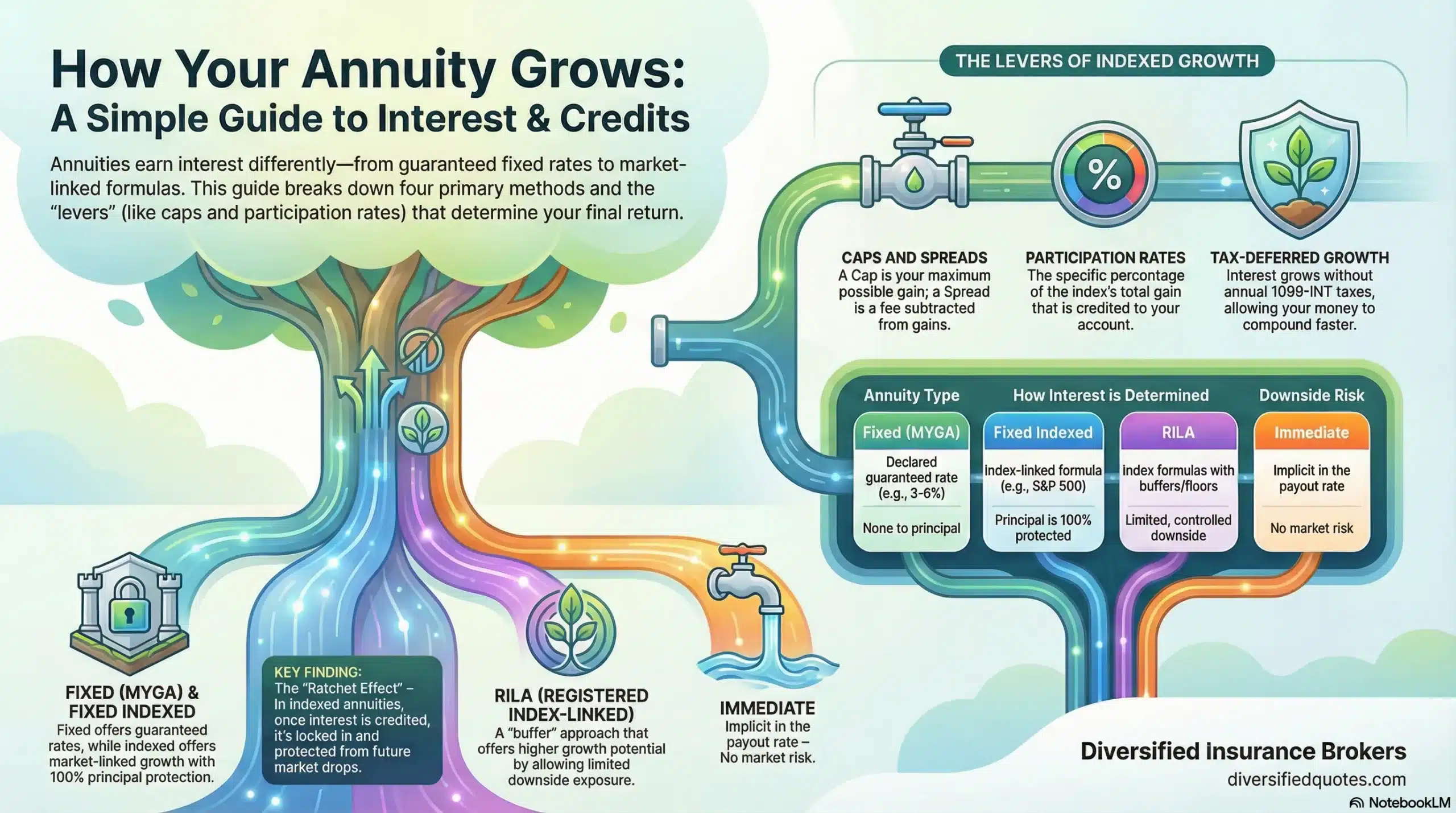
Tax efficiency is another reason annuities may fill a retirement gap. Earnings grow tax-deferred. Income riders can provide structured payouts. And for those concerned about legacy planning, certain annuity structures allow remaining values to pass to beneficiaries without probate. While annuities are not designed primarily as estate tools, they can complement strategies often discussed in broader retirement and wealth-transfer conversations.
It’s also important to separate myths from reality. Modern fixed and fixed indexed annuities are not high-commission black boxes. They are insurance contracts backed by carrier claims-paying ability. They do not eliminate liquidity entirely; most allow annual penalty-free withdrawals. They do not replace investment accounts; they balance them. And they are not “all or nothing.” Many retirees allocate only a portion—often 20% to 40%—of retirement assets to guaranteed income strategies.
The question isn’t whether an annuity is universally good or bad. The question is whether your retirement plan lacks predictable income. If you calculate your essential monthly expenses—housing, utilities, food, insurance, healthcare—and subtract guaranteed sources like Social Security, is there a gap? If so, that gap represents income exposed to market risk. An annuity can close that gap.
Some retirees also value simplicity. Managing withdrawals, tax brackets, portfolio rebalancing, and legislative changes can feel overwhelming. Guaranteed lifetime income simplifies planning. It transforms part of your retirement from ongoing strategy into contractual structure.
Of course, suitability matters. Age, health, liquidity needs, tax situation, and risk tolerance all play roles. That’s why personalized illustrations are critical. Online calculators—like the one above—provide estimates, but structured comparisons between carriers, rider options, and payout structures help clarify trade-offs.
Secure Guaranteed Lifetime Income
Explore income options designed to last as long as you do.
Start Your Income PlanRetirement is no longer a short chapter—it’s potentially decades long. Investment returns are uncertain. Markets fluctuate. Tax laws evolve. But contractual guarantees remain contractual. For many retirees, the missing piece isn’t higher returns. It’s dependable income that creates freedom: freedom from worrying about market swings, freedom from constantly recalculating withdrawals, and freedom to focus on enjoying retirement rather than managing it.
Talk With an Advisor Today
Choose how you’d like to connect—call or message us, then book a time that works for you.
Schedule here:
calendly.com/jason-dibcompanies/diversified-quotes
Licensed in all 50 states • Fiduciary, family-owned since 1980
There are several primary categories: fixed annuities, fixed indexed annuities, variable annuities, and immediate annuities. Fixed annuities provide declared interest rates. Indexed annuities link growth to market indexes with downside protection. Variable annuities invest directly in subaccounts and carry market risk. Immediate annuities convert a lump sum into income right away. You can compare structures in more detail here: Fixed vs. Indexed vs. Variable Annuities.
Bonds provide interest payments but can lose value when rates rise. Certain annuities offer principal protection backed by the issuing insurance carrier and can include lifetime income riders. Unlike bond funds, properly structured fixed annuities do not fluctuate in market value. Learn more about rate stability here: Current Fixed Annuity Rates.
Yes. Fixed and fixed indexed annuities are designed to protect principal from direct market losses. While they may cap upside potential, they remove downside exposure tied to stock market volatility. This can help retirees avoid sequence-of-returns risk during early retirement years. See how market-protected growth works: Fixed Indexed Annuity Pros and Cons.
Most annuities allow annual penalty-free withdrawals, often around 10% of the contract value. However, larger withdrawals during the surrender period may trigger charges. It’s important to match surrender schedules to your liquidity needs. Review how surrender periods work here: Annuity Surrender Charges Explained.
Annuities grow tax-deferred. Withdrawals are taxed as ordinary income on earnings. If funded with pre-tax dollars (such as an IRA rollover), the entire distribution is taxable. Non-qualified annuities are taxed on gains first. Understanding taxation helps optimize retirement withdrawals. See detailed examples here: How Are Annuities Taxed?.
Many annuities offer optional lifetime income riders that guarantee income payments for as long as you live—even if the contract value declines to zero. Payout amounts depend on age, deposit size, and rider structure. Explore lifetime income mechanics here: Lifetime Income Rider Explained.
Annuities are backed by the financial strength of the issuing insurance carrier. In addition, state guaranty associations provide limited protection (coverage limits vary by state). Evaluating carrier ratings is essential before purchasing. Learn more about carrier safety here: Are Annuities Safe?.
About the Author:
Jason Stolz, CLTC, CRPC and Chief Underwriter at Diversified Insurance Brokers, is a senior insurance and retirement professional with more than two decades of real-world experience helping individuals, families, and business owners protect their income, assets, and long-term financial stability. As a long-time partner of the nationally licensed independent agency Diversified Insurance Brokers, Jason provides trusted guidance across multiple specialties—including fixed and indexed annuities, long-term care planning, personal and business disability insurance, life insurance solutions, and short-term health coverage. Diversified Insurance Brokers maintains active contracts with over 100 highly rated insurance carriers, ensuring clients have access to a broad and competitive marketplace.
His practical, education-first approach has earned recognition in publications such as VoyageATL, highlighting his commitment to financial clarity and client-focused planning. Drawing on deep product knowledge and years of hands-on field experience, Jason helps clients evaluate carriers, compare strategies, and build retirement and protection plans that are both secure and cost-efficient.
